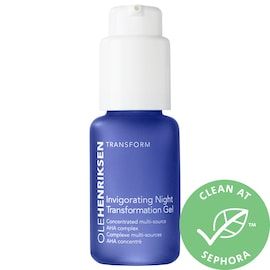
OleHenriksen Invigorating Night Transformation™ Gel
Works for
4 of 4 advertised claims delivered
Anti-agingGlycolic acid, Tocopherol + 1 moreStrong evidence
“An age-fighting night serum with potent AHAs to smooth skin texture, even tone, and reduce the look of fine lines and wrinkles while you sleep.”
This product can help reduce and prevent fine lines and wrinkles, improve skin elasticity and firmness because it contains glycolic acid.
Keep in mind that it typically takes at least 6 weeks to notice any results because the changes that are needed to improve fine lines and elasticity happen in the deeper layers of the skin. No topical anti-aging product can “erase” wrinkles or fully reverse signs of aging.
Evens skin toneGlycolic acid, Glycyrrhiza glabra root extract + 1 moreStrong evidence
“An age-fighting night serum with potent AHAs to smooth skin texture, even tone, and reduce the look of fine lines and wrinkles while you sleep.”
This product can help reduce hypepigmentation and even out the skin tone because it contains the following effective ingredients: glycolic acid
The following ingredient (ingredients) in this product might be helpful, but there is no evidence to confirm that it actually can help even out the skin tone: glycyrrhiza glabra root extract.
Keep in mind that you would need to apply any topical skincare targetted at hypigmentation consistently for a couple of months to get a result. No topical skincare product can help get rid of hyperpigmentation (including post-acne marks and age spots) instantly.
ExfoliationGlycolic acid, Lactic acidStrong evidence
“This multitasking night serum is loaded with a concentrated multi-source AHA complex—including glycolic and lactic acids—and microalgae.”
This product can help exfoliate the skin. In other words, it helps break down the bonds between dead cells on the surface of the skin and speed up the skin turnover. Skin often appears softer and brighter after exfoliation, but overdoing it can result in disrupted skin barrier. The following ingredient is doing the exfoliating job in this product: glycolic acid.
MoisturizingGlycerin, Saccharum officinarum extract + 6 moreGood evidence
“Invigorating Night Transformation™ Gel”
This product can help improve hydration of the skin with the two types of ingredients.
The first type is called “humectants”:
these ingredients help attract water.
When humectants are on the surface of the skin, they “pull in” the moisture from the outside environment, or from
within deeper layers of the skin. The following ingredients in this product do the job:
biosaccharide gum-1, glycerin.
This product also contains ingredients called “occlusives”. They help reduce the speed with which our skin loses moisture to the outside environment. These ingredients also help soften the upper layer of the skin, so it feels less tight and nicer to the touch. The following ingredients in this product do the job: glycine soja oil, glyceryl caprylate.
Can it cause trouble?
Irritancy4 strong irritants: Citrus limon fruit extract, Parfum + 2 more — patch-test recommendedHigh risk
Comedogenic3 ingredients rated 2 or more on the 0–5 pore-clogging scale3 flagged


User reviews
Be the first — your take helps the next person decide.
Ingredients
Filter by role to see what each ingredient is doing.
Water~40–60%
Glycolic acid~5.3–8%
- Irritation risk
- High
An alpha-hydroxy acid (AHA) that helps to remove the dead skin cells on the surface of the skin reveling a more even, smoother complexation. It is also able to stimulate collagen production with long-term use. Could help to reduce pore congestion. It can be irritating to the skin. Apply sunscreen daily if using products with glycolic acid
More about Glycolic acidGlycerin~3.5–5.3%
- Irritation risk
- Low
One of the best moisturizing ingredients. Naturally present in skin. It attracts water to the upper layer of the skin working as a humectant
More about GlycerinChondrus crispus~2.7–4.1%
- Irritation risk
- Low
- Comedogenicity
- 3/5
Red algae extract that helps attract water to the upper layer of the skin and create a nicer product consistency
More about Chondrus crispusCarrageenan~2.1–3.1%
- Irritation risk
- Medium
- Comedogenicity
- 3/5
Helps thicken the product formula and create a nice product formulation
More about CarrageenanXanthan gum~1.6–2.5%
- Irritation risk
- Low
Used to create a thicker product consistency
More about Xanthan gumLactic acid~1.4–2.2%
- Irritation risk
- Medium
An exfoliating and moisturizing alpha-hydroxy acid (AHA). Typically causes less irritation than other AHAs, for example, glycolic acid. At high concentrations (about 15%), lactic acid can help reduce lines and wrinkles. Recent studies show that lactic acid can support the "good" bacteria living on skin's surface (healthy skin microbiome)
More about Lactic acidPotassium hydroxide~1.3–1.9%
Vaccinium myrtillus fruit extract~1–1.5%
- Irritation risk
- Medium
A plant extract that might help neutralize free radicals in skin, but research on its efficacy in skin is lacking
More about Vaccinium myrtillus fruit extractPhenoxyethanol~0.5–1%
- Irritation risk
- Low
A preservative. It helps prevent bacterial growth in cosmetic products
More about PhenoxyethanolSaccharum officinarum extract~0.5–1.15%
- Irritation risk
- Low
Sugar extract that helps attract water to the upper layer of the skin
More about Saccharum officinarum extractPropylene glycol~0.4–0.95%
- Irritation risk
- High
Helps oil and water mix together and can enhance the penetration of other ingredients into the skin. It can be irritating
More about Propylene glycolChlorphenesin~0.16–0.32%
Citrus limon fruit extract~0.35–0.75%
- Irritation risk
- High
Used as a fragrance. Can be irritating and cause photosensitivity
More about Citrus limon fruit extractAcer saccharum extract~0.3–0.7%
- Irritation risk
- Medium
A plant extract that contains small percentage of AHAs. Is unlikely to have any skin benefit due the small concentration of the active compounds
More about Acer saccharum extractSodium dehydroacetate~0.3–0.6%
Citric acid~0.2–0.75%
- Irritation risk
- Medium
Can work as an exfoliant but is typically used to adjust the product pH
More about Citric acidParfum~0.15–0.65%
- Irritation risk
- High
An aromatic blend of unspecified and possibly irritating ingredients
More about ParfumBiosaccharide gum-1~0.15–0.65%
- Irritation risk
- Low
Helps attract water to the upper layer of the skin and is claimed to provide a longer-lasting hydration because of its ability to create a water-binding film on the surface of the skin
More about Biosaccharide gum-1Sodium levulinate~0.15–0.6%
Calcium ascorbate~0.15–0.55%
- Irritation risk
- Low
Glyceryl caprylate~0.15–0.6%
- Irritation risk
- Low
An emollient that can also help water and oil mix together, as well as prevent bacteria growth in products
More about Glyceryl caprylateTocopherol~0.1–0.45%
- Irritation risk
- Low
Pure form of vitamin E. Can help moisturise and protect the skin from free radicals. Often used to help stabilise other ingredients or the formula itself
More about TocopherolGlycine soja oil~0.1–0.45%
- Irritation risk
- Medium
- Comedogenicity
- 2/5
A good emollient that helps soften the skin and helps repair its barrier function. It can clog pores if used in high concentrations.
More about Glycine soja oilSodium anisate~0.1–0.4%
Calcium carbonate~0.2–0.7%
Glycyrrhiza glabra root extract~0.1–0.3%
- Irritation risk
- Medium
A plant extract that can help lighten the skin and calm down inflammation. Might be helpful in neutralizing free radicals
More about Glycyrrhiza glabra root extractSodium benzoate~0.05–0.25%
Potassium sorbate~0.05–0.25%
Benzyl benzoate~0.05–0.1%
- Irritation risk
- High
Fragrance with sweet balsamic smell. Help to preserve products and dissolve other ingredients. Could trigger allergic reactions and be irritating
More about Benzyl benzoateIngredient list view
Water, Glycolic acid, Glycerin, Chondrus crispus, Carrageenan, Xanthan gum, Lactic acid, Potassium hydroxide, Vaccinium myrtillus fruit extract, Phenoxyethanol, Saccharum officinarum extract, Propylene glycol, Chlorphenesin, Citrus limon fruit extract, Acer saccharum extract, Sodium dehydroacetate, Citric acid, Parfum, Biosaccharide gum-1, Sodium levulinate, Calcium ascorbate, Glyceryl caprylate, Tocopherol, Glycine soja oil, Sodium anisate, Calcium carbonate, Glycyrrhiza glabra root extract, Sodium benzoate, Potassium sorbate, Benzyl benzoate
Compare prices
Retailers ranked by price — lowest first.
Affiliate links · prices updated regularly · As an Amazon Associate, WIMJ earns from qualifying purchases.
Worth comparing, line by line.
Match % combines shared ingredients, the first five ingredients, shared actives and hero ingredients, irritancy (lower counts in the alternative's favour), texture and body area. Only products in the same routine step are compared.
| OleHenriksenInvigorating Night Transformation™ GelYOUR PRODUCT | CeraVeBlemish Control Gel Moisturiser with 2% Salicylic Acid & Niacinamide for Blemish-Prone Skin | REVOLUTION SKINCAREMulti Acid Peeling Solution | QMS MedicosmeticsActive Exfoliant 11 % Resurfacing Fluid | |
|---|---|---|---|---|
| Match | — | 59% | 56% | 56% |
| Price | $62.95 | $16.58−$46.37 | $13.35−$49.60 | $120.31+$57.36 |
| Shared key ingredients | — | 3 of 7 | 4 of 7 | 3 of 7 |
| Key difference | — | Niacinamide | Salicylic Acid | Panthenol |
| Irritancy | High | Low | Medium | Medium |
| Drying alcohol | — | — | — | Contains drying alcohol |
| View product | Shop | Shop | Shop |


Sources cited in this review
Every concentration estimate and effectiveness label is anchored to one of these 16 studies and safety reviews.
- 1
- 2Glycolic acid peel therapy – a current reviewncbi.nlm.nih.gov
- 3
- 4
- 5
- 6Epidermal and dermal effects of topical lactic acidncbi.nlm.nih.gov

Affiliate links · As an Amazon Associate, WIMJ earns from qualifying purchases.