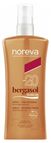
Noreva Bergasol SPF20 Body & Face Sun Milk
Works for
0 of 1 advertised claim delivered
Sun protectionSPF 20 · 4 UV filters · Broad spectrumWeak protectionSPF under 30
This product offers broad spectrum sun protection, but it is weak. We recommend to use a broad spectrum sunscreen with at least SPF 30.
This product can be considered "reef safe" because it does not contain the UV filters (oxybenzone and octinoxate) that can be harmful to coral reefs when present in the water in high concentrations.
MoisturizingNot advertised by the brand · 6 ingredients credited for this claimGood support
This product contains good ingredients to attract water to the upper layer of the skin. These ingredients are called "humectants": glycerin, propylene glycol.
When humectants are on the surface of the skin, they “pull in” the moisture from the outside environment, or from within deeper layers of the skin. If the air is dry, humectants can speed up the moisture loss from the skin. This is why it is a good idea to use another product on top of this one to help "seal in" the moisture (look for ingredients like dimethicone, squalane, oils and butters).
Can it cause trouble?
Irritancy4 strong irritants: Parfum, Limonene + 2 more — patch-test recommendedHigh risk
ComedogenicClean of flagged comedogenic ingredientsNone flagged
User reviews
Be the first — your take helps the next person decide.
Ingredients
Filter by role to see what each ingredient is doing.
Water~45–55%
Octocrylene~5.8–7.1%
- Irritation risk
- Medium
A weak sunscreen that protects against the sun rays that cause sunburn (UVB) and is somewhat effective against the UVA rays. It is quite stable and can help stabilize other, more vulnerable, sunscreen ingredients like Avobenzone. It is an organic, or so called "chemical" sunscreen
More about OctocryleneEthylhexyl stearate~4.2–5.2%
- Irritation risk
- Low
Helps soften the upper layer of the skin
More about Ethylhexyl stearateDibutyl adipate~3.2–3.9%
- Irritation risk
- Low
Helps soften the upper layer of the skin and create a nice product consistency
More about Dibutyl adipateEthylhexyl stearate~2.4–3%
- Irritation risk
- Low
Helps soften the upper layer of the skin
More about Ethylhexyl stearateGlycerin~2–2.5%
- Irritation risk
- Low
One of the best moisturizing ingredients. Naturally present in skin. It attracts water to the upper layer of the skin working as a humectant
More about GlycerinButyl methoxydibenzoylmethane~2.2–2.7%
- Irritation risk
- Medium
Avobenzone. An organic, or so-called "chemical" UV filter. Protects against both UVA and UVB rays. Needs to be combined with other filters in a formulation to be stable.
More about Butyl methoxydibenzoylmethaneMethylsilanol acetyltyrosine~1.4–1.7%
- Irritation risk
- Low
Bis-peg/ppg-16/16 peg/ppg-16/16 dimethicone~1.2–1.5%
Cyclopentasiloxane~1–1.3%
- Irritation risk
- Low
A silicone that helps improve the product texture and spreadability. Can absorb oil creating a short-term mattifying effect on the skin
More about CyclopentasiloxaneDiethylhexyl butamido triazone~1.2–1.5%
- Irritation risk
- Medium
Uvasorb HEB. A UV filter. Is effective against UVB and UVA II rays (but not UVA I). It is photostable. Unfortunately, is not approved by FDA (US) yet
More about Diethylhexyl butamido triazoneTriacontanyl pvp~0.65–1%
- Irritation risk
- Low
Parfum~0.55–0.85%
- Irritation risk
- High
An aromatic blend of unspecified and possibly irritating ingredients
More about ParfumPolysorbate 80~0.55–0.85%
Methylene bis-benzotriazolyl tetramethylbutylphenol~0.7–1%
- Irritation risk
- Medium
Tinosorb M. A UV filter. Is effective against both UVA and UVB rays. It also provides some protection against visible light. It is photostable and can also be used to improve photostability of other sunscreen ingredients. Its physical properties help to create lightweight sunscreen formulations. It can leave a slight white cast. Unfortunately, it is not approved by the FDA (US) yet
More about Methylene bis-benzotriazolyl tetramethylbutylphenolCaprylic/capric triglyceride~0.55–0.85%
- Irritation risk
- Medium
A good mix of fatty acids that forms a protective layer on the skin. Improves the shelf life of products. Derived from coconut and glycerin
More about Caprylic/capric triglycerideTocopheryl acetate~0.5–0.75%
- Irritation risk
- Medium
A more stable but less bio-available form of vitamin E compared to Tocopherol. Might help moisturize and protect the skin from free radicals, but mostly used in low concentrations to stabilize other ingredients.
More about Tocopheryl acetateCarbomer~0.45–0.65%
- Irritation risk
- Low
Helps create a thicker or gel-like product texture. It is not a surfactant but can be used in gentle cleansing formulations
More about CarbomerDisodium edta~0.35–0.65%
P-anisic acid~0.35–0.6%
- Irritation risk
- High
Helps preserve products. Can mask unpleasant smell. Could be irritating
More about P-anisic acidXanthan gum~0.3–0.6%
- Irritation risk
- Low
Used to create a thicker product consistency
More about Xanthan gumDecyl glucoside~0.35–0.65%
- Irritation risk
- High
Helps oil and water mix together. Can be irritating
More about Decyl glucosideSodium hydroxide~0.25–0.45%
Propylene glycol~0.25–0.4%
- Irritation risk
- High
Helps oil and water mix together and can enhance the penetration of other ingredients into the skin. It can be irritating
More about Propylene glycolSodium benzoate~0.15–0.3%
Citric acid~0.15–0.3%
- Irritation risk
- Medium
Can work as an exfoliant but is typically used to adjust the product pH
More about Citric acidPhenoxyethanol~0.15–0.25%
- Irritation risk
- Low
A preservative. It helps prevent bacterial growth in cosmetic products
More about PhenoxyethanolEthylhexylglycerin~0.15–0.25%
Limonene~0.1–0.2%
- Irritation risk
- High
A common frangrance that can easily irritate skin, especially if exposed to air, light or heat
More about LimoneneLinalool~0.05–0.15%
Citral~0.05–0.1%
Ingredient list view
Water, Octocrylene, Ethylhexyl stearate, Dibutyl adipate, Ethylhexyl stearate, Glycerin, Butyl methoxydibenzoylmethane, Methylsilanol acetyltyrosine, Bis-peg/ppg-16/16 peg/ppg-16/16 dimethicone, Cyclopentasiloxane, Diethylhexyl butamido triazone, Triacontanyl pvp, Parfum, Polysorbate 80, Methylene bis-benzotriazolyl tetramethylbutylphenol, Caprylic/capric triglyceride, Tocopheryl acetate, Carbomer, Disodium edta, P-anisic acid, Xanthan gum, Decyl glucoside, Sodium hydroxide, Propylene glycol, Sodium benzoate, Citric acid, Phenoxyethanol, Ethylhexylglycerin, Limonene, Linalool, Citral
Compare prices
Retailers ranked by price — lowest first.

Affiliate links · prices updated regularly
Product summary
"Noreva - Bergasol SPF20 Body & Face Sun Milk" offers broad spectrum protection. It means that it protects from both UVA and UVB rays (you can remember UVB as "burning" sunlight - they cause sunburn. You can remember UVA rays as "aging" - they do not lead to sunburn, but they cause photodamage and contribute to early signs of skin aging and hyperpigmentation). On the negative side, the SPF of this sunscreen is not high enough. We recommend to use a sunscreen with at least SPF 30 daily.
As a plus, this sunscreen uses some of the new generation UV filters (Tinosorb M). These filters are more stable and more gentle on the skin.
This sunscreen should also be hydrating enough to use without an additional moisturizer during the day.
Sunscreen filters
This sunscreen uses so-called "chemical", or organic UV filters (organic simply means that their molecules contain atoms of carbon). These filters typically give good sun protection and rarely leave a white cast, but they can be irritating for sensitive skin. Here are the exact UV filters in this sunscreen: avobenzone 2.20% - 2.70%, uvasorb heb 1.20% - 1.50%, tinosorb m 0.70% - 1.00% and octocrylene 5.80% - 7.10%.
Irritation risk
There are quite a few common irritants in this product, including ingredients without particular skin benefits. We would not recommend it for sensitive skin. We assess the overall irritancy of this sunscreen to be high. For a detailed overview of all potential irritants: click here
You can see the detailed formula review with the breakdown of all actives in the product and the full ingredient list with estimated concentrations in the tables below.
Price
The product retails for 13.03£ in the United Kingdom.
For a detailed price comparison: click here.
Sources cited in this review
Every concentration estimate and effectiveness label is anchored to one of these 6 studies and safety reviews.
- 1
- 2Sodium anisateecha.europa.eu
- 3
- 4Surfactants and experimental irritant contact dermatitisncbi.nlm.nih.gov
- 5Propylene Glycolpubmed.ncbi.nlm.nih.gov
- 6Skin-sensitizing and irritant properties of propylene glycolonlinelibrary.wiley.com

Affiliate links · As an Amazon Associate, WIMJ earns from qualifying purchases.