Works for:
based on ingredients and %- Exfoliation
- Cleansing
- Anti-blemish
Can it cause trouble?
- Irritation risk: high
- Comedogenic risk ingredients: 0
Key actives


Product Summary
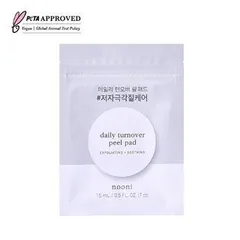
"Nooni - Daily Turnover Peel Pad" is effective for: Moisturizing, Anti-aging, Exfoliation and Evens skin tone
This product could be helpful for: Anti-blemish, but its actives are not the most effective or are not well-studied.
Ingredient callouts
- Exfoliating acids (glycolic acid 1.90% - 2.30% and lactic acid 2.30% - 2.80%). In this concentration, they will have a noticeable exfoliating effect. They can also have an anti-aging effect and stimulate collagen production in a long-run. Lactic Acid can also help to attract water to the upper layer (works as a humectant).
- Ceramides (ceramide np 0.25% - 0.50%). Ceramides are a type of lipids that our skin produces itself. They are a building block of the skin's barrier. Ceramides used in skincare are synthetic or extracted from plants. They work well for softening the skin surface and "patch holes" in the skin's barrier.
- Actives derived from an extract of the Centella Asiatica plant (also known as Gotu Kola) - madecassic acid 0.50% - 0.75%, asiatic acid 0.50% - 0.75%, asiaticoside 0.50% - 0.75% and madecassoside 0.55% - 0.85% The Centella Asiatica Actives help strengthen and restore the skin barrier, decrease inflammation in skin and neutralize free radicals. They also can help to reduce scarring. The good news is that these actives work even in low concentrations.
- Humectants (sodium pca 0.20% - 0.40%, sodium lactate 0.30% - 0.55%, glycerin 0.35% - 0.65%, panthenol 0.30% - 0.60%, diglycerin 0.50% - 0.75% and lactic acid 2.30% - 2.80%). These ingredients help attract water to the upper layer of the skin and improve the skin hydration.
Price
The product retails from 5.31$ up to 26.00$ in the United States.
For a detailed price comparison: click here.
Works for
Cleansing
What does the product description say?
One-step pimple clear pads that reduce acne breakouts and promote clearer skin by removing sebum and impurities.
Source: Yesstyle
This product works by removing dirt and oil from the surface of the skin. It uses a combination of mild cleansing agents (hydrogenated lecithin, polyglyceryl-10 laurate) and should be able to cleanse the skin gently. Still keep in mind that any cleansing can disrupt the skin barrier, and most people do not need to cleanse their skin more than once per day.
Helps water and oil mix together
Helps to retain moisture by creating a protective barrier on the skin. Rich in fatty acids. Improves product texture and helps with the penetration of other ingredients.
Exfoliation
What does the product description say?
An exfoliating and toning pad that makes skin smoother and clearer.
Source: Yesstyle
This product can help exfoliate the skin. In other words, it helps break down the bonds between dead cells on the surface of the skin and speed up the skin turnover. Skin often appears softer and brighter after exfoliation, but overdoing it can result in disrupted skin barrier. The following ingredient is doing the exfoliating job in this product: betaine salicylate, glycolic acid, lactic acid.
An exfoliating and moisturizing alpha-hydroxy acid (AHA). Typically causes less irritation than other AHAs, for example, glycolic acid. At high concentrations (about 15%), lactic acid can help reduce lines and wrinkles. Recent studies show that lactic acid can support the "good" bacteria living on skin's surface (healthy skin microbiome)
Exfoliating acid, a "relative" of salicylic acid
An alpha-hydroxy acid (AHA) that helps to remove the dead skin cells on the surface of the skin reveling a more even, smoother complexation. It is also able to stimulate collagen production with long-term use. Could help to reduce pore congestion. It can be irritating to the skin. Apply sunscreen daily if using products with glycolic acid
An enzyme extracted from papaya fruit. Can have an exfoliating effect on the skin. Can be irritating
A plant extract that can help neutralize free radicals in skin. It contains a compound salicin that can theoretically be converted into salicylic acid that, in turn, helps reduce inflammation in skin, but the evidence of effectiveness in skin is lacking and the extract is usually not used in a concentration that would enable an exfoliating effect
Anti-blemish
What does the product description say?
One-step pimple clear pads that reduce acne breakouts and promote clearer skin by removing sebum and impurities.
Source: Yesstyle
This product might be able to help reduce blemishes and clogged pores because it contains betaine salicylate.
The following ingredient (ingredients) in this product might be helpful, but there is no evidence to confirm that it actually works: glycolic acid
Exfoliating acid, a "relative" of salicylic acid
An alpha-hydroxy acid (AHA) that helps to remove the dead skin cells on the surface of the skin reveling a more even, smoother complexation. It is also able to stimulate collagen production with long-term use. Could help to reduce pore congestion. It can be irritating to the skin. Apply sunscreen daily if using products with glycolic acid
A plant extract that has been shown to be able to reduce inflammation in skin, support restoration of skin barrier function, as well as support collagen production. Contains active compounds called centelloids: asiaticoside, madecasosside, asiatic acid and madecassic acid. Might be helpful in preventing stretch marks. It can be itself be irritating though.
A plant extract that can help neutralize free radicals in skin. It contains a compound salicin that can theoretically be converted into salicylic acid that, in turn, helps reduce inflammation in skin, but the evidence of effectiveness in skin is lacking and the extract is usually not used in a concentration that would enable an exfoliating effect
Is proven to be effective in reducing blemishes, evening out skin tone and helping to improve lines and wrinkles. It helps the skin to repair sun damage, calm down inflammation and keep maintain good levels of moisture. The concentration of about 2% is effective for supporting the skin barrier and evening out the skin tone. Concentration of 4-6% is better for helping with acne and balancing the sebum production
How honest is this product?
| Promise | Can it deliver? |
|---|---|
| Cleansing | |
| Exfoliation | |
| Anti-blemish |
Total Promises Fulfilled score: 91/100.
We receive a small commission for purchases made through these links at no cost for you. Thank you for your support! Learn more
Potential irritants
Comedogenic ingredients
No comedogenic ingredients detected
User reviews (0)
Averages from community submissions.
No reviews yet for this product.
Be the first to share your experience!
Tried this product?
Help capture what the ingredient list can't—texture, finish, pilling, scent, and more. Answer what you can, skip the rest.
Takes ~30 seconds.
Reviews are shown in aggregate. No personal details.
| Product | Similarity | Price | Irritancy |
|---|---|---|---|
 Nooni Daily Turnover Peel Pad | Current | $5.31 | |
 Skinfix USA Acne+ 2% BHA Cleanser | 63% | $35.00 | |
 Filorga Age-Purify Clean Smoothing Purifying Cleansing Gel | 63% | ≈ $36.83 | |
 Community Sixty-Six Detoxifying AHA/BHA Gel Cleanser | 63% | $15.82 | |
Acnecide Purifide Ph Control Face Wash | 62% | ≈ $13.25 | |
 Skincare by Dr V Micellar Gel Wash | 59% | ≈ $19.90 |
Key Actives
Is proven to be effective in reducing blemishes, evening out skin tone and helping to improve lines and wrinkles. It helps the skin to repair sun damage, calm down inflammation and keep maintain good levels of moisture. The concentration of about 2% is effective for supporting the skin barrier and evening out the skin tone. Concentration of 4-6% is better for helping with acne and balancing the sebum production
A plant extract that has been shown to be able to reduce inflammation in skin, support restoration of skin barrier function, as well as support collagen production. Contains active compounds called centelloids: asiaticoside, madecasosside, asiatic acid and madecassic acid. Might be helpful in preventing stretch marks. It can be itself be irritating though.
An exfoliating and moisturizing alpha-hydroxy acid (AHA). Typically causes less irritation than other AHAs, for example, glycolic acid. At high concentrations (about 15%), lactic acid can help reduce lines and wrinkles. Recent studies show that lactic acid can support the "good" bacteria living on skin's surface (healthy skin microbiome)
An alpha-hydroxy acid (AHA) that helps to remove the dead skin cells on the surface of the skin reveling a more even, smoother complexation. It is also able to stimulate collagen production with long-term use. Could help to reduce pore congestion. It can be irritating to the skin. Apply sunscreen daily if using products with glycolic acid
An antioxidant that is typically derived from plant Centella Asiatica. It can help neutralize free radicals in skin and support skin barrier function. It could, however, itself be irritating. It is often unstable in formulations
An active compound of Centella Asiatica plant extract. In combination with other active compounds of Centella Asiatica extract (madecasosside, asiatic acid and madecassic acid), asiaticoside has been shown to be helpful in wound-healing, restoring skin barrier function and supporting collagen production in skin. It can, however, itself be irritating
An active compound of Centella Asiatica plant extract. In combination with other active compounds of Centella Asiatica extract (asiaticoside, madecasosside and madecassic acid) asiatic acid has been shown to be helpful in wound-healing, restoring skin barrier function and supporting collagen production in skin. It can, however, itself be irritating
Helps attract water to the upper layer of the skin and can help improve skin barrier function
A salt derived from licorice. Works as an emollient to soften the upper layer of the skin and can help calm down inflammation. Might be helpful for skin lightening
A type of lipid similar to ceramides naturally present in skin. Helps to soften the upper layer of the skin and supports the skin barrier function to keep it hydrated. Can help to prevent inflammation in skin
Exfoliating acid, a "relative" of salicylic acid
An active compound of Centella Asiatica plant extract. In combination with other active compounds of Centella Asiatica extract (asiaticoside, madecasosside and asiatic acid), madecassic acid has been shown to be helpful in wound-healing, restoring skin barrier function and supporting collagen production in skin. It can, however, itself be irritating
Helps attract water to the upper layer of the skin
Helps water and oil mix together
One of the best moisturizing ingredients. Naturally present in skin. It attracts water to the upper layer of the skin working as a humectant
A plant extract that can help neutralize free radicals. The concentrations typically used in cosmetics are too small to have an effect
A good mix of fatty acids that forms a protective layer on the skin. Improves the shelf life of products. Derived from coconut and glycerin
Helps attract water to the upper layer of the skin. Is often used to adjust the pH level of the product
A plant extract that contains anti-oxidants. It might help to neutralize free radicals in skin. Can be used to help preserve the product formulation
Naturally present in skin and helps to attract water to its upper layer
Helps to retain moisture by creating a protective barrier on the skin. Rich in fatty acids. Improves product texture and helps with the penetration of other ingredients.
Potential irritants
An alpha-hydroxy acid (AHA) that helps to remove the dead skin cells on the surface of the skin reveling a more even, smoother complexation. It is also able to stimulate collagen production with long-term use. Could help to reduce pore congestion. It can be irritating to the skin. Apply sunscreen daily if using products with glycolic acid
A plant extract that can help neutralize free radicals in skin. It contains a compound salicin that can theoretically be converted into salicylic acid that, in turn, helps reduce inflammation in skin, but the evidence of effectiveness in skin is lacking and the extract is usually not used in a concentration that would enable an exfoliating effect
An enzyme extracted from papaya fruit. Can have an exfoliating effect on the skin. Can be irritating
An essential oil. Potential allergen and can be irritating. It has some anti-bacterial properties
A plant extract. Can have an anti-oxidant effect, but can also contain irritants
A fruit extact. Might have some anti-oxidant properties
A plant extract that might contain a compound baicalin that could be helpful in neutralizing free radicals and reducing inflammation in skin. The baicalin concentration in skincare products is often too low for an effective action. Can be used for its fragrant properties
A plant extract that contains anti-oxidants. It might help to neutralize free radicals in skin. Can be used to help preserve the product formulation
Used as a fragrance and can be irritating
Plant extract that has some anti-bacterial properties. Can be used as a fragrance. Can be irritating
Produces temporary toning effect. Can help dissolve other ingredients or preserve products
An exfoliating and moisturizing alpha-hydroxy acid (AHA). Typically causes less irritation than other AHAs, for example, glycolic acid. At high concentrations (about 15%), lactic acid can help reduce lines and wrinkles. Recent studies show that lactic acid can support the "good" bacteria living on skin's surface (healthy skin microbiome)
A plant extract that has been shown to be able to reduce inflammation in skin, support restoration of skin barrier function, as well as support collagen production. Contains active compounds called centelloids: asiaticoside, madecasosside, asiatic acid and madecassic acid. Might be helpful in preventing stretch marks. It can be itself be irritating though.
A plant extract that has some anti-oxidant activity, but solid research is lacking. Can help attract water to the upper layer of the skin
An antioxidant that is typically derived from plant Centella Asiatica. It can help neutralize free radicals in skin and support skin barrier function. It could, however, itself be irritating. It is often unstable in formulations
An active compound of Centella Asiatica plant extract. In combination with other active compounds of Centella Asiatica extract (madecasosside, asiatic acid and madecassic acid), asiaticoside has been shown to be helpful in wound-healing, restoring skin barrier function and supporting collagen production in skin. It can, however, itself be irritating
An active compound of Centella Asiatica plant extract. In combination with other active compounds of Centella Asiatica extract (asiaticoside, madecasosside and madecassic acid) asiatic acid has been shown to be helpful in wound-healing, restoring skin barrier function and supporting collagen production in skin. It can, however, itself be irritating
An active compound of Centella Asiatica plant extract. In combination with other active compounds of Centella Asiatica extract (asiaticoside, madecasosside and asiatic acid), madecassic acid has been shown to be helpful in wound-healing, restoring skin barrier function and supporting collagen production in skin. It can, however, itself be irritating
Traditionally used to treat sunburns, dermatitis and inflammation, but data on its effectiveness is lacking. While the majority of the content is plain water, it can contain some goodies like vitamins, enzymes, minerals, and humectants that help attract water into the skin
Helps preserve products and creates a nice product texture
A plant extract that can contain an antioxidant compound
A plant extract that can help neutralize free radicals. The concentrations typically used in cosmetics are too small to have an effect
A plant extract containing sugars that might help attract water to the upper layer of the skin. Is claimed by the manufacturer to help reduce pore size but evidence is lacking
Can have some moisturizing properties due to its sugar content
A good mix of fatty acids that forms a protective layer on the skin. Improves the shelf life of products. Derived from coconut and glycerin
Helps attract water to the upper layer of the skin. Is often used to adjust the pH level of the product
Used to preserve products, dissolve other ingredients and create a nice product texture
Comedogenic ingredients
We couldn't find any comedogenic ingredients in this product
All ingredients
Helps attract water to the upper layer of the skin and improves the product texture
Used to create a nice product texture and help delivery of other ingredients. Might be somewhat helpful in attracting water to the upper layer of the skin
An exfoliating and moisturizing alpha-hydroxy acid (AHA). Typically causes less irritation than other AHAs, for example, glycolic acid. At high concentrations (about 15%), lactic acid can help reduce lines and wrinkles. Recent studies show that lactic acid can support the "good" bacteria living on skin's surface (healthy skin microbiome)
An alpha-hydroxy acid (AHA) that helps to remove the dead skin cells on the surface of the skin reveling a more even, smoother complexation. It is also able to stimulate collagen production with long-term use. Could help to reduce pore congestion. It can be irritating to the skin. Apply sunscreen daily if using products with glycolic acid
A plant extract that has been shown to be able to reduce inflammation in skin, support restoration of skin barrier function, as well as support collagen production. Contains active compounds called centelloids: asiaticoside, madecasosside, asiatic acid and madecassic acid. Might be helpful in preventing stretch marks. It can be itself be irritating though.
A plant extract that can help neutralize free radicals in skin. It contains a compound salicin that can theoretically be converted into salicylic acid that, in turn, helps reduce inflammation in skin, but the evidence of effectiveness in skin is lacking and the extract is usually not used in a concentration that would enable an exfoliating effect
A plant extract that has some anti-oxidant activity, but solid research is lacking. Can help attract water to the upper layer of the skin
An enzyme extracted from papaya fruit. Can have an exfoliating effect on the skin. Can be irritating
An antioxidant that is typically derived from plant Centella Asiatica. It can help neutralize free radicals in skin and support skin barrier function. It could, however, itself be irritating. It is often unstable in formulations
An active compound of Centella Asiatica plant extract. In combination with other active compounds of Centella Asiatica extract (madecasosside, asiatic acid and madecassic acid), asiaticoside has been shown to be helpful in wound-healing, restoring skin barrier function and supporting collagen production in skin. It can, however, itself be irritating
An active compound of Centella Asiatica plant extract. In combination with other active compounds of Centella Asiatica extract (asiaticoside, madecasosside and madecassic acid) asiatic acid has been shown to be helpful in wound-healing, restoring skin barrier function and supporting collagen production in skin. It can, however, itself be irritating
An active compound of Centella Asiatica plant extract. In combination with other active compounds of Centella Asiatica extract (asiaticoside, madecasosside and asiatic acid), madecassic acid has been shown to be helpful in wound-healing, restoring skin barrier function and supporting collagen production in skin. It can, however, itself be irritating
Helps to dissolve other ingredients in a formulation. Slows down the rate of product drying
Traditionally used to treat sunburns, dermatitis and inflammation, but data on its effectiveness is lacking. While the majority of the content is plain water, it can contain some goodies like vitamins, enzymes, minerals, and humectants that help attract water into the skin
Helps preserve products and creates a nice product texture
Helps attract water to the upper layer of the skin and can help improve skin barrier function
Is proven to be effective in reducing blemishes, evening out skin tone and helping to improve lines and wrinkles. It helps the skin to repair sun damage, calm down inflammation and keep maintain good levels of moisture. The concentration of about 2% is effective for supporting the skin barrier and evening out the skin tone. Concentration of 4-6% is better for helping with acne and balancing the sebum production
An essential oil. Potential allergen and can be irritating. It has some anti-bacterial properties
One of the best moisturizing ingredients. Naturally present in skin. It attracts water to the upper layer of the skin working as a humectant
A plant extract that can contain an antioxidant compound
A plant extract that can help neutralize free radicals. The concentrations typically used in cosmetics are too small to have an effect
A plant extract. Can have an anti-oxidant effect, but can also contain irritants
A salt derived from licorice. Works as an emollient to soften the upper layer of the skin and can help calm down inflammation. Might be helpful for skin lightening
A fruit extact. Might have some anti-oxidant properties
A plant extract containing sugars that might help attract water to the upper layer of the skin. Is claimed by the manufacturer to help reduce pore size but evidence is lacking
Can have some moisturizing properties due to its sugar content
A fermentation product created by bacteria Lactobacillus out of soybean. The fermented product helps to attract water to the upper layer of the skin and has anti-bacterial properties. It might be helpful in calming down inflammation and could be helpful in evening out skin tone, but studies are lacking
A plant extract that might contain a compound baicalin that could be helpful in neutralizing free radicals and reducing inflammation in skin. The baicalin concentration in skincare products is often too low for an effective action. Can be used for its fragrant properties
Helps attract water to the upper layer of the skin. Could be helpful in restoring the skin barrier function
A good mix of fatty acids that forms a protective layer on the skin. Improves the shelf life of products. Derived from coconut and glycerin
Helps attract water to the upper layer of the skin. Is often used to adjust the pH level of the product
A plant extract that contains anti-oxidants. It might help to neutralize free radicals in skin. Can be used to help preserve the product formulation
Used as a fragrance and can be irritating
Plant extract that has some anti-bacterial properties. Can be used as a fragrance. Can be irritating
A type of lipid similar to ceramides naturally present in skin. Helps to soften the upper layer of the skin and supports the skin barrier function to keep it hydrated. Can help to prevent inflammation in skin
Naturally present in skin and helps to attract water to its upper layer
Used to preserve products, dissolve other ingredients and create a nice product texture
Helps to retain moisture by creating a protective barrier on the skin. Rich in fatty acids. Improves product texture and helps with the penetration of other ingredients.
Produces temporary toning effect. Can help dissolve other ingredients or preserve products
Ingredient list view
Water, Methylpropanediol, Sorbitol, Butylene glycol, Lactic acid, Glycolic acid, Centella asiatica extract, Betula alba juice, Salix alba bark extract, Betaine salicylate, Portulaca oleracea extract, Papain, Madecassoside, Asiaticoside, Asiatic acid, Madecassic acid, Diglycerin, Tromethamine, 1,2-hexanediol, Dipropylene glycol, Polyglyceryl-10 laurate, Hydroxyacetophenone, Aloe barbadensis leaf water, Caprylyl glycol, Panthenol, Niacinamide, Ethylhexylglycerin, Lavandula angustifolia oil, Glycerin, Citrullus lanatus fruit extract, Ficus carica fruit extract, Origanum vulgare leaf extract, Hylocereus undatus fruit extract, Chamaecyparis obtusa leaf extract, Citrus paradisi fruit extract, Litchi chinensis fruit extract, Dipotassium glycyrrhizate, Prunus persica fruit extract, Lens esculenta fruit extract, Pyrus malus fruit extract, Lactobacillus/soybean ferment extract, Cinnamomum cassia bark extract, Scutellaria baicalensis root extract, Glucose, Caprylic/capric triglyceride, Sodium lactate, Cornus officinalis fruit extract, Morus alba fruit extract, Mentha spicata flower/leaf/stem extract, Thymus vulgaris flower/leaf extract, Ginkgo biloba nut extract, Ceramide np, Sodium pca, Pentylene glycol, Hydrogenated lecithin, Potassium sorbate, Sodium benzoate, Alcohol denat., Disodium edta, Linalool
- Epidermal and dermal effects of topical lactic acid
- Dual Effects of Alpha-Hydroxy Acids on the Skin
- Photoprotective and antiinflammatory effects of topical glycolic acid
- Glycolic acid peel therapy – a current review
- Dual Effects of Alpha-Hydroxy Acids on the Skin
- Anti-Inflammatory Effect of Titrated Extract of Centella asiatica in Phthalic Anhydride-Induced Allergic Dermatitis Animal Model
- Centella asiatica in cosmetology
- Triterpene Composition and Bioactivities of Centella asiatica
- Asiaticoside induction for cell-cycle progression, proliferation and collagen synthesis in human dermal fibroblasts
- Assessment report on Centella asiatica (L.) Urban, herba
- Contact dermatitis due to Madecassol
- The Effects of a Standardized Extract of Centella asiatica on Postlaser Resurfacing Wound Healing on the Face: A Split-Face, Double-Blind, Randomized, Placebo-Controlled Trial
- Efficacy and Safety of White Willow Bark (Salix alba) Extract
- An evaluation of the effect of a topical product containing salicin on the visible signs of human skin aging
- Portulaca oleracea (purslane)
- Centella asiatica in Dermatology: An Overview
- Protective effect of madecassoside on H2O2-induced oxidative stress and autophagy activation in human melanocytes
- Madecassoside, a triterpenoid saponin isolated from Centella asiatica herbs, protects endothelial cells against oxidative stress
- Madecassoside Inhibits Melanin Synthesis by Blocking Ultraviolet-Induced Inflammation
- Contact dermatitis due to Madecassol
- Stability Study of the Active Constituents in the Centella asiatica Extract Formulations
- Contact dermatitis due to Madecassol
- Centella asiatica in Dermatology: An Overview
- Safety Assessment of Tromethamine as Used in Cosmetics
- The influence of alkane chain length on the skin irritation potential of 1,2-alkanediols
- In Vitro Assessment of Skin Irritation Potential of Surfactant-based Formulations by Using a 3-D Skin Reconstructed Tissue Model and Cytokine Response
- Skin moisturizing effects of panthenol-based formulations
- Safety Assessment of Panthenol, Pantothenic Acid, and Derivatives as Used in Cosmetics
- Niacinamide - mechanisms of action and its topical use in dermatology
- Gehring, W. (2004). Nicotinic acid/niacinamide and the skin. Journal of Cosmetic Dermatology, 3(2), 88–93. doi:10.1111/j.1473-2130.2004.00115.x
- Glycerol and the skin: holistic approach to its origin and functions
- Analyzing Lycopene Content in Fruits
- Ameliorating effect of dipotassium glycyrrhizinate on an IL-4- and IL-13-induced atopic dermatitis-like skin-equivalent model
- Final report on the safety assessment of Glycyrrhetinic Acid, Potassium Glycyrrhetinate, Disodium Succinoyl Glycyrrhetinate, Glyceryl Glycyrrhetinate, Glycyrrhetinyl Stearate, Stearyl Glycyrrhetinate, Glycyrrhizic Acid, Ammonium Glycyrrhizate, Dipotassium Glycyrrhizate, Disodium Glycyrrhizate, Trisodium Glycyrrhizate, Methyl Glycyrrhizate, and Potassium Glycyrrhizinate.
- Scutellaria baicalensis, the golden herb from the garden of Chinese medicinal plants
- Flavonoids in Treating Psoriasis
- Improvement of skin barrier dysfunction by Scutellaria baicalensis GEOGI extracts through lactic acid fermentation
- Safety Assessment of Scutellaria baicalensis-Derived Ingredients as Used in Cosmetics
- Topical Glucose Induces Claudin-1 and Filaggrin Expression in a Mouse Model of Atopic Dermatitis and in Keratinocyte Culture, Exerting Anti-inflammatory Effects by Repairing Skin Barrier Function
- Chemoprevention Against Hepatocellular Carcinoma of Cornus officinalis in vitro
- Skin hydration is significantly increased by a cream formulated to mimic the skin’s own natural moisturizing systems
- Topically Applied Ceramides Interact with the Stratum Corneum Lipid Matrix in Compromised Ex Vivo Skin