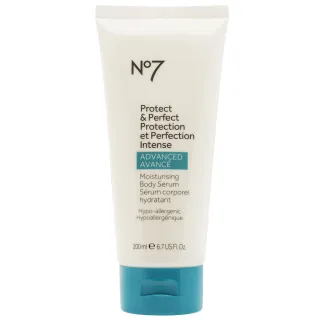
No7 Protect & Perfect Intensive ADVANCED Body Serum
Works for
MoisturizingAcetyl dipeptide-1 cetyl ester, Palmitoyl tripeptide-1 + 12 moreWorks well
“Nourishing argan oil and moisture locking hyaluronic acid provide lasting hydration”
This product can help improve hydration of the skin with the two types of ingredients.
The first type is called “humectants”:
these ingredients help attract water.
When humectants are on the surface of the skin, they “pull in” the moisture from the outside environment, or from
within deeper layers of the skin. The following ingredients in this product do the job:
glycerin, sodium hyaluronate.
This product also contains ingredients called “occlusives”. They help reduce the speed with which our skin loses moisture to the outside environment. These ingredients also help soften the upper layer of the skin, so it feels less tight and nicer to the touch. The following ingredients in this product do the job: dimethicone, argania spinosa kernel oil.
The following ingredients in this product are especially good for supporting the skin barrier and helping with the hydration level: acetyl dipeptide-1 cetyl ester, palmitoyl tetrapeptide-7, palmitoyl tripeptide-1
Anti-agingAcetyl dipeptide-1 cetyl ester, Palmitoyl tripeptide-1 + 4 moreMay help
“See younger looking skin in just 2 weeks.”
This product contains acetyl dipeptide-1 cetyl ester, palmitoyl tetrapeptide-7, palmitoyl tripeptide-1. These ingredients might be able to help reduce and prevent fine lines and wrinkles, improve skin elasticity and firmness, but there is not enough evidence that it actually works.
Can it cause trouble?
Irritancy2 strong irritants: Parfum, Retinyl palmitateMedium risk
ComedogenicClean of flagged comedogenic ingredientsNone flagged

User reviews
Be the first — your take helps the next person decide.
Ingredients
Filter by role to see what each ingredient is doing.
Water~45–55%
Glycerin~4.6–5.6%
- Irritation risk
- Low
One of the best moisturizing ingredients. Naturally present in skin. It attracts water to the upper layer of the skin working as a humectant
More about GlycerinDimethicone~4.2–5.1%
- Irritation risk
- Low
A silicone that helps to reduce water loss from the surface of the skin. Can temporarily "fill in" lines and wrinkles, absorb oil, and create a nice product finish
More about DimethiconeDimethicone crosspolymer~3.1–3.7%
- Irritation risk
- Low
Used to create a thicker product texture. Helps soften the upper layer of the skin and might be able to prevent moisture loss from its surface
More about Dimethicone crosspolymerOctyldodecanol~2.3–2.8%
- Irritation risk
- Low
An emollient that helps to soften the skin and create a pleasant product texture and stabilize the formulation
More about OctyldodecanolAcrylamide/ammonium acrylate copolymer~1.9–2.4%
- Irritation risk
- Low
Helps to improve product texture
More about Acrylamide/ammonium acrylate copolymerArgania spinosa kernel oil~1.6–2%
- Irritation risk
- Medium
An emollient that helps soften the upper layer of the skin. Might have some weak anti-oxidant properties
More about Argania spinosa kernel oilC12-15 alkyl benzoate~1.5–1.8%
- Irritation risk
- Low
Enhances the product texture and makes it more spreadable. Helps reduce water loss from the outer layer of skin. Extands the shelf life by preventing bacteria growth
More about C12-15 alkyl benzoateButylene glycol~1.2–1.4%
- Irritation risk
- Low
Used to create a nice product texture and help delivery of other ingredients. Might be somewhat helpful in attracting water to the upper layer of the skin
More about Butylene glycolPhenoxyethanol~0.5–1%
- Irritation risk
- Low
A preservative. It helps prevent bacterial growth in cosmetic products
More about PhenoxyethanolPolyisobutene~0.75–1.1%
Peg-30 dipolyhydroxystearate~0.6–0.85%
- Irritation risk
- Medium
Helps oil and water mix together
More about Peg-30 dipolyhydroxystearateOctyldodecyl xyloside~0.5–0.75%
Parfum~0.45–0.65%
- Irritation risk
- High
An aromatic blend of unspecified and possibly irritating ingredients
More about ParfumDipropylene glycol~0.4–0.6%
- Irritation risk
- Low
Helps to dissolve other ingredients in a formulation. Slows down the rate of product drying
More about Dipropylene glycolMethylparaben~0.15–0.3%
Tocopheryl acetate~0.4–0.6%
- Irritation risk
- Medium
A more stable but less bio-available form of vitamin E compared to Tocopherol. Might help moisturize and protect the skin from free radicals, but mostly used in low concentrations to stabilize other ingredients.
More about Tocopheryl acetateSodium hyaluronate~0.3–0.6%
- Irritation risk
- Low
One of the best moisturizing ingredients. Attracts water into the upper layer of the skin
More about Sodium hyaluronateEthylparaben~0.2–0.4%
Polysorbate 20~0.3–0.55%
Retinyl palmitate~0.25–0.45%
- Irritation risk
- High
Three steps removed from the active form of vitamin A - retinoic acid. To have an effect in the skin, it first needs to be converted twice to become the retinoic acid. This means it is less potent than retinol, but could also be less irritating. Once converted to the retinoic acid in the skin, it helps against all signs of aging, improves skin cell turnover and helps fight blemishes and clogged pores. However, in many cosmetic formulations, it is used in a concentration that is too low to have the full effect
More about Retinyl palmitateSorbitan isostearate~0.25–0.5%
- Irritation risk
- Low
Helps oil and water mix together
More about Sorbitan isostearatePropylene glycol~0.2–0.4%
- Irritation risk
- High
Helps oil and water mix together and can enhance the penetration of other ingredients into the skin. It can be irritating
More about Propylene glycolSodium ascorbyl phosphate~0.25–0.45%
- Irritation risk
- Medium
A stable derivative of vitamin C. It is oil-soluble which means it is more likely to penetrate the skin compared to the pure form of vitamin C (which is water-soluble), but it is less bio-available and is way less effective in stimulating collagen and reducing wrinkles compared to the pure form of vitamin C (L-ascorbic acid) and its other derivatives (for example, magnesium ascorbyl phosphate). At the same time, this vitamin C derivative has been shown in studies to be effective in reducing acne, blemishes and clogged pores. It is less irritating then the pure form of vitamin C
More about Sodium ascorbyl phosphateTetrasodium edta~0.25–0.45%
Sorbitan laurate~0.25–0.45%
Carbomer~0.25–0.45%
- Irritation risk
- Low
Helps create a thicker or gel-like product texture. It is not a surfactant but can be used in gentle cleansing formulations
More about CarbomerHydrolyzed rice protein~0.25–0.4%
- Irritation risk
- Low
Helps attract water to the upper layer of the skin. Might have some anti-oxidant properties
More about Hydrolyzed rice proteinHydroxyethylcellulose~0.25–0.45%
- Irritation risk
- Low
Used to thicken product formulations and create gel-like textures
More about HydroxyethylcelluloseAcetyl dipeptide-1 cetyl ester~0.2–0.4%
- Irritation risk
- Low
A type of peptide. Peptides are excellent moisturizers and might be able support collagen production reducing fine lines and wrinkles
More about Acetyl dipeptide-1 cetyl esterPanax ginseng root extract~0.25–0.45%
- Irritation risk
- High
A plant extract that might have some anti-inflammatory properties, but solid evidence is lacking. It can be irritating
More about Panax ginseng root extractMedicago sativa extract~0.2–0.35%
- Irritation risk
- Medium
A plant extract that might help neutralize free radicals in skin
More about Medicago sativa extractMorus alba leaf extract~0.15–0.3%
- Irritation risk
- Low
Tocopherol~0.15–0.3%
- Irritation risk
- Low
Pure form of vitamin E. Can help moisturise and protect the skin from free radicals. Often used to help stabilise other ingredients or the formula itself
More about TocopherolSodium benzoate~0.1–0.25%
Palmitoyl tripeptide-1~0.15–0.3%
- Irritation risk
- Low
A type of peptide. Peptides are excellent moisturizers and might be able support collagen production reducing fine lines and wrinkles
More about Palmitoyl tripeptide-1Ethylhexylglycerin~0.1–0.15%
Palmitoyl tetrapeptide-7~0.1–0.2%
- Irritation risk
- Low
A type of peptide. Peptides are excellent moisturizers and might be able support collagen production reducing fine lines and wrinkles
More about Palmitoyl tetrapeptide-7Ingredient list view
Water, Glycerin, Dimethicone, Dimethicone crosspolymer, Octyldodecanol, Acrylamide/ammonium acrylate copolymer, Argania spinosa kernel oil, C12-15 alkyl benzoate, Butylene glycol, Phenoxyethanol, Polyisobutene, Peg-30 dipolyhydroxystearate, Octyldodecyl xyloside, Parfum, Dipropylene glycol, Methylparaben, Tocopheryl acetate, Sodium hyaluronate, Ethylparaben, Polysorbate 20, Retinyl palmitate, Sorbitan isostearate, Propylene glycol, Sodium ascorbyl phosphate, Tetrasodium edta, Sorbitan laurate, Carbomer, Hydrolyzed rice protein, Hydroxyethylcellulose, Acetyl dipeptide-1 cetyl ester, Panax ginseng root extract, Medicago sativa extract, Morus alba leaf extract, Tocopherol, Sodium benzoate, Palmitoyl tripeptide-1, Ethylhexylglycerin, Palmitoyl tetrapeptide-7
Compare prices
Retailers ranked by price — lowest first.
Affiliate links · As an Amazon Associate, WIMJ earns from qualifying purchases.
Worth comparing, line by line.
Match % combines shared ingredients, the first five ingredients, shared actives and hero ingredients, irritancy (lower counts in the alternative's favour), texture and body area. Only products in the same routine step are compared.
| No7Protect & Perfect Intensive ADVANCED Body SerumYOUR PRODUCT | La ChênaieSupreme Anti-Aging Serum | numbuzinNo.9 NAD+ Peptide Lifting Serum | M-61Hydraboost Gradual Tan Body Serum | |
|---|---|---|---|---|
| Match | — | 51% | 49% | 48% |
| Price | — | — | $21.00 | $56.00 |
| Shared key ingredients | — | 6 of 8 | 6 of 8 | 4 of 8 |
| Key difference | — | Squalane | Biotinoyl Tripeptide-1 | Gluconolactone |
| Irritancy | Medium | Medium | Medium | Medium |
| Drying alcohol | — | — | — | — |
| View product | Shop | Shop | Shop |


More alternatives: Maely's Cosmetics B-GLOSSY Smoothing Body SerumCODAGE Serum No.10 Eye Contour Anti-Aging and Energy Serum
Sources cited in this review
Every concentration estimate and effectiveness label is anchored to one of these 24 studies and safety reviews.
- 1
- 2
- 3Final Report on the Safety Assessment of Dimethicone Copolyoljournals.sagepub.com
- 4
- 5
- 6Hyaluronic acid: A key molecule in skin agingncbi.nlm.nih.gov

Affiliate links · As an Amazon Associate, WIMJ earns from qualifying purchases.