Works for
MoisturizingButyrospermum parkii butter, Helianthus annuus seed oil + 11 moreWorks
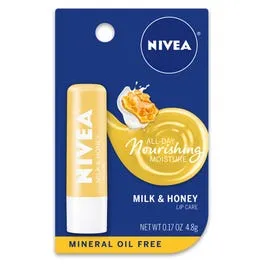
“This NIVEA moisturizing lip balm formula is Mineral Oil free and enriched with nourishing ingredients, including Honey, Milk Proteins and Shea Butter to deliver all-day nourishing moisture to dry lips.”
This product can help soften the skin and reduce its moisture loss with emollients and occlusives: beeswax, butyrospermum parkii butter.
Keep in mind that this product does not contain effective ingredients to attract water to the upper layer of the skin. This is why an additional product with humectants like glycerin or hyaluronic acid can be helpful (apply it before this product for the best results).
Can it cause trouble?
Irritancy1 strong irritant: ParfumMedium risk
Comedogenic2 ingredients rated 2 or more on the 0–5 pore-clogging scale2 flagged
User reviews
Be the first — your take helps the next person decide.
Ingredients
Filter by role to see what each ingredient is doing.
Octyldodecanol~22–33%
- Irritation risk
- Low
An emollient that helps to soften the skin and create a pleasant product texture and stabilize the formulation
More about OctyldodecanolCocoglycerides~4.9–7.4%
- Irritation risk
- High
Help soften the upper layer of the skin and make it easier for oil and water mix together. Recently, a rising number of allergic reactions to cocoglycerides and other coconut-derived surfactants has been reported. As there is a significant overlap between frequent irritants and allergens, we flag this ingredient for attention of those with very sensitive, reactive skin
More about CocoglyceridesButyrospermum parkii butter~4.9–7.4%
- Irritation risk
- Low
- Comedogenicity
- 3/5
A great moisturising ingredient that softens the skin and reduces water loss from its upper layer. It also can be helpful in protecting skin from free radicals
More about Butyrospermum parkii butterEuphorbia cerifera wax~4.2–6.4%
- Irritation risk
- Low
Helianthus annuus seed oil~3.1–4.7%
- Irritation risk
- Low
A great emollient due to its high linoleic acid content. One of the most effective plant oils in helping skin hydration and repairing skin barrier function
More about Helianthus annuus seed oilBeeswax~2.4–3.5%
- Irritation risk
- Low
Forms a protective barrier that holds water and keeps dry skin hydrated. Keeps an emulsion from separating into its oil and liquid components, and increases the thickness of a product. Can be an allergen
More about BeeswaxCopernicia cerifera wax~2–2.9%
- Irritation risk
- Low
Helps to soften the upper layer of the skin and create a nice product consistency
More about Copernicia cerifera waxCaprylic/capric triglyceride~1.6–2.4%
- Irritation risk
- Medium
A good mix of fatty acids that forms a protective layer on the skin. Improves the shelf life of products. Derived from coconut and glycerin
More about Caprylic/capric triglycerideDicaprylyl ether~1.2–1.9%
- Irritation risk
- Low
Helps soften the upper layer of the skin while creating a non-greasy feel on the skin. Helps to dissolve other ingredients
More about Dicaprylyl etherOlea europaea fruit oil~1.1–1.7%
- Irritation risk
- Medium
An emollient that helps soften the skin but is not effective for restoring its barrier function. Might be helpful to calm down inflammation
More about Olea europaea fruit oilCetyl ricinoleate~0.95–1.4%
- Irritation risk
- Low
An emollient that helps soften the upper layer of the skin
More about Cetyl ricinoleateMyristyl myristate~0.95–1.45%
- Irritation risk
- Medium
- Comedogenicity
- 3/5
An emollient. Is not recommended for acne-prone skin as it can be comedogenic
More about Myristyl myristateRicinus communis seed oil~0.55–1.25%
- Irritation risk
- Medium
A plant oil that can help soften the skin. It might be helpful in calming down inflammation, but solid research is lacking. Is often used in lip products to create the needed product consistency
More about Ricinus communis seed oilNonfat dry milk~0.4–0.9%
- Irritation risk
- Low
Honey~0.3–0.75%
- Irritation risk
- Low
Helps attract water to the skin and might have some anti-bacterial properties. Can be an allergen
More about HoneyParfum~0.2–0.75%
- Irritation risk
- High
An aromatic blend of unspecified and possibly irritating ingredients
More about ParfumMaltodextrin~0.3–0.7%
- Irritation risk
- Low
Used to stabilize the product formulation and can help absorb oil
More about MaltodextrinTricalcium phosphate~0.15–0.7%
- Irritation risk
- Low
Bht~0.05–0.3%
Iron oxides~0.1–0.4%
- Irritation risk
- Low
An umbrella term for the following three colorants: CI 77491, CI 77492, CI 77499. They might be able to offer some protection against visible light, but the degree of the protection is not clear
More about Iron oxidesIngredient list view
Octyldodecanol, Cocoglycerides, Butyrospermum parkii butter, Euphorbia cerifera wax, Helianthus annuus seed oil, Beeswax, Copernicia cerifera wax, Caprylic/capric triglyceride, Dicaprylyl ether, Olea europaea fruit oil, Cetyl ricinoleate, Myristyl myristate, Ricinus communis seed oil, Nonfat dry milk, Honey, Parfum, Maltodextrin, Tricalcium phosphate, Bht, Iron oxides
Compare prices
Retailers ranked by price — lowest first.
Affiliate links · As an Amazon Associate, WIMJ earns from qualifying purchases.
Worth comparing, line by line.
Match % combines shared ingredients, the first five ingredients, shared actives and hero ingredients, irritancy (lower counts in the alternative's favour), texture and body area. Only products in the same routine step are compared.
| NiveaMilk Honey Lip CareYOUR PRODUCT | Burt's BeesCherry Lip Shimmer | ORMONICALip The Lip Fragrance Free | La RoséeNourishing Tinted Lip Balm 4 | |
|---|---|---|---|---|
| Match | — | 37% | 36% | 35% |
| Price | — | $4.06 | $9.30 | $8.78 |
| Shared key ingredients | — | 5 of 7 | 4 of 7 | 4 of 7 |
| Key difference | — | Lanolin | Cera Alba | Vitamin E |
| Irritancy | Medium | Medium | Low | Low |
| Drying alcohol | — | — | — | — |
| View product | Shop | Shop | Shop |


More alternatives: Saint Cosmetics Velvet Lip CreamEvereden Baby Lip Balm
Sources cited in this review
Every concentration estimate and effectiveness label is anchored to one of these 8 studies and safety reviews.
- 1
- 2
- 3Effect of topically applied lipids on surfactant-irritated skinonlinelibrary.wiley.com
- 4
- 5Use of “natural” oils for moisturization: Review of olive, coconut, and sunflower seed oilonlinelibrary.wiley.com
- 6

Affiliate links · As an Amazon Associate, WIMJ earns from qualifying purchases.