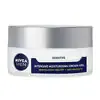
Nivea Sensitive Intensive Face Cream Moisturiser
Works for
MoisturizingPanthenol, Glycerin + 9 moreWorks well
“Sensitive Intensive Face Cream Moisturiser”
This product can help improve hydration of the skin with the two types of ingredients.
The first type is called “humectants”:
these ingredients help attract water.
When humectants are on the surface of the skin, they “pull in” the moisture from the outside environment, or from
within deeper layers of the skin. The following ingredients in this product do the job:
glycerin, pantolactone.
This product also contains ingredients called “occlusives”. They help reduce the speed with which our skin loses moisture to the outside environment. These ingredients also help soften the upper layer of the skin, so it feels less tight and nicer to the touch. The following ingredients in this product do the job: dimethicone, cetyl alcohol.
The following ingredients in this product are especially good for supporting the skin barrier and helping with the hydration level: panthenol
Can it cause trouble?
Irritancy4 strong irritants: Linalool, Alpha-isomethyl ionone + 2 more — patch-test recommendedHigh risk
Comedogenic1 ingredient rated 2 or more on the 0–5 pore-clogging scale1 flagged

User reviews
Be the first — your take helps the next person decide.
Ingredients
Filter by role to see what each ingredient is doing.
Water~40–60%
Glycerin~4.1–6.2%
- Irritation risk
- Low
One of the best moisturizing ingredients. Naturally present in skin. It attracts water to the upper layer of the skin working as a humectant
More about GlycerinIsopropyl stearate~3.7–5.5%
- Irritation risk
- Low
Helps soften the upper layer of the skin
More about Isopropyl stearateCetyl alcohol~2.2–3.3%
- Irritation risk
- Low
A non-drying alcohol that works to soften the skin and stabilize product formulations helping oil and water mix together
More about Cetyl alcoholDistarch phosphate~2.1–3.1%
- Irritation risk
- Low
Panthenol~1.6–2.5%
- Irritation risk
- Low
Helps attract water to the upper layer of the skin and can help improve skin barrier function
More about PanthenolTocopheryl acetate~1.4–2.1%
- Irritation risk
- Medium
A more stable but less bio-available form of vitamin E compared to Tocopherol. Might help moisturize and protect the skin from free radicals, but mostly used in low concentrations to stabilize other ingredients.
More about Tocopheryl acetateChamomilla recutita flower extract~1.3–1.9%
- Irritation risk
- High
Plant extract that can have healing and anti-inflammatory properties. It is a potential allergen and can be irritating
More about Chamomilla recutita flower extractGlyceryl stearate~1.1–1.6%
- Irritation risk
- Low
An emollient that softens the skin and forms a protective layer on its surface. Helps water and oil mix together
More about Glyceryl stearatePalmitic acid~0.9–1.35%
- Irritation risk
- Low
An emollient that is naturally present in skin and helps soften it
More about Palmitic acidStearic acid~0.6–1.4%
- Irritation risk
- Low
Helps oil and water mix together and works as an emollient
More about Stearic acidMaltodextrin~0.45–1.05%
- Irritation risk
- Low
Used to stabilize the product formulation and can help absorb oil
More about MaltodextrinMyristic acid~0.4–0.95%
- Irritation risk
- Medium
- Comedogenicity
- 3/5
Helps oil and water mix together. Could be comedogenic
More about Myristic acidArachidic acid~0.45–1.1%
Citric acid~0.3–0.7%
- Irritation risk
- Medium
Can work as an exfoliant but is typically used to adjust the product pH
More about Citric acidOleic acid~0.35–0.8%
- Irritation risk
- Medium
Helps soften the upper layer of the skin. At the same time, it can weaken the skin's barrier enhancing penetration of other ingredients and increasing the risk of skin dryness
More about Oleic acidSodium hydroxide~0.2–0.75%
Pantolactone~0.15–0.6%
- Irritation risk
- Low
Helps attract water to the upper layer of the skin
More about PantolactoneDimethicone~0.15–0.65%
- Irritation risk
- Low
A silicone that helps to reduce water loss from the surface of the skin. Can temporarily "fill in" lines and wrinkles, absorb oil, and create a nice product finish
More about DimethiconeCarbomer~0.1–0.5%
- Irritation risk
- Low
Helps create a thicker or gel-like product texture. It is not a surfactant but can be used in gentle cleansing formulations
More about CarbomerAcrylates/c10-30 alkyl acrylate crosspolymer~0.1–0.5%
- Irritation risk
- Medium
Maintains the texture of skincare products. Allows the product to spread evenly. Helps oil and water mix together
More about Acrylates/c10-30 alkyl acrylate crosspolymerPhenoxyethanol~0.1–0.35%
- Irritation risk
- Low
A preservative. It helps prevent bacterial growth in cosmetic products
More about PhenoxyethanolCaprylyl glycol~0.1–0.4%
- Irritation risk
- Medium
Helps preserve products and creates a nice product texture
More about Caprylyl glycolLinalool~0.05–0.25%
Alpha-isomethyl ionone~0.05–0.2%
- Irritation risk
- High
A fragrance. Potential allergen and can be irritating
More about Alpha-isomethyl iononeGeraniol~0.05–0.15%
Parfum~0.05–0.1%
- Irritation risk
- High
An aromatic blend of unspecified and possibly irritating ingredients
More about ParfumIngredient list view
Water, Glycerin, Isopropyl stearate, Cetyl alcohol, Distarch phosphate, Panthenol, Tocopheryl acetate, Chamomilla recutita flower extract, Glyceryl stearate, Palmitic acid, Stearic acid, Maltodextrin, Myristic acid, Arachidic acid, Citric acid, Oleic acid, Sodium hydroxide, Pantolactone, Dimethicone, Carbomer, Acrylates/c10-30 alkyl acrylate crosspolymer, Phenoxyethanol, Caprylyl glycol, Linalool, Alpha-isomethyl ionone, Geraniol, Parfum
Compare prices
Retailers ranked by price — lowest first.

Worth comparing, line by line.
Match % combines shared ingredients, the first five ingredients, shared actives and hero ingredients, irritancy (lower counts in the alternative's favour), texture and body area. Only products in the same routine step are compared.
| NiveaSensitive Intensive Face Cream MoisturiserYOUR PRODUCT | NaturiumMulti-Peptide Moisturizer | MISSHAMISA Geum Sul Rejuvenating Cream | GaldermaCetaphil Moisturising Cream | |
|---|---|---|---|---|
| Match | — | 70% | 69% | 69% |
| Price | — | $11.00 | — | $8.74 |
| Shared key ingredients | — | 4 of 4 | 4 of 4 | 4 of 4 |
| Key difference | — | Niacinamide | Niacinamide | Niacinamide |
| Irritancy | High | Medium | Medium | Low |
| Drying alcohol | — | — | — | — |
| View product | Shop | Shop | Shop |


More alternatives: Cetaphil Rich Night CreamEucerin pH5 Cream
Sources cited in this review
Every concentration estimate and effectiveness label is anchored to one of these 10 studies and safety reviews.
- 1
- 2Skin moisturizing effects of panthenol-based formulationspdfs.semanticscholar.org
- 3
- 4
- 5
- 6https://www.sciencedirect.com/science/article/pii/0168365995000887sciencedirect.com

Affiliate links · As an Amazon Associate, WIMJ earns from qualifying purchases.