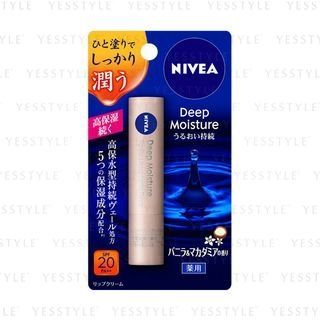
Nivea Japan Deep Moisture Lip Vanilla & Macadamia SPF 20 PA++
Works for
1 of 2 advertised claims delivered
Sun protectionSPF 20 · 2 UV filters · Broad spectrumWeak protectionSPF under 30
This product offers broad spectrum sun protection, but it is weak. We recommend to use a broad spectrum sunscreen with at least SPF 30.
Moisturizing8 ingredients credited for this claimStrong support
“It’s formulated with honey, royal jelly extract and olive oil to deliver moisture and prevent rough and cracked lips.”
This product can help soften the skin and reduce its moisture loss with emollients and occlusives: petrolatum, diisostearyl malate.
Keep in mind that this product does not contain effective ingredients to attract water to the upper layer of the skin. This is why an additional product with humectants like glycerin or hyaluronic acid can be helpful (apply it before this product for the best results).
The following ingredients in this product are especially good for supporting the skin barrier and helping with the hydration level: petrolatum
Can it cause trouble?
Irritancy1 strong irritant: AlcoholMedium risk
Comedogenic1 ingredient rated 2 or more on the 0–5 pore-clogging scale1 flagged


User reviews
Be the first — your take helps the next person decide.
Ingredients
Filter by role to see what each ingredient is doing.
Tocopheryl acetate~26–39%
- Irritation risk
- Medium
A more stable but less bio-available form of vitamin E compared to Tocopherol. Might help moisturize and protect the skin from free radicals, but mostly used in low concentrations to stabilize other ingredients.
More about Tocopheryl acetateStearyl glycyrrhetinate~6.5–9.8%
- Irritation risk
- Medium
A fatty acid derived from licorice. Works as an emollient and can help calm down inflammation
More about Stearyl glycyrrhetinateOlea europaea fruit oil~4.7–7.1%
- Irritation risk
- Medium
An emollient that helps soften the skin but is not effective for restoring its barrier function. Might be helpful to calm down inflammation
More about Olea europaea fruit oilHydrogenated polybutene~3.4–5%
- Irritation risk
- Low
Petrolatum~2.7–4%
- Irritation risk
- Low
One of the most effective and the most studied occlusive ingredients that creates a protective layer on top of the skin preventing moisture loss
More about PetrolatumDiisostearyl malate~2.1–3.2%
- Irritation risk
- Medium
Helps to soften the upper layer of the skin
More about Diisostearyl malateCeresin~1.6–2.4%
Phytosteryl/behenyl/octyldodecyl lauroyl glutamate~1.4–2.2%
- Irritation risk
- Low
Dipentaerythrityl hexahydroxystearate~1.2–1.8%
Phytosteryl isostearyl dimer dilinoleate~1.1–1.6%
- Irritation risk
- Low
Ethylhexyl methoxycinnamate~1.1–1.7%
- Irritation risk
- High
Octinoxate. When used in higher concentrations, works as a sunscreen protecting the skin from UVB rays. When used in lower concentration, helps to preserve the product formulation. Is shown to be harmful to coral reefs - consider avoiding bathing in coral reef areas when wearing a product with this ingredient. It can be irritating
More about Ethylhexyl methoxycinnamatePolyethylene~0.9–1.35%
Honey~0.5–1.2%
- Irritation risk
- Low
Helps attract water to the skin and might have some anti-bacterial properties. Can be an allergen
More about HoneyRoyal jelly extract~0.45–1.05%
- Irritation risk
- Medium
A compound secreted by bees. Might be able to attract water to the top layer of the skin. Avoid if sensitive to honey and bee products
More about Royal jelly extractMicrocrystalline wax~0.4–1%
Polyglyceryl-3 diisostearate~0.35–0.85%
- Irritation risk
- Medium
- Comedogenicity
- 3/5
Helps oil and water mix together
More about Polyglyceryl-3 diisostearateButyl methoxydibenzoylmethane~0.4–1%
- Irritation risk
- Medium
Avobenzone. An organic, or so-called "chemical" UV filter. Protects against both UVA and UVB rays. Needs to be combined with other filters in a formulation to be stable.
More about Butyl methoxydibenzoylmethaneBht~0.15–0.55%
Water~0.15–0.55%
Tocopherol~0.1–0.5%
- Irritation risk
- Low
Pure form of vitamin E. Can help moisturise and protect the skin from free radicals. Often used to help stabilise other ingredients or the formula itself
More about TocopherolAlcohol~0.1–0.4%
- Irritation risk
- High
Can be drying and contribute to skin irritation. Used in formulars to dissolve other ingredients, create a thinner product consistency or for its antibacterial properties
More about AlcoholCi 19140~0.1–0.35%
Ci 19140~0.05–0.3%
Ingredient list view
Tocopheryl acetate, Stearyl glycyrrhetinate, Olea europaea fruit oil, Hydrogenated polybutene, Petrolatum, Diisostearyl malate, Ceresin, Unknown, Phytosteryl/behenyl/octyldodecyl lauroyl glutamate, Dipentaerythrityl hexahydroxystearate, Phytosteryl isostearyl dimer dilinoleate, Ethylhexyl methoxycinnamate, Polyethylene, Honey, Royal jelly extract, Microcrystalline wax, Polyglyceryl-3 diisostearate, Butyl methoxydibenzoylmethane, Bht, Water, Tocopherol, Alcohol, Ci 19140, Ci 19140
Compare prices
Retailers ranked by price — lowest first.

Affiliate links · prices updated regularly
Worth comparing, line by line.
Match % combines shared ingredients, the first five ingredients, shared actives and hero ingredients, irritancy (lower counts in the alternative's favour), texture and body area. Only products in the same routine step are compared.
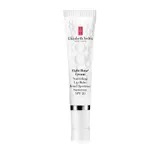
| Nivea JapanDeep Moisture Lip Vanilla & Macadamia SPF 20 PA++YOUR PRODUCT | Elizabeth ArdenEight Hour Cream Nourishing Lip Balm SPF 20 | Rohto MentholatumMelty Cream Lip Balm SPF 25 PA+++ - 4 Types | MUJILip Cream SPF 20 - 2 Types | |
|---|---|---|---|---|
| Match | — | 56% | 53% | 52% |
| Price | $6.75 | $19.61+$12.86 | $6.12−$0.63 | $7.40+$0.65 |
| Shared key ingredients | — | 3 of 4 | 3 of 4 | 2 of 4 |
| Key difference | — | Retinyl Palmitate | Mineral Oil | Lanolin |
| Irritancy | Medium | Medium | Medium | Low |
| SPF | SPF 20 | SPF 20 | SPF 25 | SPF 20 |
| Drying alcohol | Contains drying alcohol | — | — | — |
| View product | Shop | Shop | Shop |

Sources cited in this review
Every concentration estimate and effectiveness label is anchored to one of these 4 studies and safety reviews.
- 1Use of “natural” oils for moisturization: Review of olive, coconut, and sunflower seed oilonlinelibrary.wiley.com
- 2Vitamin E in dermatologyncbi.nlm.nih.gov
- 3Vitamin E and Skin Healthlpi.oregonstate.edu
- 4

Affiliate links · As an Amazon Associate, WIMJ earns from qualifying purchases.