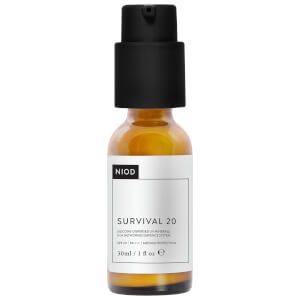
NIOD Survival 20 Serum
Works for
1 of 3 advertised claims delivered
Sun protectionSPF 20 · 2 UV filters · Broad spectrumWeak protectionSPF under 30
This product offers broad spectrum sun protection, but it is weak. We recommend to use a broad spectrum sunscreen with at least SPF 30.
This product can be considered "reef safe" because it does not contain the UV filters (oxybenzone and octinoxate) that can be harmful to coral reefs when present in the water in high concentrations.
Anti-aging4 ingredients credited for this claimModerate support
“Purified Lutein (an antioxidant ingredient extracted from Marigold Flower to help counteract the effects of blue light while enhancing elasticity), and Yeast-Derived Superoxide Dismutase for protection against oxidation.”
This product contains aspartic acid, serine, threonine. These ingredients might be able to help reduce and prevent fine lines and wrinkles, improve skin elasticity and firmness, but there is not enough evidence that it actually works. The biggest anti-aging effect in this product comes from sun protection. Sun damage is the main factor causing early signs of skin aging. We, however, do not recommend using this product as a sunscreen because the protection it offers is not strong enough).
Evens skin tone2 ingredients credited for this claimLimited support
“Designed for medium and darker skin tones (III, IV and V within the Fitzpatrick skin tone scale) and when UV index is low or moderate (under 5).”
This product contains ingredients (alanine, pinus pinaster bark extract) that could help reduce hyperpigmentation (for example, post-acne marks or age spots) in theory, but there is not enough evidence that they actually work.
The biggest effect for evening out skin tone in this product comes from sun protection. Sun damage is the main factor causing age spots, darkening of post-acne marks and other discolorations. This is why sun protection is the best strategy for maintaining an even skin tone. We, however, do not recommend using this product as a sunscreen because the protection it offers is not strong enough).
Anti-oxidationNot advertised by the brand · 6 ingredients credited for this claimStrong support
This product contains antioxidants (dimethylmethoxy chromanol, polygonum aviculare extract, superoxide dismutase) that can help neutralize free radicals in skin. By doing so, they can lessen the damage the skin gets from the UV light (sun).
The following ingredients - pinus pinaster bark extract also can have an antioxidant effect, but there is less evidence to confirm their effectiveness in skin.
MoisturizingNot advertised by the brand · 29 ingredients credited for this claimGood support
This product can help improve hydration of the skin with the two types of ingredients.
The first type is called “humectants”:
these ingredients help attract water.
When humectants are on the surface of the skin, they “pull in” the moisture from the outside environment, or from
within deeper layers of the skin. The following ingredients in this product do the job:
alanine, arginine.
This product also contains ingredients called “occlusives”. They help reduce the speed with which our skin loses moisture to the outside environment. These ingredients also help soften the upper layer of the skin, so it feels less tight and nicer to the touch. The following ingredients in this product do the job: arginine, peg-10 dimethicone.
Can it cause trouble?
Irritancy17 flagged ingredientsMedium risk
Comedogenic1 ingredient rated 2 or more on the 0–5 pore-clogging scale1 flagged

User reviews
Be the first — your take helps the next person decide.
Ingredients
Filter by role to see what each ingredient is doing.
Cyclopentasiloxane~26–32%
- Irritation risk
- Low
A silicone that helps improve the product texture and spreadability. Can absorb oil creating a short-term mattifying effect on the skin
More about CyclopentasiloxaneWater~12–15%
Zinc oxide~5.5–6.8%
- Irritation risk
- Low
A broad spectrum sunblock (protects from both UVA and UVB rays). Is suitable for most sensitive skins. In small concentrations, can be used as a colorant
More about Zinc oxideTitanium dioxide~4.3–5.3%
- Irritation risk
- Low
Works as a UV filter when used in high concentrations. It is photostable and is effective mostly against the UVB light, with some protection in the UVA range. In small concentrations, used for its ability to improve the color of cosmetic products. Is usually well tolerated by the skin
More about Titanium dioxideGlycerin~3.1–3.7%
- Irritation risk
- Low
One of the best moisturizing ingredients. Naturally present in skin. It attracts water to the upper layer of the skin working as a humectant
More about GlycerinPeg-10 dimethicone~2.6–3.1%
- Irritation risk
- Low
A silicone that works to soften the upper layer of the skin and reduce its water loss
More about Peg-10 dimethiconePeg-9 polydimethylsiloxyethyl dimethicone~1.9–2.3%
- Irritation risk
- Medium
A type of silicone that helps water and oil mix together
More about Peg-9 polydimethylsiloxyethyl dimethiconePropanediol~1.5–1.9%
- Irritation risk
- Low
Acts as a solvent for other ingredients. Speeds up the absorption of other ingredients into the skin
More about PropanediolAcrylates/ethylhexyl acrylate crosspolymer~1.5–1.8%
- Irritation risk
- Low
Dimethicone/peg-10/15 crosspolymer~1.4–1.8%
Hexyl laurate~1.1–1.3%
- Irritation risk
- Medium
Helps soften the upper layer of the skin and create a nice product consistency
More about Hexyl lauratePolyglyceryl-4 isostearate~0.95–1.2%
- Irritation risk
- Medium
Helps water and oil mix together
More about Polyglyceryl-4 isostearateDimethylmethoxy chromanol~0.9–1.1%
- Irritation risk
- Low
Can help neutralize free radicals in skin
More about Dimethylmethoxy chromanolInulin~0.75–1.15%
- Irritation risk
- Low
Helps attract water to the upper layer of the skin. Is claimed to support the growth of "good" bacteria in skin (as a "prebiotic"), but the research is lacking
More about InulinAlpha-glucan oligosaccharide~0.8–1.15%
- Irritation risk
- Low
Helps attract water to the upper layer of the skin
More about Alpha-glucan oligosaccharideSolanum lycopersicum fruit extract~0.75–1.15%
- Irritation risk
- Low
Superoxide dismutase~0.7–1.05%
- Irritation risk
- Low
An antioxidant enzyme that is naturally present in skin. It can help support skin barrier function and reduce inflammation in skin. It is used in topical medications for inflammatory skin conditions including atopic dermatitis (eczema) and psoriasis. There are three types of natural Superoxide Dismutase in human skin. The compound used in topical treatments and cosmetics are mimics of typically one of these natural variants
More about Superoxide dismutaseXanthophylls~0.7–1%
Pinus pinaster bark extract~0.65–1%
- Irritation risk
- Medium
A plant extract that might help neutralize free radicals and reduce hyperpigmentation, but evidence of effectiveness of topical application is lacking. It can be an INCI name for the trademarked ingredient Pycnogenol (but could also be a different type of this plant's bark extract)
More about Pinus pinaster bark extractPolygonum aviculare extract~0.7–1%
- Irritation risk
- Medium
A plant extract that contains a flavanol Juglanin. It can help neutralize free radicals in skin and reduce inflammation
More about Polygonum aviculare extractAlteromonas ferment extract~0.6–0.9%
- Irritation risk
- Low
A marine extract that helps attract water to the upper layer of the skin. It is claimed to have anti-inflammatory properties but research is lacking
More about Alteromonas ferment extractPadina pavonica thallus extract~0.6–0.9%
- Irritation risk
- Low
- Comedogenicity
- 3/5
Might help to soften the upper layer of the skin. Is claimed to have anti-oxidant properties, but evidence in missing
More about Padina pavonica thallus extractArginine~0.55–0.85%
- Irritation risk
- Low
An amino acid that is naturally present in skin and helps keep it hydrated. When used together with AHAs, it can reduce their irritating effect on the skin
More about ArginineGlycine~0.6–0.85%
- Irritation risk
- Low
Helps to attract water to the upper layer of the skin and can help restore the skin barrier function
More about GlycineAlanine~0.6–0.85%
- Irritation risk
- Low
An amino-acid that helps to attract water to the upper layer of the skin and might help to lighten the skin, but solid evidence is lacking
More about AlanineSerine~0.6–0.85%
- Irritation risk
- Low
An amino-acid that helps to attract water to the upper layer of the skin. In combination with other amino-acids, might help to reduce fine lines and wrinkles
More about SerineValine~0.6–0.85%
- Irritation risk
- Low
Proline~0.6–0.9%
Threonine~0.6–0.9%
- Irritation risk
- Low
An amino-acid that helps to attract water to the upper layer of the skin. In combination with other amino-acids, might help to reduce fine lines and wrinkles
More about ThreonineIsoleucine~0.6–0.9%
- Irritation risk
- Low
An amino acid that can help attract water to the upper layer of the skin and support skin's barrier function
More about IsoleucineHistidine~0.55–0.85%
Phenylalanine~0.6–0.9%
- Irritation risk
- Low
Aspartic acid~0.55–0.85%
- Irritation risk
- Low
An amino-acid that helps increase skin hydration and might help to slightly improve skin firmness, potentially reducing lines and wrinkles
More about Aspartic acidPca~0.6–0.9%
- Irritation risk
- Low
Naturally present in skin and helps to attract water to its upper layer
More about PcaSodium pca~0.6–0.9%
- Irritation risk
- Low
Naturally present in skin and helps to attract water to its upper layer
More about Sodium pcaSodium lactate~0.6–0.9%
- Irritation risk
- Medium
Helps attract water to the upper layer of the skin. Is often used to adjust the pH level of the product
More about Sodium lactateSqualane~0.65–0.95%
- Irritation risk
- Low
An oil naturally present in skin. Works as an emollient to soften the skin and form a protective layer on its surface without a greasy feeling.
More about SqualaneSimmondsia chinensis seed oil~0.65–0.95%
- Irritation risk
- Medium
Softens the upper layer of skin and helps restore the healthy skin barrier. Has shown to help calm down inflammation in skin. It is a stable oil, meaning that it retains its properties even when exposed to air.
More about Simmondsia chinensis seed oilTocopherol~0.6–0.85%
- Irritation risk
- Low
Pure form of vitamin E. Can help moisturise and protect the skin from free radicals. Often used to help stabilise other ingredients or the formula itself
More about TocopherolMelanin~0.6–0.85%
- Irritation risk
- Low
Sucrose~0.55–0.8%
- Irritation risk
- Low
Can help attract water to the upper layer of the skin. In crystal form, it can work as a gentle exfoliant, gentler than the salt scrub. Helps stabilize the emulsion
More about SucroseTapioca starch~0.5–0.8%
Stearic acid~0.55–0.8%
- Irritation risk
- Low
Helps oil and water mix together and works as an emollient
More about Stearic acidTrimethylsiloxysilicate~0.5–0.7%
- Irritation risk
- Low
A type of silicone that helps create a nice product consistency and support the delivery of other ingredients
More about TrimethylsiloxysilicatePentylene glycol~0.5–0.75%
- Irritation risk
- Medium
Used to preserve products, dissolve other ingredients and create a nice product texture
More about Pentylene glycolButylene glycol~0.4–0.65%
- Irritation risk
- Low
Used to create a nice product texture and help delivery of other ingredients. Might be somewhat helpful in attracting water to the upper layer of the skin
More about Butylene glycolTrisodium ethylenediamine disuccinate~0.4–0.6%
- Irritation risk
- Medium
Used to improve stability of the formulation
More about Trisodium ethylenediamine disuccinateSodium chloride~0.4–0.6%
- Irritation risk
- Low
Used to stabilize mixtures of oil and water, and create thicker, gel-like product textures
More about Sodium chlorideDipropylene glycol~0.3–0.55%
- Irritation risk
- Low
Helps to dissolve other ingredients in a formulation. Slows down the rate of product drying
More about Dipropylene glycolTromethamine~0.3–0.6%
Ethoxydiglycol~0.25–0.45%
Alumina~0.45–0.7%
- Irritation risk
- Low
The same compound that is used safely in dental implants and bone cements. In cosmetics, it is used to improve the consistency of products
More about AluminaPotassium sorbate~0.2–0.35%
Sodium benzoate~0.15–0.25%
1,2-hexanediol~0.2–0.35%
Ethylhexylglycerin~0.15–0.3%
Phenoxyethanol~0.15–0.3%
- Irritation risk
- Low
A preservative. It helps prevent bacterial growth in cosmetic products
More about PhenoxyethanolCaprylyl glycol~0.2–0.35%
- Irritation risk
- Medium
Helps preserve products and creates a nice product texture
More about Caprylyl glycolIngredient list view
Cyclopentasiloxane, Water, Zinc oxide, Titanium dioxide, Glycerin, Peg-10 dimethicone, Peg-9 polydimethylsiloxyethyl dimethicone, Propanediol, Acrylates/ethylhexyl acrylate crosspolymer, Dimethicone/peg-10/15 crosspolymer, Hexyl laurate, Polyglyceryl-4 isostearate, Dimethylmethoxy chromanol, Inulin, Alpha-glucan oligosaccharide, Solanum lycopersicum fruit extract, Superoxide dismutase, Xanthophylls, Pinus pinaster bark extract, Polygonum aviculare extract, Alteromonas ferment extract, Padina pavonica thallus extract, Arginine, Glycine, Alanine, Serine, Valine, Proline, Threonine, Isoleucine, Histidine, Phenylalanine, Aspartic acid, Pca, Sodium pca, Sodium lactate, Squalane, Simmondsia chinensis seed oil, Tocopherol, Melanin, Sucrose, Tapioca starch, Stearic acid, Trimethylsiloxysilicate, Pentylene glycol, Butylene glycol, Trisodium ethylenediamine disuccinate, Sodium chloride, Dipropylene glycol, Tromethamine, Ethoxydiglycol, Alumina, Potassium sorbate, Sodium benzoate, 1,2-hexanediol, Ethylhexylglycerin, Phenoxyethanol, Caprylyl glycol
Compare prices
Retailers ranked by price — lowest first.

.png)

Worth comparing, line by line.
Match % combines shared ingredients, the first five ingredients, shared actives and hero ingredients, irritancy (lower counts in the alternative's favour), texture and body area. Only products in the same routine step are compared.
| NIODSurvival 20 SerumYOUR PRODUCT | ROSE INCMini Solar Power Luminous SPF 30 Serum | MaeloveSun Protector SPF 30 | DermaquestYouth Protection SPF 30 | |
|---|---|---|---|---|
| Match | — | 54% | 52% | 51% |
| Price | $24.00 | $18.00−$6.00 | $24.95+$0.95 | $41.40+$17.40 |
| Shared key ingredients | — | 5 of 27 | 6 of 27 | 8 of 27 |
| Key difference | — | Bisabolol | Vitamin C | Acetyl Hexapeptide-30 |
| Irritancy | Medium | Low | Low | Medium |
| SPF | SPF 20 | SPF 30 | SPF 30 | SPF 30 |
| Drying alcohol | — | — | — | — |
| View product | Shop | Shop | Shop |


Product summary
"NIOD - Survival 20 Serum" "is a broad spectrum sunscreen meaning that it protects both from UVB rays (" burning "- they cause sunburn) and UVA rays (" aging "- they don't cause sunburn but lead to premature aging and pigmentation issues). However, it does not offer enough sun protection. We recommend to use a sunscreen with at least SPF 30 daily.
It contains good moisturizing ingredients and can double as a hydrating day cream.
Sunscreen filters
This product is a mineral sunscreen. It uses titanium dioxide and zinc oxide for sun protection. Both titanium dioxide and zinc oxide almost never irritate even the most sensitive skin and eyes, but can leave a white cast.
Irritation risk
This product does not contain known common irritants and is suitable for sensitive skin. We assess the overall irritancy of this product to be medium. For a detailed overview of all potential irritants: click here
You can see the detailed formula review with the breakdown of all actives in the product and the full ingredient list with estimated concentrations in the tables below.
Price
The product retails from 24.00$ up to 26.50$ in the United States, from 19.20£ up to 26.00£ in the United Kingdom and for 33.60CA$ in Canada.
For a detailed price comparison: click here.
Sources cited in this review
Every concentration estimate and effectiveness label is anchored to one of these 31 studies and safety reviews.
- 1A review of inorganic UV filters zinc oxide and titanium dioxideonlinelibrary.wiley.com
- 2
- 3
- 4
- 5
- 6

Affiliate links · As an Amazon Associate, WIMJ earns from qualifying purchases.