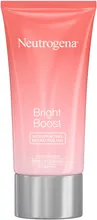
Neutrogena Bright Boost Resurfacing Micro Polish
Works for
CleansingCetyl alcohol, Polysorbate 60 + 3 moreCleanses gently
“Cleanses away dirt, oil, grime, impurities, and bacteria”
This product works by removing dirt and oil from the surface of the skin. It uses a combination of mild cleansing agents (cetyl alcohol, polysorbate 60, potassium cetyl phosphate, steareth-21, xanthan gum) and should be able to cleanse the skin gently. Still keep in mind that any cleansing can disrupt the skin barrier, and most people do not need to cleanse their skin more than once per day.
ExfoliationMandelic acid, Glycolic acidWorks well
“Our best face polish exfoliates skin and removes skin aging dullness with 3x the polishing power of a normal scrub.”
This product can help exfoliate the skin. In other words, it helps break down the bonds between dead cells on the surface of the skin and speed up the skin turnover. Skin often appears softer and brighter after exfoliation, but overdoing it can result in disrupted skin barrier. The following ingredient is doing the exfoliating job in this product: glycolic acid, mandelic acid.
Can it cause trouble?
Irritancy3 strong irritants: Parfum, Citronellol + 1 more — patch-test recommendedHigh risk
ComedogenicClean of flagged comedogenic ingredientsNone flagged

User reviews
Be the first — your take helps the next person decide.
Ingredients
Filter by role to see what each ingredient is doing.
Water~40–60%
Cetyl alcohol~5.2–7.9%
- Irritation risk
- Low
A non-drying alcohol that works to soften the skin and stabilize product formulations helping oil and water mix together
More about Cetyl alcoholCellulose~3.9–5.8%
- Irritation risk
- Low
Can be used to help absorb oil as well as add volume and imporve texture of products.
More about CellulosePpg-15 stearyl ether~2.8–4.2%
- Irritation risk
- Low
Help soften the upper layer of the skin and create a nice product consistency
More about Ppg-15 stearyl etherGlycerin~2.1–3.1%
- Irritation risk
- Low
One of the best moisturizing ingredients. Naturally present in skin. It attracts water to the upper layer of the skin working as a humectant
More about GlycerinMandelic acid~1.6–2.4%
- Irritation risk
- High
Helps shed the upper layer of dead cells from the surface of the skin revealing smoother, brighter skin. It can help to reduce hyperpigmentation. It has anti-bacterial properties, and might help to reduce blemishes, as well as fine lines and wrinkles. It is considered to be gentler than glycolic acid
More about Mandelic acidGlycolic acid~1.4–2%
- Irritation risk
- High
An alpha-hydroxy acid (AHA) that helps to remove the dead skin cells on the surface of the skin reveling a more even, smoother complexation. It is also able to stimulate collagen production with long-term use. Could help to reduce pore congestion. It can be irritating to the skin. Apply sunscreen daily if using products with glycolic acid
More about Glycolic acidPolysorbate 60~1.2–1.8%
Steareth-21~1.1–1.6%
Sodium hydroxide~0.6–1.4%
Potassium cetyl phosphate~0.5–1.15%
- Irritation risk
- Medium
Helps oil and water mix together
More about Potassium cetyl phosphatePhenoxyethanol~0.35–0.85%
- Irritation risk
- Low
A preservative. It helps prevent bacterial growth in cosmetic products
More about PhenoxyethanolCaprylyl glycol~0.4–0.9%
- Irritation risk
- Medium
Helps preserve products and creates a nice product texture
More about Caprylyl glycolParfum~0.15–0.65%
- Irritation risk
- High
An aromatic blend of unspecified and possibly irritating ingredients
More about ParfumXanthan gum~0.15–0.55%
- Irritation risk
- Low
Used to create a thicker product consistency
More about Xanthan gumTocopheryl acetate~0.1–0.45%
- Irritation risk
- Medium
A more stable but less bio-available form of vitamin E compared to Tocopherol. Might help moisturize and protect the skin from free radicals, but mostly used in low concentrations to stabilize other ingredients.
More about Tocopheryl acetateDisodium edta~0.05–0.25%
Citronellol~0.05–0.15%
Benzyl salicylate~0.05–0.15%
Ingredient list view
Water, Cetyl alcohol, Cellulose, Ppg-15 stearyl ether, Glycerin, Mandelic acid, Glycolic acid, Polysorbate 60, Steareth-21, Sodium hydroxide, Potassium cetyl phosphate, Phenoxyethanol, Caprylyl glycol, Parfum, Xanthan gum, Tocopheryl acetate, Disodium edta, Citronellol, Benzyl salicylate
Compare prices
Retailers ranked by price — lowest first.
Affiliate links · As an Amazon Associate, WIMJ earns from qualifying purchases.
Worth comparing, line by line.
Match % combines shared ingredients, the first five ingredients, shared actives and hero ingredients, irritancy (lower counts in the alternative's favour), texture and body area. Only products in the same routine step are compared.
| NeutrogenaBright Boost Resurfacing Micro PolishYOUR PRODUCT | UriageHyséac 3-Régul Global Skin Care + Cleansing Gel | NassifMD DermaceuticalsSkin Perfecting Dual Action Face & Body Scrub with 10% Glycolic Acid | FilorgaAge-Purify Clean Smoothing Purifying Cleansing Gel | |
|---|---|---|---|---|
| Match | — | 57% | 56% | 54% |
| Price | $29.99 | $21.81−$8.18 | — | $36.82+$6.83 |
| Shared key ingredients | — | 6 of 8 | 4 of 8 | 4 of 8 |
| Key difference | — | Salicylic Acid | 3-O-Ethyl Ascorbic Acid | Azelaic Acid |
| Irritancy | High | Medium | Medium | Medium |
| Drying alcohol | — | — | — | — |
| View product | Shop | Shop | Shop |


More alternatives: Purifide Blackhead Control 2% SA Deep Exfoliating CleanserAcnecide Purifide Ph Control Face Wash
Sources cited in this review
Every concentration estimate and effectiveness label is anchored to one of these 7 studies and safety reviews.
- 1
- 2
- 3
- 4
- 5
- 6Glycolic acid peel therapy – a current reviewncbi.nlm.nih.gov

Affiliate links · As an Amazon Associate, WIMJ earns from qualifying purchases.