Works for:
based on ingredients and %- Exfoliation
- Cleansing
Can it cause trouble?
- Irritation risk: medium
- Comedogenic risk ingredients: 2
Key actives
Product Summary
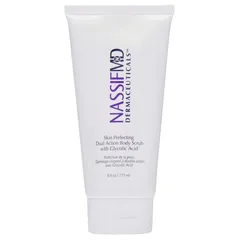
"NassifMD Dermaceuticals - Skin Perfecting Dual Action Face & Body Scrub with 10% Glycolic Acid" is effective for: Anti-aging, Exfoliation and Evens skin tone
This product could be helpful for: Moisturizing, but its actives are not the most effective or are not well-studied.
Ingredient callouts
- Exfoliating acids (glycolic acid 5.90% - 7.20%). In this concentration, they will have a noticeable exfoliating effect. They can also have an anti-aging effect and stimulate collagen production in a long-run.
- Humectants (glycerin 1.50% - 1.80%). These ingredients help attract water to the upper layer of the skin and improve the skin hydration.
Price
The product retails for 46.00$ in the United States.
For a detailed price comparison: click here.
Works for
Cleansing
What does the product description say?
The creamy, lightly foaming cleanser with sustainable exfoliating particles:
Source: Nassif MD
This product works by removing dirt and oil from the surface of the skin. It uses a combination of mild cleansing agents (ceteth-16, cetyl alcohol, glyceryl stearate, laneth-16, laureth-7, oleth-16, peg-2 stearate se, steareth-16, xanthan gum) and should be able to cleanse the skin gently. Still keep in mind that any cleansing can disrupt the skin barrier, and most people do not need to cleanse their skin more than once per day.
Used to create a thicker product consistency
A non-drying alcohol that works to soften the skin and stabilize product formulations helping oil and water mix together
An emollient that softens the skin and forms a protective layer on its surface. Helps water and oil mix together
Helps oil and water mix together
Exfoliation
What does the product description say?
Helps exfoliate and remove dead surface skin cells, to reveal fresh skin cells
Source: Nassif MD
This product can help exfoliate the skin. In other words, it helps break down the bonds between dead cells on the surface of the skin and speed up the skin turnover. Skin often appears softer and brighter after exfoliation, but overdoing it can result in disrupted skin barrier. The following ingredient is doing the exfoliating job in this product: glycolic acid.
An alpha-hydroxy acid (AHA) that helps to remove the dead skin cells on the surface of the skin reveling a more even, smoother complexation. It is also able to stimulate collagen production with long-term use. Could help to reduce pore congestion. It can be irritating to the skin. Apply sunscreen daily if using products with glycolic acid
How honest is this product?
| Promise | Can it deliver? |
|---|---|
| Cleansing | |
| Exfoliation |
Total Promises Fulfilled score: 100/100.
Potential irritants
Comedogenic ingredients
User reviews (0)
Averages from community submissions.
No reviews yet for this product.
Be the first to share your experience!
Tried this product?
Help capture what the ingredient list can't—texture, finish, pilling, scent, and more. Answer what you can, skip the rest.
Takes ~30 seconds.
Reviews are shown in aggregate. No personal details.
Key Actives
An alpha-hydroxy acid (AHA) that helps to remove the dead skin cells on the surface of the skin reveling a more even, smoother complexation. It is also able to stimulate collagen production with long-term use. Could help to reduce pore congestion. It can be irritating to the skin. Apply sunscreen daily if using products with glycolic acid
Pure form of vitamin E. Can help moisturise and protect the skin from free radicals. Often used to help stabilise other ingredients or the formula itself
A vitamin C derivative that is more stable but less potent than pure form of vitamin C. Can help neutralize free radicals and help reduce hyperpigmentation, but the required concentration is likely to be much higher than for the pure form of vitamin C, limiting the ingredient's effectiveness in products
A non-drying alcohol that works to soften the skin and stabilize product formulations helping oil and water mix together
An emollient that softens the skin and forms a protective layer on its surface. Helps water and oil mix together
A good mix of fatty acids that forms a protective layer on the skin. Improves the shelf life of products. Derived from coconut and glycerin
One of the best moisturizing ingredients. Naturally present in skin. It attracts water to the upper layer of the skin working as a humectant
A type of silicone that can decrease loss of moisture from the skin surface. It helps create a nice product texture
Used to create a thicker product consistency
Softens the upper layer of the skin and can support skin barrier function
Potential irritants
An alpha-hydroxy acid (AHA) that helps to remove the dead skin cells on the surface of the skin reveling a more even, smoother complexation. It is also able to stimulate collagen production with long-term use. Could help to reduce pore congestion. It can be irritating to the skin. Apply sunscreen daily if using products with glycolic acid
An aromatic blend of unspecified and possibly irritating ingredients
A vitamin C derivative that is more stable but less potent than pure form of vitamin C. Can help neutralize free radicals and help reduce hyperpigmentation, but the required concentration is likely to be much higher than for the pure form of vitamin C, limiting the ingredient's effectiveness in products
Used to stabilize formulations and increase water resistance of sunscreen ingredients. In cosmetics, the polymer form of this compound is used. The polymer's molecules cannot penetrate the skin making the compound safe for use in skin care as long as the monomer residue (which, unlike polyacrylamide, is toxic) in the final product is below 0.2%. It can be irritating for skin
Helps soften the upper layer of the skin and create a thicker product consistency
A good mix of fatty acids that forms a protective layer on the skin. Improves the shelf life of products. Derived from coconut and glycerin
Used to improve product texture and help oil and water mix together
Comedogenic ingredients
Helps soften the upper layer of the skin and create a thicker product consistency
An oil from a mixture of different vegetables. Helps soften the upper layer of the skin
All ingredients
An alpha-hydroxy acid (AHA) that helps to remove the dead skin cells on the surface of the skin reveling a more even, smoother complexation. It is also able to stimulate collagen production with long-term use. Could help to reduce pore congestion. It can be irritating to the skin. Apply sunscreen daily if using products with glycolic acid
Helps soften the upper layer of the skin and create a thicker product consistency
A non-drying alcohol that works to soften the skin and stabilize product formulations helping oil and water mix together
A good mix of fatty acids that forms a protective layer on the skin. Improves the shelf life of products. Derived from coconut and glycerin
An oil from a mixture of different vegetables. Helps soften the upper layer of the skin
One of the best moisturizing ingredients. Naturally present in skin. It attracts water to the upper layer of the skin working as a humectant
Used to improve product texture and help oil and water mix together
An emollient that softens the skin and forms a protective layer on its surface. Helps water and oil mix together
A type of silicone that can decrease loss of moisture from the skin surface. It helps create a nice product texture
Helps soften the upper layer of the skin, dissolve other ingredients and create a thicker product consistency
An oil from a mixture of different vegetables. Helps soften the upper layer of the skin
A preservative. It helps prevent bacterial growth in cosmetic products
Might be helpful in restoring skin barrier function and, when combined with zinc carbonate and malonic acid, reducing fine lines and wrinkles by stimulating elastin production. Also helps stabilize the product formulation
An aromatic blend of unspecified and possibly irritating ingredients
Softens the upper layer of the skin and can support skin barrier function
A vitamin C derivative that is more stable but less potent than pure form of vitamin C. Can help neutralize free radicals and help reduce hyperpigmentation, but the required concentration is likely to be much higher than for the pure form of vitamin C, limiting the ingredient's effectiveness in products
Pure form of vitamin E. Can help moisturise and protect the skin from free radicals. Often used to help stabilise other ingredients or the formula itself
Helps attract water to the upper layer of the skin and improves the product texture
Used to stabilize formulations and increase water resistance of sunscreen ingredients. In cosmetics, the polymer form of this compound is used. The polymer's molecules cannot penetrate the skin making the compound safe for use in skin care as long as the monomer residue (which, unlike polyacrylamide, is toxic) in the final product is below 0.2%. It can be irritating for skin
Ingredient list view
Water, Glycolic acid, Isopropyl palmitate, Cetyl alcohol, Caprylic/capric triglyceride, Phytelephas aequatorialis seed powder, Vegetable oil, Glycerin, Sodium hydroxide, Polyacrylamide, Glyceryl stearate, Peg-2 stearate se, Phenyl trimethicone, C13-14 isoparaffin, Laureth-7, Hydrogenated vegetable oil, Euphorbia cerifera wax, Phenoxyethanol, Magnesium aluminum silicate, Xanthan gum, Laneth-16, Ceteth-16, Oleth-16, Steareth-16, Parfum, Ectoin, 3-o-ethyl ascorbic acid, Tocopherol, Ethylhexylglycerin, Sorbitol, Dihydroxy methylchromone, Acrylamide, Linalool, Ci 19140, Ci 42090
- Photoprotective and antiinflammatory effects of topical glycolic acid
- Glycolic acid peel therapy – a current review
- Dual Effects of Alpha-Hydroxy Acids on the Skin
- Final Report on the Safety Assessment of Isopropyl Isostearate
- Glycerol and the skin: holistic approach to its origin and functions
- Safety Assessment of Isoparaffins as Used in Cosmetics
- Final report on the safety assessment of aluminum silicate, calcium silicate, magnesium aluminum silicate, magnesium silicate, magnesium trisilicate, sodium magnesium silicate, zirconium silicate, attapulgite, bentonite, Fuller's earth, hectorite, kaolin, lithium magnesium silicate, lithium magnesium sodium silicate, montmorillonite, pyrophyllite, and zeolite
- Extracellular matrix in cutaneous ageing: the effects of 0.1% copper-zinc malonate-containing cream on elastin biosynthesis
- Antioxidant Ability and Stability Studies of 3-O-Ethyl Ascorbic Acid, a Cosmetic Tyrosinase Inhibitor
- Vitamin E in dermatology
- Vitamin E and Skin Health
- Amended final report on the safety assessment of polyacrylamide and acrylamide residues in cosmetics
- Analysis of Dyes in Cosmetics: Challenges and Recent Developments