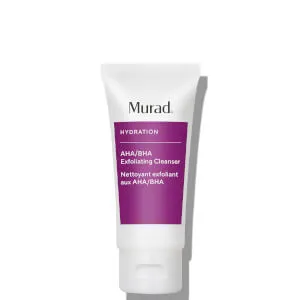
Murad Mini AHA/BHA Exfoliating Cleanser
Works for
ExfoliationGlycolic acid, Salicylic acid + 2 moreWorks well
“Mini AHA/BHA Exfoliating Cleanser”
This product can help exfoliate the skin. In other words, it helps break down the bonds between dead cells on the surface of the skin and speed up the skin turnover. Skin often appears softer and brighter after exfoliation, but overdoing it can result in disrupted skin barrier. The following ingredient is doing the exfoliating job in this product: glycolic acid, salicylic acid.
Anti-blemishSalicylic acid, Glycolic acid + 2 moreWorks well
“The acid complex features salicylic acid (a penetrating beta hydroxy acid that unclogs pores and controls excess sebum), lactic acid (a gentle AHA with moisturising properties) and glycolic acid (to melt the bonds between dead skin cells).”
This product can help reduce breakouts and clogged pores because it contains the following ingredient: salicylic acid. This ingredient is used for treating acne and can have a noticeable effect.
The following ingredient (ingredients) in this product might be helpful, but there is no evidence to confirm that it actually works: glycolic acid
CleansingSodium c14-16 olefin sulfonate, Cocamidopropyl betaine + 1 moreCleanses gently
“Mini AHA/BHA Exfoliating Cleanser”
This product works by removing dirt and oil from the surface of the skin. It uses a combination of mild cleansing agents (cocamidopropyl betaine, glycol stearate, sodium c14-16 olefin sulfonate) and should be able to cleanse the skin gently. Still keep in mind that any cleansing can disrupt the skin barrier, and most people do not need to cleanse their skin more than once per day.
Even though this formulation is mild, the following cleansing agents could trigger an irritation or allergy for some people: cocamidopropyl betaine, sodium c14-16 olefin sulfonate
Can it cause trouble?
Irritancy15 flagged ingredientsLow risk
ComedogenicClean of flagged comedogenic ingredientsNone flagged

User reviews
1 of 1 community members would buy it again.
I’ve searched all the Sephoras and shopping malls in Thailand and Kuala Lumpur to find this again in SEA. I miss it so much. It helped drastically reduce new spots within a day. And it helped me finally get rid of those last stubborn spotty areas. It was epic for acne but I probably would only use it once/max twice a week now. Gentle enough for sensitive skin, highly recommend.
Ingredients
Filter by role to see what each ingredient is doing.
Water~45–55%
Sodium c14-16 olefin sulfonate~9.9–12.1%
- Irritation risk
- High
Helps oil and water mix together and used as a cleansing agent. Can be irritating and is better avoided for sensitive skin
More about Sodium c14-16 olefin sulfonateJojoba esters~4.3–5.2%
- Irritation risk
- Medium
An emollient made of jojoba oil. Helps soften the skin and support its barrier function
More about Jojoba estersCocamidopropyl betaine~4.3–5.3%
- Irritation risk
- High
Helps water and oil mix together. Used as a cleansing ingredient. Could be an allergen
More about Cocamidopropyl betaineAcrylates copolymer~2.4–2.9%
- Irritation risk
- Medium
Used to stabilize product formulation, help create an even product layer over skin (for example, in sunscreen) and create a thicker product consistency
More about Acrylates copolymerGlycol stearate~1.9–2.4%
Propanediol~1.6–2%
- Irritation risk
- Low
Acts as a solvent for other ingredients. Speeds up the absorption of other ingredients into the skin
More about PropanediolGlycolic acid~1.4–1.7%
- Irritation risk
- High
An alpha-hydroxy acid (AHA) that helps to remove the dead skin cells on the surface of the skin reveling a more even, smoother complexation. It is also able to stimulate collagen production with long-term use. Could help to reduce pore congestion. It can be irritating to the skin. Apply sunscreen daily if using products with glycolic acid
More about Glycolic acidLactic acid~1.1–1.4%
- Irritation risk
- Medium
An exfoliating and moisturizing alpha-hydroxy acid (AHA). Typically causes less irritation than other AHAs, for example, glycolic acid. At high concentrations (about 15%), lactic acid can help reduce lines and wrinkles. Recent studies show that lactic acid can support the "good" bacteria living on skin's surface (healthy skin microbiome)
More about Lactic acidSalicylic acid~0.65–1%
- Irritation risk
- High
Used for skin exfoliation. It has an anti-inflammatory and anti-bacterial effect, helps to unclog pores, prevent blemishes and speed up healing of the existing ones. Sometimes referred to as a BHA (beta-hydroxy acid)
More about Salicylic acidDipotassium glycyrrhizate~0.6–0.9%
- Irritation risk
- Low
A salt derived from licorice. Works as an emollient to soften the upper layer of the skin and can help calm down inflammation. Might be helpful for skin lightening
More about Dipotassium glycyrrhizateSodium ascorbyl phosphate~0.5–0.7%
- Irritation risk
- Medium
A stable derivative of vitamin C. It is oil-soluble which means it is more likely to penetrate the skin compared to the pure form of vitamin C (which is water-soluble), but it is less bio-available and is way less effective in stimulating collagen and reducing wrinkles compared to the pure form of vitamin C (L-ascorbic acid) and its other derivatives (for example, magnesium ascorbyl phosphate). At the same time, this vitamin C derivative has been shown in studies to be effective in reducing acne, blemishes and clogged pores. It is less irritating then the pure form of vitamin C
More about Sodium ascorbyl phosphateSodium pca~0.3–0.6%
- Irritation risk
- Low
Naturally present in skin and helps to attract water to its upper layer
More about Sodium pcaUrea~0.3–0.55%
- Irritation risk
- Low
Naturally present in skin (urea makes up about 7% of natural moisturizing factors in skin). Attracts water to the upper layer of the skin. Also has a positive effect on the skin barrier beyond the humectant action. Can enhance penetration of other ingredients. Is an exfoliating ingredient when used in high concentrations
More about UreaYeast amino acids~0.25–0.5%
- Irritation risk
- Low
Trehalose~0.25–0.5%
- Irritation risk
- Low
A sugar that attracts water to the upper layer of the skin
More about TrehaloseInositol~0.3–0.5%
Taurine~0.25–0.5%
- Irritation risk
- Medium
Could be helpful in reducing inflammation in skin, evening out the skin tone and neutralizing free radicals, but more research is needed to confirm its effectiveness
More about TaurineBetaine~0.25–0.45%
- Irritation risk
- Low
Helps attract water to the upper layer of the skin and improves the product texture
More about BetaineCitric acid~0.25–0.4%
- Irritation risk
- Medium
Can work as an exfoliant but is typically used to adjust the product pH
More about Citric acidSodium hydroxide~0.2–0.35%
Polyquaternium-4~0.2–0.4%
- Irritation risk
- Low
Sodium chloride~0.2–0.4%
- Irritation risk
- Low
Used to stabilize mixtures of oil and water, and create thicker, gel-like product textures
More about Sodium chlorideTetrasodium glutamate diacetate~0.15–0.3%
- Irritation risk
- Low
Helps stabilize the product formulation
More about Tetrasodium glutamate diacetateTetrasodium edta~0.15–0.25%
Leuconostoc/radish root ferment filtrate~0.15–0.25%
- Irritation risk
- Medium
A preservative that comes from radishes fermented by a bacteria. New research suggests that the preservation properties in the ingredient come from an ammonium salt that is not present naturally in radish root but used in its cultivation. Is problematic because the exact amount of the preservative agents is difficult to determine
More about Leuconostoc/radish root ferment filtrateTocopherol~0.15–0.25%
- Irritation risk
- Low
Pure form of vitamin E. Can help moisturise and protect the skin from free radicals. Often used to help stabilise other ingredients or the formula itself
More about TocopherolEthylhexylglycerin~0.1–0.2%
Chlorphenesin~0.1–0.15%
Sodium benzoate~0.05–0.15%
Ingredient list view
Water, Sodium c14-16 olefin sulfonate, Jojoba esters, Cocamidopropyl betaine, Acrylates copolymer, Glycol stearate, Propanediol, Glycolic acid, Lactic acid, Salicylic acid, Dipotassium glycyrrhizate, Sodium ascorbyl phosphate, Sodium pca, Urea, Yeast amino acids, Trehalose, Inositol, Taurine, Betaine, Citric acid, Sodium hydroxide, Polyquaternium-4, Sodium chloride, Tetrasodium glutamate diacetate, Tetrasodium edta, Leuconostoc/radish root ferment filtrate, Tocopherol, Ethylhexylglycerin, Chlorphenesin, Sodium benzoate
Compare prices
Retailers ranked by price — lowest first.


Worth comparing, line by line.
Match % combines shared ingredients, the first five ingredients, shared actives and hero ingredients, irritancy (lower counts in the alternative's favour), texture and body area. Only products in the same routine step are compared.
| MuradMini AHA/BHA Exfoliating CleanserYOUR PRODUCT | CeraVeGel Moussant Anti-Imperfections | SkinCeuticalsClarifying Exfoliating Cleanser | NeutrogenaStubborn Texture Acne Cleanser for Textured Skin | |
|---|---|---|---|---|
| Match | — | 72% | 70% | 67% |
| Price | $19.00 | — | $36.00+$17.00 | $14.21−$4.79 |
| Shared key ingredients | — | 3 of 13 | 3 of 13 | 3 of 13 |
| Key difference | — | Niacinamide | Zinc Pca | Gluconolactone |
| Irritancy | Low | Low | Low | Low |
| Drying alcohol | — | — | — | — |
| View product | Shop | Shop | Shop |

More alternatives: Celeteque Acne Cleansing GelCommunity Sixty-Six Detoxifying AHA/BHA Gel Cleanser
Sources cited in this review
Every concentration estimate and effectiveness label is anchored to one of these 25 studies and safety reviews.
- 1Final Report On the Safety Assessment of Sodium Alpha-Olefin Sulfonatesjournals.sagepub.com
- 2
- 3
- 4
- 5Glycolic acid peel therapy – a current reviewncbi.nlm.nih.gov
- 6

Affiliate links · As an Amazon Associate, WIMJ earns from qualifying purchases.