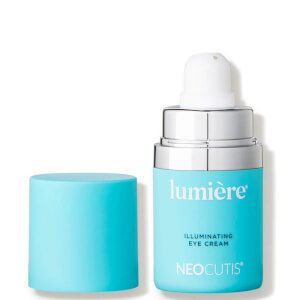
Neocutis Lumiere Bio-Restorative Eye Cream
Works for
2 of 2 advertised claims delivered
Anti-agingTocotrienols, Tocopherol + 3 moreModerate evidence
“This powerful combination energizes and nourishes to minimize signs of aging.”
This product contains tocotrienols. This ingredient might be able to help reduce and prevent fine lines and wrinkles, improve skin elasticity and firmness, but there is not enough evidence that it actually works.
MoisturizingSaccharide isomerate, Caprylic/capric triglyceride + 11 moreGood evidence
“Lumiere Bio-Restorative Eye Cream”
This product can help improve hydration of the skin with the two types of ingredients.
The first type is called “humectants”:
these ingredients help attract water.
When humectants are on the surface of the skin, they “pull in” the moisture from the outside environment, or from
within deeper layers of the skin. The following ingredients in this product do the job:
glycerin, saccharide isomerate.
This product also contains ingredients called “occlusives”. They help reduce the speed with which our skin loses moisture to the outside environment. These ingredients also help soften the upper layer of the skin, so it feels less tight and nicer to the touch. The following ingredients in this product do the job: caprylic/capric triglyceride, squalane.
Anti-oxidationNot advertised by the brand · Tocotrienols, Glycyrrhetinic acid + 6 moreStrong evidence
This product contains antioxidants (glycyrrhetinic acid, tocotrienols) that can help neutralize free radicals in skin. By doing so, they can lessen the damage the skin gets from the UV light (sun).
Evens skin toneNot advertised by the brand · Glycyrrhetinic acid, Ascorbic acid + 1 moreModerate evidence
The following ingredient (ingredients) in this product might be helpful, but there is no evidence to confirm that it actually works: glycyrrhetinic acid.
Can it cause trouble?
Irritancy14 flagged ingredientsMedium risk
ComedogenicClean of flagged comedogenic ingredientsNone flagged

User reviews
Be the first — your take helps the next person decide.
Ingredients
Filter by role to see what each ingredient is doing.
Water~45–55%
Caprylic/capric triglyceride~6.2–7.5%
- Irritation risk
- Medium
A good mix of fatty acids that forms a protective layer on the skin. Improves the shelf life of products. Derived from coconut and glycerin
More about Caprylic/capric triglycerideC12-20 acid peg-8 ester~3.8–4.6%
- Irritation risk
- Medium
Helps oil and water mix together
More about C12-20 acid peg-8 esterGlycerin~3.2–3.9%
- Irritation risk
- Low
One of the best moisturizing ingredients. Naturally present in skin. It attracts water to the upper layer of the skin working as a humectant
More about GlycerinButylene glycol~2.4–2.9%
- Irritation risk
- Low
Used to create a nice product texture and help delivery of other ingredients. Might be somewhat helpful in attracting water to the upper layer of the skin
More about Butylene glycolCetyl alcohol~2–2.5%
- Irritation risk
- Low
A non-drying alcohol that works to soften the skin and stabilize product formulations helping oil and water mix together
More about Cetyl alcoholPeg-8~1.7–2.1%
- Irritation risk
- Medium
Used to create a nice product consistency
More about Peg-8Saccharide isomerate~1.4–1.7%
- Irritation risk
- Low
Helps attract water to the upper layer of the skin
More about Saccharide isomerateCaprylyl glycol~1.2–1.5%
- Irritation risk
- Medium
Helps preserve products and creates a nice product texture
More about Caprylyl glycolPotassium cetyl phosphate~0.95–1.15%
- Irritation risk
- Medium
Helps oil and water mix together
More about Potassium cetyl phosphateCarbomer~0.65–1%
- Irritation risk
- Low
Helps create a thicker or gel-like product texture. It is not a surfactant but can be used in gentle cleansing formulations
More about CarbomerBisabolol~0.5–0.7%
- Irritation risk
- Low
An active component of chamomile plant that historically has been used to calm down irritated skin. A recent study shows that bisabolol indeed can have some anti-inflammatory effect on skin, even though conclusive data is lacking. Bisabolol has a sweet floral scent and can be added to products for its aromatic properties
More about BisabololTetrahexyldecyl ascorbate~0.45–0.7%
- Irritation risk
- Medium
Being a lipid soluble form of vitamin C, it is more stable than ascorbic acid, but still degrades quickly and needs to be stabilized in a formulation with another ingredient. It is claimed to penetrate skin better than pure vitamin C and have the the similar benefits, but solid studies of its effectiveness are lacking. Is likely to require a higher concentration in a product than pure vitamin C to be effective. It might be able to help reduce pore clogging.
More about Tetrahexyldecyl ascorbateCaffeine~0.4–0.6%
- Irritation risk
- Medium
Might be helpful in neutralizing free radicals. Can have a dehydration effect that might somewhat decrease the look of puffy eyes
More about CaffeineLecithin~0.4–0.65%
- Irritation risk
- Low
Used mostly for creating emulsions - helping oil and water mix together. Helps soften the upper layer of the skin
More about LecithinCutaneous lysate~0.35–0.6%
- Irritation risk
- Low
Glycyrrhetinic acid~0.3–0.55%
- Irritation risk
- Medium
Active compound of licorice root. Works to calm down inflammation, as an anti-oxidant, and might be helpful in lightening the skin and reducing hyperpigmentation
More about Glycyrrhetinic acidSodium hyaluronate~0.3–0.55%
- Irritation risk
- Low
One of the best moisturizing ingredients. Attracts water into the upper layer of the skin
More about Sodium hyaluronateSodium polyacrylate~0.3–0.55%
- Irritation risk
- Low
Used to create a gel-like product texture, as well as to stabilize emulsions
More about Sodium polyacrylateCitric acid~0.25–0.45%
- Irritation risk
- Medium
Can work as an exfoliant but is typically used to adjust the product pH
More about Citric acidTocopherol~0.2–0.4%
- Irritation risk
- Low
Pure form of vitamin E. Can help moisturise and protect the skin from free radicals. Often used to help stabilise other ingredients or the formula itself
More about TocopherolFagus sylvatica bud extract~0.2–0.35%
- Irritation risk
- Low
Elaeis guineensis oil~0.2–0.4%
- Irritation risk
- Low
Helps soften the upper layer of the skin
More about Elaeis guineensis oilTocotrienols~0.2–0.35%
- Irritation risk
- Low
A type of vitamin E that is more powerful in neutralizing free radicals compared to its other forms
More about TocotrienolsAscorbyl palmitate~0.15–0.3%
- Irritation risk
- Medium
Being a lipid soluble form of vitamin C, it is more stable and can penetrate the skin better than L-Ascorbic acid. It is effective in protecting the skin from free radicals, as well as evening the skin tone, but is less effective in stimulating collagen production compared to L-Ascorbic acid.
More about Ascorbyl palmitateSqualane~0.25–0.4%
- Irritation risk
- Low
An oil naturally present in skin. Works as an emollient to soften the skin and form a protective layer on its surface without a greasy feeling.
More about SqualaneAscorbic acid~0.15–0.3%
- Irritation risk
- High
The most well-researched antioxidant that works in skin. Helps neutralize free radicals supporting collagen production, helping to even out the skin tone and preventing early signs of aging
More about Ascorbic acidPhytosterols~0.25–0.45%
- Irritation risk
- Medium
Lipids that work as an emollient and can be helpful in repairing skin barrier function
More about PhytosterolsSodium citrate~0.2–0.35%
- Irritation risk
- Medium
Helps to control the skin's pH level. Maintains the skin's natural film of amino-lactic acids and oils. Helps to preserve products
More about Sodium citrateDisodium edta~0.15–0.3%
Sodium hydroxide~0.15–0.3%
Phenoxyethanol~0.15–0.25%
- Irritation risk
- Low
A preservative. It helps prevent bacterial growth in cosmetic products
More about PhenoxyethanolMethylparaben~0.1–0.25%
Ethylparaben~0.1–0.2%
Propylparaben~0.1–0.2%
Butylparaben~0.1–0.15%
Ingredient list view
Water, Caprylic/capric triglyceride, C12-20 acid peg-8 ester, Glycerin, Butylene glycol, Cetyl alcohol, Peg-8, Saccharide isomerate, Caprylyl glycol, Potassium cetyl phosphate, Carbomer, Bisabolol, Tetrahexyldecyl ascorbate, Caffeine, Lecithin, Cutaneous lysate, Glycyrrhetinic acid, Sodium hyaluronate, Sodium polyacrylate, Citric acid, Tocopherol, Fagus sylvatica bud extract, Elaeis guineensis oil, Tocotrienols, Ascorbyl palmitate, Squalane, Ascorbic acid, Phytosterols, Sodium citrate, Disodium edta, Sodium hydroxide, Phenoxyethanol, Methylparaben, Ethylparaben, Propylparaben, Butylparaben
Compare prices
Retailers ranked by price — lowest first.


Worth comparing, line by line.
Match % combines shared ingredients, the first five ingredients, shared actives and hero ingredients, irritancy (lower counts in the alternative's favour), texture and body area. Only products in the same routine step are compared.
| NeocutisLumiere Bio-Restorative Eye CreamYOUR PRODUCT | Revision SkincareD·E·J Eye Cream advanced all-in-one age-defying treatment for the eyes | Peter Thomas RothPotent-C™ Vitamin C Power Eye Cream | Youth To The PeopleSuperberry Dream Eye Cream | |
|---|---|---|---|---|
| Match | — | 53% | 53% | 53% |
| Price | $97.00 | $75.00−$22.00 | $47.87−$49.13 | — |
| Shared key ingredients | — | 6 of 13 | 4 of 13 | 3 of 13 |
| Key difference | — | Panthenol | Ferulic Acid | Prickly Pear Seed Oil |
| Irritancy | Medium | Medium | Medium | Medium |
| Drying alcohol | — | — | — | — |
| View product | Shop | Shop | Shop |


Sources cited in this review
Every concentration estimate and effectiveness label is anchored to one of these 18 studies and safety reviews.
- 1
- 2
- 3
- 4
- 5
- 6

Affiliate links · As an Amazon Associate, WIMJ earns from qualifying purchases.