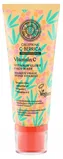
Natura Siberica C-Berrica Vitamin Glory Face Mask
Works for
Anti-agingRetinyl palmitate, Sodium ascorbyl phosphateMay help
“vitamins A and E that help reduce the first signs of aging and boost skin radiance.”
This product contains retinyl palmitate. There is some human evidence that this ingredient helps reduce and prevent fine lines and wrinkles and improve skin elasticity and firmness, though it is smaller or less consistent than the evidence for the best anti-aging ingredients.
MoisturizingHelianthus annuus seed oil, Polyglyceryl-10 oleate + 3 moreWorks
“organic oblepikha hydrolat that acts on the elasticity and hydration of the skin,”
This product can help improve hydration of the skin with the two types of ingredients.
The first type is called “humectants”:
these ingredients help attract water.
When humectants are on the surface of the skin, they “pull in” the moisture from the outside environment, or from
within deeper layers of the skin. The following ingredients in this product do the job:
glycerin.
This product also contains ingredients called “occlusives”. They help reduce the speed with which our skin loses moisture to the outside environment. These ingredients also help soften the upper layer of the skin, so it feels less tight and nicer to the touch. The following ingredients in this product do the job: helianthus annuus seed oil, cetearyl alcohol.
Evens skin toneSide benefit · Retinyl palmitateMay help
The following ingredient (ingredients) in this product might be helpful, but there is no evidence to confirm that it actually works: retinyl palmitate.
Can it cause trouble?
Irritancy6 strong irritants: Retinyl palmitate, Parfum + 4 more — patch-test recommendedHigh risk
Comedogenic1 ingredient rated 2 or more on the 0–5 pore-clogging scale1 flagged


User reviews
Be the first — your take helps the next person decide.
Ingredients
Filter by role to see what each ingredient is doing.
Helianthus annuus seed oil~23–34%
- Irritation risk
- Low
A great emollient due to its high linoleic acid content. One of the most effective plant oils in helping skin hydration and repairing skin barrier function
More about Helianthus annuus seed oilGlycerin~4.7–7.1%
- Irritation risk
- Low
One of the best moisturizing ingredients. Naturally present in skin. It attracts water to the upper layer of the skin working as a humectant
More about GlycerinPolyglyceryl-10 oleate~4.9–7.3%
- Irritation risk
- Low
Helps soften the upper layer of the skin
More about Polyglyceryl-10 oleateCetearyl alcohol~3.6–5.4%
- Irritation risk
- Low
- Comedogenicity
- 2/5
A non-drying alcohol. Works as an emollient. Helps water and oil mix together and creates a nice product texture
More about Cetearyl alcoholSucrose palmitate~2.8–4.2%
Hippophae rhamnoides fruit oil~1.9–2.9%
- Irritation risk
- High
A plant oil that might somewhat help to neutralize free radicals. It could be irritating
More about Hippophae rhamnoides fruit oilWater~1.4–2.1%
Sodium ascorbyl phosphate~1.1–1.6%
- Irritation risk
- Medium
A stable derivative of vitamin C. It is oil-soluble which means it is more likely to penetrate the skin compared to the pure form of vitamin C (which is water-soluble), but it is less bio-available and is way less effective in stimulating collagen and reducing wrinkles compared to the pure form of vitamin C (L-ascorbic acid) and its other derivatives (for example, magnesium ascorbyl phosphate). At the same time, this vitamin C derivative has been shown in studies to be effective in reducing acne, blemishes and clogged pores. It is less irritating then the pure form of vitamin C
More about Sodium ascorbyl phosphateTocopheryl acetate~0.9–1.35%
- Irritation risk
- Medium
A more stable but less bio-available form of vitamin E compared to Tocopherol. Might help moisturize and protect the skin from free radicals, but mostly used in low concentrations to stabilize other ingredients.
More about Tocopheryl acetateRetinyl palmitate~0.85–1.25%
- Irritation risk
- High
Three steps removed from the active form of vitamin A - retinoic acid. To have an effect in the skin, it first needs to be converted twice to become the retinoic acid. This means it is less potent than retinol, but could also be less irritating. Once converted to the retinoic acid in the skin, it helps against all signs of aging, improves skin cell turnover and helps fight blemishes and clogged pores. However, in many cosmetic formulations, it is used in a concentration that is too low to have the full effect
More about Retinyl palmitateCitric acid~0.5–1.2%
- Irritation risk
- Medium
Can work as an exfoliant but is typically used to adjust the product pH
More about Citric acidSodium benzoate~0.25–0.5%
Potassium sorbate~0.3–0.6%
Parfum~0.3–0.7%
- Irritation risk
- High
An aromatic blend of unspecified and possibly irritating ingredients
More about ParfumCi 15985~0.2–0.7%
Citral~0.1–0.5%
Citronellol~0.1–0.35%
Geraniol~0.05–0.25%
Linalool~0.05–0.25%
Ingredient list view
Helianthus annuus seed oil, Glycerin, Polyglyceryl-10 oleate, Cetearyl alcohol, Sucrose palmitate, Hippophae rhamnoides fruit oil, Water, Sodium ascorbyl phosphate, Tocopheryl acetate, Retinyl palmitate, Citric acid, Sodium benzoate, Potassium sorbate, Parfum, Ci 15985, Citral, Citronellol, Geraniol, Linalool
Worth comparing, line by line.
Match % combines shared ingredients, the first five ingredients, shared actives and hero ingredients, irritancy (lower counts in the alternative's favour), texture and body area. Only products in the same routine step are compared.
| Natura SibericaC-Berrica Vitamin Glory Face MaskYOUR PRODUCT | Osmosis +BeautyBarrier Repair Mask | VitageVitamin C Radiance Mask | JAYJUNMulti-Vita Tone Up Mask | |
|---|---|---|---|---|
| Match | — | 61% | 59% | 57% |
| Price | — | — | — | — |
| Shared key ingredients | — | 2 of 4 | 3 of 4 | 1 of 4 |
| Key difference | — | Astrocaryum Murumuru Seed Butter | Panthenol | Niacinamide |
| Irritancy | High | Low | High | Medium |
| Drying alcohol | — | — | — | — |
| View product | Shop | Shop | Shop |


More alternatives: TONYMOLY Intense Care Syn-Ake Hydro-Gel MaskBiobelle My Diary of Beauty Secrets Facial Masks
Product summary
"Natura Siberica - C-Berrica Vitamin Glory Face Mask" could be helpful for: Anti-aging, Moisturizing and Evens skin tone, but its actives are not the most effective or are not well-studied.
Ingredient callouts
- this product includes a form of Retinoids (vitamin A) - retinyl palmitate 0.80% - 1.20%, but this type of vitamin A is not very effective. It could in theory help with fine lines and wrinkles, but the effect is most likely minimal.
- Humectants (glycerin 4.70% - 7.10%). These ingredients help attract water to the upper layer of the skin and improve the skin hydration.
About the brand
According to Cruelty-Free Kitty "Natura Siberica" is cruelty free and so is its parent company.
Price
The product retails for 34.09A$ in Australia, for 10.10$ in the United States and at around 7.09£ in the United Kingdom.
For a detailed price comparison: click here.
Sources cited in this review
Every concentration estimate and effectiveness label is anchored to one of these 13 studies and safety reviews.
- 1
- 2
- 3Effect of topically applied lipids on surfactant-irritated skinonlinelibrary.wiley.com
- 4
- 5
- 6
