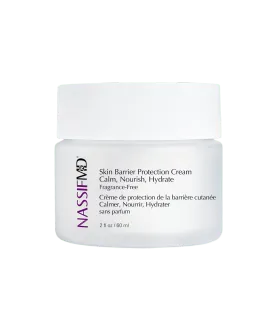
NassifMD Dermaceuticals Skin Barrier Protection Cream

NassifMD Dermaceuticals Skin Barrier Protection Cream

Efficacy87/100IrritancyMedium

Works for

Moisturizing
Panthenol, Cetearyl alcohol + 10 more
Works well
What the product description says
“Our rich barrier cream uses unique botanicals to calm and comfort skin, while immediately moisturizing and reviving skin's natural barrier.”
Source: Nassif MD

This product can help improve hydration of the skin with the two types of ingredients.

The first type is called “humectants”:
these ingredients help attract water. When humectants are on the surface of the skin, they “pull in” the moisture from the outside environment, or from within deeper layers of the skin. The following ingredients in this product do the job: panthenol.

This product also contains ingredients called “occlusives”. They help reduce the speed with which our skin loses moisture to the outside environment. These ingredients also help soften the upper layer of the skin, so it feels less tight and nicer to the touch. The following ingredients in this product do the job: caprylic/capric triglyceride, helianthus annuus seed oil.

The following ingredients in this product are especially good for supporting the skin barrier and helping with the hydration level: panthenol

PanthenolHero· HumectantEffect: HighHelps attract water to the upper layer of the skin and can help improve skin barrier function~0.5–1.2%
Cetearyl alcoholKey active· EmollientEffect: MediumA non-drying alcohol. Works as an emollient. Helps water and oil mix together and creates a nice product texture~5.5–8.2%
Caprylic/capric triglycerideKey active· Emollient, OcclusiveEffect: HighA good mix of fatty acids that forms a protective layer on the skin. Improves the shelf life of products. Derived from coconut and glycerin~2.9–4.3%
Helianthus annuus seed oilKey active· Emollient, OcclusiveEffect: HighA great emollient due to its high linoleic acid content. One of the most effective plant oils in helping skin hydration and repairing skin barrier function~1.6–2.4%
Ricinus communis seed oilKey active· Emollient, OcclusiveEffect: HighA plant oil that can help soften the skin. It might be helpful in calming down inflammation, but solid research is lacking. Is often used in lip products to create the needed product consistency~1.4–2.1%
Centella asiatica extractKey activeEffect: HighA plant extract that has been shown to be able to reduce inflammation in skin, support restoration of skin barrier function, as well as support collagen production. Contains active compounds called centelloids: asiaticoside, madecasosside, asiatic acid and madecassic acid. Might be helpful in preventing stretch marks. It can be itself be irritating though.~0.9–1.4%
Dicaprylyl ether· EmollientEffect: LowHelps soften the upper layer of the skin while creating a non-greasy feel on the skin. Helps to dissolve other ingredients~3.9–5.8%
Ophiopogon japonicus root extractEffect: LowPlant extract that might help neutralize free radicals and support skin barrier function, but research on its effectiveness in skin is lacking~0.8–1.2%
Glyceryl caprylate· EmollientEffect: LowAn emollient that can also help water and oil mix together, as well as prevent bacteria growth in products~0.3–0.7%
TocopherolEffect: Low, below effective dosePure form of vitamin E. Can help moisturise and protect the skin from free radicals. Often used to help stabilise other ingredients or the formula itself~0.05–0.2%
NiacinamideUnder-dosedIs proven to be effective in reducing blemishes, evening out skin tone and helping to improve lines and wrinkles. It helps the skin to repair sun damage, calm down inflammation and keep maintain good levels of moisture. The concentration of about 2% is effective for supporting the skin barrier and evening out the skin tone. Concentration of 4-6% is better for helping with acne and balancing the sebum production~0.4–0.95%
Simmondsia chinensis seed oilUnder-dosedSoftens the upper layer of skin and helps restore the healthy skin barrier. Has shown to help calm down inflammation in skin. It is a stable oil, meaning that it retains its properties even when exposed to air.~0.4–0.95%
Anti-aging
Centella asiatica extract, Tocopherol + 1 more
May help
What the product description says
“Plumps and smooths fine lines and wrinkles.”
Source: Nassif MD

This product contains centella asiatica extract. This ingredient might be able to help reduce and prevent fine lines and wrinkles, improve skin elasticity and firmness, but there is not enough evidence that it actually works.

Centella asiatica extractKey activeEffect: MediumA plant extract that has been shown to be able to reduce inflammation in skin, support restoration of skin barrier function, as well as support collagen production. Contains active compounds called centelloids: asiaticoside, madecasosside, asiatic acid and madecassic acid. Might be helpful in preventing stretch marks. It can be itself be irritating though.~0.9–1.4%
TocopherolEffect: Low, below effective dosePure form of vitamin E. Can help moisturise and protect the skin from free radicals. Often used to help stabilise other ingredients or the formula itself~0.05–0.2%
NiacinamideUnder-dosedIs proven to be effective in reducing blemishes, evening out skin tone and helping to improve lines and wrinkles. It helps the skin to repair sun damage, calm down inflammation and keep maintain good levels of moisture. The concentration of about 2% is effective for supporting the skin barrier and evening out the skin tone. Concentration of 4-6% is better for helping with acne and balancing the sebum production~0.4–0.95%
Anti-oxidation
Side benefit · Centella asiatica extract, Ophiopogon japonicus root extract + 2 more
May help

This product contains antioxidants (centella asiatica extract) that might be able to help neutralize free radicals in skin to lessen the damage it gets from the UV light (sun). There is not enough evidence to confirm their effectiveness in skin though.

Centella asiatica extractKey activeEffect: MediumA plant extract that has been shown to be able to reduce inflammation in skin, support restoration of skin barrier function, as well as support collagen production. Contains active compounds called centelloids: asiaticoside, madecasosside, asiatic acid and madecassic acid. Might be helpful in preventing stretch marks. It can be itself be irritating though.~0.9–1.4%
Ophiopogon japonicus root extractEffect: LowPlant extract that might help neutralize free radicals and support skin barrier function, but research on its effectiveness in skin is lacking~0.8–1.2%
Tocopheryl acetateEffect: Low, below effective doseA more stable but less bio-available form of vitamin E compared to Tocopherol. Might help moisturize and protect the skin from free radicals, but mostly used in low concentrations to stabilize other ingredients.~0.15–0.5%
TocopherolUnder-dosedPure form of vitamin E. Can help moisturise and protect the skin from free radicals. Often used to help stabilise other ingredients or the formula itself~0.05–0.2%

Can it cause trouble?

Irritancy
1 strong irritant: Alcohol
Medium risk
We flagged 10 ingredients with irritancy potential. Severity depends on your sensitivity threshold; the table lists the worst offenders first.
IngredientFunctionIrritationEst. amount
AlcoholCan be drying and contribute to skin irritation. Used in formulars to dissolve other ingredients, create a thinner product consistency or for its antibacterial propertiesHigh~0.05–0.1%est.
Caprylic/capric triglycerideA good mix of fatty acids that forms a protective layer on the skin. Improves the shelf life of products. Derived from coconut and glycerinMedium~2.9–4.3%est.
Ricinus communis seed oilA plant oil that can help soften the skin. It might be helpful in calming down inflammation, but solid research is lacking. Is often used in lip products to create the needed product consistencyMedium~1.4–2.1%est.
Centella asiatica extractA plant extract that has been shown to be able to reduce inflammation in skin, support restoration of skin barrier function, as well as support collagen production. Contains active compounds called centelloids: asiaticoside, madecasosside, asiatic acid and madecassic acid. Might be helpful in preventing stretch marks. It can be itself be irritating though.Medium~0.9–1.4%est.
Ophiopogon japonicus root extractPlant extract that might help neutralize free radicals and support skin barrier function, but research on its effectiveness in skin is lackingMedium~0.8–1.2%est.
Simmondsia chinensis seed oilSoftens the upper layer of skin and helps restore the healthy skin barrier. Has shown to help calm down inflammation in skin. It is a stable oil, meaning that it retains its properties even when exposed to air.Medium~0.4–0.95%est.
Citric acidCan work as an exfoliant but is typically used to adjust the product pHMedium~0.3–0.7%est.
EthylhexylglycerinA preservativeMedium~0.15–0.5%est.
Tocopheryl acetateA more stable but less bio-available form of vitamin E compared to Tocopherol. Might help moisturize and protect the skin from free radicals, but mostly used in low concentrations to stabilize other ingredients.Medium~0.15–0.5%est.
Potassium sorbateA preservativeMedium~0.1–0.3%est.
Comedogenic
1 ingredient rated 2 or more on the 0–5 pore-clogging scale
1 flagged
These ingredients have a comedogenic rating of 2 or more on a 0–5 scale; the table shows each one's rating. In leave-on products they can clog pores in acne-prone skin.
IngredientFunctionRatingEst. amount
Cetearyl alcoholA non-drying alcohol. Works as an emollient. Helps water and oil mix together and creates a nice product texture2/5~5.5–8.2%est.

User reviews

Would you recommend?
No community reviews yet.

Be the first — your take helps the next person decide.

Ingredients

Filter by role to see what each ingredient is doing.

Water~40–60%
Formula
Irritation risk
Low

Plain old water

More about Water
Cetearyl alcohol~5.5–8.2%
Key activeComedogenic 2/5
Irritation risk
Low
Comedogenicity
2/5
Works for
CleansingMoisturizing

A non-drying alcohol. Works as an emollient. Helps water and oil mix together and creates a nice product texture

More about Cetearyl alcohol
Dicaprylyl ether~3.9–5.8%
Formula
Irritation risk
Low
Works for
Moisturizing

Helps soften the upper layer of the skin while creating a non-greasy feel on the skin. Helps to dissolve other ingredients

More about Dicaprylyl ether
Caprylic/capric triglyceride~2.9–4.3%
Key activeIrritant · medium
Irritation risk
Medium
Works for
Moisturizing

A good mix of fatty acids that forms a protective layer on the skin. Improves the shelf life of products. Derived from coconut and glycerin

More about Caprylic/capric triglyceride
Propanediol~2.1–3.1%
Formula
Irritation risk
Low

Acts as a solvent for other ingredients. Speeds up the absorption of other ingredients into the skin

More about Propanediol
Polyglyceryl-3 stearate~1.7–2.6%
Formula
Irritation risk
Low
Works for
Cleansing

Helps oil and water mix together

More about Polyglyceryl-3 stearate
Helianthus annuus seed oil~1.6–2.4%
Key active
Irritation risk
Low
Works for
Moisturizing

A great emollient due to its high linoleic acid content. One of the most effective plant oils in helping skin hydration and repairing skin barrier function

More about Helianthus annuus seed oil
Ricinus communis seed oil~1.4–2.1%
Key activeIrritant · medium
Irritation risk
Medium
Works for
MoisturizingAnti-inflammatory

A plant oil that can help soften the skin. It might be helpful in calming down inflammation, but solid research is lacking. Is often used in lip products to create the needed product consistency

More about Ricinus communis seed oil
Centella asiatica extract~0.9–1.4%
Key activeIrritant · medium
Irritation risk
Medium
Works for
Reduces irritationMoisturizingAnti-inflammatoryReduces rednessAnti-oxidationAnti-agingAnti-blemish

A plant extract that has been shown to be able to reduce inflammation in skin, support restoration of skin barrier function, as well as support collagen production. Contains active compounds called centelloids: asiaticoside, madecasosside, asiatic acid and madecassic acid. Might be helpful in preventing stretch marks. It can be itself be irritating though.

More about Centella asiatica extract
Ophiopogon japonicus root extract~0.8–1.2%
Irritant · medium
Irritation risk
Medium
Works for
MoisturizingAnti-oxidation

Plant extract that might help neutralize free radicals and support skin barrier function, but research on its effectiveness in skin is lacking

More about Ophiopogon japonicus root extract
Panthenol~0.5–1.2%
Hero · Moisturizing
Irritation risk
Low
Works for
Reduces rednessMoisturizingReduces irritation

Helps attract water to the upper layer of the skin and can help improve skin barrier function

More about Panthenol
Niacinamide~0.4–0.95%
Under-dosed
Irritation risk
Low
Works for
MoisturizingEvens skin toneAnti-blemishAnti-agingReduces irritationReduces rednessAnti-inflammatoryAntibacterial

Is proven to be effective in reducing blemishes, evening out skin tone and helping to improve lines and wrinkles. It helps the skin to repair sun damage, calm down inflammation and keep maintain good levels of moisture. The concentration of about 2% is effective for supporting the skin barrier and evening out the skin tone. Concentration of 4-6% is better for helping with acne and balancing the sebum production

More about Niacinamide
Simmondsia chinensis seed oil~0.4–0.95%
Under-dosedIrritant · medium
Irritation risk
Medium
Works for
Moisturizing

Softens the upper layer of skin and helps restore the healthy skin barrier. Has shown to help calm down inflammation in skin. It is a stable oil, meaning that it retains its properties even when exposed to air.

More about Simmondsia chinensis seed oil
Xanthan gum~0.35–0.8%
Formula
Irritation risk
Low
Works for
Cleansing

Used to create a thicker product consistency

More about Xanthan gum
Citric acid~0.3–0.7%
Irritant · medium
Irritation risk
Medium

Can work as an exfoliant but is typically used to adjust the product pH

More about Citric acid
Glyceryl caprylate~0.3–0.7%
Formula
Irritation risk
Low
Works for
CleansingMoisturizing

An emollient that can also help water and oil mix together, as well as prevent bacteria growth in products

More about Glyceryl caprylate
Phenoxyethanol~0.15–0.55%
Formula
Irritation risk
Low

A preservative. It helps prevent bacterial growth in cosmetic products

More about Phenoxyethanol
Ethylhexylglycerin~0.15–0.5%
Irritant · medium
Irritation risk
Medium

A preservative

More about Ethylhexylglycerin
Tocopheryl acetate~0.15–0.5%
Irritant · medium
Irritation risk
Medium
Works for
Anti-oxidation

A more stable but less bio-available form of vitamin E compared to Tocopherol. Might help moisturize and protect the skin from free radicals, but mostly used in low concentrations to stabilize other ingredients.

More about Tocopheryl acetate
Sodium phytate~0.1–0.4%
Formula
Irritation risk
Low

Used to stabilize product formulations

More about Sodium phytate
Sodium benzoate~0.05–0.25%
Formula
Irritation risk
Low

A preservative

More about Sodium benzoate
Potassium sorbate~0.1–0.3%
Irritant · medium
Irritation risk
Medium

A preservative

More about Potassium sorbate
Maltodextrin~0.05–0.25%
Formula
Irritation risk
Low
Works for
Mattifying

Used to stabilize the product formulation and can help absorb oil

More about Maltodextrin
Tocopherol~0.05–0.2%
Under-dosed
Irritation risk
Low
Works for
Anti-oxidationMoisturizingAnti-inflammatoryAnti-aging

Pure form of vitamin E. Can help moisturise and protect the skin from free radicals. Often used to help stabilise other ingredients or the formula itself

More about Tocopherol
Alcohol~0.05–0.1%
Irritant · high
Irritation risk
High
Works for
Antibacterial

Can be drying and contribute to skin irritation. Used in formulars to dissolve other ingredients, create a thinner product consistency or for its antibacterial properties

More about Alcohol
Ingredient list view

Water, Cetearyl alcohol, Dicaprylyl ether, Caprylic/capric triglyceride, Propanediol, Polyglyceryl-3 stearate, Helianthus annuus seed oil, Ricinus communis seed oil, Centella asiatica extract, Ophiopogon japonicus root extract, Panthenol, Niacinamide, Simmondsia chinensis seed oil, Xanthan gum, Citric acid, Glyceryl caprylate, Phenoxyethanol, Ethylhexylglycerin, Tocopheryl acetate, Sodium phytate, Sodium benzoate, Potassium sorbate, Maltodextrin, Tocopherol, Alcohol

Compare prices

Retailers ranked by price — lowest first.

Nassif MD
$17.00
Buy
Nassif MD
$50.00
Buy
Ulta2 oz
$50.00
Buy

Affiliate links · As an Amazon Associate, WIMJ earns from qualifying purchases.

Worth comparing, line by line.

Match % combines shared ingredients, the first five ingredients, shared actives and hero ingredients, irritancy (lower counts in the alternative's favour), texture and body area. Only products in the same routine step are compared.

Side-by-side comparison of this product against its closest alternatives
NassifMD DermaceuticalsSkin Barrier Protection CreamYOUR PRODUCTNécessaireThe Body CreamSkincare by Dr VDr V Kids Magic CreamBepanthenDerma Body Nutritive Cream
Match—94%91%89%
Price$17.00$48.00+$31.00—$18.10+$1.10
Shared key ingredients—3 of 74 of 73 of 7
Key difference—Colloidal OatmealCyclopentasiloxaneGlycerin
Irritancy Medium Low Low Low
Drying alcohol Contains drying alcohol ———
View product Shop Shop Shop

More alternatives: Cetaphil Moisturising CreamMetode Spesialpleie karbamidkrem 9,5%

Cheaper alternatives? See how this stacks up against similar formulas.
We compare ingredient profiles across our catalog — pick the closest match for your budget.
Open dupe finder

Sources cited in this review

Every concentration estimate and effectiveness label is anchored to one of these 22 studies and safety reviews.

  1. 1
  2. 2
  3. 3
  4. 4
  5. 5
  6. 6
NassifMD Dermaceuticals Skin Barrier Protection Cream
NassifMD DermaceuticalsSkin Barrier Protection Cream

Affiliate links · As an Amazon Associate, WIMJ earns from qualifying purchases.

As an Amazon Associate, WIMJ earns from qualifying purchases.