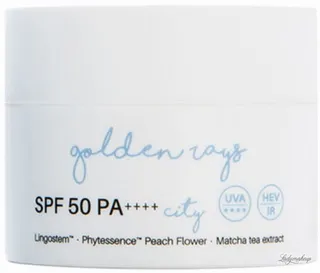
Nacomi Golden Rays City - City face cream with a filter - SPF 50 PA ++++

Nacomi Golden Rays City - City face cream with a filter - SPF 50 PA ++++

SPF 50Efficacy100/100IrritancyHigh·4 UV filters

Works for

Sun protection
SPF 50 · 4 UV filters
Broad spectrum
SPF 50Broad spectrumChemical filters

This product offers a good level of protection against both UVB and UVA rays.

This sunscreen uses organic (so-called "chemical") sunscreen filters. Organic, or "chemical" filters usually provide reliable sun protection and rarely leave a white cast. Sunscreens with organic filters can sting eyes.

This product can be considered "reef safe" because it does not contain the UV filters (oxybenzone and octinoxate) that can be harmful to coral reefs when present in the water in high concentrations.

UV spectrum
UVB290–320 nmUVA II320–340 nmUVA I340–400 nm
Uvinul T
Tinosorb S
Tinosorb M
Uvinul A Plus
FilterCoverageWhat it doesEst. amount
Uvinul TEthylhexyl TriazoneUVB Photo-stable Uvinul T. A UV filter. Effective against UVB rays. It is photostable. Can increase water resistance properties of the sunscreen. Unfortunately, not approved by the FDA (US) yet~3.2–3.9%
Tinosorb SBis-ethylhexyloxyphenol Methoxyphenyl TriazineUVBUVA Photo-stable Tinosorb S. One of the most effective broad spectrum sunscreen ingredients. Protects from both UVA and UVB rays. It is photostable. Approved by the US FDA in 2026 (listed as bemotrizinol on US labels).~3.5–4.3%
Tinosorb MMethylene Bis-benzotriazolyl TetramethylbutylphenolUVBUVA Photo-stable Tinosorb M. A UV filter. Is effective against both UVA and UVB rays. It also provides some protection against visible light. It is photostable and can also be used to improve photostability of other sunscreen ingredients. Its physical properties help to create lightweight sunscreen formulations. It can leave a slight white cast. Unfortunately, it is not approved by the FDA (US) yet~1.6–2%
Uvinul A PlusDiethylamino Hydroxybenzoyl Hexyl BenzoateUVA1 Photo-stable Uvinul A Plus. A new generation broad spectrum sunscreen that offers an effective protection especially in the UVA range. It is stable in formulations. Unfortunately, is not approved by the FDA (US) yet~4.4–5.4%
~ marks concentrations estimated from label position and typical use levels
Reef-safe
No oxybenzone or octinoxate — the two filters banned in Hawaii, Florida Keys and Aruba.
Anti-aging
Camellia sinensis leaf extract, Hyaluronic acid + 2 more
Works well
What the product description says
“In addition, it smoothes and soothes irritations, supports the regeneration of the epidermis, and stimulates the production of collagen.”
Source: Ladymakeup

This product can help prevent early signs of skin aging because it offers a good level of broad spectrum sun protection. Sun damage is the main cause of premature skin aging, and protecting your skin from the sun is the best anti-aging strategy.

Camellia sinensis leaf extractEffect: LowCan contain potent anti-oxidant compounds (abbreviated ECG, GCG, EGC, and EGCG) that might help protect the skin from free radicals. Can help calm down inflammation and has some anti-bacterial properties. Unfortunately, these antioxidants are unstable and lose their effectiveness very quickly in products. The concentration of the antioxidant compounds in the extract also tends to be low to be effective in topical formulation~0.4–0.6%
Hyaluronic acidEffect: LowOne of the best moisturizing ingredients. Attracts water into the upper layer of the skin. Naturally present in skin. Typically has large molecule size unless advertised otherwise on the product label. Helps support skin's barrier function and may help to reduce inflammation~0.25–0.45%
TocopherolEffect: Low, below effective dosePure form of vitamin E. Can help moisturise and protect the skin from free radicals. Often used to help stabilise other ingredients or the formula itself~0.25–0.5%
GluconolactoneUnder-dosedA polyhydroxy acid (PHA) that helps shed the dead cells from the skin surface revealing smoother skin. Is believed to be genter than AHAs. It helps attract water to the upper layer of the skin and can stimulate production of skin's own hyaluronic acid resulting in improved hydration levels. It has been shown to be helpful against acne and clogged pores if used consistently (e.g over a period of 12 weeks) in high enough concentration. It can help reduce fine lines and wrinkles and improve skin tone with long-term application. Can help neutralize free radicals~0.25–0.45%
Evens skin tone
Side benefit · Camellia sinensis leaf extract, Gluconolactone
Works well

This product offers broad spectrum sun protection. It means that it can prevent hyperpigmentation and help keep the skin tone even (sun damage is the main factor causing age spots, darkening of post-acne marks and other discolorations).

Camellia sinensis leaf extractEffect: LowCan contain potent anti-oxidant compounds (abbreviated ECG, GCG, EGC, and EGCG) that might help protect the skin from free radicals. Can help calm down inflammation and has some anti-bacterial properties. Unfortunately, these antioxidants are unstable and lose their effectiveness very quickly in products. The concentration of the antioxidant compounds in the extract also tends to be low to be effective in topical formulation~0.4–0.6%
GluconolactoneUnder-dosedA polyhydroxy acid (PHA) that helps shed the dead cells from the skin surface revealing smoother skin. Is believed to be genter than AHAs. It helps attract water to the upper layer of the skin and can stimulate production of skin's own hyaluronic acid resulting in improved hydration levels. It has been shown to be helpful against acne and clogged pores if used consistently (e.g over a period of 12 weeks) in high enough concentration. It can help reduce fine lines and wrinkles and improve skin tone with long-term application. Can help neutralize free radicals~0.25–0.45%
Moisturizing
Side benefit the brand mentions · Glycerin, Cetyl alcohol + 20 more
Works
What the product description says
“When applied to the skin, it immediately oxygenates, deeply moisturizes and nourishes, and also has antioxidant properties.”
Source: Ladymakeup

This product can help improve hydration of the skin with the two types of ingredients.

The first type is called “humectants”:
these ingredients help attract water. When humectants are on the surface of the skin, they “pull in” the moisture from the outside environment, or from within deeper layers of the skin. The following ingredients in this product do the job: glycerin, hyaluronic acid.

This product also contains ingredients called “occlusives”. They help reduce the speed with which our skin loses moisture to the outside environment. These ingredients also help soften the upper layer of the skin, so it feels less tight and nicer to the touch. The following ingredients in this product do the job: glycine soja oil, isopropyl myristate.

GlycerinKey active· HumectantEffect: HighOne of the best moisturizing ingredients. Naturally present in skin. It attracts water to the upper layer of the skin working as a humectant~5–6.1%
Cetyl alcoholKey active· EmollientEffect: MediumA non-drying alcohol that works to soften the skin and stabilize product formulations helping oil and water mix together~2–2.4%
Cetearyl alcoholKey active· EmollientEffect: MediumA non-drying alcohol. Works as an emollient. Helps water and oil mix together and creates a nice product texture~1.7–2%
Coco-caprylate/caprateKey active· EmollientEffect: MediumHelps to soften the upper layer of the skin without creating a greasy texture~1–1.2%
Isopropyl myristateKey active· EmollientEffect: HighAn emollient that helps soften the skin. Could be comedogenic~0.75–1.1%
Propylheptyl caprylateKey active· EmollientEffect: MediumHelps soften the upper layer of the skin~0.6–0.95%
Olea europaea fruit oilKey active· EmollientEffect: MediumAn emollient that helps soften the skin but is not effective for restoring its barrier function. Might be helpful to calm down inflammation~0.5–0.75%
Hyaluronic acidKey active· HumectantEffect: HighOne of the best moisturizing ingredients. Attracts water into the upper layer of the skin. Naturally present in skin. Typically has large molecule size unless advertised otherwise on the product label. Helps support skin's barrier function and may help to reduce inflammation~0.25–0.45%
Hydrolyzed glycosaminoglycansKey active· HumectantEffect: HighLong sugars that help attract water to the upper layer of the skin~0.25–0.45%
Glycine soja oilKey active· EmollientEffect: HighA good emollient that helps soften the skin and helps repair its barrier function. It can clog pores if used in high concentrations.~0.25–0.5%
Sodium hyaluronateKey active· HumectantEffect: HighOne of the best moisturizing ingredients. Attracts water into the upper layer of the skin~0.25–0.45%
Sodium hyaluronate crosspolymerKey active· HumectantEffect: HighAttracts water into the upper layer of the skin~0.25–0.45%
Althaea officinalis root extractKey activeEffect: HighA plant extract that can help attract water to the upper layer of the skin and might help to reduce inflammation~0.25–0.5%
Hydrolyzed hyaluronic acidKey active· HumectantEffect: HighOne of the best moisturizing ingredients. Attracts water into the upper layer of the skin. A version of it is naturally present in skin~0.25–0.45%
Glyceryl stearate· EmollientEffect: LowAn emollient that softens the skin and forms a protective layer on its surface. Helps water and oil mix together~1.5–1.8%
Passiflora incarnata seed oilEffect: LowA plant oil that can help soften the upper layer of the skin. Contains essential oil that can be irritating~0.45–0.65%
Camellia sinensis leaf extractEffect: LowCan contain potent anti-oxidant compounds (abbreviated ECG, GCG, EGC, and EGCG) that might help protect the skin from free radicals. Can help calm down inflammation and has some anti-bacterial properties. Unfortunately, these antioxidants are unstable and lose their effectiveness very quickly in products. The concentration of the antioxidant compounds in the extract also tends to be low to be effective in topical formulation~0.4–0.6%
Propylene glycol· HumectantEffect: LowHelps oil and water mix together and can enhance the penetration of other ingredients into the skin. It can be irritating~0.25–0.45%
Calcium gluconate· HumectantEffect: LowHelps attract water to the upper layer of the skin and helps to improve appearance of the product~0.25–0.5%
Stearic acidEffect: Low, below effective doseHelps oil and water mix together and works as an emollient~0.55–0.85%
TocopherolEffect: Low, below effective dosePure form of vitamin E. Can help moisturise and protect the skin from free radicals. Often used to help stabilise other ingredients or the formula itself~0.25–0.5%
GluconolactoneUnder-dosedA polyhydroxy acid (PHA) that helps shed the dead cells from the skin surface revealing smoother skin. Is believed to be genter than AHAs. It helps attract water to the upper layer of the skin and can stimulate production of skin's own hyaluronic acid resulting in improved hydration levels. It has been shown to be helpful against acne and clogged pores if used consistently (e.g over a period of 12 weeks) in high enough concentration. It can help reduce fine lines and wrinkles and improve skin tone with long-term application. Can help neutralize free radicals~0.25–0.45%
Anti-oxidation
Side benefit · Camellia sinensis leaf extract, Althaea officinalis root extract + 3 more
May help

This product contains antioxidants (camellia sinensis leaf extract) that can help neutralize free radicals in skin to lessen the damage it gets from the UV light (sun). There is some human evidence for this effect in skin, though it is smaller or less consistent than the evidence for the best antioxidants.

Camellia sinensis leaf extractKey activeEffect: MediumCan contain potent anti-oxidant compounds (abbreviated ECG, GCG, EGC, and EGCG) that might help protect the skin from free radicals. Can help calm down inflammation and has some anti-bacterial properties. Unfortunately, these antioxidants are unstable and lose their effectiveness very quickly in products. The concentration of the antioxidant compounds in the extract also tends to be low to be effective in topical formulation~0.4–0.6%
Althaea officinalis root extractEffect: LowA plant extract that can help attract water to the upper layer of the skin and might help to reduce inflammation~0.25–0.5%
Tocopheryl acetateEffect: Low, below effective doseA more stable but less bio-available form of vitamin E compared to Tocopherol. Might help moisturize and protect the skin from free radicals, but mostly used in low concentrations to stabilize other ingredients.~0.25–0.5%
TocopherolUnder-dosedPure form of vitamin E. Can help moisturise and protect the skin from free radicals. Often used to help stabilise other ingredients or the formula itself~0.25–0.5%
GluconolactoneUnder-dosedA polyhydroxy acid (PHA) that helps shed the dead cells from the skin surface revealing smoother skin. Is believed to be genter than AHAs. It helps attract water to the upper layer of the skin and can stimulate production of skin's own hyaluronic acid resulting in improved hydration levels. It has been shown to be helpful against acne and clogged pores if used consistently (e.g over a period of 12 weeks) in high enough concentration. It can help reduce fine lines and wrinkles and improve skin tone with long-term application. Can help neutralize free radicals~0.25–0.45%

Can it cause trouble?

Irritancy
4 strong irritants: Passiflora incarnata seed oil, Parfum + 2 more — patch-test recommended
High risk
We flagged 26 ingredients with irritancy potential. Severity depends on your sensitivity threshold; the table lists the worst offenders first.
IngredientFunctionIrritationEst. amount
Passiflora incarnata seed oilA plant oil that can help soften the upper layer of the skin. Contains essential oil that can be irritatingHigh~0.45–0.65%est.
Althaea officinalis root extractA plant extract that can help attract water to the upper layer of the skin and might help to reduce inflammationHigh~0.25–0.5%est.
Decyl glucosideHelps oil and water mix together. Can be irritatingHigh~0.35–0.6%est.
Propylene glycolHelps oil and water mix together and can enhance the penetration of other ingredients into the skin. It can be irritatingHigh~0.25–0.45%est.
ParfumAn aromatic blend of unspecified and possibly irritating ingredientsHigh~0.2–0.35%est.
Raspberry ketoneUsed as a fragrance. It can reduce skin pigmentation, but it is not safe to use for these purposes in high concentrations as use of raspberry ketone and its derivative is linked to causing loss of skin pigmentation in people (leukoderma)High~0.2–0.35%est.
Benzyl alcoholA preservative. Can be used to mask unpleasant smell. Can be irritatingHigh~0.15–0.25%est.
CitralA fragrance with a lemon scent. A likely irritantHigh~0.1–0.15%est.
LinaloolA fragrance. Can be irritatingHigh~0.1–0.15%est.
Diethylamino hydroxybenzoyl hexyl benzoateUvinul A Plus. A new generation broad spectrum sunscreen that offers an effective protection especially in the UVA range. It is stable in formulations. Unfortunately, is not approved by the FDA (US) yetMedium~4.4–5.4%est.
Bis-ethylhexyloxyphenol methoxyphenyl triazineTinosorb S. One of the most effective broad spectrum sunscreen ingredients. Protects from both UVA and UVB rays. It is photostable. Approved by the US FDA in 2026 (listed as bemotrizinol on US labels).Medium~3.5–4.3%est.
Ethylhexyl triazoneUvinul T. A UV filter. Effective against UVB rays. It is photostable. Can increase water resistance properties of the sunscreen. Unfortunately, not approved by the FDA (US) yetMedium~3.2–3.9%est.
Methylene bis-benzotriazolyl tetramethylbutylphenolTinosorb M. A UV filter. Is effective against both UVA and UVB rays. It also provides some protection against visible light. It is photostable and can also be used to improve photostability of other sunscreen ingredients. Its physical properties help to create lightweight sunscreen formulations. It can leave a slight white cast. Unfortunately, it is not approved by the FDA (US) yetMedium~1.6–2%est.
Olea europaea fruit oilAn emollient that helps soften the skin but is not effective for restoring its barrier function. Might be helpful to calm down inflammationMedium~0.5–0.75%est.
Sodium hyaluronate crosspolymerAttracts water into the upper layer of the skinMedium~0.25–0.45%est.
Glycine soja oilA good emollient that helps soften the skin and helps repair its barrier function. It can clog pores if used in high concentrations.Medium~0.25–0.5%est.
Sodium lauroyl glutamateUsed as a cleansing agent. It creates foamMedium~0.25–0.45%est.
Hydroxypropyl starch phosphateHelps oil and water mix together and used to stabilize product formulationsMedium~0.3–0.55%est.
Zea mays starchUsed to thicken the product's consistencyMedium~0.25–0.45%est.
GluconolactoneA polyhydroxy acid (PHA) that helps shed the dead cells from the skin surface revealing smoother skin. Is believed to be genter than AHAs. It helps attract water to the upper layer of the skin and can stimulate production of skin's own hyaluronic acid resulting in improved hydration levels. It has been shown to be helpful against acne and clogged pores if used consistently (e.g over a period of 12 weeks) in high enough concentration. It can help reduce fine lines and wrinkles and improve skin tone with long-term application. Can help neutralize free radicalsMedium~0.25–0.45%est.
Tocopheryl acetateA more stable but less bio-available form of vitamin E compared to Tocopherol. Might help moisturize and protect the skin from free radicals, but mostly used in low concentrations to stabilize other ingredients.Medium~0.25–0.5%est.
Dehydroacetic acidA preservativeMedium~0.25–0.45%est.
Citric acidCan work as an exfoliant but is typically used to adjust the product pHMedium~0.2–0.4%est.
Potassium sorbateA preservativeMedium~0.2–0.35%est.
Benzyl glycolHelps dissolve other ingredients and preserve productsMedium~0.15–0.3%est.
EthylhexylglycerinA preservativeMedium~0.15–0.3%est.
Comedogenic
4 ingredients rated 2 or more on the 0–5 pore-clogging scale
4 flagged
These ingredients have a comedogenic rating of 2 or more on a 0–5 scale; the table shows each one's rating. In leave-on products they can clog pores in acne-prone skin.
IngredientFunctionRatingEst. amount
Isopropyl myristateAn emollient that helps soften the skin. Could be comedogenic3/5~0.75–1.1%est.
Zea mays starchUsed to thicken the product's consistency3/5~0.25–0.45%est.
Cetearyl alcoholA non-drying alcohol. Works as an emollient. Helps water and oil mix together and creates a nice product texture2/5~1.7–2%est.
Glycine soja oilA good emollient that helps soften the skin and helps repair its barrier function. It can clog pores if used in high concentrations.2/5~0.25–0.5%est.
Did this help you decide?

User reviews

Would you recommend?
No community reviews yet.

Be the first — your take helps the next person decide.

Ingredients

Filter by role to see what each ingredient is doing.

Water~45–55%
Formula
Irritation risk
Low

Plain old water

More about Water
Glycerin~5–6.1%
Key active
Irritation risk
Low
Works for
Moisturizing

One of the best moisturizing ingredients. Naturally present in skin. It attracts water to the upper layer of the skin working as a humectant

More about Glycerin
Diethylamino hydroxybenzoyl hexyl benzoate~4.4–5.4%
UV filterKey activeIrritant · medium
Irritation risk
Medium
Works for
Sun protection

Uvinul A Plus. A new generation broad spectrum sunscreen that offers an effective protection especially in the UVA range. It is stable in formulations. Unfortunately, is not approved by the FDA (US) yet

More about Diethylamino hydroxybenzoyl hexyl benzoate
Bis-ethylhexyloxyphenol methoxyphenyl triazine~3.5–4.3%
UV filterKey activeIrritant · medium
Irritation risk
Medium
Works for
Sun protection

Tinosorb S. One of the most effective broad spectrum sunscreen ingredients. Protects from both UVA and UVB rays. It is photostable. Approved by the US FDA in 2026 (listed as bemotrizinol on US labels).

More about Bis-ethylhexyloxyphenol methoxyphenyl triazine
Ethylhexyl triazone~3.2–3.9%
UV filterKey activeIrritant · medium
Irritation risk
Medium
Works for
Sun protection

Uvinul T. A UV filter. Effective against UVB rays. It is photostable. Can increase water resistance properties of the sunscreen. Unfortunately, not approved by the FDA (US) yet

More about Ethylhexyl triazone
Cetyl alcohol~2–2.4%
Key active
Irritation risk
Low
Works for
CleansingMoisturizing

A non-drying alcohol that works to soften the skin and stabilize product formulations helping oil and water mix together

More about Cetyl alcohol
Cetearyl alcohol~1.7–2%
Key activeComedogenic 2/5
Irritation risk
Low
Comedogenicity
2/5
Works for
CleansingMoisturizing

A non-drying alcohol. Works as an emollient. Helps water and oil mix together and creates a nice product texture

More about Cetearyl alcohol
Glyceryl stearate~1.5–1.8%
Formula
Irritation risk
Low
Works for
CleansingMoisturizing

An emollient that softens the skin and forms a protective layer on its surface. Helps water and oil mix together

More about Glyceryl stearate
Methylene bis-benzotriazolyl tetramethylbutylphenol~1.6–2%
UV filterKey activeIrritant · medium
Irritation risk
Medium
Works for
Sun protection

Tinosorb M. A UV filter. Is effective against both UVA and UVB rays. It also provides some protection against visible light. It is photostable and can also be used to improve photostability of other sunscreen ingredients. Its physical properties help to create lightweight sunscreen formulations. It can leave a slight white cast. Unfortunately, it is not approved by the FDA (US) yet

More about Methylene bis-benzotriazolyl tetramethylbutylphenol
Coco-caprylate/caprate~1–1.2%
Key active
Irritation risk
Low
Works for
Moisturizing

Helps to soften the upper layer of the skin without creating a greasy texture

More about Coco-caprylate/caprate
Isopropyl myristate~0.75–1.1%
Key activeComedogenic 3/5
Irritation risk
Low
Comedogenicity
3/5
Works for
Moisturizing

An emollient that helps soften the skin. Could be comedogenic

More about Isopropyl myristate
Propylheptyl caprylate~0.6–0.95%
Key active
Irritation risk
Low
Works for
Moisturizing

Helps soften the upper layer of the skin

More about Propylheptyl caprylate
Hydrogenated farnesene~0.55–0.8%
Formula
Olea europaea fruit oil~0.5–0.75%
Key activeIrritant · medium
Irritation risk
Medium
Works for
Moisturizing

An emollient that helps soften the skin but is not effective for restoring its barrier function. Might be helpful to calm down inflammation

More about Olea europaea fruit oil
Stearic acid~0.55–0.85%
Formula
Irritation risk
Low
Works for
CleansingMoisturizing

Helps oil and water mix together and works as an emollient

More about Stearic acid
Passiflora incarnata seed oil~0.45–0.65%
Irritant · high
Irritation risk
High
Works for
Moisturizing

A plant oil that can help soften the upper layer of the skin. Contains essential oil that can be irritating

More about Passiflora incarnata seed oil
Prunus persica flower extract~0.4–0.6%
Formula
Camellia sinensis leaf extract~0.4–0.6%
Key active
Irritation risk
Low
Works for
Anti-oxidationAntibacterialAnti-agingAnti-blemishEvens skin toneMoisturizing

Can contain potent anti-oxidant compounds (abbreviated ECG, GCG, EGC, and EGCG) that might help protect the skin from free radicals. Can help calm down inflammation and has some anti-bacterial properties. Unfortunately, these antioxidants are unstable and lose their effectiveness very quickly in products. The concentration of the antioxidant compounds in the extract also tends to be low to be effective in topical formulation

More about Camellia sinensis leaf extract
Vaccinium vitis-idaea fruit extract~0.3–0.6%
Formula
Linum usitatissimum seed extract~0.25–0.5%
Formula
Althaea officinalis root extract~0.25–0.5%
Key activeIrritant · high
Irritation risk
High
Works for
MoisturizingAnti-oxidation

A plant extract that can help attract water to the upper layer of the skin and might help to reduce inflammation

More about Althaea officinalis root extract
Prunus amygdalus dulcis fruit extract~0.25–0.5%
Formula
Hydrolyzed glycosaminoglycans~0.25–0.45%
Key active
Irritation risk
Low
Works for
Moisturizing

Long sugars that help attract water to the upper layer of the skin

More about Hydrolyzed glycosaminoglycans
Sodium hyaluronate~0.25–0.45%
Key active
Irritation risk
Low
Works for
Moisturizing

One of the best moisturizing ingredients. Attracts water into the upper layer of the skin

More about Sodium hyaluronate
Hyaluronic acid~0.25–0.45%
Key active
Irritation risk
Low
Works for
MoisturizingAnti-inflammatoryAnti-aging

One of the best moisturizing ingredients. Attracts water into the upper layer of the skin. Naturally present in skin. Typically has large molecule size unless advertised otherwise on the product label. Helps support skin's barrier function and may help to reduce inflammation

More about Hyaluronic acid
Hydrolyzed hyaluronic acid~0.25–0.45%
Key active
Irritation risk
Low
Works for
Moisturizing

One of the best moisturizing ingredients. Attracts water into the upper layer of the skin. A version of it is naturally present in skin

More about Hydrolyzed hyaluronic acid
Sodium hyaluronate crosspolymer~0.25–0.45%
Key activeIrritant · medium
Irritation risk
Medium
Works for
Moisturizing

Attracts water into the upper layer of the skin

More about Sodium hyaluronate crosspolymer
Tocopherol~0.25–0.5%
Under-dosed
Irritation risk
Low
Works for
Anti-oxidationMoisturizingAnti-inflammatoryAnti-aging

Pure form of vitamin E. Can help moisturise and protect the skin from free radicals. Often used to help stabilise other ingredients or the formula itself

More about Tocopherol
Glycine soja oil~0.25–0.5%
Key activeComedogenic 2/5Irritant · medium
Irritation risk
Medium
Comedogenicity
2/5
Works for
Moisturizing

A good emollient that helps soften the skin and helps repair its barrier function. It can clog pores if used in high concentrations.

More about Glycine soja oil
Sodium lauroyl glutamate~0.25–0.45%
Irritant · medium
Irritation risk
Medium
Works for
Cleansing

Used as a cleansing agent. It creates foam

More about Sodium lauroyl glutamate
Hydroxypropyl starch phosphate~0.3–0.55%
Irritant · medium
Irritation risk
Medium

Helps oil and water mix together and used to stabilize product formulations

More about Hydroxypropyl starch phosphate
Decyl glucoside~0.35–0.6%
Irritant · high
Irritation risk
High
Works for
Cleansing

Helps oil and water mix together. Can be irritating

More about Decyl glucoside
Zea mays starch~0.25–0.45%
Comedogenic 3/5Irritant · medium
Irritation risk
Medium
Comedogenicity
3/5
Works for
Mattifying

Used to thicken the product's consistency

More about Zea mays starch
Propanediol~0.25–0.5%
Formula
Irritation risk
Low

Acts as a solvent for other ingredients. Speeds up the absorption of other ingredients into the skin

More about Propanediol
Gluconolactone~0.25–0.45%
Under-dosedIrritant · medium
Irritation risk
Medium
Works for
MoisturizingAnti-agingEvens skin toneExfoliationAnti-blemishAnti-oxidation

A polyhydroxy acid (PHA) that helps shed the dead cells from the skin surface revealing smoother skin. Is believed to be genter than AHAs. It helps attract water to the upper layer of the skin and can stimulate production of skin's own hyaluronic acid resulting in improved hydration levels. It has been shown to be helpful against acne and clogged pores if used consistently (e.g over a period of 12 weeks) in high enough concentration. It can help reduce fine lines and wrinkles and improve skin tone with long-term application. Can help neutralize free radicals

More about Gluconolactone
Tocopheryl acetate~0.25–0.5%
Irritant · medium
Irritation risk
Medium
Works for
Anti-oxidation

A more stable but less bio-available form of vitamin E compared to Tocopherol. Might help moisturize and protect the skin from free radicals, but mostly used in low concentrations to stabilize other ingredients.

More about Tocopheryl acetate
Calcium gluconate~0.25–0.5%
Formula
Irritation risk
Low
Works for
Moisturizing

Helps attract water to the upper layer of the skin and helps to improve appearance of the product

More about Calcium gluconate
Dehydroacetic acid~0.25–0.45%
Irritant · medium
Irritation risk
Medium

A preservative

More about Dehydroacetic acid
Xanthan gum~0.25–0.45%
Formula
Irritation risk
Low
Works for
Cleansing

Used to create a thicker product consistency

More about Xanthan gum
Propylene glycol~0.25–0.45%
Irritant · high
Irritation risk
High
Works for
Moisturizing

Helps oil and water mix together and can enhance the penetration of other ingredients into the skin. It can be irritating

More about Propylene glycol
Citric acid~0.2–0.4%
Irritant · medium
Irritation risk
Medium

Can work as an exfoliant but is typically used to adjust the product pH

More about Citric acid
Parfum~0.2–0.35%
Irritant · high
Irritation risk
High

An aromatic blend of unspecified and possibly irritating ingredients

More about Parfum
Raspberry ketone~0.2–0.35%
Irritant · high
Irritation risk
High

Used as a fragrance. It can reduce skin pigmentation, but it is not safe to use for these purposes in high concentrations as use of raspberry ketone and its derivative is linked to causing loss of skin pigmentation in people (leukoderma)

More about Raspberry ketone
Potassium sorbate~0.2–0.35%
Irritant · medium
Irritation risk
Medium

A preservative

More about Potassium sorbate
Sodium benzoate~0.15–0.3%
Formula
Irritation risk
Low

A preservative

More about Sodium benzoate
Benzyl glycol~0.15–0.3%
Irritant · medium
Irritation risk
Medium

Helps dissolve other ingredients and preserve products

More about Benzyl glycol
Phenoxyethanol~0.15–0.25%
Formula
Irritation risk
Low

A preservative. It helps prevent bacterial growth in cosmetic products

More about Phenoxyethanol
Ethylhexylglycerin~0.15–0.3%
Irritant · medium
Irritation risk
Medium

A preservative

More about Ethylhexylglycerin
Benzyl alcohol~0.15–0.25%
Irritant · high
Irritation risk
High

A preservative. Can be used to mask unpleasant smell. Can be irritating

More about Benzyl alcohol
Citral~0.1–0.15%
Irritant · high
Irritation risk
High

A fragrance with a lemon scent. A likely irritant

More about Citral
Linalool~0.1–0.15%
Irritant · high
Irritation risk
High

A fragrance. Can be irritating

More about Linalool
Ingredient list view

Water, Glycerin, Diethylamino hydroxybenzoyl hexyl benzoate, Bis-ethylhexyloxyphenol methoxyphenyl triazine, Ethylhexyl triazone, Cetyl alcohol, Cetearyl alcohol, Glyceryl stearate, Methylene bis-benzotriazolyl tetramethylbutylphenol, Coco-caprylate/caprate, Isopropyl myristate, Propylheptyl caprylate, Hydrogenated farnesene, Olea europaea fruit oil, Stearic acid, Passiflora incarnata seed oil, Prunus persica flower extract, Camellia sinensis leaf extract, Vaccinium vitis-idaea fruit extract, Linum usitatissimum seed extract, Althaea officinalis root extract, Prunus amygdalus dulcis fruit extract, Hydrolyzed glycosaminoglycans, Sodium hyaluronate, Hyaluronic acid, Hydrolyzed hyaluronic acid, Sodium hyaluronate crosspolymer, Tocopherol, Glycine soja oil, Sodium lauroyl glutamate, Hydroxypropyl starch phosphate, Decyl glucoside, Zea mays starch, Propanediol, Gluconolactone, Tocopheryl acetate, Calcium gluconate, Dehydroacetic acid, Xanthan gum, Propylene glycol, Citric acid, Parfum, Raspberry ketone, Potassium sorbate, Sodium benzoate, Benzyl glycol, Phenoxyethanol, Ethylhexylglycerin, Benzyl alcohol, Citral, Linalool

Compare prices

Retailers ranked by price — lowest first.

🌐 Ladymakeup (PL)50 ml
$9.42
Buy

Affiliate links · As an Amazon Associate, WIMJ earns from qualifying purchases.

Worth comparing, line by line.

Match % combines shared ingredients, the first five ingredients, shared actives and hero ingredients, irritancy (lower counts in the alternative's favour), texture and body area. Only products in the same routine step are compared.

Side-by-side comparison of this product against its closest alternatives
NacomiGolden Rays City - City face cream with a filter - SPF 50 PA ++++YOUR PRODUCTSVRSEBIACLEAR Crème SPF50AnthonyDay Cream Broad Spectrum Sunscreen SPF 30Josie MaranArgan Daily Defense Lotion SPF 30
Match—56%53%50%
Price—$46.99$27.36—
Shared key ingredients—6 of 164 of 164 of 16
Key difference—Salicylic AcidAvobenzoneBisabolol
Irritancy High Medium Medium Low
SPFSPF 50SPF 50SPF 30SPF 30
Drying alcohol————
View product Shop Shop Shop

More alternatives: Green People Sun Scent Free Sun Cream SPF30Philosophy Ultimate Miracle Worker SPF 30

Cheaper alternatives? See how this stacks up against similar formulas.
We compare ingredient profiles across our catalog — pick the closest match for your budget.
Open dupe finder

Product summary

Based on the ingredients included, we believe that "Nacomi - Golden Rays City - City face cream with a filter - SPF 50 PA ++++" can offer reliable sun protection. It can protect from both UVA and UVB rays. This is great news because not all sunscreens with SPF ratings give UVA protection. (UVA rays do not cause sunburn, but still damage our skin and lead to early aging).

It contains good moisturizing ingredients and can double as a hydrating day cream. Like all broad-spectrum sunscreens, this product helps prevent early signs of aging.

Sunscreen filters

This is a so-called "chemical" sunscreen. It means that it uses organic UV filters. They typically offer good sun protection and rarely leave a white cast, but they can be irritating for some people with sensitive skin. These are the sun protection ingredients in this sunscreen: tinosorb s 6.80% - 10.20%.

Irritation risk

This product does not contain known common irritants and is suitable for sensitive skin. We assess the overall irritancy of this product to be low. For a detailed overview of all potential irritants: click here

You can see the detailed formula review with the breakdown of all actives in the product and the full ingredient list with estimated concentrations in the tables below.

Sources cited in this review

Every concentration estimate and effectiveness label is anchored to one of these 27 studies and safety reviews.

  1. 1
  2. 2
  3. 3
  4. 4
  5. 5
  6. 6
Nacomi Golden Rays City - City face cream with a filter - SPF 50 PA ++++
NacomiGolden Rays City - City face cream with a filter - SPF 50 PA ++++

Affiliate links · As an Amazon Associate, WIMJ earns from qualifying purchases.

As an Amazon Associate, WIMJ earns from qualifying purchases.