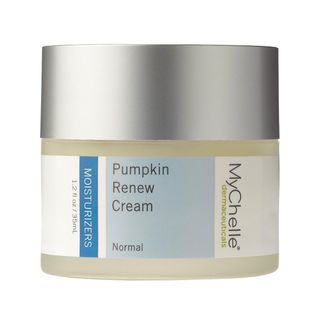
MyChelle Dermaceuticals Pumpkin Renew Cream
Works for
1 of 1 advertised claim delivered
Moisturizing15 ingredients credited for this claimGood support
“Lightweight + Antioxidant Rich An essential lightweight daily moisturizer with antioxidant-rich Pumpkin Seed Oil and Cloudberry Extract to protect and nourish skin.”
This product can help improve hydration of the skin with the two types of ingredients.
The first type is called “humectants”:
these ingredients help attract water.
When humectants are on the surface of the skin, they “pull in” the moisture from the outside environment, or from
within deeper layers of the skin. The following ingredients in this product do the job:
carnosine, fructooligosaccharides.
This product also contains ingredients called “occlusives”. They help reduce the speed with which our skin loses moisture to the outside environment. These ingredients also help soften the upper layer of the skin, so it feels less tight and nicer to the touch. The following ingredients in this product do the job: butyrospermum parkii butter, caprylic/capric triglyceride.
Anti-oxidationNot advertised by the brand · 11 ingredients credited for this claimStrong support
This product contains antioxidants (astaxanthin, carnosine, tocotrienols) that can help neutralize free radicals in skin. By doing so, they can lessen the damage the skin gets from the UV light (sun).
Anti-agingNot advertised by the brand · 7 ingredients credited for this claimModerate support
This product contains astaxanthin, carnosine, tocotrienols. These ingredients might be able to help reduce and prevent fine lines and wrinkles, improve skin elasticity and firmness, but there is not enough evidence that it actually works.
Can it cause trouble?
Irritancy9 strong irritants: Myristica fragrans kernel oil, Vanilla planifolia fruit extract + 7 more — patch-test recommendedHigh risk
Comedogenic2 ingredients rated 2 or more on the 0–5 pore-clogging scale2 flagged
User reviews
Be the first — your take helps the next person decide.
Ingredients
Filter by role to see what each ingredient is doing.
Water~45–55%
Caprylic/capric triglyceride~5.6–6.9%
- Irritation risk
- Medium
A good mix of fatty acids that forms a protective layer on the skin. Improves the shelf life of products. Derived from coconut and glycerin
More about Caprylic/capric triglycerideGlycerin~4.1–5%
- Irritation risk
- Low
One of the best moisturizing ingredients. Naturally present in skin. It attracts water to the upper layer of the skin working as a humectant
More about GlycerinCoco-caprylate/caprate~3.3–4%
- Irritation risk
- Low
Helps to soften the upper layer of the skin without creating a greasy texture
More about Coco-caprylate/caprateCetearyl alcohol~2.4–3%
- Irritation risk
- Low
- Comedogenicity
- 2/5
A non-drying alcohol. Works as an emollient. Helps water and oil mix together and creates a nice product texture
More about Cetearyl alcoholCetearyl glucoside~2–2.4%
- Irritation risk
- Medium
Helps water and oil in the product mix well together and improves product texture
More about Cetearyl glucosideButyrospermum parkii butter~1.8–2.2%
- Irritation risk
- Low
- Comedogenicity
- 3/5
A great moisturising ingredient that softens the skin and reduces water loss from its upper layer. It also can be helpful in protecting skin from free radicals
More about Butyrospermum parkii butterDicaprylyl ether~1.5–1.8%
- Irritation risk
- Low
Helps soften the upper layer of the skin while creating a non-greasy feel on the skin. Helps to dissolve other ingredients
More about Dicaprylyl etherGlyceryl stearate~1.3–1.5%
- Irritation risk
- Low
An emollient that softens the skin and forms a protective layer on its surface. Helps water and oil mix together
More about Glyceryl stearatePolyglyceryl-4 caprate~1–1.2%
Rubus chamaemorus seed oil~0.7–1.05%
- Irritation risk
- High
A berry extract that can have some anti-oxidant properties. It helps to preserve product formulations and improve their smell. It can be irritating
More about Rubus chamaemorus seed oilCucurbita pepo seed oil~0.6–0.95%
- Irritation risk
- Low
Helps soften the upper layer of the skin
More about Cucurbita pepo seed oilCrocus chrysanthus bulb extract~0.5–0.8%
- Irritation risk
- Low
Phenyl t-butylnitrone~0.5–0.75%
- Irritation risk
- Low
Garcinia mangostana pericarp powder~0.45–0.65%
- Irritation risk
- Low
Euterpe oleracea fruit extract~0.45–0.65%
- Irritation risk
- Medium
A plant extract that can have some anti-oxidant effect in skin
More about Euterpe oleracea fruit extractMyrciaria dubia fruit extract~0.4–0.65%
- Irritation risk
- Medium
A plant extract that might help neutralize free radicals in skin, but research on its effectiveness is lacking
More about Myrciaria dubia fruit extractMyristica fragrans kernel oil~0.35–0.65%
Vanilla planifolia fruit extract~0.3–0.55%
- Irritation risk
- High
A plant extract used as a fragrance. Can be irritating
More about Vanilla planifolia fruit extractEugenia caryophyllus leaf oil~0.25–0.45%
- Irritation risk
- High
An essential oil. Used as a fragrance. Can be irritating and sensitizing
More about Eugenia caryophyllus leaf oilCinnamomum cassia leaf oil~0.25–0.5%
Citrus aurantium dulcis peel oil~0.25–0.5%
- Irritation risk
- High
An essentil oil from orange peel. Potential allergen and can be irritating
More about Citrus aurantium dulcis peel oilLavandula angustifolia oil~0.25–0.45%
- Irritation risk
- High
An essential oil. Potential allergen and can be irritating. It has some anti-bacterial properties
More about Lavandula angustifolia oilLactic acid~0.25–0.45%
- Irritation risk
- Medium
An exfoliating and moisturizing alpha-hydroxy acid (AHA). Typically causes less irritation than other AHAs, for example, glycolic acid. At high concentrations (about 15%), lactic acid can help reduce lines and wrinkles. Recent studies show that lactic acid can support the "good" bacteria living on skin's surface (healthy skin microbiome)
More about Lactic acidTotarol~0.25–0.5%
- Irritation risk
- Low
Astaxanthin~0.25–0.45%
- Irritation risk
- Medium
Helps neutralize free radicals in skin and might help to calm down inflammation
More about AstaxanthinTocotrienols~0.25–0.45%
- Irritation risk
- Low
A type of vitamin E that is more powerful in neutralizing free radicals compared to its other forms
More about TocotrienolsElaeis guineensis oil~0.3–0.55%
- Irritation risk
- Low
Helps soften the upper layer of the skin
More about Elaeis guineensis oilFructooligosaccharides~0.25–0.45%
- Irritation risk
- Low
Help attract water to the upper layer of the skin
More about FructooligosaccharidesCarnosine~0.25–0.45%
- Irritation risk
- Low
A type of peptide. It attracts water to the upper layer of the skin. It can help neutralize free radicals in skin combatting the sun damage
More about CarnosineTocopherol~0.25–0.45%
- Irritation risk
- Low
Pure form of vitamin E. Can help moisturise and protect the skin from free radicals. Often used to help stabilise other ingredients or the formula itself
More about TocopherolGluconolactone~0.2–0.4%
- Irritation risk
- Medium
A polyhydroxy acid (PHA) that helps shed the dead cells from the skin surface revealing smoother skin. Is believed to be genter than AHAs. It helps attract water to the upper layer of the skin and can stimulate production of skin's own hyaluronic acid resulting in improved hydration levels. It has been shown to be helpful against acne and clogged pores if used consistently (e.g over a period of 12 weeks) in high enough concentration. It can help reduce fine lines and wrinkles and improve skin tone with long-term application. Can help neutralize free radicals
More about GluconolactoneAcacia senegal gum~0.25–0.45%
- Irritation risk
- Medium
Helps mask the small of other ingredients and improve the product texture
More about Acacia senegal gumHamamelis virginiana water~0.2–0.35%
- Irritation risk
- High
A plant extract that can help calm down inflammation in skin. Can, however, itself be irritating
More about Hamamelis virginiana waterAlcohol~0.2–0.4%
- Irritation risk
- High
Can be drying and contribute to skin irritation. Used in formulars to dissolve other ingredients, create a thinner product consistency or for its antibacterial properties
More about AlcoholAlcohol denat.~0.2–0.4%
- Irritation risk
- High
Produces temporary toning effect. Can help dissolve other ingredients or preserve products
More about Alcohol denat.Caprylyl glycol~0.25–0.45%
- Irritation risk
- Medium
Helps preserve products and creates a nice product texture
More about Caprylyl glycolXanthan gum~0.2–0.4%
- Irritation risk
- Low
Used to create a thicker product consistency
More about Xanthan gumPolysorbate 20~0.2–0.4%
Phenethyl alcohol~0.15–0.3%
Potassium sorbate~0.2–0.35%
Sodium benzoate~0.15–0.3%
Lonicera caprifolium flower extract~0.1–0.2%
- Irritation risk
- High
A plant extract that might help neutralize free radicals in skin. Can contain volalite oils and be irritating
More about Lonicera caprifolium flower extractLonicera japonica flower extract~0.1–0.2%
- Irritation risk
- High
A plant extract that might help neutralize free radicals in skin. Can contain volalite oils and be irritating
More about Lonicera japonica flower extractIngredient list view
Water, Caprylic/capric triglyceride, Glycerin, Coco-caprylate/caprate, Cetearyl alcohol, Cetearyl glucoside, Butyrospermum parkii butter, Dicaprylyl ether, Glyceryl stearate, Polyglyceryl-4 caprate, Rubus chamaemorus seed oil, Cucurbita pepo seed oil, Crocus chrysanthus bulb extract, Phenyl t-butylnitrone, Garcinia mangostana pericarp powder, Euterpe oleracea fruit extract, Myrciaria dubia fruit extract, Myristica fragrans kernel oil, Vanilla planifolia fruit extract, Eugenia caryophyllus leaf oil, Cinnamomum cassia leaf oil, Citrus aurantium dulcis peel oil, Lavandula angustifolia oil, Lactic acid, Totarol, Astaxanthin, Unknown, Tocotrienols, Elaeis guineensis oil, Fructooligosaccharides, Carnosine, Tocopherol, Gluconolactone, Acacia senegal gum, Hamamelis virginiana water, Alcohol, Alcohol denat., Caprylyl glycol, Xanthan gum, Polysorbate 20, Phenethyl alcohol, Potassium sorbate, Sodium benzoate, Lonicera caprifolium flower extract, Lonicera japonica flower extract
Compare prices
Retailers ranked by price — lowest first.
.png)
Sources cited in this review
Every concentration estimate and effectiveness label is anchored to one of these 34 studies and safety reviews.
- 1
- 2Safety Assessment of Alkyl Esters as Used in Cosmeticscir-safety.org
- 3
- 4
- 5
- 6Epidermal and dermal effects of topical lactic acidncbi.nlm.nih.gov

Affiliate links · As an Amazon Associate, WIMJ earns from qualifying purchases.