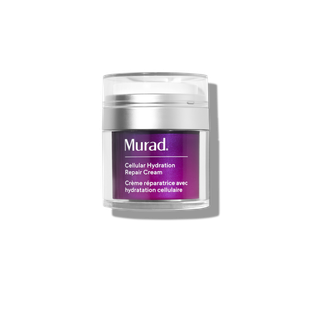
Murad UK Cellular Hydration Barrier Repair Cream
Works for
1 of 1 advertised claim delivered
Moisturizing21 ingredients credited for this claimStrong support
“Daily nourishing cream with fatty acids from bilberry omegas that immediately repairs dry, flaky skin at the cellular level”
This product can help improve hydration of the skin with the two types of ingredients.
The first type is called “humectants”:
these ingredients help attract water.
When humectants are on the surface of the skin, they “pull in” the moisture from the outside environment, or from
within deeper layers of the skin. The following ingredients in this product do the job:
betaine, galactoarabinan.
This product also contains ingredients called “occlusives”. They help reduce the speed with which our skin loses moisture to the outside environment. These ingredients also help soften the upper layer of the skin, so it feels less tight and nicer to the touch. The following ingredients in this product do the job: squalane, cetylhydroxyproline palmitamide.
The following ingredients in this product are especially good for supporting the skin barrier and helping with the hydration level: niacinamide, urea
Evens skin toneNot advertised by the brand · 2 ingredients credited for this claimStrong support
This product can help reduce hypepigmentation and even out the skin tone because it contains the following effective ingredients: niacinamide
Keep in mind that you would need to apply any topical skincare targetted at hypigmentation consistently for a couple of months to get a result. No topical skincare product can help get rid of hyperpigmentation (including post-acne marks and age spots) instantly.
Anti-blemishNot advertised by the brand · 3 ingredients credited for this claimStrong support
This product can help reduce breakouts and clogged pores because it contains the following ingredient: niacinamide. This ingredient is used for treating acne and can have a noticeable effect.
Anti-agingNot advertised by the brand · 3 ingredients credited for this claimStrong support
This product can help reduce and prevent fine lines and wrinkles, improve skin elasticity and firmness because it contains niacinamide.
Keep in mind that it typically takes at least 6 weeks to notice any results because the changes that are needed to improve fine lines and elasticity happen in the deeper layers of the skin. No topical anti-aging product can “erase” wrinkles or fully reverse signs of aging.
Can it cause trouble?
Irritancy3 strong irritants: Limonene, Linalool + 1 more — patch-test recommendedHigh risk
Comedogenic1 ingredient rated 2 or more on the 0–5 pore-clogging scale1 flagged

User reviews
Be the first — your take helps the next person decide.
Ingredients
Filter by role to see what each ingredient is doing.
Water~45–55%
Squalane~4.8–5.9%
- Irritation risk
- Low
An oil naturally present in skin. Works as an emollient to soften the skin and form a protective layer on its surface without a greasy feeling.
More about SqualaneGlycerin~4.2–5.2%
- Irritation risk
- Low
One of the best moisturizing ingredients. Naturally present in skin. It attracts water to the upper layer of the skin working as a humectant
More about GlycerinCocoglycerides~2.9–3.6%
- Irritation risk
- High
Help soften the upper layer of the skin and make it easier for oil and water mix together. Recently, a rising number of allergic reactions to cocoglycerides and other coconut-derived surfactants has been reported. As there is a significant overlap between frequent irritants and allergens, we flag this ingredient for attention of those with very sensitive, reactive skin
More about CocoglyceridesPentylene glycol~2.4–3%
- Irritation risk
- Medium
Used to preserve products, dissolve other ingredients and create a nice product texture
More about Pentylene glycolHydrogenated rapeseed oil~2–2.5%
- Irritation risk
- Low
Vaccinium myrtillus seed oil~1.7–2%
- Irritation risk
- Low
Isopentyldiol~1.5–1.8%
C10-18 triglycerides~1.3–1.5%
- Irritation risk
- Low
Helps soften the skin and attract water to its upper layer. Helps create nice product texture
More about C10-18 triglyceridesNiacinamide~1–1.3%
- Irritation risk
- Low
Is proven to be effective in reducing blemishes, evening out skin tone and helping to improve lines and wrinkles. It helps the skin to repair sun damage, calm down inflammation and keep maintain good levels of moisture. The concentration of about 2% is effective for supporting the skin barrier and evening out the skin tone. Concentration of 4-6% is better for helping with acne and balancing the sebum production
More about NiacinamideCandelilla/jojoba/rice bran polyglyceryl-3 esters~0.75–1.15%
- Irritation risk
- Medium
Help oil and water mix together
More about Candelilla/jojoba/rice bran polyglyceryl-3 estersPolyglyceryl-10 distearate~0.65–1%
- Irritation risk
- Medium
Helps water and oil mix together
More about Polyglyceryl-10 distearate4-t-butylcyclohexanol~0.6–0.85%
- Irritation risk
- Low
Potassium cetyl phosphate~0.6–0.9%
- Irritation risk
- Medium
Helps oil and water mix together
More about Potassium cetyl phosphateAllantoin~0.5–0.75%
- Irritation risk
- Low
Helps calm down inflammation in skin and can help reduce itching. Helps to repair the skin barrier and keep skin hydrated
More about AllantoinGalactoarabinan~0.55–0.8%
- Irritation risk
- Medium
Helps attract water to the upper layer of the skin
More about GalactoarabinanBisabolol~0.45–0.7%
- Irritation risk
- Low
An active component of chamomile plant that historically has been used to calm down irritated skin. A recent study shows that bisabolol indeed can have some anti-inflammatory effect on skin, even though conclusive data is lacking. Bisabolol has a sweet floral scent and can be added to products for its aromatic properties
More about BisabololCetylhydroxyproline palmitamide~0.5–0.75%
- Irritation risk
- Low
A type of lipid similar to ceramides naturally present in skin. Helps to soften the upper layer of the skin and supports the skin barrier function to keep it hydrated. Can help to prevent inflammation in skin
More about Cetylhydroxyproline palmitamideBrassica campestris sterols~0.5–0.7%
- Irritation risk
- Low
Help soften the upper layer of the skin
More about Brassica campestris sterolsHydroxyphenyl propamidobenzoic acid~0.4–0.65%
- Irritation risk
- Low
Might help to reduce inflammation in skin, but solid research is lacking
More about Hydroxyphenyl propamidobenzoic acidUrea~0.4–0.6%
- Irritation risk
- Low
Naturally present in skin (urea makes up about 7% of natural moisturizing factors in skin). Attracts water to the upper layer of the skin. Also has a positive effect on the skin barrier beyond the humectant action. Can enhance penetration of other ingredients. Is an exfoliating ingredient when used in high concentrations
More about UreaYeast amino acids~0.35–0.65%
- Irritation risk
- Low
Trehalose~0.35–0.6%
- Irritation risk
- Low
A sugar that attracts water to the upper layer of the skin
More about TrehaloseInositol~0.35–0.6%
Taurine~0.35–0.65%
- Irritation risk
- Medium
Could be helpful in reducing inflammation in skin, evening out the skin tone and neutralizing free radicals, but more research is needed to confirm its effectiveness
More about TaurineBetaine~0.35–0.6%
- Irritation risk
- Low
Helps attract water to the upper layer of the skin and improves the product texture
More about BetaineHydroxyacetophenone~0.35–0.65%
Tocopherol~0.35–0.65%
- Irritation risk
- Low
Pure form of vitamin E. Can help moisturise and protect the skin from free radicals. Often used to help stabilise other ingredients or the formula itself
More about TocopherolAscorbyl palmitate~0.35–0.6%
- Irritation risk
- Medium
Being a lipid soluble form of vitamin C, it is more stable and can penetrate the skin better than L-Ascorbic acid. It is effective in protecting the skin from free radicals, as well as evening the skin tone, but is less effective in stimulating collagen production compared to L-Ascorbic acid.
More about Ascorbyl palmitateHexyldecanol~0.4–0.6%
- Irritation risk
- Low
Helps soften the upper layer of the skin
More about HexyldecanolEthylhexylglycerin~0.35–0.65%
Butylene glycol~0.35–0.6%
- Irritation risk
- Low
Used to create a nice product texture and help delivery of other ingredients. Might be somewhat helpful in attracting water to the upper layer of the skin
More about Butylene glycolGlyceryl stearate~0.45–0.65%
- Irritation risk
- Low
An emollient that softens the skin and forms a protective layer on its surface. Helps water and oil mix together
More about Glyceryl stearateCetearyl alcohol~0.45–0.65%
- Irritation risk
- Low
- Comedogenicity
- 2/5
A non-drying alcohol. Works as an emollient. Helps water and oil mix together and creates a nice product texture
More about Cetearyl alcoholSodium polyacrylate~0.4–0.6%
- Irritation risk
- Low
Used to create a gel-like product texture, as well as to stabilize emulsions
More about Sodium polyacrylateSodium polyacryloyldimethyl taurate~0.35–0.6%
- Irritation risk
- Medium
Helps oil and water mix together
More about Sodium polyacryloyldimethyl taurateSodium stearoyl lactylate~0.35–0.6%
- Irritation risk
- Medium
Helps oil and water mix together
More about Sodium stearoyl lactylateXanthan gum~0.3–0.6%
- Irritation risk
- Low
Used to create a thicker product consistency
More about Xanthan gumStearic acid~0.45–0.7%
- Irritation risk
- Low
Helps oil and water mix together and works as an emollient
More about Stearic acidXylitol~0.3–0.55%
- Irritation risk
- Low
Helps attract water to the upper layer of the skin and repair the skin barrier function
More about XylitolCaprylic acid~0.35–0.6%
Leuconostoc/radish root ferment filtrate~0.25–0.5%
- Irritation risk
- Medium
A preservative that comes from radishes fermented by a bacteria. New research suggests that the preservation properties in the ingredient come from an ammonium salt that is not present naturally in radish root but used in its cultivation. Is problematic because the exact amount of the preservative agents is difficult to determine
More about Leuconostoc/radish root ferment filtrateTetrasodium glutamate diacetate~0.25–0.45%
- Irritation risk
- Low
Helps stabilize the product formulation
More about Tetrasodium glutamate diacetateCitric acid~0.2–0.4%
- Irritation risk
- Medium
Can work as an exfoliant but is typically used to adjust the product pH
More about Citric acidChlorphenesin~0.15–0.25%
Dehydroacetic acid~0.1–0.2%
Caprylyl glycol~0.2–0.35%
- Irritation risk
- Medium
Helps preserve products and creates a nice product texture
More about Caprylyl glycolLimonene~0.1–0.25%
- Irritation risk
- High
A common frangrance that can easily irritate skin, especially if exposed to air, light or heat
More about LimoneneLinalool~0.05–0.15%
Parfum~0.05–0.1%
- Irritation risk
- High
An aromatic blend of unspecified and possibly irritating ingredients
More about ParfumIngredient list view
Water, Squalane, Glycerin, Cocoglycerides, Pentylene glycol, Hydrogenated rapeseed oil, Vaccinium myrtillus seed oil, Isopentyldiol, C10-18 triglycerides, Niacinamide, Candelilla/jojoba/rice bran polyglyceryl-3 esters, Polyglyceryl-10 distearate, 4-t-butylcyclohexanol, Potassium cetyl phosphate, Allantoin, Galactoarabinan, Bisabolol, Cetylhydroxyproline palmitamide, Brassica campestris sterols, Hydroxyphenyl propamidobenzoic acid, Urea, Yeast amino acids, Trehalose, Inositol, Taurine, Betaine, Hydroxyacetophenone, Tocopherol, Ascorbyl palmitate, Hexyldecanol, Ethylhexylglycerin, Butylene glycol, Glyceryl stearate, Cetearyl alcohol, Sodium polyacrylate, Sodium polyacryloyldimethyl taurate, Sodium stearoyl lactylate, Xanthan gum, Stearic acid, Xylitol, Caprylic acid, Leuconostoc/radish root ferment filtrate, Tetrasodium glutamate diacetate, Citric acid, Chlorphenesin, Dehydroacetic acid, Caprylyl glycol, Limonene, Linalool, Parfum
Compare prices
Retailers ranked by price — lowest first.
Affiliate links · prices updated regularly
Worth comparing, line by line.
Match % combines shared ingredients, the first five ingredients, shared actives and hero ingredients, irritancy (lower counts in the alternative's favour), texture and body area. Only products in the same routine step are compared.
| Murad UKCellular Hydration Barrier Repair CreamYOUR PRODUCT | The Grey MenCOMFORT+ FACE CREAM | Perricone MDHigh Potency Classics Hyaluronic Intensive Moisturiser | MuradEssential-C Firming Radiance Day Cream | |
|---|---|---|---|---|
| Match | — | 91% | 89% | 88% |
| Price | $91.22 | $100.00+$8.78 | $61.01−$30.21 | $92.01+$0.79 |
| Shared key ingredients | — | 6 of 13 | 7 of 13 | 7 of 13 |
| Key difference | — | Saccharomyces/Copper Ferment | Tetrahexyldecyl Ascorbate | Tetrahexyldecyl Ascorbate |
| Irritancy | High | Low | Medium | High |
| Drying alcohol | — | — | — | — |
| View product | Shop | Shop | Shop |


Sources cited in this review
Every concentration estimate and effectiveness label is anchored to one of these 10 studies and safety reviews.
- 1
- 2
- 3
- 4
- 5
- 6Topical urea in skincare: A reviewpubmed.ncbi.nlm.nih.gov

Affiliate links · As an Amazon Associate, WIMJ earns from qualifying purchases.