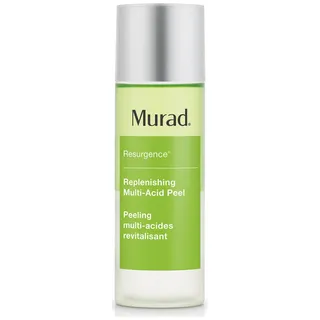
Murad Replenishing Multi-Acid Peel

Murad Replenishing Multi-Acid Peel

Efficacy100/100IrritancyMedium

Works for

Anti-aging
Glycolic acid, Lactic acid
Works well
What the product description says
“Unlike other peels that only remove the surface layer of skin, Replenishing Multi-Acid Peel combines multi-level exfoliation, youth-boosting treatment and intensive nourishment to take your skin from dull to glow in just one step—all while being gentle on skin.”
Source: Murad

This product can help reduce and prevent fine lines and wrinkles, improve skin elasticity and firmness because it contains glycolic acid.

Keep in mind that it typically takes at least 6 weeks to notice any results because the changes that are needed to improve fine lines and elasticity happen in the deeper layers of the skin. No topical anti-aging product can “erase” wrinkles or fully reverse signs of aging.

Glycolic acidKey activeEffect: HighAn alpha-hydroxy acid (AHA) that helps to remove the dead skin cells on the surface of the skin reveling a more even, smoother complexation. It is also able to stimulate collagen production with long-term use. Could help to reduce pore congestion. It can be irritating to the skin. Apply sunscreen daily if using products with glycolic acid~3.2–3.9%
Lactic acidUnder-dosedAn exfoliating and moisturizing alpha-hydroxy acid (AHA). Typically causes less irritation than other AHAs, for example, glycolic acid. At high concentrations (about 15%), lactic acid can help reduce lines and wrinkles. Recent studies show that lactic acid can support the "good" bacteria living on skin's surface (healthy skin microbiome)~0.95–1.15%
Exfoliation
Glycolic acid, Salicylic acid + 2 more
Works well
What the product description says
“Replenishing Multi-Acid Peel”
Source: Murad

This product can help exfoliate the skin. In other words, it helps break down the bonds between dead cells on the surface of the skin and speed up the skin turnover. Skin often appears softer and brighter after exfoliation, but overdoing it can result in disrupted skin barrier. The following ingredient is doing the exfoliating job in this product: glycolic acid, salicylic acid.

Glycolic acidKey activeEffect: HighAn alpha-hydroxy acid (AHA) that helps to remove the dead skin cells on the surface of the skin reveling a more even, smoother complexation. It is also able to stimulate collagen production with long-term use. Could help to reduce pore congestion. It can be irritating to the skin. Apply sunscreen daily if using products with glycolic acid~3.2–3.9%
Salicylic acidKey activeEffect: HighUsed for skin exfoliation. It has an anti-inflammatory and anti-bacterial effect, helps to unclog pores, prevent blemishes and speed up healing of the existing ones. Sometimes referred to as a BHA (beta-hydroxy acid)~0.45–0.7%
UreaKey activeEffect: MediumNaturally present in skin (urea makes up about 7% of natural moisturizing factors in skin). Attracts water to the upper layer of the skin. Also has a positive effect on the skin barrier beyond the humectant action. Can enhance penetration of other ingredients. Is an exfoliating ingredient when used in high concentrations~0.2–0.4%
Lactic acidUnder-dosedAn exfoliating and moisturizing alpha-hydroxy acid (AHA). Typically causes less irritation than other AHAs, for example, glycolic acid. At high concentrations (about 15%), lactic acid can help reduce lines and wrinkles. Recent studies show that lactic acid can support the "good" bacteria living on skin's surface (healthy skin microbiome)~0.95–1.15%
Evens skin tone
Glycolic acid, Tranexamic acid + 3 more
Works well
What the product description says
“TXA fights discolouration, promoting a more even skin tone.”
Source: Mankind

This product can help reduce hypepigmentation and even out the skin tone because it contains the following effective ingredients: glycolic acid, salicylic acid, tranexamic acid

Keep in mind that you would need to apply any topical skincare targetted at hypigmentation consistently for a couple of months to get a result. No topical skincare product can help get rid of hyperpigmentation (including post-acne marks and age spots) instantly.

Glycolic acidKey activeEffect: HighAn alpha-hydroxy acid (AHA) that helps to remove the dead skin cells on the surface of the skin reveling a more even, smoother complexation. It is also able to stimulate collagen production with long-term use. Could help to reduce pore congestion. It can be irritating to the skin. Apply sunscreen daily if using products with glycolic acid~3.2–3.9%
Tranexamic acidKey activeEffect: HighAn amino acid that is effective in reducing hyperpigmentation and evening out the skin tone. It can also help in skin barrier recovery. It is used to treat melasma, especially with injections and when taken orally~0.55–0.85%
Salicylic acidEffect: LowUsed for skin exfoliation. It has an anti-inflammatory and anti-bacterial effect, helps to unclog pores, prevent blemishes and speed up healing of the existing ones. Sometimes referred to as a BHA (beta-hydroxy acid)~0.45–0.7%
TaurineEffect: LowCould be helpful in reducing inflammation in skin, evening out the skin tone and neutralizing free radicals, but more research is needed to confirm its effectiveness~0.15–0.3%
Lactic acidUnder-dosedAn exfoliating and moisturizing alpha-hydroxy acid (AHA). Typically causes less irritation than other AHAs, for example, glycolic acid. At high concentrations (about 15%), lactic acid can help reduce lines and wrinkles. Recent studies show that lactic acid can support the "good" bacteria living on skin's surface (healthy skin microbiome)~0.95–1.15%
Anti-blemish
Salicylic acid, Glycolic acid + 2 more
Works well
What the product description says
“Harnessing acne-fighting properties, these two ingredients help to soothe blemishes and revive stressed complexions.”
Source: Mankind

This product can help reduce breakouts and clogged pores because it contains the following ingredient: salicylic acid. This ingredient is used for treating acne and can have a noticeable effect.

The following ingredient (ingredients) in this product might be helpful, but there is no evidence to confirm that it actually works: glycolic acid

Salicylic acidHeroEffect: HighUsed for skin exfoliation. It has an anti-inflammatory and anti-bacterial effect, helps to unclog pores, prevent blemishes and speed up healing of the existing ones. Sometimes referred to as a BHA (beta-hydroxy acid)~0.45–0.7%
Glycolic acidKey activeEffect: MediumAn alpha-hydroxy acid (AHA) that helps to remove the dead skin cells on the surface of the skin reveling a more even, smoother complexation. It is also able to stimulate collagen production with long-term use. Could help to reduce pore congestion. It can be irritating to the skin. Apply sunscreen daily if using products with glycolic acid~3.2–3.9%
Melia azadirachta leaf extractEffect: LowA plant extract that has anti-bacterial properties. Can be used to preserve the product. Can be irritating~0.3–0.6%
TaurineEffect: LowCould be helpful in reducing inflammation in skin, evening out the skin tone and neutralizing free radicals, but more research is needed to confirm its effectiveness~0.15–0.3%
Moisturizing
Urea, Caprylic/capric triglyceride + 12 more
Works well
What the product description says
“Daily bi-phase peel accelerates cell renewal by 33% in 7 days while nourishing skin to prevent dryness and reduce irritation.”
Source: Murad

This product can help improve hydration of the skin with the two types of ingredients.

The first type is called “humectants”:
these ingredients help attract water. When humectants are on the surface of the skin, they “pull in” the moisture from the outside environment, or from within deeper layers of the skin. The following ingredients in this product do the job: betaine, glycerin.

This product also contains ingredients called “occlusives”. They help reduce the speed with which our skin loses moisture to the outside environment. These ingredients also help soften the upper layer of the skin, so it feels less tight and nicer to the touch. The following ingredients in this product do the job: caprylic/capric triglyceride, simmondsia chinensis seed oil.

The following ingredients in this product are especially good for supporting the skin barrier and helping with the hydration level: urea

UreaHero· HumectantEffect: HighNaturally present in skin (urea makes up about 7% of natural moisturizing factors in skin). Attracts water to the upper layer of the skin. Also has a positive effect on the skin barrier beyond the humectant action. Can enhance penetration of other ingredients. Is an exfoliating ingredient when used in high concentrations~0.2–0.4%
Caprylic/capric triglycerideKey active· Emollient, OcclusiveEffect: HighA good mix of fatty acids that forms a protective layer on the skin. Improves the shelf life of products. Derived from coconut and glycerin~6.2–7.6%
C13-16 isoparaffinKey active· EmollientEffect: HighIs mostly used to dissolve other ingredients. Helps soften the upper layer of the skin. It might be comedogenic when used in high concentrations~4.5–5.5%
Simmondsia chinensis seed oilKey active· Emollient, OcclusiveEffect: HighSoftens the upper layer of skin and helps restore the healthy skin barrier. Has shown to help calm down inflammation in skin. It is a stable oil, meaning that it retains its properties even when exposed to air.~2.5–3.1%
TrioleinKey activeEffect: HighHelps soften the upper layer of the skin~2–2.4%
GlycerinKey active· HumectantEffect: HighOne of the best moisturizing ingredients. Naturally present in skin. It attracts water to the upper layer of the skin working as a humectant~1.8–2.2%
Tranexamic acidKey activeEffect: HighAn amino acid that is effective in reducing hyperpigmentation and evening out the skin tone. It can also help in skin barrier recovery. It is used to treat melasma, especially with injections and when taken orally~0.55–0.85%
Sodium hyaluronateKey active· HumectantEffect: HighOne of the best moisturizing ingredients. Attracts water into the upper layer of the skin~0.45–0.7%
Corallina officinalis extractKey activeEffect: HighRed algae extract that helps attract water to the upper layer of the skin and might contain antioxidants~0.2–0.4%
TrehaloseKey active· HumectantEffect: HighA sugar that attracts water to the upper layer of the skin~0.2–0.35%
InositolKey active· HumectantEffect: High~0.15–0.3%
BetaineKey active· HumectantEffect: HighHelps attract water to the upper layer of the skin and improves the product texture~0.15–0.25%
Moringa oleifera seed oil· EmollientEffect: LowA plant oil that helps soften the upper layer of the skin. Is unlikely to be helpful in restoring skin barrier function due to the low content of linoleic acid~0.25–0.5%
Lactic acidUnder-dosedAn exfoliating and moisturizing alpha-hydroxy acid (AHA). Typically causes less irritation than other AHAs, for example, glycolic acid. At high concentrations (about 15%), lactic acid can help reduce lines and wrinkles. Recent studies show that lactic acid can support the "good" bacteria living on skin's surface (healthy skin microbiome)~0.95–1.15%

Can it cause trouble?

Irritancy
1 strong irritant: Ocimum sanctum leaf extract
Medium risk
We flagged 16 ingredients with irritancy potential. Severity depends on your sensitivity threshold; the table lists the worst offenders first.
IngredientFunctionIrritationEst. amount
Glycolic acidAn alpha-hydroxy acid (AHA) that helps to remove the dead skin cells on the surface of the skin reveling a more even, smoother complexation. It is also able to stimulate collagen production with long-term use. Could help to reduce pore congestion. It can be irritating to the skin. Apply sunscreen daily if using products with glycolic acidHigh~3.2–3.9%est.
Salicylic acidUsed for skin exfoliation. It has an anti-inflammatory and anti-bacterial effect, helps to unclog pores, prevent blemishes and speed up healing of the existing ones. Sometimes referred to as a BHA (beta-hydroxy acid)High~0.45–0.7%est.
Ocimum sanctum leaf extractA plant extract that is rich in a fragrance compound eugenol that is a frequent allergen and can be irritating. It might also contain anti-oxidants to help neutralize free radicalsHigh~0.4–0.6%est.
Melia azadirachta leaf extractA plant extract that has anti-bacterial properties. Can be used to preserve the product. Can be irritatingHigh~0.3–0.6%est.
Curcuma longa root extractA plant extract that can contain an active compound curcumin, that may have some anti-inflammatory properties when applied to the skin, but solid research is lacking and the typical concentration used in skincare products is too low. Can be an irritantHigh~0.2–0.4%est.
Caprylic/capric triglycerideA good mix of fatty acids that forms a protective layer on the skin. Improves the shelf life of products. Derived from coconut and glycerinMedium~6.2–7.6%est.
Simmondsia chinensis seed oilSoftens the upper layer of skin and helps restore the healthy skin barrier. Has shown to help calm down inflammation in skin. It is a stable oil, meaning that it retains its properties even when exposed to air.Medium~2.5–3.1%est.
Lactic acidAn exfoliating and moisturizing alpha-hydroxy acid (AHA). Typically causes less irritation than other AHAs, for example, glycolic acid. At high concentrations (about 15%), lactic acid can help reduce lines and wrinkles. Recent studies show that lactic acid can support the "good" bacteria living on skin's surface (healthy skin microbiome)Medium~0.95–1.15%est.
Tocopheryl acetateA more stable but less bio-available form of vitamin E compared to Tocopherol. Might help moisturize and protect the skin from free radicals, but mostly used in low concentrations to stabilize other ingredients.Medium~0.45–0.65%est.
Melia azadirachta flower extractA plant extract that might be helpful to neutralize free radicals in skinMedium~0.3–0.55%est.
Coccinia indica fruit extractA plant extract that might have some anti-oxidant effect helping neutralize free radicals in skinMedium~0.25–0.5%est.
Solanum melongena fruit extractEggplant fruit extract. Might have some anti-oxidant effectMedium~0.25–0.4%est.
Moringa oleifera seed oilA plant oil that helps soften the upper layer of the skin. Is unlikely to be helpful in restoring skin barrier function due to the low content of linoleic acidMedium~0.25–0.5%est.
TaurineCould be helpful in reducing inflammation in skin, evening out the skin tone and neutralizing free radicals, but more research is needed to confirm its effectivenessMedium~0.15–0.3%est.
Caprylhydroxamic acidA preservativeMedium~0.1–0.15%est.
1,2-hexanediolA preservativeMedium~0.1–0.15%est.
Comedogenic
1 ingredient rated 2 or more on the 0–5 pore-clogging scale
1 flagged
These ingredients have a comedogenic rating of 2 or more on a 0–5 scale; the table shows each one's rating. In leave-on products they can clog pores in acne-prone skin.
IngredientFunctionRatingEst. amount
Corallina officinalis extractRed algae extract that helps attract water to the upper layer of the skin and might contain antioxidants3/5~0.2–0.4%est.

User reviews

Would you recommend?
No community reviews yet.

Be the first — your take helps the next person decide.

Ingredients

Filter by role to see what each ingredient is doing.

Water~45–55%
Formula
Irritation risk
Low

Plain old water

More about Water
Caprylic/capric triglyceride~6.2–7.6%
Key activeIrritant · medium
Irritation risk
Medium
Works for
Moisturizing

A good mix of fatty acids that forms a protective layer on the skin. Improves the shelf life of products. Derived from coconut and glycerin

More about Caprylic/capric triglyceride
C13-16 isoparaffin~4.5–5.5%
Key active
Irritation risk
Low
Works for
Moisturizing

Is mostly used to dissolve other ingredients. Helps soften the upper layer of the skin. It might be comedogenic when used in high concentrations

More about C13-16 isoparaffin
Glycolic acid~3.2–3.9%
Key activeIrritant · high
Irritation risk
High
Works for
ExfoliationAnti-agingEvens skin toneAnti-blemish

An alpha-hydroxy acid (AHA) that helps to remove the dead skin cells on the surface of the skin reveling a more even, smoother complexation. It is also able to stimulate collagen production with long-term use. Could help to reduce pore congestion. It can be irritating to the skin. Apply sunscreen daily if using products with glycolic acid

More about Glycolic acid
Simmondsia chinensis seed oil~2.5–3.1%
Key activeIrritant · medium
Irritation risk
Medium
Works for
Moisturizing

Softens the upper layer of skin and helps restore the healthy skin barrier. Has shown to help calm down inflammation in skin. It is a stable oil, meaning that it retains its properties even when exposed to air.

More about Simmondsia chinensis seed oil
Triolein~2–2.4%
Key active
Irritation risk
Low
Works for
Moisturizing

Helps soften the upper layer of the skin

More about Triolein
Glycerin~1.8–2.2%
Key active
Irritation risk
Low
Works for
Moisturizing

One of the best moisturizing ingredients. Naturally present in skin. It attracts water to the upper layer of the skin working as a humectant

More about Glycerin
Sodium hydroxide~1.4–1.7%
Formula
Irritation risk
Low

Used to adjust the product's pH

More about Sodium hydroxide
Propylene glycol caprylate~1.2–1.4%
Formula
Irritation risk
Low
Works for
Cleansing
More about Propylene glycol caprylate
Lactic acid~0.95–1.15%
Under-dosedIrritant · medium
Irritation risk
Medium
Works for
Evens skin toneMoisturizingExfoliationAnti-aging

An exfoliating and moisturizing alpha-hydroxy acid (AHA). Typically causes less irritation than other AHAs, for example, glycolic acid. At high concentrations (about 15%), lactic acid can help reduce lines and wrinkles. Recent studies show that lactic acid can support the "good" bacteria living on skin's surface (healthy skin microbiome)

More about Lactic acid
Malic acid~0.7–1.05%
Formula
Irritation risk
Low

Helps adjust the product pH

More about Malic acid
Tranexamic acid~0.55–0.85%
Key active
Irritation risk
Low
Works for
MoisturizingEvens skin tone

An amino acid that is effective in reducing hyperpigmentation and evening out the skin tone. It can also help in skin barrier recovery. It is used to treat melasma, especially with injections and when taken orally

More about Tranexamic acid
Salicylic acid~0.45–0.7%
Hero · Anti-blemishIrritant · high
Irritation risk
High
Works for
Anti-inflammatoryAnti-blemishExfoliationAntibacterialEvens skin tone

Used for skin exfoliation. It has an anti-inflammatory and anti-bacterial effect, helps to unclog pores, prevent blemishes and speed up healing of the existing ones. Sometimes referred to as a BHA (beta-hydroxy acid)

More about Salicylic acid
Sodium hyaluronate~0.45–0.7%
Key active
Irritation risk
Low
Works for
Moisturizing

One of the best moisturizing ingredients. Attracts water into the upper layer of the skin

More about Sodium hyaluronate
Bisabolol~0.35–0.65%
Formula
Irritation risk
Low
Works for
Anti-inflammatoryReduces irritationAnti-oxidation

An active component of chamomile plant that historically has been used to calm down irritated skin. A recent study shows that bisabolol indeed can have some anti-inflammatory effect on skin, even though conclusive data is lacking. Bisabolol has a sweet floral scent and can be added to products for its aromatic properties

More about Bisabolol
Tocopheryl acetate~0.45–0.65%
Irritant · medium
Irritation risk
Medium
Works for
Anti-oxidation

A more stable but less bio-available form of vitamin E compared to Tocopherol. Might help moisturize and protect the skin from free radicals, but mostly used in low concentrations to stabilize other ingredients.

More about Tocopheryl acetate
Ocimum sanctum leaf extract~0.4–0.6%
Irritant · high
Irritation risk
High
Works for
Anti-oxidation

A plant extract that is rich in a fragrance compound eugenol that is a frequent allergen and can be irritating. It might also contain anti-oxidants to help neutralize free radicals

More about Ocimum sanctum leaf extract
Melia azadirachta leaf extract~0.3–0.6%
Irritant · high
Irritation risk
High
Works for
AntibacterialAnti-blemish

A plant extract that has anti-bacterial properties. Can be used to preserve the product. Can be irritating

More about Melia azadirachta leaf extract
Melia azadirachta flower extract~0.3–0.55%
Irritant · medium
Irritation risk
Medium
Works for
Anti-oxidation

A plant extract that might be helpful to neutralize free radicals in skin

More about Melia azadirachta flower extract
Amino esters-1~0.3–0.5%
Formula
Irritation risk
Low
More about Amino esters-1
Amber powder~0.25–0.5%
Formula
Irritation risk
Low

Does not have proven skin benefits

More about Amber powder
Coccinia indica fruit extract~0.25–0.5%
Irritant · medium
Irritation risk
Medium
Works for
Anti-oxidation

A plant extract that might have some anti-oxidant effect helping neutralize free radicals in skin

More about Coccinia indica fruit extract
Solanum melongena fruit extract~0.25–0.4%
Irritant · medium
Irritation risk
Medium
Works for
Anti-oxidation

Eggplant fruit extract. Might have some anti-oxidant effect

More about Solanum melongena fruit extract
Curcuma longa root extract~0.2–0.4%
Irritant · high
Irritation risk
High
Works for
Anti-inflammatory

A plant extract that can contain an active compound curcumin, that may have some anti-inflammatory properties when applied to the skin, but solid research is lacking and the typical concentration used in skincare products is too low. Can be an irritant

More about Curcuma longa root extract
Corallina officinalis extract~0.2–0.4%
Key activeComedogenic 3/5
Irritation risk
Low
Comedogenicity
3/5
Works for
MoisturizingAnti-oxidation

Red algae extract that helps attract water to the upper layer of the skin and might contain antioxidants

More about Corallina officinalis extract
Moringa oleifera seed oil~0.25–0.5%
Irritant · medium
Irritation risk
Medium
Works for
Moisturizing

A plant oil that helps soften the upper layer of the skin. Is unlikely to be helpful in restoring skin barrier function due to the low content of linoleic acid

More about Moringa oleifera seed oil
Urea~0.2–0.4%
Hero · Moisturizing
Irritation risk
Low
Works for
MoisturizingExfoliation

Naturally present in skin (urea makes up about 7% of natural moisturizing factors in skin). Attracts water to the upper layer of the skin. Also has a positive effect on the skin barrier beyond the humectant action. Can enhance penetration of other ingredients. Is an exfoliating ingredient when used in high concentrations

More about Urea
Yeast amino acids~0.2–0.4%
Formula
Trehalose~0.2–0.35%
Key active
Irritation risk
Low
Works for
Moisturizing

A sugar that attracts water to the upper layer of the skin

More about Trehalose
Inositol~0.15–0.3%
Key active
Irritation risk
Low
Works for
Moisturizing
More about Inositol
Taurine~0.15–0.3%
Irritant · medium
Irritation risk
Medium
Works for
Anti-inflammatoryAnti-oxidationAnti-blemishEvens skin tone

Could be helpful in reducing inflammation in skin, evening out the skin tone and neutralizing free radicals, but more research is needed to confirm its effectiveness

More about Taurine
Betaine~0.15–0.25%
Key active
Irritation risk
Low
Works for
Moisturizing

Helps attract water to the upper layer of the skin and improves the product texture

More about Betaine
Caprylhydroxamic acid~0.1–0.15%
Irritant · medium
Irritation risk
Medium

A preservative

More about Caprylhydroxamic acid
Propanediol~0.1–0.2%
Formula
Irritation risk
Low

Acts as a solvent for other ingredients. Speeds up the absorption of other ingredients into the skin

More about Propanediol
1,2-hexanediol~0.1–0.15%
Irritant · medium
Irritation risk
Medium

A preservative

More about 1,2-hexanediol
Ingredient list view

Water, Caprylic/capric triglyceride, C13-16 isoparaffin, Glycolic acid, Simmondsia chinensis seed oil, Triolein, Glycerin, Sodium hydroxide, Propylene glycol caprylate, Lactic acid, Malic acid, Tranexamic acid, Salicylic acid, Sodium hyaluronate, Bisabolol, Tocopheryl acetate, Ocimum sanctum leaf extract, Melia azadirachta leaf extract, Melia azadirachta flower extract, Amino esters-1, Amber powder, Coccinia indica fruit extract, Solanum melongena fruit extract, Curcuma longa root extract, Corallina officinalis extract, Moringa oleifera seed oil, Urea, Yeast amino acids, Trehalose, Inositol, Taurine, Betaine, Caprylhydroxamic acid, Propanediol, 1,2-hexanediol

Compare prices

Retailers ranked by price — lowest first.

Murad
$86.00
Buy
Amazon USPrice as of 11/10 00:43 GMT
$89.00
Buy
Dermstore3.3 oz
$89.00 Out of stock
Check

Affiliate links · As an Amazon Associate, WIMJ earns from qualifying purchases.

Worth comparing, line by line.

Match % combines shared ingredients, the first five ingredients, shared actives and hero ingredients, irritancy (lower counts in the alternative's favour), texture and body area. Only products in the same routine step are compared.

Side-by-side comparison of this product against its closest alternatives
MuradReplenishing Multi-Acid PeelYOUR PRODUCTDeviant SkincareGentle Resurfacing LiquidGlossierSolutionJan MariniMarini Multi-Acid Exfoliating Pads
Match—80%80%77%
Price$86.00$52.00−$34.00$30.00−$56.00$95.00+$9.00
Shared key ingredients—4 of 174 of 176 of 17
Key difference—GluconolactoneNiacinamideCamellia Sinensis Leaf Extract
Irritancy Medium Low Low Low
Drying alcohol————
View product Shop Shop Shop

More alternatives: Beauty Drops AHA 30% + BHA 2% PeelingCeraVe Blemish Control Gel Moisturiser with 2% Salicylic Acid & Niacinamide for Blemish-Prone Skin

Cheaper alternatives? See how this stacks up against similar formulas.
We compare ingredient profiles across our catalog — pick the closest match for your budget.
Open dupe finder

Sources cited in this review

Every concentration estimate and effectiveness label is anchored to one of these 27 studies and safety reviews.

  1. 1
  2. 2
  3. 3
  4. 4
  5. 5
  6. 6
Murad Replenishing Multi-Acid Peel
MuradReplenishing Multi-Acid Peel

Affiliate links · As an Amazon Associate, WIMJ earns from qualifying purchases.

As an Amazon Associate, WIMJ earns from qualifying purchases.