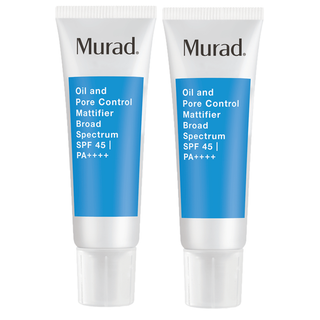
Murad Oil and Pore Control Mattifier Broad Spectrum SPF 45 1.7 Ounce
Works for
2 of 3 advertised claims delivered
Sun protectionSPF 45 · 4 UV filtersBroad spectrum
This product offers a good level of protection against both UVB and UVA rays.
This sunscreen uses organic (so-called "chemical") sunscreen filters. Organic, or "chemical" filters usually provide reliable sun protection and rarely leave a white cast. Sunscreens with organic filters can sting eyes.
This product can be considered "reef safe" because it does not contain the UV filters (oxybenzone and octinoxate) that can be harmful to coral reefs when present in the water in high concentrations.
Moisturizing14 ingredients credited for this claimStrong support
“Along with providing UV protection, this gentle, yet powerful formula alleviates breakouts and oiliness, minimizes visible pores and hydrates the skin.”
This product contains good ingredients to attract water to the upper layer of the skin. These ingredients are called "humectants": betaine, glycerin.
When humectants are on the surface of the skin, they “pull in” the moisture from the outside environment, or from within deeper layers of the skin. If the air is dry, humectants can speed up the moisture loss from the skin. This is why it is a good idea to use another product on top of this one to help "seal in" the moisture (look for ingredients like dimethicone, squalane, oils and butters).
The following ingredients in this product are especially good for supporting the skin barrier and helping with the hydration level: urea
Anti-blemish5 ingredients credited for this claimLimited support
“Along with providing UV protection, this gentle, yet powerful formula alleviates breakouts and oiliness, minimizes visible pores and hydrates the skin.”
This product contains ingredients (retinyl palmitate) that could help reduce blemishes and clogged pores in theory, but there is not enough evidence that they actually work.
Evens skin toneNot advertised by the brand · 3 ingredients credited for this claimStrong support
This product offers broad spectrum sun protection. It means that it can prevent hyperpigmentation and help keep the skin tone even (sun damage is the main factor causing age spots, darkening of post-acne marks and other discolorations).
Anti-agingNot advertised by the brand · 4 ingredients credited for this claimStrong support
This product can help prevent early signs of skin aging because it offers a good level of broad spectrum sun protection. Sun damage is the main cause of premature skin aging, and protecting your skin from the sun is the best anti-aging strategy.
These ingredients in the product might also be helpful for reducing and preventing fine lines, wrinkles, and skin elasticity, even though there is no conclusive evidence for their effectiveness: retinyl palmitate.
Can it cause trouble?
Irritancy5 strong irritants: Retinyl palmitate, Parfum + 3 more — patch-test recommendedHigh risk
Comedogenic2 ingredients rated 2 or more on the 0–5 pore-clogging scale2 flagged


User reviews
Be the first — your take helps the next person decide.
Ingredients
Filter by role to see what each ingredient is doing.
Butyl methoxydibenzoylmethane3%
- Irritation risk
- Medium
Avobenzone. An organic, or so-called "chemical" UV filter. Protects against both UVA and UVB rays. Needs to be combined with other filters in a formulation to be stable.
More about Butyl methoxydibenzoylmethaneHomosalate10%
- Irritation risk
- Medium
A weak sunscreen that offers some protection against the sun rays that cause sunburn (UVB), but does not offer meaningful protection against protect against the most aging sun rays (UVA). It loses its effectiveness quickly when exposed to sunlight. It is an organic, or so called "chemical" sunscreen. When used in low concentrations, helps to stabilize the product formulation
More about HomosalateEthylhexyl salicylate5%
- Irritation risk
- Low
Octisalate. A UV filter. It offers some protection against the sun rays that cause sunburn (UVB), but does not protect against the most aging sun rays (UVA). It loses its effectiveness quickly when exposed to sunlight. It is an organic, or so called "chemical" sunscreen
More about Ethylhexyl salicylateOctocrylene5%
- Irritation risk
- Medium
A weak sunscreen that protects against the sun rays that cause sunburn (UVB) and is somewhat effective against the UVA rays. It is quite stable and can help stabilize other, more vulnerable, sunscreen ingredients like Avobenzone. It is an organic, or so called "chemical" sunscreen
More about OctocryleneWater~45–55%
Tapioca starch~7.4–9%
Polysilicone-11~5.8–7.1%
- Irritation risk
- Low
A silicone that forms a light film on the skin surface helping to bind water and temporarily absorb oils creating a matt and powdery feel
More about Polysilicone-11Methyl methacrylate crosspolymer~4.5–5.5%
- Irritation risk
- Low
Helps thicken the product consistency
More about Methyl methacrylate crosspolymerPropanediol dicaprylate~3.4–4.2%
- Irritation risk
- Low
Butylene glycol~2.3–2.8%
- Irritation risk
- Low
Used to create a nice product texture and help delivery of other ingredients. Might be somewhat helpful in attracting water to the upper layer of the skin
More about Butylene glycolCoconut alkanes~1.8–2.2%
- Irritation risk
- Medium
- Comedogenicity
- 2/5
An emollient that helps soften the skin
More about Coconut alkanesCetearyl alcohol~1.6–2%
- Irritation risk
- Low
- Comedogenicity
- 2/5
A non-drying alcohol. Works as an emollient. Helps water and oil mix together and creates a nice product texture
More about Cetearyl alcoholC20-22 alkyl phosphate~1.2–1.5%
Enantia chlorantha bark extract~1–1.3%
- Irritation risk
- High
A bark extract that might help clam down inflammation and neutralize free radicals , but evidence of effectiveness in skin is lacking
More about Enantia chlorantha bark extractButyl avocadate~0.75–1.15%
- Irritation risk
- Low
Retinyl palmitate~0.6–0.9%
- Irritation risk
- High
Three steps removed from the active form of vitamin A - retinoic acid. To have an effect in the skin, it first needs to be converted twice to become the retinoic acid. This means it is less potent than retinol, but could also be less irritating. Once converted to the retinoic acid in the skin, it helps against all signs of aging, improves skin cell turnover and helps fight blemishes and clogged pores. However, in many cosmetic formulations, it is used in a concentration that is too low to have the full effect
More about Retinyl palmitateTocopheryl acetate~0.6–0.85%
- Irritation risk
- Medium
A more stable but less bio-available form of vitamin E compared to Tocopherol. Might help moisturize and protect the skin from free radicals, but mostly used in low concentrations to stabilize other ingredients.
More about Tocopheryl acetateAscorbyl palmitate~0.5–0.8%
- Irritation risk
- Medium
Being a lipid soluble form of vitamin C, it is more stable and can penetrate the skin better than L-Ascorbic acid. It is effective in protecting the skin from free radicals, as well as evening the skin tone, but is less effective in stimulating collagen production compared to L-Ascorbic acid.
More about Ascorbyl palmitateSodium hyaluronate~0.5–0.75%
- Irritation risk
- Low
One of the best moisturizing ingredients. Attracts water into the upper layer of the skin
More about Sodium hyaluronateAllantoin~0.45–0.7%
- Irritation risk
- Low
Helps calm down inflammation in skin and can help reduce itching. Helps to repair the skin barrier and keep skin hydrated
More about AllantoinZinc gluconate~0.5–0.7%
- Irritation risk
- Medium
Typically used to stabilize the product formulations. It is a salt of a polyhydroxy acid (PHA) and in larger concentrations, can help shed the dead cells from the skin surface revealing smoother skin. It can help attract water to the upper layer of the skin. Might to be helpful against acne and clogged pores. Could be helpful in neutralizing free radicals, but solid research is missing. Due to the zinc content, might help calm down inflammation in skin
More about Zinc gluconateGlycerin~0.5–0.75%
- Irritation risk
- Low
One of the best moisturizing ingredients. Naturally present in skin. It attracts water to the upper layer of the skin working as a humectant
More about GlycerinOleanolic acid~0.4–0.65%
- Irritation risk
- Low
Might be helpful against blemishes, work as an anti-oxidant, reduce inflammation and improve skin's ability to hold on to moisture, but more research is needed to confirm its effectiveness when applied topically to human skin
More about Oleanolic acidUrea~0.35–0.65%
- Irritation risk
- Low
Naturally present in skin (urea makes up about 7% of natural moisturizing factors in skin). Attracts water to the upper layer of the skin. Also has a positive effect on the skin barrier beyond the humectant action. Can enhance penetration of other ingredients. Is an exfoliating ingredient when used in high concentrations
More about UreaYeast amino acids~0.35–0.6%
- Irritation risk
- Low
Trehalose~0.3–0.6%
- Irritation risk
- Low
A sugar that attracts water to the upper layer of the skin
More about TrehaloseInositol~0.3–0.55%
Taurine~0.3–0.55%
- Irritation risk
- Medium
Could be helpful in reducing inflammation in skin, evening out the skin tone and neutralizing free radicals, but more research is needed to confirm its effectiveness
More about TaurineBetaine~0.3–0.55%
- Irritation risk
- Low
Helps attract water to the upper layer of the skin and improves the product texture
More about BetaineCoco-caprylate/caprate~0.45–0.65%
- Irritation risk
- Low
Helps to soften the upper layer of the skin without creating a greasy texture
More about Coco-caprylate/caprateHydrogenated lecithin~0.3–0.6%
- Irritation risk
- Low
Helps to retain moisture by creating a protective barrier on the skin. Rich in fatty acids. Improves product texture and helps with the penetration of other ingredients.
More about Hydrogenated lecithinCoco-glucoside~0.4–0.6%
- Irritation risk
- High
Used as a cleansing agent (surfactant) in cleansers. Helps water and oil mix together in lotions. Can be irritating
More about Coco-glucosideC20-22 alcohols~0.3–0.55%
- Irritation risk
- Low
Laureth-12~0.35–0.6%
Polyacrylate crosspolymer-6~0.3–0.6%
- Irritation risk
- Low
Sodium hydroxide~0.3–0.55%
Disodium edta~0.3–0.55%
Ethylhexylglycerin~0.25–0.5%
Phenoxyethanol~0.25–0.45%
- Irritation risk
- Low
A preservative. It helps prevent bacterial growth in cosmetic products
More about PhenoxyethanolParfum~0.2–0.4%
- Irritation risk
- High
An aromatic blend of unspecified and possibly irritating ingredients
More about ParfumLimonene~0.2–0.35%
- Irritation risk
- High
A common frangrance that can easily irritate skin, especially if exposed to air, light or heat
More about LimoneneLinalool~0.2–0.35%
Citral~0.15–0.3%
Ingredient list view
Butyl methoxydibenzoylmethane, Homosalate, Ethylhexyl salicylate, Octocrylene, Water, Tapioca starch, Polysilicone-11, Methyl methacrylate crosspolymer, Propanediol dicaprylate, Butylene glycol, Coconut alkanes, Cetearyl alcohol, C20-22 alkyl phosphate, Enantia chlorantha bark extract, Butyl avocadate, Retinyl palmitate, Tocopheryl acetate, Ascorbyl palmitate, Sodium hyaluronate, Allantoin, Zinc gluconate, Glycerin, Oleanolic acid, Urea, Yeast amino acids, Trehalose, Inositol, Taurine, Betaine, Coco-caprylate/caprate, Hydrogenated lecithin, Coco-glucoside, C20-22 alcohols, Laureth-12, Polyacrylate crosspolymer-6, Sodium hydroxide, Disodium edta, Ethylhexylglycerin, Phenoxyethanol, Parfum, Limonene, Linalool, Citral
Compare prices
Retailers ranked by price — lowest first.

Worth comparing, line by line.
Match % combines shared ingredients, the first five ingredients, shared actives and hero ingredients, irritancy (lower counts in the alternative's favour), texture and body area. Only products in the same routine step are compared.
| MuradOil and Pore Control Mattifier Broad Spectrum SPF 45 1.7 OunceYOUR PRODUCT | Murad UKSuperactive Moisturiser SPF 50: Brightening | Lab Series For MenDay Rescue Defense Lotion SPF 35 | LumeneNordic Hydra [LÄHDE] SPF30 Day Fluid | |
|---|---|---|---|---|
| Match | — | 65% | 64% | 62% |
| Price | $45.00 | $72.71+$27.71 | $35.00−$10.00 | $24.90−$20.10 |
| Shared key ingredients | — | 7 of 15 | 7 of 15 | 9 of 15 |
| Key difference | — | 3-O-Ethyl Ascorbic Acid | Linoleic Acid | Biosaccharide Gum-1 |
| Irritancy | High | Medium | Medium | Medium |
| SPF | SPF 45 | SPF 50 | SPF 35 | SPF 30 |
| Drying alcohol | — | — | — | — |
| View product | Shop | Shop | Shop |

Product summary
We believe that "Murad - Oil and Pore Control Mattifier Broad Spectrum SPF 45 1. 7 Ounce" can provide reliable sun protection based on the ingredients listed. It can protect from both UVA and UVB rays. This is great news because not all sunscreens with SPF ratings give UVA protection. (UVA rays do not cause sunburn, but still damage our skin and lead to early aging).
This moisturizer should also be hydrating enough to use without an additional moisturizer during the day. This product prevents early signs of aging by protecting against sun damage (all broad spectrum sunscreens do that).
Sunscreen filters
This is a so-called "chemical" sunscreen. It means that it uses organic UV filters. They typically offer good sun protection and rarely leave a white cast, but they can be irritating for some people with sensitive skin. These are the sun protection ingredients in this sunscreen: avobenzone 3.00% (declared), octisalate 5.00% (declared), homosalate 10.00% (declared) and octocrylene 5.00% (declared).
Irritation risk
We assess the overall irritancy of this moisturizer to be high. For a detailed overview of all potential irritants: click here
You can see the detailed formula review with the breakdown of all actives in the product and the full ingredient list with estimated concentrations in the tables below.
About the brand
According to Cruelty-Free Kitty "Murad" is cruelty free, but its parent company is not.
Price
The product retails for 128.48A$ in Australia and from 45.00$ up to 72.98$ in the United States.
For a detailed price comparison: click here.
Sources cited in this review
Every concentration estimate and effectiveness label is anchored to one of these 19 studies and safety reviews.
- 1
- 2
- 3Hyaluronic acid: A key molecule in skin agingncbi.nlm.nih.gov
- 4
- 5
- 6Zinc salts in dermatologyncbi.nlm.nih.gov

Affiliate links · As an Amazon Associate, WIMJ earns from qualifying purchases.