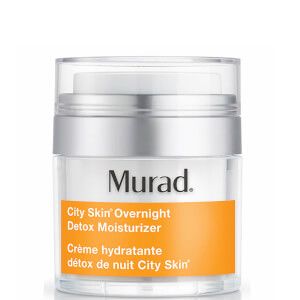
Murad City Skin Overnight Detox Moisturiser
Works for
1 of 3 advertised claims delivered
Moisturizing24 ingredients credited for this claimStrong support
“City Skin Overnight Detox Moisturiser”
This product can help improve hydration of the skin with the two types of ingredients.
The first type is called “humectants”:
these ingredients help attract water.
When humectants are on the surface of the skin, they “pull in” the moisture from the outside environment, or from
within deeper layers of the skin. The following ingredients in this product do the job:
betaine, glycerin.
This product also contains ingredients called “occlusives”. They help reduce the speed with which our skin loses moisture to the outside environment. These ingredients also help soften the upper layer of the skin, so it feels less tight and nicer to the touch. The following ingredients in this product do the job: dimethicone, cetylhydroxyproline palmitamide.
The following ingredients in this product are especially good for supporting the skin barrier and helping with the hydration level: urea
Anti-aging1 ingredient credited for this claimLimited support
“The formula also boasts next generation Vitamin C, which visibly brightens the complexion and improves skin tone, whilst effective botanicals reduce the appearance of fine lines and wrinkles.”
This product does not contain ingredients that are able to reduce fine lines and wrinkles or help with skin elasticity, but it can improve the look of the skin temporarily through moisturization. Well-moisturized skin might also be able to repair the sun damage better.
Evens skin tone2 ingredients credited for this claimWeak support
“The formula also boasts next generation Vitamin C, which visibly brightens the complexion and improves skin tone, whilst effective botanicals reduce the appearance of fine lines and wrinkles.”
Effective ingredients missing or their concentration is too low
Can it cause trouble?
Irritancy5 strong irritants: Zingiber officinale root extract, Parfum + 3 more — patch-test recommendedHigh risk
ComedogenicClean of flagged comedogenic ingredientsNone flagged
User reviews
Be the first — your take helps the next person decide.
Ingredients
Filter by role to see what each ingredient is doing.
Water~45–55%
Glycerin~4.3–5.3%
- Irritation risk
- Low
One of the best moisturizing ingredients. Naturally present in skin. It attracts water to the upper layer of the skin working as a humectant
More about GlycerinShea butter ethyl esters~4.1–5.1%
- Irritation risk
- Low
Helps soften the upper layer of the skin
More about Shea butter ethyl estersDicaprylyl carbonate~3.1–3.8%
- Irritation risk
- Low
Helps products spread more easily and works as an emollient to soften skin
More about Dicaprylyl carbonateIsodecyl neopentanoate~2.4–2.9%
- Irritation risk
- Low
An emollient that helps soften the skin. It also forms a protective on its surface to reduce water loss.
More about Isodecyl neopentanoateJojoba esters~1.9–2.3%
- Irritation risk
- Medium
An emollient made of jojoba oil. Helps soften the skin and support its barrier function
More about Jojoba estersGlyceryl stearate citrate~1.6–2%
- Irritation risk
- Low
Helps oil and water mix together while softening the upper layer of the skin
More about Glyceryl stearate citrateSynthetic beeswax~1.4–1.7%
- Irritation risk
- Low
Helps soften the upper layer of the skin
More about Synthetic beeswaxDimethicone~1.3–1.5%
- Irritation risk
- Low
A silicone that helps to reduce water loss from the surface of the skin. Can temporarily "fill in" lines and wrinkles, absorb oil, and create a nice product finish
More about DimethiconeHydrogenated palm kernel glycerides~1–1.2%
- Irritation risk
- Low
Help soften the upper layer of the skin
More about Hydrogenated palm kernel glyceridesEctoin~0.7–1%
- Irritation risk
- Low
Softens the upper layer of the skin and can support skin barrier function
More about EctoinMarrubium vulgare extract~0.4–0.65%
- Irritation risk
- Low
Allantoin~0.35–0.6%
- Irritation risk
- Low
Helps calm down inflammation in skin and can help reduce itching. Helps to repair the skin barrier and keep skin hydrated
More about AllantoinZingiber officinale root extract~0.45–0.7%
- Irritation risk
- High
A plant extract that can contain an irritating essential oil. Might have some anti-oxidant effect, but evidence is lacking
More about Zingiber officinale root extractBrassica campestris sterols~0.45–0.7%
- Irritation risk
- Low
Help soften the upper layer of the skin
More about Brassica campestris sterolsHydrolyzed jojoba esters~0.45–0.7%
- Irritation risk
- Low
Helps soften the upper layer of the skin
More about Hydrolyzed jojoba estersTetrahexyldecyl ascorbate~0.45–0.65%
- Irritation risk
- Medium
Being a lipid soluble form of vitamin C, it is more stable than ascorbic acid, but still degrades quickly and needs to be stabilized in a formulation with another ingredient. It is claimed to penetrate skin better than pure vitamin C and have the the similar benefits, but solid studies of its effectiveness are lacking. Is likely to require a higher concentration in a product than pure vitamin C to be effective. It might be able to help reduce pore clogging.
More about Tetrahexyldecyl ascorbateHordeum vulgare extract~0.4–0.65%
- Irritation risk
- Medium
A plant extract that might have some anti-oxidant properties. Avoid if you are sensitive to gluten
More about Hordeum vulgare extractCucumis sativus fruit extract~0.3–0.6%
- Irritation risk
- Medium
Might be somewhat helpful in reducing hyperpigmentation and neutralizing free radicals but its typical concentration in a product is too low for having an effect
More about Cucumis sativus fruit extractHelianthus annuus seed extract~0.3–0.55%
- Irritation risk
- Low
Urea~0.3–0.5%
- Irritation risk
- Low
Naturally present in skin (urea makes up about 7% of natural moisturizing factors in skin). Attracts water to the upper layer of the skin. Also has a positive effect on the skin barrier beyond the humectant action. Can enhance penetration of other ingredients. Is an exfoliating ingredient when used in high concentrations
More about UreaYeast amino acids~0.25–0.5%
- Irritation risk
- Low
Trehalose~0.25–0.5%
- Irritation risk
- Low
A sugar that attracts water to the upper layer of the skin
More about TrehaloseInositol~0.25–0.5%
Taurine~0.25–0.5%
- Irritation risk
- Medium
Could be helpful in reducing inflammation in skin, evening out the skin tone and neutralizing free radicals, but more research is needed to confirm its effectiveness
More about TaurineBetaine~0.25–0.45%
- Irritation risk
- Low
Helps attract water to the upper layer of the skin and improves the product texture
More about BetaineBisabolol~0.25–0.45%
- Irritation risk
- Low
An active component of chamomile plant that historically has been used to calm down irritated skin. A recent study shows that bisabolol indeed can have some anti-inflammatory effect on skin, even though conclusive data is lacking. Bisabolol has a sweet floral scent and can be added to products for its aromatic properties
More about BisabololHydroxyphenyl propamidobenzoic acid~0.25–0.45%
- Irritation risk
- Low
Might help to reduce inflammation in skin, but solid research is lacking
More about Hydroxyphenyl propamidobenzoic acidHydrogenated palm glycerides~0.3–0.55%
- Irritation risk
- Low
An emollient that softens the skin
More about Hydrogenated palm glyceridesXanthan gum~0.25–0.5%
- Irritation risk
- Low
Used to create a thicker product consistency
More about Xanthan gumPropylene glycol dicaprate~0.3–0.55%
- Irritation risk
- Low
An emollient that helps soften the upper layer of the skin
More about Propylene glycol dicaprateAcrylates/c10-30 alkyl acrylate crosspolymer~0.3–0.5%
- Irritation risk
- Medium
Maintains the texture of skincare products. Allows the product to spread evenly. Helps oil and water mix together
More about Acrylates/c10-30 alkyl acrylate crosspolymerHexyldecanol~0.3–0.5%
- Irritation risk
- Low
Helps soften the upper layer of the skin
More about HexyldecanolPentylene glycol~0.3–0.55%
- Irritation risk
- Medium
Used to preserve products, dissolve other ingredients and create a nice product texture
More about Pentylene glycol4-t-butylcyclohexanol~0.25–0.45%
- Irritation risk
- Low
Cetylhydroxyproline palmitamide~0.25–0.5%
- Irritation risk
- Low
A type of lipid similar to ceramides naturally present in skin. Helps to soften the upper layer of the skin and supports the skin barrier function to keep it hydrated. Can help to prevent inflammation in skin
More about Cetylhydroxyproline palmitamideStearic acid~0.35–0.65%
- Irritation risk
- Low
Helps oil and water mix together and works as an emollient
More about Stearic acidDisodium carboxyethyl siliconate~0.25–0.4%
- Irritation risk
- Low
Aminomethyl propanol~0.2–0.4%
Disodium edta~0.2–0.35%
Ethylhexylglycerin~0.2–0.35%
Phenoxyethanol~0.15–0.3%
- Irritation risk
- Low
A preservative. It helps prevent bacterial growth in cosmetic products
More about PhenoxyethanolParfum~0.15–0.25%
- Irritation risk
- High
An aromatic blend of unspecified and possibly irritating ingredients
More about ParfumLimonene~0.15–0.25%
- Irritation risk
- High
A common frangrance that can easily irritate skin, especially if exposed to air, light or heat
More about LimoneneLinalool~0.15–0.25%
Benzyl salicylate~0.15–0.25%
Titanium dioxide~0.1–0.2%
- Irritation risk
- Low
Works as a UV filter when used in high concentrations. It is photostable and is effective mostly against the UVB light, with some protection in the UVA range. In small concentrations, used for its ability to improve the color of cosmetic products. Is usually well tolerated by the skin
More about Titanium dioxideCi 77891~0.1–0.15%
- Irritation risk
- Low
Ingredient list view
Water, Glycerin, Shea butter ethyl esters, Dicaprylyl carbonate, Isodecyl neopentanoate, Jojoba esters, Glyceryl stearate citrate, Synthetic beeswax, Dimethicone, Hydrogenated palm kernel glycerides, Ectoin, Marrubium vulgare extract, Allantoin, Zingiber officinale root extract, Brassica campestris sterols, Hydrolyzed jojoba esters, Tetrahexyldecyl ascorbate, Hordeum vulgare extract, Cucumis sativus fruit extract, Helianthus annuus seed extract, Urea, Yeast amino acids, Trehalose, Inositol, Taurine, Betaine, Bisabolol, Hydroxyphenyl propamidobenzoic acid, Hydrogenated palm glycerides, Xanthan gum, Propylene glycol dicaprate, Acrylates/c10-30 alkyl acrylate crosspolymer, Hexyldecanol, Pentylene glycol, 4-t-butylcyclohexanol, Cetylhydroxyproline palmitamide, Stearic acid, Disodium carboxyethyl siliconate, Aminomethyl propanol, Disodium edta, Ethylhexylglycerin, Phenoxyethanol, Parfum, Limonene, Linalool, Benzyl salicylate, Titanium dioxide, Ci 77891
Compare prices
Retailers ranked by price — lowest first.

Worth comparing, line by line.
Match % combines shared ingredients, the first five ingredients, shared actives and hero ingredients, irritancy (lower counts in the alternative's favour), texture and body area. Only products in the same routine step are compared.
| MuradCity Skin Overnight Detox MoisturiserYOUR PRODUCT | GUERLAINOrchide Impriale - The Light Cream | |
|---|---|---|
| Match | — | 51% |
| Price | $63.70 | $780.00+$716.30 |
| Shared key ingredients | — | 8 of 14 |
| Key difference | — | Adenosine |
| Irritancy | High | Medium |
| Drying alcohol | — | Contains drying alcohol |
| View product | Shop |

Sources cited in this review
Every concentration estimate and effectiveness label is anchored to one of these 12 studies and safety reviews.
- 1
- 2
- 3Final Report on the Safety Assessment of Dimethicone Copolyoljournals.sagepub.com
- 4
- 5
- 6

Affiliate links · As an Amazon Associate, WIMJ earns from qualifying purchases.