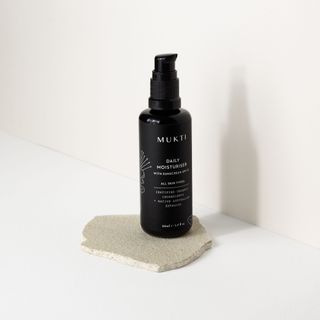
Mukti Daily Moisturiser With Sunscreen
Works for
2 of 3 advertised claims delivered
Sun protectionSPF 15 · 1 UV filter · Broad spectrumWeak protectionSPF under 30
This product offers broad spectrum sun protection, but it is weak. We recommend to use a broad spectrum sunscreen with at least SPF 30.
This product can be considered "reef safe" because it does not contain the UV filters (oxybenzone and octinoxate) that can be harmful to coral reefs when present in the water in high concentrations.
Anti-agingUbiquinone, Aloe barbadensis leaf juice + 2 moreModerate evidence
“*Zinc Oxide (20%) filters both aging UVA and burning UVB rays.”
This product contains polygonum aviculare extract, ubiquinone. These ingredients help neutralize free radicals in skin. By doing so, they might be able to prevent early signs of aging (like fine lines and wrinkles), at least to some extent. These ingredients will not be able to "reverse" signs of aging. The biggest anti-aging effect in this product comes from sun protection. Sun damage is the main factor causing early signs of skin aging. We, however, do not recommend using this product as a sunscreen because the protection it offers is not strong enough).
MoisturizingSqualane, Carthamus tinctorius seed oil + 10 moreGood evidence
“Daily Moisturiser With Sunscreen”
This product can help improve hydration of the skin with the two types of ingredients.
The first type is called “humectants”:
these ingredients help attract water.
When humectants are on the surface of the skin, they “pull in” the moisture from the outside environment, or from
within deeper layers of the skin. The following ingredients in this product do the job:
glycerin, aloe barbadensis leaf juice.
This product also contains ingredients called “occlusives”. They help reduce the speed with which our skin loses moisture to the outside environment. These ingredients also help soften the upper layer of the skin, so it feels less tight and nicer to the touch. The following ingredients in this product do the job: caprylic/capric triglyceride, helianthus annuus seed oil.
Anti-oxidationNot advertised by the brand · Polygonum aviculare extract, Ubiquinone + 7 moreStrong evidence
This product contains antioxidants (polygonum aviculare extract, ubiquinone) that can help neutralize free radicals in skin. By doing so, they can lessen the damage the skin gets from the UV light (sun).
Can it cause trouble?
Irritancy4 strong irritants: Calendula officinalis flower extract, Citrus glauca fruit extract + 2 more — patch-test recommendedHigh risk
ComedogenicClean of flagged comedogenic ingredientsNone flagged
User reviews
Ingredients
Filter by role to see what each ingredient is doing.
Caprylic/capric triglyceride~23–34%
- Irritation risk
- Medium
A good mix of fatty acids that forms a protective layer on the skin. Improves the shelf life of products. Derived from coconut and glycerin
More about Caprylic/capric triglycerideAloe barbadensis leaf juice~5.7–8.5%
- Irritation risk
- Medium
Traditionally used to treat sunburns, dermatitis and inflammation, but evidence for its effectiveness is lacking. The extract can contain humectants that help attract water into the skin
More about Aloe barbadensis leaf juiceZinc oxide~4.9–7.3%
- Irritation risk
- Low
A broad spectrum sunblock (protects from both UVA and UVB rays). Is suitable for most sensitive skins. In small concentrations, can be used as a colorant
More about Zinc oxideSqualane~3.8–5.7%
- Irritation risk
- Low
An oil naturally present in skin. Works as an emollient to soften the skin and form a protective layer on its surface without a greasy feeling.
More about SqualaneGlycerin~2.7–4%
- Irritation risk
- Low
One of the best moisturizing ingredients. Naturally present in skin. It attracts water to the upper layer of the skin working as a humectant
More about GlycerinPolyhydroxystearic acid~2–3%
- Irritation risk
- Medium
Used to create a thicker product consistency and stabilize the formulation
More about Polyhydroxystearic acidPotassium cetyl phosphate~1.6–2.3%
- Irritation risk
- Medium
Helps oil and water mix together
More about Potassium cetyl phosphateJojoba esters~1.3–1.9%
- Irritation risk
- Medium
An emollient made of jojoba oil. Helps soften the skin and support its barrier function
More about Jojoba estersCetearyl olivate~1.1–1.6%
Rose flower oil/extract~0.9–1.35%
- Irritation risk
- Low
Astragalus membranaceus root extract~0.8–1.25%
- Irritation risk
- Low
Calendula officinalis flower extract~0.5–1.15%
- Irritation risk
- High
A plant extract that has some anti-oxidant and anti-bacterial properties. Can be irritating
More about Calendula officinalis flower extractCitrus glauca fruit extract~0.5–1.15%
- Irritation risk
- High
Melaleuca alternifolia leaf extract~0.45–1.05%
- Irritation risk
- High
An essential oil that can be irritating. Has some anti-bacterial properties
More about Melaleuca alternifolia leaf extractSpilanthes acmella flower/leaf/stem extract~0.45–1.05%
- Irritation risk
- Low
Terminalia ferdinandiana fruit extract~0.45–1.05%
- Irritation risk
- Medium
A plant extract that might have some anti-oxidant effect in skin, but evidence is lacking
More about Terminalia ferdinandiana fruit extractCarthamus tinctorius seed oil~0.5–1.1%
- Irritation risk
- Low
An emollient that helps soften the skin and might help calm down inflammation
More about Carthamus tinctorius seed oilHelianthus annuus seed oil~0.45–1.05%
- Irritation risk
- Low
A great emollient due to its high linoleic acid content. One of the most effective plant oils in helping skin hydration and repairing skin barrier function
More about Helianthus annuus seed oilRosmarinus officinalis leaf extract~0.35–0.75%
- Irritation risk
- High
Can be helpful in reducing inflammation in skin, including inflamed acne. It can be irritating
More about Rosmarinus officinalis leaf extractUbiquinone~0.35–0.8%
- Irritation risk
- Low
Coenzyme Q10. It helps neutralize free radicals in skin, improves skin hydration and might be helpful agains fine lines and wrinkles. It can be an allergen
More about UbiquinonePolygonum aviculare extract~0.4–0.9%
- Irritation risk
- Medium
A plant extract that contains a flavanol Juglanin. It can help neutralize free radicals in skin and reduce inflammation
More about Polygonum aviculare extractRosa canina fruit extract~0.3–0.75%
- Irritation risk
- Medium
A plant extract that might have some anti-oxidant properties, but evidence is lacking
More about Rosa canina fruit extractWater~0.2–0.8%
Camellia sinensis leaf extract~0.15–0.65%
- Irritation risk
- Low
Can contain potent anti-oxidant compounds (abbreviated ECG, GCG, EGC, and EGCG) that might help protect the skin from free radicals. Can help calm down inflammation and has some anti-bacterial properties. Unfortunately, these antioxidants are unstable and lose their effectiveness very quickly in products. The concentration of the antioxidant compounds in the extract also tends to be low to be effective in topical formulation
More about Camellia sinensis leaf extractOctyldodecanol~0.2–0.7%
- Irritation risk
- Low
An emollient that helps to soften the skin and create a pleasant product texture and stabilize the formulation
More about OctyldodecanolSorbitan olivate~0.15–0.7%
Tocopherol~0.15–0.6%
- Irritation risk
- Low
Pure form of vitamin E. Can help moisturise and protect the skin from free radicals. Often used to help stabilise other ingredients or the formula itself
More about TocopherolTrihydroxystearin~0.15–0.65%
- Irritation risk
- Low
Helps soften the upper layer of the skin and improve the product texture
More about TrihydroxystearinCi 77491~0.15–0.6%
- Irritation risk
- Low
A red colorant made of iron oxide. Typically is not irritating
More about Ci 77491Iron oxides~0.15–0.5%
- Irritation risk
- Low
An umbrella term for the following three colorants: CI 77491, CI 77492, CI 77499. They might be able to offer some protection against visible light, but the degree of the protection is not clear
More about Iron oxidesCi 77492~0.15–0.55%
Iron oxides~0.1–0.5%
- Irritation risk
- Low
An umbrella term for the following three colorants: CI 77491, CI 77492, CI 77499. They might be able to offer some protection against visible light, but the degree of the protection is not clear
More about Iron oxidesCi 77499~0.1–0.45%
Iron oxides~0.1–0.35%
- Irritation risk
- Low
An umbrella term for the following three colorants: CI 77491, CI 77492, CI 77499. They might be able to offer some protection against visible light, but the degree of the protection is not clear
More about Iron oxidesCitric acid~0.05–0.3%
- Irritation risk
- Medium
Can work as an exfoliant but is typically used to adjust the product pH
More about Citric acidBenzyl alcohol~0.05–0.25%
- Irritation risk
- High
A preservative. Can be used to mask unpleasant smell. Can be irritating
More about Benzyl alcoholDehydroacetic acid~0.05–0.2%
Potassium sorbate~0.05–0.3%
Sodium benzoate~0.05–0.25%
Ingredient list view
Caprylic/capric triglyceride, Aloe barbadensis leaf juice, Zinc oxide, Squalane, Glycerin, Polyhydroxystearic acid, Potassium cetyl phosphate, Jojoba esters, Cetearyl olivate, Rose flower oil/extract, Astragalus membranaceus root extract, Calendula officinalis flower extract, Citrus glauca fruit extract, Melaleuca alternifolia leaf extract, Spilanthes acmella flower/leaf/stem extract, Terminalia ferdinandiana fruit extract, Carthamus tinctorius seed oil, Helianthus annuus seed oil, Rosmarinus officinalis leaf extract, Ubiquinone, Polygonum aviculare extract, Rosa canina fruit extract, Water, Camellia sinensis leaf extract, Octyldodecanol, Sorbitan olivate, Tocopherol, Trihydroxystearin, Ci 77491, Iron oxides, Ci 77492, Iron oxides, Ci 77499, Iron oxides, Citric acid, Benzyl alcohol, Dehydroacetic acid, Potassium sorbate, Sodium benzoate
Compare prices
Retailers ranked by price — lowest first.

Affiliate links · prices updated regularly
Product summary
"Mukti - Daily Moisturiser With Sunscreen" "is a broad spectrum sunscreen meaning that it protects both from UVB rays (" burning "- they cause sunburn) and UVA rays (" aging "- they don't cause sunburn but lead to premature aging and pigmentation issues). However, this moisturizer does not offer enough sun protection. We recommend to use a sunscreen with at least SPF 30 daily.
It contains good moisturizing ingredients and can double as a hydrating day cream.
Sunscreen filters
This moisturizer is a mineral sunscreen. It uses zinc oxide for sun protection. Zinc oxide almost never irritates the skin or stings eyes, but it can leave a white cast.
Irritation risk
We assess the overall irritancy of this moisturizer to be high. For a detailed overview of all potential irritants: click here
You can see the detailed formula review with the breakdown of all actives in the product and the full ingredient list with estimated concentrations in the tables below.
What our users say
Based on 1 review 100% recommend this product- When it comes to comedogenicity, the reviewer found that it does not clog pores.
- As for the white cast, it did not leave a noticeable white residue for the reviewer.
- When it comes to using this sunscreen under makeup, the user found that it pills under a foundation.
- As for using this sunscreen in the eye area, the reviewer reported that it does not sting eyes.
About the brand
According to Cruelty-Free Kitty" Mukti "is cruelty free and so is its parent company.
Price
The product retails for 99.00A$ in Australia.
For a detailed price comparison: click here.
Sources cited in this review
Every concentration estimate and effectiveness label is anchored to one of these 22 studies and safety reviews.
- 1A review of inorganic UV filters zinc oxide and titanium dioxideonlinelibrary.wiley.com
- 2
- 3
- 4
- 5
- 6

Affiliate links · As an Amazon Associate, WIMJ earns from qualifying purchases.