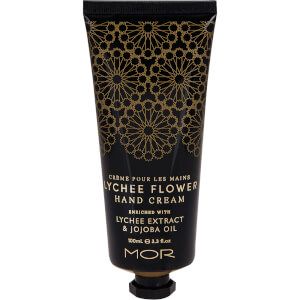
MOR Emporium Classics Hand Cream Lychee Flower
Works for
1 of 2 advertised claims delivered
Moisturizing12 ingredients credited for this claimGood support
“Enriched with Jojoba Oil and Aloe Vera, the cream works to moisturise and soothe skin, offering intense hydration.”
This product can help improve hydration of the skin with the two types of ingredients.
The first type is called “humectants”:
these ingredients help attract water.
When humectants are on the surface of the skin, they “pull in” the moisture from the outside environment, or from
within deeper layers of the skin. The following ingredients in this product do the job:
glycerin.
This product also contains ingredients called “occlusives”. They help reduce the speed with which our skin loses moisture to the outside environment. These ingredients also help soften the upper layer of the skin, so it feels less tight and nicer to the touch. The following ingredients in this product do the job: helianthus annuus seed oil, ricinus communis seed oil.
Evens skin tone1 ingredient credited for this claimWeak support
“Acai and Papaya Extracts strive to improve the texture and tone of skin, while Vitamin E softens and protects the surface.”
Effective ingredients missing or their concentration is too low
Anti-oxidationNot advertised by the brand · 4 ingredients credited for this claimModerate support
This product contains antioxidants (camellia sinensis leaf extract) that might be able to help neutralize free radicals in skin to lessen the damage it gets from the UV light (sun). There is not enough evidence to confirm their effectiveness in skin though.
Can it cause trouble?
Irritancy13 strong irritants: Parfum, Carica papaya leaf extract + 11 more — patch-test recommendedHigh risk
Comedogenic4 ingredients rated 2 or more on the 0–5 pore-clogging scale4 flagged
User reviews
Be the first — your take helps the next person decide.
Ingredients
Filter by role to see what each ingredient is doing.
Water~45–55%
Isopropyl myristate~4.4–5.4%
- Irritation risk
- Low
- Comedogenicity
- 3/5
An emollient that helps soften the skin. Could be comedogenic
More about Isopropyl myristateCetearyl alcohol~3.6–4.4%
- Irritation risk
- Low
- Comedogenicity
- 2/5
A non-drying alcohol. Works as an emollient. Helps water and oil mix together and creates a nice product texture
More about Cetearyl alcoholGlyceryl stearate~2.7–3.3%
- Irritation risk
- Low
An emollient that softens the skin and forms a protective layer on its surface. Helps water and oil mix together
More about Glyceryl stearatePotassium cetyl phosphate~2.2–2.7%
- Irritation risk
- Medium
Helps oil and water mix together
More about Potassium cetyl phosphateStearic acid~2–2.4%
- Irritation risk
- Low
Helps oil and water mix together and works as an emollient
More about Stearic acidHelianthus annuus seed oil~1.6–2%
- Irritation risk
- Low
A great emollient due to its high linoleic acid content. One of the most effective plant oils in helping skin hydration and repairing skin barrier function
More about Helianthus annuus seed oilRicinus communis seed oil~1.4–1.7%
- Irritation risk
- Medium
A plant oil that can help soften the skin. It might be helpful in calming down inflammation, but solid research is lacking. Is often used in lip products to create the needed product consistency
More about Ricinus communis seed oilParfum~1.1–1.3%
- Irritation risk
- High
An aromatic blend of unspecified and possibly irritating ingredients
More about ParfumTocopheryl acetate~0.75–1.15%
- Irritation risk
- Medium
A more stable but less bio-available form of vitamin E compared to Tocopherol. Might help moisturize and protect the skin from free radicals, but mostly used in low concentrations to stabilize other ingredients.
More about Tocopheryl acetateAloe barbadensis leaf juice~0.65–0.95%
- Irritation risk
- Medium
Traditionally used to treat sunburns, dermatitis and inflammation, but evidence for its effectiveness is lacking. The extract can contain humectants that help attract water into the skin
More about Aloe barbadensis leaf juiceCarica papaya leaf extract~0.5–0.75%
- Irritation risk
- High
Passiflora incarnata extract~0.45–0.7%
- Irritation risk
- High
A plant extract that might help neutralize free radicals in skin
More about Passiflora incarnata extractCamellia sinensis leaf extract~0.45–0.65%
- Irritation risk
- Low
Can contain potent anti-oxidant compounds (abbreviated ECG, GCG, EGC, and EGCG) that might help protect the skin from free radicals. Can help calm down inflammation and has some anti-bacterial properties. Unfortunately, these antioxidants are unstable and lose their effectiveness very quickly in products. The concentration of the antioxidant compounds in the extract also tends to be low to be effective in topical formulation
More about Camellia sinensis leaf extractEuterpe oleracea fruit extract~0.35–0.65%
- Irritation risk
- Medium
A plant extract that can have some anti-oxidant effect in skin
More about Euterpe oleracea fruit extractCitrus aurantium dulcis oil~0.35–0.65%
- Irritation risk
- High
Used as a fragrance. It can be irritating and cause photosensitivity
More about Citrus aurantium dulcis oilOlea europaea leaf extract~0.3–0.55%
- Irritation risk
- Medium
A plant extract that might have some anti-oxidant and anti-inflammatory properties but evidence for effectiveness in skin is missing
More about Olea europaea leaf extractXanthan gum~0.3–0.55%
- Irritation risk
- Low
Used to create a thicker product consistency
More about Xanthan gumDisodium edta~0.25–0.5%
Citric acid~0.25–0.45%
- Irritation risk
- Medium
Can work as an exfoliant but is typically used to adjust the product pH
More about Citric acidPotassium sorbate~0.25–0.45%
Phenethyl alcohol~0.25–0.45%
Phenoxyethanol~0.2–0.4%
- Irritation risk
- Low
A preservative. It helps prevent bacterial growth in cosmetic products
More about PhenoxyethanolCitral~0.2–0.35%
Butylphenyl methylpropional~0.2–0.35%
- Irritation risk
- High
A fragrance. Can trigger allergic reactions and be irritating
More about Butylphenyl methylpropionalLinalool~0.2–0.35%
Citronellol~0.2–0.35%
Hexyl cinnamal~0.2–0.35%
Limonene~0.2–0.35%
- Irritation risk
- High
A common frangrance that can easily irritate skin, especially if exposed to air, light or heat
More about LimoneneAlpha-isomethyl ionone~0.2–0.35%
- Irritation risk
- High
A fragrance. Potential allergen and can be irritating
More about Alpha-isomethyl iononeWater~0.2–0.4%
Isopropyl myristate~0.25–0.45%
- Irritation risk
- Low
- Comedogenicity
- 3/5
An emollient that helps soften the skin. Could be comedogenic
More about Isopropyl myristateCetearyl alcohol~0.25–0.45%
- Irritation risk
- Low
- Comedogenicity
- 2/5
A non-drying alcohol. Works as an emollient. Helps water and oil mix together and creates a nice product texture
More about Cetearyl alcoholGlyceryl stearate~0.25–0.5%
- Irritation risk
- Low
An emollient that softens the skin and forms a protective layer on its surface. Helps water and oil mix together
More about Glyceryl stearatePotassium cetyl phosphate~0.25–0.45%
- Irritation risk
- Medium
Helps oil and water mix together
More about Potassium cetyl phosphateParfum~0.2–0.35%
- Irritation risk
- High
An aromatic blend of unspecified and possibly irritating ingredients
More about ParfumHelianthus annuus seed oil~0.25–0.45%
- Irritation risk
- Low
A great emollient due to its high linoleic acid content. One of the most effective plant oils in helping skin hydration and repairing skin barrier function
More about Helianthus annuus seed oilRicinus communis seed oil~0.25–0.45%
- Irritation risk
- Medium
A plant oil that can help soften the skin. It might be helpful in calming down inflammation, but solid research is lacking. Is often used in lip products to create the needed product consistency
More about Ricinus communis seed oilPalmitic acid~0.25–0.5%
- Irritation risk
- Low
An emollient that is naturally present in skin and helps soften it
More about Palmitic acidStearic acid~0.3–0.6%
- Irritation risk
- Low
Helps oil and water mix together and works as an emollient
More about Stearic acidTocopheryl acetate~0.2–0.4%
- Irritation risk
- Medium
A more stable but less bio-available form of vitamin E compared to Tocopherol. Might help moisturize and protect the skin from free radicals, but mostly used in low concentrations to stabilize other ingredients.
More about Tocopheryl acetateAloe barbadensis leaf juice powder~0.2–0.35%
- Irritation risk
- Medium
Traditionally used to treat sunburns, dermatitis and inflammation, but evidence for its effectiveness is lacking. The extract can contain humectants that help attract water into the skin
More about Aloe barbadensis leaf juice powderLactobacillus/papaya fruit ferment extract~0.25–0.5%
- Irritation risk
- High
Passiflora incarnata extract~0.2–0.4%
- Irritation risk
- High
A plant extract that might help neutralize free radicals in skin
More about Passiflora incarnata extractCamellia sinensis leaf extract~0.2–0.4%
- Irritation risk
- Low
Can contain potent anti-oxidant compounds (abbreviated ECG, GCG, EGC, and EGCG) that might help protect the skin from free radicals. Can help calm down inflammation and has some anti-bacterial properties. Unfortunately, these antioxidants are unstable and lose their effectiveness very quickly in products. The concentration of the antioxidant compounds in the extract also tends to be low to be effective in topical formulation
More about Camellia sinensis leaf extractEuterpe oleracea fruit extract~0.2–0.4%
- Irritation risk
- Medium
A plant extract that can have some anti-oxidant effect in skin
More about Euterpe oleracea fruit extractSimmondsia chinensis seed oil~0.25–0.45%
- Irritation risk
- Medium
Softens the upper layer of skin and helps restore the healthy skin barrier. Has shown to help calm down inflammation in skin. It is a stable oil, meaning that it retains its properties even when exposed to air.
More about Simmondsia chinensis seed oilLitchi chinensis fruit extract~0.2–0.4%
- Irritation risk
- Low
Glycerin~0.25–0.45%
- Irritation risk
- Low
One of the best moisturizing ingredients. Naturally present in skin. It attracts water to the upper layer of the skin working as a humectant
More about GlycerinXanthan gum~0.2–0.4%
- Irritation risk
- Low
Used to create a thicker product consistency
More about Xanthan gumDisodium edta~0.2–0.4%
Citric acid~0.2–0.35%
- Irritation risk
- Medium
Can work as an exfoliant but is typically used to adjust the product pH
More about Citric acidAlcohol~0.2–0.35%
- Irritation risk
- High
Can be drying and contribute to skin irritation. Used in formulars to dissolve other ingredients, create a thinner product consistency or for its antibacterial properties
More about AlcoholIsobutyl acetate~0.15–0.3%
- Irritation risk
- Low
Potassium sorbate~0.15–0.3%
Phenethyl alcohol~0.15–0.3%
Phenoxyethanol~0.1–0.2%
- Irritation risk
- Low
A preservative. It helps prevent bacterial growth in cosmetic products
More about PhenoxyethanolCitral~0.15–0.25%
Linalool~0.1–0.2%
Benzyl benzoate~0.05–0.1%
- Irritation risk
- High
Fragrance with sweet balsamic smell. Help to preserve products and dissolve other ingredients. Could trigger allergic reactions and be irritating
More about Benzyl benzoateLimonene~0.05–0.1%
- Irritation risk
- High
A common frangrance that can easily irritate skin, especially if exposed to air, light or heat
More about LimoneneIngredient list view
Water, Isopropyl myristate, Cetearyl alcohol, Glyceryl stearate, Potassium cetyl phosphate, Stearic acid, Helianthus annuus seed oil, Ricinus communis seed oil, Parfum, Tocopheryl acetate, Aloe barbadensis leaf juice, Carica papaya leaf extract, Passiflora incarnata extract, Camellia sinensis leaf extract, Euterpe oleracea fruit extract, Citrus aurantium dulcis oil, Olea europaea leaf extract, Xanthan gum, Disodium edta, Citric acid, Potassium sorbate, Phenethyl alcohol, Phenoxyethanol, Citral, Butylphenyl methylpropional, Linalool, Citronellol, Hexyl cinnamal, Limonene, Alpha-isomethyl ionone, Water, Isopropyl myristate, Cetearyl alcohol, Glyceryl stearate, Potassium cetyl phosphate, Parfum, Helianthus annuus seed oil, Ricinus communis seed oil, Palmitic acid, Stearic acid, Tocopheryl acetate, Aloe barbadensis leaf juice powder, Lactobacillus/papaya fruit ferment extract, Passiflora incarnata extract, Camellia sinensis leaf extract, Euterpe oleracea fruit extract, Simmondsia chinensis seed oil, Litchi chinensis fruit extract, Glycerin, Xanthan gum, Disodium edta, Citric acid, Alcohol, Isobutyl acetate, Potassium sorbate, Phenethyl alcohol, Phenoxyethanol, Citral, Linalool, Benzyl benzoate, Limonene
Compare prices
Retailers ranked by price — lowest first.

.png)

.png)
Sources cited in this review
Every concentration estimate and effectiveness label is anchored to one of these 16 studies and safety reviews.
- 1
- 2
- 3Effect of topically applied lipids on surfactant-irritated skinonlinelibrary.wiley.com
- 4
- 5
- 6

Affiliate links · As an Amazon Associate, WIMJ earns from qualifying purchases.