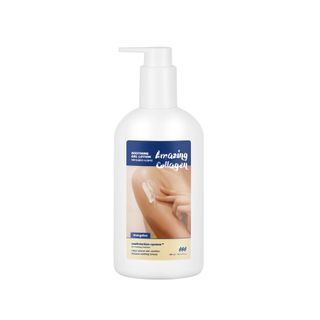
Mongdies Amazing Collagen Soothing Gel Lotion
Works for
1 of 1 advertised claim delivered
Moisturizing17 ingredients credited for this claimGood support
“A body lotion with rich collagen replenishes hydration, improves skin texture while creating an intact skin barrier.”
This product contains good ingredients to attract water to the upper layer of the skin. These ingredients are called "humectants": biosaccharide gum-1, glycerin.
When humectants are on the surface of the skin, they “pull in” the moisture from the outside environment, or from within deeper layers of the skin. If the air is dry, humectants can speed up the moisture loss from the skin. This is why it is a good idea to use another product on top of this one to help "seal in" the moisture (look for ingredients like dimethicone, squalane, oils and butters).
ExfoliationNot advertised by the brand · 1 ingredient credited for this claimStrong support
This product can help exfoliate the skin. In other words, it helps break down the bonds between dead cells on the surface of the skin and speed up the skin turnover. Skin often appears softer and brighter after exfoliation, but overdoing it can result in disrupted skin barrier. The following ingredient is doing the exfoliating job in this product: capryloyl salicylic acid.
Anti-agingNot advertised by the brand · 3 ingredients credited for this claimModerate support
This product contains atelocollagen. This ingredient might be able to help reduce and prevent fine lines and wrinkles, improve skin elasticity and firmness, but there is not enough evidence that it actually works.
Evens skin toneNot advertised by the brand · 2 ingredients credited for this claimModerate support
The following ingredient (ingredients) in this product might be helpful, but there is no evidence to confirm that it actually works: capryloyl salicylic acid.
Can it cause trouble?
Irritancy1 strong irritant: Melaleuca alternifolia leaf extractMedium risk
ComedogenicClean of flagged comedogenic ingredientsNone flagged
User reviews
Be the first — your take helps the next person decide.
Ingredients
Filter by role to see what each ingredient is doing.
Water~40–60%
Glycerin~4.1–6.2%
- Irritation risk
- Low
One of the best moisturizing ingredients. Naturally present in skin. It attracts water to the upper layer of the skin working as a humectant
More about GlycerinCetyl ethylhexanoate~3.4–5.1%
- Irritation risk
- Medium
An emollient that helps soften the skin and creates a thicker product texture
More about Cetyl ethylhexanoate1,2-hexanediol~1.9–2.8%
Butylene glycol~1.9–2.8%
- Irritation risk
- Low
Used to create a nice product texture and help delivery of other ingredients. Might be somewhat helpful in attracting water to the upper layer of the skin
More about Butylene glycolPropanediol~1.5–2.3%
- Irritation risk
- Low
Acts as a solvent for other ingredients. Speeds up the absorption of other ingredients into the skin
More about PropanediolHyaluronic acid~1.2–1.8%
- Irritation risk
- Low
One of the best moisturizing ingredients. Attracts water into the upper layer of the skin. Naturally present in skin. Typically has large molecule size unless advertised otherwise on the product label. Helps support skin's barrier function and may help to reduce inflammation
More about Hyaluronic acidHydrolyzed hyaluronic acid~1.1–1.7%
- Irritation risk
- Low
One of the best moisturizing ingredients. Attracts water into the upper layer of the skin. A version of it is naturally present in skin
More about Hydrolyzed hyaluronic acidSodium hyaluronate~0.85–1.3%
- Irritation risk
- Low
One of the best moisturizing ingredients. Attracts water into the upper layer of the skin
More about Sodium hyaluronateBiosaccharide gum-1~0.5–1.15%
- Irritation risk
- Low
Helps attract water to the upper layer of the skin and is claimed to provide a longer-lasting hydration because of its ability to create a water-binding film on the surface of the skin
More about Biosaccharide gum-1Hydroxyethylcellulose~0.4–0.95%
- Irritation risk
- Low
Used to thicken product formulations and create gel-like textures
More about HydroxyethylcelluloseEthylhexylglycerin~0.2–0.75%
C14-22 alcohols~0.15–0.65%
- Irritation risk
- Low
A non-drying alcohol that helps stabilize product formulations
More about C14-22 alcoholsC12-20 alkyl glucoside~0.15–0.6%
- Irritation risk
- Medium
Helps water and oil mix together
More about C12-20 alkyl glucosideGlucose~0.15–0.5%
- Irritation risk
- Low
Helps attract water to the upper layer of the skin. Could be helpful in restoring the skin barrier function
More about GlucoseGlycereth-26~0.1–0.5%
Ammonium polyacryloyldimethyl taurate~0.1–0.5%
- Irritation risk
- Low
Used to create a thicker product consistency
More about Ammonium polyacryloyldimethyl taurateDipropylene glycol~0.1–0.4%
- Irritation risk
- Low
Helps to dissolve other ingredients in a formulation. Slows down the rate of product drying
More about Dipropylene glycolArtemisia princeps leaf extract~0.1–0.35%
- Irritation risk
- Low
Melaleuca alternifolia leaf extract~0.05–0.25%
- Irritation risk
- High
An essential oil that can be irritating. Has some anti-bacterial properties
More about Melaleuca alternifolia leaf extractPolygonum fagopyrum seed extract~0.05–0.25%
- Irritation risk
- Low
4-terpineol~0.05–0.25%
- Irritation risk
- Low
Capryloyl salicylic acid~0.05–0.15%
- Irritation risk
- High
Rutin~0.05–0.15%
- Irritation risk
- Low
An antioxidant that might help neutralize free radicals in skin
More about RutinCarbomer~0.05–0.15%
- Irritation risk
- Low
Helps create a thicker or gel-like product texture. It is not a surfactant but can be used in gentle cleansing formulations
More about CarbomerTromethamine~0.05–0.15%
Hydrolyzed collagen extract~0.05–0.15%
- Irritation risk
- Low
Collagen~0.05–0.15%
- Irritation risk
- Low
Cannot penetrate the skin barrier so is not particularly useful in skincare products
More about CollagenCollagen amino acids~0.05–0.15%
- Irritation risk
- Low
Help attract water to the upper layer of the skin, soften it and support the skin barrier function
More about Collagen amino acidsSoluble collagen~0.05–0.15%
- Irritation risk
- Low
A typically plant-derived compound that is supposed mimic human collagen. Cannot penetrate the skin barrier so is not particularly useful in skincare products beyond attracting water to the upper layer of the skin
More about Soluble collagenAtelocollagen~0.05–0.15%
- Irritation risk
- Low
A protein that helps to attract moisture to the upper layer of the skin and might be helpful in reducing fine lines and wrinkles
More about AtelocollagenPotassium myristoyl hydrolyzed collagen~0.05–0.15%
- Irritation risk
- Low
Rosin hydrolyzed collagen~0.05–0.2%
- Irritation risk
- Low
Soluble collagen crosspolymer~0.05–0.25%
- Irritation risk
- Low
Chamomilla recutita flower extract~0.05–0.2%
- Irritation risk
- High
Plant extract that can have healing and anti-inflammatory properties. It is a potential allergen and can be irritating
More about Chamomilla recutita flower extractPolyglutamic acid~0.05–0.25%
- Irritation risk
- Low
Helps attract water to the upper layer of the skin.
More about Polyglutamic acidHydrolyzed sodium hyaluronate~0.05–0.2%
- Irritation risk
- Low
Attracts water into the upper layer of the skin
More about Hydrolyzed sodium hyaluronateHydroxypropyltrimonium hyaluronate~0.05–0.2%
- Irritation risk
- Low
Potassium hyaluronate~0.05–0.2%
- Irritation risk
- Low
Sodium hyaluronate crosspolymer~0.05–0.2%
- Irritation risk
- Medium
Attracts water into the upper layer of the skin
More about Sodium hyaluronate crosspolymerPentylene glycol~0.1–0.4%
- Irritation risk
- Medium
Used to preserve products, dissolve other ingredients and create a nice product texture
More about Pentylene glycolSodium acetylated hyaluronate~0.05–0.25%
- Irritation risk
- Low
A type of hyaluronic acid that works as an excellent moisturizer by attracting water into the upper layer of the skin. Is typically feels less sticky on the skin compared to the usual hyaluronic acid
More about Sodium acetylated hyaluronateAscorbic acid~0.05–0.15%
- Irritation risk
- High
The most well-researched antioxidant that works in skin. Helps neutralize free radicals supporting collagen production, helping to even out the skin tone and preventing early signs of aging
More about Ascorbic acidDisodium edta~0.01–0.1%
Ingredient list view
Water, Glycerin, Cetyl ethylhexanoate, 1,2-hexanediol, Butylene glycol, Propanediol, Hyaluronic acid, Hydrolyzed hyaluronic acid, Sodium hyaluronate, Biosaccharide gum-1, Hydroxyethylcellulose, Ethylhexylglycerin, C14-22 alcohols, C12-20 alkyl glucoside, Glucose, Glycereth-26, Ammonium polyacryloyldimethyl taurate, Dipropylene glycol, Artemisia princeps leaf extract, Melaleuca alternifolia leaf extract, Polygonum fagopyrum seed extract, 4-terpineol, Capryloyl salicylic acid, Rutin, Carbomer, Tromethamine, Hydrolyzed collagen extract, Collagen, Collagen amino acids, Soluble collagen, Atelocollagen, Potassium myristoyl hydrolyzed collagen, Rosin hydrolyzed collagen, Soluble collagen crosspolymer, Chamomilla recutita flower extract, Polyglutamic acid, Hydrolyzed sodium hyaluronate, Hydroxypropyltrimonium hyaluronate, Potassium hyaluronate, Sodium hyaluronate crosspolymer, Pentylene glycol, Sodium acetylated hyaluronate, Ascorbic acid, Disodium edta
Compare prices
Retailers ranked by price — lowest first.

Affiliate links · prices updated regularly
Sources cited in this review
Every concentration estimate and effectiveness label is anchored to one of these 16 studies and safety reviews.
- 1
- 2
- 3Efficacy of a New Topical Nano-hyaluronic Acid in Humansncbi.nlm.nih.gov
- 4Physiochemical properties and application of hyaluronic acid: a systematic reviewonlinelibrary.wiley.com
- 5Hyaluronic acid: A key molecule in skin agingncbi.nlm.nih.gov
- 6

Affiliate links · As an Amazon Associate, WIMJ earns from qualifying purchases.