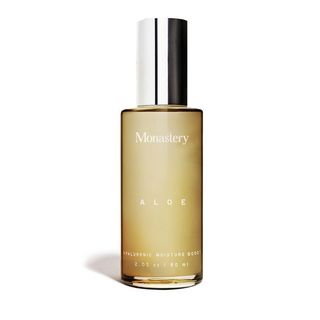
monastery Aloe Hyaluronic Moisture Boost
Works for
1 of 2 advertised claims delivered
Moisturizing7 ingredients credited for this claimGood support
“Aloe Hyaluronic Moisture Boost”
This product contains good ingredients to attract water to the upper layer of the skin. These ingredients are called "humectants": hyaluronic acid, sodium hyaluronate.
When humectants are on the surface of the skin, they “pull in” the moisture from the outside environment, or from within deeper layers of the skin. If the air is dry, humectants can speed up the moisture loss from the skin. This is why it is a good idea to use another product on top of this one to help "seal in" the moisture (look for ingredients like dimethicone, squalane, oils and butters).
Anti-blemish2 ingredients credited for this claimWeak support
“Regulates sebum production, tones the skin by acting as a mild astringent and reduces inflammation associated with acne.”
Effective ingredients missing or their concentration is too low.
Can it cause trouble?
Irritancy9 strong irritants: Salvia sclarea oil, Cinnamomum camphora oil + 7 more — patch-test recommendedHigh risk
ComedogenicClean of flagged comedogenic ingredientsNone flagged


User reviews
Be the first — your take helps the next person decide.
Ingredients
Filter by role to see what each ingredient is doing.
Aloe barbadensis leaf juice~23–35%
- Irritation risk
- Medium
Traditionally used to treat sunburns, dermatitis and inflammation, but evidence for its effectiveness is lacking. The extract can contain humectants that help attract water into the skin
More about Aloe barbadensis leaf juiceHyaluronic acid~4.4–6.5%
- Irritation risk
- Low
One of the best moisturizing ingredients. Attracts water into the upper layer of the skin. Naturally present in skin. Typically has large molecule size unless advertised otherwise on the product label. Helps support skin's barrier function and may help to reduce inflammation
More about Hyaluronic acidLeuconostoc/radish root ferment filtrate~4.5–6.7%
- Irritation risk
- Medium
A preservative that comes from radishes fermented by a bacteria. New research suggests that the preservation properties in the ingredient come from an ammonium salt that is not present naturally in radish root but used in its cultivation. Is problematic because the exact amount of the preservative agents is difficult to determine
More about Leuconostoc/radish root ferment filtrateSalvia sclarea oil~3.6–5.5%
- Irritation risk
- High
Cinnamomum camphora oil~2.7–4%
- Irritation risk
- High
Camphor~1.9–2.9%
- Irritation risk
- High
Lavandula angustifolia extract~1.5–2.2%
- Irritation risk
- High
Used for fragrance and contains volatile compounds that can irritate the skin
More about Lavandula angustifolia extractSalvia officinalis oil~1.2–1.8%
- Irritation risk
- High
Xanthan gum~1.1–1.6%
- Irritation risk
- Low
Used to create a thicker product consistency
More about Xanthan gumAloe barbadensis leaf extract~1–1.5%
- Irritation risk
- Medium
Traditionally used to treat sunburns, dermatitis and inflammation, but evidence for its effectiveness is lacking. The extract can contain humectants that help attract water into the skin
More about Aloe barbadensis leaf extractGluconolactone~0.55–1.3%
- Irritation risk
- Medium
A polyhydroxy acid (PHA) that helps shed the dead cells from the skin surface revealing smoother skin. Is believed to be genter than AHAs. It helps attract water to the upper layer of the skin and can stimulate production of skin's own hyaluronic acid resulting in improved hydration levels. It has been shown to be helpful against acne and clogged pores if used consistently (e.g over a period of 12 weeks) in high enough concentration. It can help reduce fine lines and wrinkles and improve skin tone with long-term application. Can help neutralize free radicals
More about GluconolactoneSalvia sclarea oil~0.5–1.1%
- Irritation risk
- High
Sodium hyaluronate~0.4–1%
- Irritation risk
- Low
One of the best moisturizing ingredients. Attracts water into the upper layer of the skin
More about Sodium hyaluronateLeuconostoc/radish root ferment filtrate~0.4–0.95%
- Irritation risk
- Medium
A preservative that comes from radishes fermented by a bacteria. New research suggests that the preservation properties in the ingredient come from an ammonium salt that is not present naturally in radish root but used in its cultivation. Is problematic because the exact amount of the preservative agents is difficult to determine
More about Leuconostoc/radish root ferment filtrateSodium benzoate~0.25–0.5%
Erythorbic acid~0.35–0.85%
- Irritation risk
- Low
Lavandula angustifolia oil~0.35–0.85%
- Irritation risk
- High
An essential oil. Potential allergen and can be irritating. It has some anti-bacterial properties
More about Lavandula angustifolia oilCitric acid~0.3–0.75%
- Irritation risk
- Medium
Can work as an exfoliant but is typically used to adjust the product pH
More about Citric acidHoney extract~0.2–0.7%
- Irritation risk
- Medium
Helps attract water to the upper layer of the skin
More about Honey extractSalvia officinalis oil~0.2–0.7%
- Irritation risk
- High
Xanthan gum~0.15–0.7%
- Irritation risk
- Low
Used to create a thicker product consistency
More about Xanthan gumPotassium sorbate~0.15–0.55%
Populus tremuloides bark extract~0.15–0.6%
- Irritation risk
- Low
Calcium gluconate~0.15–0.6%
- Irritation risk
- Low
Helps attract water to the upper layer of the skin and helps to improve appearance of the product
More about Calcium gluconateLimonene~0.1–0.4%
- Irritation risk
- High
A common frangrance that can easily irritate skin, especially if exposed to air, light or heat
More about LimoneneLinalool~0.1–0.35%
Geraniol~0.1–0.35%
Ingredient list view
Aloe barbadensis leaf juice, Unknown, Hyaluronic acid, Leuconostoc/radish root ferment filtrate, Unknown, Salvia sclarea oil, Cinnamomum camphora oil, Unknown, Camphor, Lavandula angustifolia extract, Salvia officinalis oil, Xanthan gum, Aloe barbadensis leaf extract, Gluconolactone, Salvia sclarea oil, Sodium hyaluronate, Leuconostoc/radish root ferment filtrate, Sodium benzoate, Erythorbic acid, Lavandula angustifolia oil, Citric acid, Unknown, Honey extract, Salvia officinalis oil, Xanthan gum, Potassium sorbate, Populus tremuloides bark extract, Calcium gluconate, Limonene, Linalool, Geraniol
Compare prices
Retailers ranked by price — lowest first.


Worth comparing, line by line.
Match % combines shared ingredients, the first five ingredients, shared actives and hero ingredients, irritancy (lower counts in the alternative's favour), texture and body area. Only products in the same routine step are compared.
| monasteryAloe Hyaluronic Moisture BoostYOUR PRODUCT | SayaNight Moisture | Estelle and ThildEstelle Thild Super BioActive Firming Anti Age Day Cream | Juice BeautyPREBIOTIX Gel Moisturizer | |
|---|---|---|---|---|
| Match | — | 55% | 55% | 51% |
| Price | $84.00 | $62.00−$22.00 | $75.36−$8.64 | $27.74−$56.26 |
| Shared key ingredients | — | 2 of 3 | 2 of 3 | 2 of 3 |
| Key difference | — | Salicylic Acid | Butyrospermum Parkii Butter | Panthenol |
| Irritancy | High | High | Medium | High |
| Drying alcohol | — | — | — | — |
| View product | Shop | Shop | Shop |


Sources cited in this review
Every concentration estimate and effectiveness label is anchored to one of these 16 studies and safety reviews.
- 1Efficacy of a New Topical Nano-hyaluronic Acid in Humansncbi.nlm.nih.gov
- 2Physiochemical properties and application of hyaluronic acid: a systematic reviewonlinelibrary.wiley.com
- 3
- 4
- 5
- 6

Affiliate links · As an Amazon Associate, WIMJ earns from qualifying purchases.