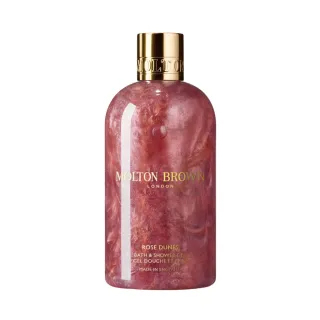
Molton Brown Rose Dunes Bath and Shower Gel
Works for
CleansingSodium laureth sulfate, Cocamidopropyl betaine + 2 moreCan be harsh
“Rose Dunes Bath and Shower Gel”
This product works by removing dirt and oil from the surface of the skin.
It contains the following cleansing agents that tend to be harsh on the skin: sodium laureth sulfate.
The following cleansing agents are typically mild, but still can cause an irritation or allergy for some people cocamidopropyl betaine, coco-glucoside.
Keep in mind that cleansing can disrupt the skin barrier, and most people do not need to cleanse their skin more than once per day.
Can it cause trouble?
Irritancy6 strong irritants: Parfum, Benzyl benzoate + 4 more — patch-test recommendedHigh risk
Comedogenic1 ingredient rated 2 or more on the 0–5 pore-clogging scale1 flagged
User reviews
Be the first — your take helps the next person decide.
Ingredients
Filter by role to see what each ingredient is doing.
Water~45–55%
Sodium laureth sulfate~10–12%
- Irritation risk
- High
- Comedogenicity
- 2/5
Works as a foaming cleansing agent
More about Sodium laureth sulfatePropylene glycol~4–4.9%
- Irritation risk
- High
Helps oil and water mix together and can enhance the penetration of other ingredients into the skin. It can be irritating
More about Propylene glycolCocamidopropyl betaine~4.4–5.4%
- Irritation risk
- High
Helps water and oil mix together. Used as a cleansing ingredient. Could be an allergen
More about Cocamidopropyl betaineParfum~1.8–2.2%
- Irritation risk
- High
An aromatic blend of unspecified and possibly irritating ingredients
More about ParfumAcrylates copolymer~1.8–2.2%
- Irritation risk
- Medium
Used to stabilize product formulation, help create an even product layer over skin (for example, in sunscreen) and create a thicker product consistency
More about Acrylates copolymerC12-13 pareth-9~1.5–1.9%
Glycerin~1.4–1.7%
- Irritation risk
- Low
One of the best moisturizing ingredients. Naturally present in skin. It attracts water to the upper layer of the skin working as a humectant
More about GlycerinCoco-glucoside~1.2–1.4%
- Irritation risk
- High
Used as a cleansing agent (surfactant) in cleansers. Helps water and oil mix together in lotions. Can be irritating
More about Coco-glucosideCaprylyl glycol~0.95–1.15%
- Irritation risk
- Medium
Helps preserve products and creates a nice product texture
More about Caprylyl glycolTetrasodium glutamate diacetate~0.65–0.95%
- Irritation risk
- Low
Helps stabilize the product formulation
More about Tetrasodium glutamate diacetateMica~0.65–1%
- Irritation risk
- Low
Creates an illusion of smoother and more radiant skin tone. Adds shimmer to the skin by reflecting light
More about MicaSynthetic fluorphlogopite~0.55–0.8%
- Irritation risk
- Low
A mineral that is used as an optical filter (makes the skin looks nicer through light reflection) and to improve the texture of cosmetic products
More about Synthetic fluorphlogopiteSilica~0.7–1.05%
Tin oxide~0.6–0.85%
- Irritation risk
- Low
A colorant that can add a pearl-like appearance to the formulation
More about Tin oxideSodium hydroxide~0.35–0.6%
Citric acid~0.25–0.5%
- Irritation risk
- Medium
Can work as an exfoliant but is typically used to adjust the product pH
More about Citric acidPhenoxyethanol~0.2–0.35%
- Irritation risk
- Low
A preservative. It helps prevent bacterial growth in cosmetic products
More about PhenoxyethanolBenzyl alcohol~0.1–0.25%
- Irritation risk
- High
A preservative. Can be used to mask unpleasant smell. Can be irritating
More about Benzyl alcoholBenzyl benzoate~0.1–0.2%
- Irritation risk
- High
Fragrance with sweet balsamic smell. Help to preserve products and dissolve other ingredients. Could trigger allergic reactions and be irritating
More about Benzyl benzoateCitronellol~0.1–0.15%
Coumarin~0.05–0.15%
Eugenol~0.05–0.1%
Geraniol~0.05%
Iron oxides~0.01–0.05%
- Irritation risk
- Low
An umbrella term for the following three colorants: CI 77491, CI 77492, CI 77499. They might be able to offer some protection against visible light, but the degree of the protection is not clear
More about Iron oxidesTitanium dioxide~0.05%
- Irritation risk
- Low
Works as a UV filter when used in high concentrations. It is photostable and is effective mostly against the UVB light, with some protection in the UVA range. In small concentrations, used for its ability to improve the color of cosmetic products. Is usually well tolerated by the skin
More about Titanium dioxideIngredient list view
Water, Sodium laureth sulfate, Propylene glycol, Cocamidopropyl betaine, Parfum, Acrylates copolymer, C12-13 pareth-9, Glycerin, Coco-glucoside, Caprylyl glycol, Tetrasodium glutamate diacetate, Mica, Synthetic fluorphlogopite, Silica, Tin oxide, Sodium hydroxide, Citric acid, Phenoxyethanol, Benzyl alcohol, Benzyl benzoate, Citronellol, Coumarin, Eugenol, Geraniol, Iron oxides, Titanium dioxide
Compare prices
Retailers ranked by price — lowest first.

Worth comparing, line by line.
Match % combines shared ingredients, the first five ingredients, shared actives and hero ingredients, irritancy (lower counts in the alternative's favour), texture and body area. Only products in the same routine step are compared.
| Molton BrownRose Dunes Bath and Shower GelYOUR PRODUCT | BaleaVanilla Coconut Shower Cream | NiveaNature Fresh Raspberry Shower Gel | BABE LABORATORIOSIntimate Hygiene Gel | |
|---|---|---|---|---|
| Match | — | 44% | 44% | 42% |
| Price | $40.00 | $1.99−$38.01 | $9.83−$30.17 | $13.46−$26.54 |
| Shared key ingredients | — | 4 of 5 | 4 of 5 | 3 of 5 |
| Key difference | — | Panthenol | Glyceryl Stearate Se | Lactic Acid |
| Irritancy | High | Medium | Medium | Medium |
| Drying alcohol | — | — | — | — |
| View product | Shop | Shop | Shop |


More alternatives: Sanex Micellar Revitalising Face and Body CleanserPalmolive Naturals Body Wash Milk & Cherry Blossom Shower Gel
Sources cited in this review
Every concentration estimate and effectiveness label is anchored to one of these 10 studies and safety reviews.
- 1Surfactants and experimental irritant contact dermatitisncbi.nlm.nih.gov
- 2Propylene Glycolpubmed.ncbi.nlm.nih.gov
- 3Skin-sensitizing and irritant properties of propylene glycolonlinelibrary.wiley.com
- 4
- 5
- 6

Affiliate links · As an Amazon Associate, WIMJ earns from qualifying purchases.