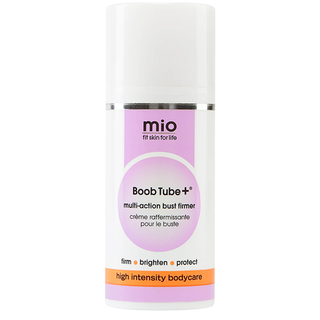
Mio Skincare Boob Tube + Multi-Action Bust Cream
Works for
1 of 1 advertised claim delivered
Moisturizing26 ingredients credited for this claimGood support
“Boob Tube + Multi-Action Bust Cream”
This product can help improve hydration of the skin with the two types of ingredients.
The first type is called “humectants”:
these ingredients help attract water.
When humectants are on the surface of the skin, they “pull in” the moisture from the outside environment, or from
within deeper layers of the skin. The following ingredients in this product do the job:
glycerin, sodium hyaluronate.
This product also contains ingredients called “occlusives”. They help reduce the speed with which our skin loses moisture to the outside environment. These ingredients also help soften the upper layer of the skin, so it feels less tight and nicer to the touch. The following ingredients in this product do the job: chondrus crispus extract, cocos nucifera oil.
Anti-oxidationNot advertised by the brand · 11 ingredients credited for this claimStrong support
This product contains antioxidants (ubiquinone) that can help neutralize free radicals in skin. By doing so, they can lessen the damage the skin gets from the UV light (sun).
Anti-agingNot advertised by the brand · 7 ingredients credited for this claimModerate support
This product contains ubiquinone. This ingredient help neutralize free radicals in skin. By doing so, they might be able to prevent early signs of aging (like fine lines and wrinkles), at least to some extent. These ingredients will not be able to "reverse" signs of aging.
Can it cause trouble?
Irritancy8 strong irritants: Parfum, Limonene + 6 more — patch-test recommendedHigh risk
Comedogenic6 ingredients rated 2 or more on the 0–5 pore-clogging scale6 flagged


User reviews
Be the first — your take helps the next person decide.
Ingredients
Filter by role to see what each ingredient is doing.
Water~45–55%
Cocos nucifera oil~4.5–5.5%
- Irritation risk
- Low
- Comedogenicity
- 3/5
An emollient. Found to be as effective as a moisturizer for dry skin as mineral oil. Could be comedogenic
More about Cocos nucifera oilEthylhexyl palmitate~4.5–5.4%
- Irritation risk
- Low
- Comedogenicity
- 3/5
An emollient that helps soften the skin and create a nice product texture
More about Ethylhexyl palmitatePrunus amygdalus dulcis oil~3.2–3.9%
- Irritation risk
- Low
An emollient that softens the skin
More about Prunus amygdalus dulcis oilIsopropyl palmitate~2.3–2.9%
- Irritation risk
- Medium
- Comedogenicity
- 3/5
Helps soften the upper layer of the skin and create a thicker product consistency
More about Isopropyl palmitateC15-19 alkane~2–2.4%
- Irritation risk
- Low
Helps soften the upper layer of the skin and create a nice product texture
More about C15-19 alkaneCetyl alcohol~1.7–2.1%
- Irritation risk
- Low
A non-drying alcohol that works to soften the skin and stabilize product formulations helping oil and water mix together
More about Cetyl alcoholGlyceryl stearate~1.5–1.8%
- Irritation risk
- Low
An emollient that softens the skin and forms a protective layer on its surface. Helps water and oil mix together
More about Glyceryl stearatePeg-100 stearate~1.2–1.5%
- Irritation risk
- Low
Helps oil and water mix togehter and creates a nice product texture
More about Peg-100 stearateStearic acid~1.1–1.3%
- Irritation risk
- Low
Helps oil and water mix together and works as an emollient
More about Stearic acidButyrospermum parkii butter~0.75–1.1%
- Irritation risk
- Low
- Comedogenicity
- 3/5
A great moisturising ingredient that softens the skin and reduces water loss from its upper layer. It also can be helpful in protecting skin from free radicals
More about Butyrospermum parkii butterParfum~0.55–0.8%
- Irritation risk
- High
An aromatic blend of unspecified and possibly irritating ingredients
More about ParfumSqualane~0.55–0.85%
- Irritation risk
- Low
An oil naturally present in skin. Works as an emollient to soften the skin and form a protective layer on its surface without a greasy feeling.
More about SqualanePhenoxyethanol~0.45–0.7%
- Irritation risk
- Low
A preservative. It helps prevent bacterial growth in cosmetic products
More about PhenoxyethanolHydrolyzed vegetable protein~0.45–0.65%
Hydroxyacetophenone~0.45–0.65%
Oenothera biennis oil~0.45–0.7%
- Irritation risk
- Medium
Helps soften the upper layer of the skin and can support skin barrier function
More about Oenothera biennis oilOlea europaea fruit oil~0.4–0.6%
- Irritation risk
- Medium
An emollient that helps soften the skin but is not effective for restoring its barrier function. Might be helpful to calm down inflammation
More about Olea europaea fruit oilTerminalia chebula fruit extract~0.3–0.55%
- Irritation risk
- Low
Carbomer~0.3–0.55%
- Irritation risk
- Low
Helps create a thicker or gel-like product texture. It is not a surfactant but can be used in gentle cleansing formulations
More about CarbomerGlycerin~0.3–0.6%
- Irritation risk
- Low
One of the best moisturizing ingredients. Naturally present in skin. It attracts water to the upper layer of the skin working as a humectant
More about GlycerinTocopheryl acetate~0.3–0.55%
- Irritation risk
- Medium
A more stable but less bio-available form of vitamin E compared to Tocopherol. Might help moisturize and protect the skin from free radicals, but mostly used in low concentrations to stabilize other ingredients.
More about Tocopheryl acetateLimonene~0.25–0.45%
- Irritation risk
- High
A common frangrance that can easily irritate skin, especially if exposed to air, light or heat
More about LimoneneLinalool~0.25–0.45%
Niacinamide~0.3–0.5%
- Irritation risk
- Low
Is proven to be effective in reducing blemishes, evening out skin tone and helping to improve lines and wrinkles. It helps the skin to repair sun damage, calm down inflammation and keep maintain good levels of moisture. The concentration of about 2% is effective for supporting the skin barrier and evening out the skin tone. Concentration of 4-6% is better for helping with acne and balancing the sebum production
More about NiacinamidePersea gratissima oil~0.3–0.6%
- Irritation risk
- Medium
An emollient that helps soften the skin and could be helpful in repairing its barrier function
More about Persea gratissima oilAlcohol~0.25–0.5%
- Irritation risk
- High
Can be drying and contribute to skin irritation. Used in formulars to dissolve other ingredients, create a thinner product consistency or for its antibacterial properties
More about AlcoholTrisodium ethylenediamine disuccinate~0.25–0.5%
- Irritation risk
- Medium
Used to improve stability of the formulation
More about Trisodium ethylenediamine disuccinateHibiscus sabdariffa flower extract~0.25–0.5%
- Irritation risk
- High
A plant extract that can be irritating. It might contain a compound anthocyanin that could be helpful in neutralizing free radicals
More about Hibiscus sabdariffa flower extractMorus alba bark extract~0.25–0.5%
- Irritation risk
- High
A plant extract that might have anti-oxidant properties and help even out skin tone, but solid evidence is lacking
More about Morus alba bark extractSodium benzoate~0.25–0.5%
Citral~0.25–0.45%
Cucumis sativus seed extract~0.25–0.5%
- Irritation risk
- Low
Potassium sorbate~0.3–0.5%
Lecithin~0.3–0.55%
- Irritation risk
- Low
Used mostly for creating emulsions - helping oil and water mix together. Helps soften the upper layer of the skin
More about LecithinCitronellol~0.25–0.45%
Opuntia ficus-indica stem extract~0.25–0.5%
- Irritation risk
- Low
Sodium hydroxide~0.25–0.5%
Ubiquinone~0.25–0.5%
- Irritation risk
- Low
Coenzyme Q10. It helps neutralize free radicals in skin, improves skin hydration and might be helpful agains fine lines and wrinkles. It can be an allergen
More about UbiquinoneChondrus crispus extract~0.3–0.55%
- Irritation risk
- Low
- Comedogenicity
- 3/5
Red algae extract that helps attract water to the upper layer of the skin and create a nicer product consistency
More about Chondrus crispus extractOlus oil~0.3–0.55%
- Irritation risk
- Low
An oil from a mixture of different vegetables. Helps soften the upper layer of the skin
More about Olus oilVegetable oil~0.3–0.55%
- Irritation risk
- Low
An oil from a mixture of different vegetables. Helps soften the upper layer of the skin
More about Vegetable oilEthylhexylglycerin~0.25–0.45%
Eugenol~0.2–0.4%
Rhizobian gum~0.25–0.45%
- Irritation risk
- Medium
Can temporarily tighten the skin right after application of the product. The effect will be short-lived. Helps improve the product considtency
More about Rhizobian gumSodium hyaluronate~0.25–0.45%
- Irritation risk
- Low
One of the best moisturizing ingredients. Attracts water into the upper layer of the skin
More about Sodium hyaluronateTocopherol~0.25–0.4%
- Irritation risk
- Low
Pure form of vitamin E. Can help moisturise and protect the skin from free radicals. Often used to help stabilise other ingredients or the formula itself
More about TocopherolVitex agnus-castus extract~0.2–0.35%
- Irritation risk
- Medium
A plant extract that might have some antioxidant properties but evidence of effectiveness in skin is missing
More about Vitex agnus-castus extractAscorbyl tetraisopalmitate~0.2–0.35%
- Irritation risk
- Medium
A vitamin C derivative. Studies show that is might be effective in reducing hyperpigmentation, but there are no studies confirming that it is effectively converted into the bioavailable form of Vitamin C in skin. It is not clear how this derivative compares in effectiveness to the topical application of bioavailable form of vitamin C (L-ascorbic acid)
More about Ascorbyl tetraisopalmitateCyclodextrin~0.15–0.3%
- Irritation risk
- Low
A type of sugar that is used to support delivery of active ingredients and can enhance their penetration into the skin without disrupting the skin's barrier
More about CyclodextrinChlorphenesin~0.15–0.3%
Lithothamnion calcareum extract~0.1–0.2%
- Irritation risk
- Low
- Comedogenicity
- 3/5
A mineral-rich extract from red algae. Might be able to help attract water to the upper layer of the skin
More about Lithothamnion calcareum extractCentella asiatica extract~0.15–0.3%
- Irritation risk
- Medium
A plant extract that has been shown to be able to reduce inflammation in skin, support restoration of skin barrier function, as well as support collagen production. Contains active compounds called centelloids: asiaticoside, madecasosside, asiatic acid and madecassic acid. Might be helpful in preventing stretch marks. It can be itself be irritating though.
More about Centella asiatica extractIngredient list view
Water, Cocos nucifera oil, Ethylhexyl palmitate, Prunus amygdalus dulcis oil, Isopropyl palmitate, C15-19 alkane, Cetyl alcohol, Glyceryl stearate, Peg-100 stearate, Stearic acid, Butyrospermum parkii butter, Parfum, Squalane, Phenoxyethanol, Hydrolyzed vegetable protein, Hydroxyacetophenone, Oenothera biennis oil, Olea europaea fruit oil, Terminalia chebula fruit extract, Carbomer, Glycerin, Tocopheryl acetate, Limonene, Linalool, Niacinamide, Persea gratissima oil, Alcohol, Trisodium ethylenediamine disuccinate, Hibiscus sabdariffa flower extract, Morus alba bark extract, Sodium benzoate, Citral, Cucumis sativus seed extract, Potassium sorbate, Lecithin, Citronellol, Opuntia ficus-indica stem extract, Sodium hydroxide, Ubiquinone, Chondrus crispus extract, Olus oil, Vegetable oil, Ethylhexylglycerin, Eugenol, Rhizobian gum, Sodium hyaluronate, Tocopherol, Vitex agnus-castus extract, Ascorbyl tetraisopalmitate, Cyclodextrin, Chlorphenesin, Lithothamnion calcareum extract, Centella asiatica extract
Compare prices
Retailers ranked by price — lowest first.
Affiliate links · prices updated regularly
Worth comparing, line by line.
Match % combines shared ingredients, the first five ingredients, shared actives and hero ingredients, irritancy (lower counts in the alternative's favour), texture and body area. Only products in the same routine step are compared.
| Mio SkincareBoob Tube + Multi-Action Bust CreamYOUR PRODUCT | NEOGEN X SUR.MEDICSurmedic 24K Gold Caviar Repair Vital Cream | GeologieGentle 0.05% Retinol Night Cream | Genus SkincarePhysio~Logic Fortifying Moisturiser | |
|---|---|---|---|---|
| Match | — | 78% | 77% | 76% |
| Price | $30.41 | $39.59+$9.18 | $39.00+$8.59 | $39.66+$9.25 |
| Shared key ingredients | — | 8 of 12 | 5 of 12 | 7 of 12 |
| Key difference | — | Copper Tripeptide-1 | Retinol | Ceramide 1 |
| Irritancy | High | Medium | Medium | Low |
| Drying alcohol | Contains drying alcohol | — | — | — |
| View product | Shop | Shop | Shop |


Sources cited in this review
Every concentration estimate and effectiveness label is anchored to one of these 27 studies and safety reviews.
- 1
- 2Final Report on the Safety Assessment of Isopropyl Isostearatejournals.sagepub.com
- 3Use of “natural” oils for moisturization: Review of olive, coconut, and sunflower seed oilonlinelibrary.wiley.com
- 4
- 5
- 6

Affiliate links · As an Amazon Associate, WIMJ earns from qualifying purchases.