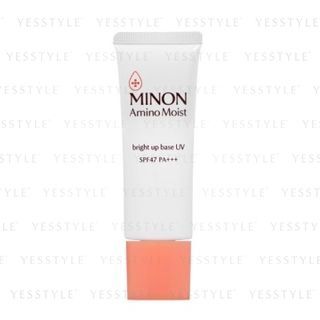
Minon Amino Moist Bright Up Base UV SPF 47 PA+++
Works for
0 of 1 advertised claim delivered
Sun protectionSPF 47 · 1 UV filter · Partial spectrumWeak protection
This product does not offer good protection against UVA rays.
This product can be considered "reef safe" because it does not contain the UV filters (oxybenzone and octinoxate) that can be harmful to coral reefs when present in the water in high concentrations.
Anti-oxidationNot advertised by the brand · 3 ingredients credited for this claimStrong support
This product contains antioxidants (carnosine) that can help neutralize free radicals in skin. By doing so, they can lessen the damage the skin gets from the UV light (sun).
MoisturizingNot advertised by the brand · 29 ingredients credited for this claimGood support
This product can help improve hydration of the skin with the two types of ingredients.
The first type is called “humectants”:
these ingredients help attract water.
When humectants are on the surface of the skin, they “pull in” the moisture from the outside environment, or from
within deeper layers of the skin. The following ingredients in this product do the job:
alanine, arginine.
This product also contains ingredients called “occlusives”. They help reduce the speed with which our skin loses moisture to the outside environment. These ingredients also help soften the upper layer of the skin, so it feels less tight and nicer to the touch. The following ingredients in this product do the job: arginine, dimethicone.
Anti-agingNot advertised by the brand · 4 ingredients credited for this claimModerate support
This product contains carnosine, serine, threonine. These ingredients might be able to help reduce and prevent fine lines and wrinkles, improve skin elasticity and firmness, but there is not enough evidence that it actually works. The biggest anti-aging effect in this product comes from sun protection. Sun damage is the main factor causing early signs of skin aging. We, however, do not recommend using this product as a sunscreen because the protection it offers is not strong enough).
Evens skin toneNot advertised by the brand · 3 ingredients credited for this claimModerate support
The following ingredient (ingredients) in this product might be helpful, but there is no evidence to confirm that it actually works: alanine, stearyl glycyrrhetinate.
The biggest effect for evening out skin tone in this product comes from sun protection. Sun damage is the main factor causing age spots, darkening of post-acne marks and other discolorations. This is why sun protection is the best strategy for maintaining an even skin tone. We, however, do not recommend using this product as a sunscreen because the protection it offers is not strong enough).
Can it cause trouble?
Irritancy6 flagged ingredientsLow risk
ComedogenicClean of flagged comedogenic ingredientsNone flagged
User reviews
Be the first — your take helps the next person decide.
Ingredients
Filter by role to see what each ingredient is doing.
Water~45–55%
Cyclopentasiloxane~5.9–7.2%
- Irritation risk
- Low
A silicone that helps improve the product texture and spreadability. Can absorb oil creating a short-term mattifying effect on the skin
More about CyclopentasiloxaneTitanium dioxide~4.9–6%
- Irritation risk
- Low
Works as a UV filter when used in high concentrations. It is photostable and is effective mostly against the UVB light, with some protection in the UVA range. In small concentrations, used for its ability to improve the color of cosmetic products. Is usually well tolerated by the skin
More about Titanium dioxideDiphenylsiloxy phenyl trimethicone~3.4–4.1%
- Irritation risk
- Low
Help improve the product's texture
More about Diphenylsiloxy phenyl trimethiconePeg-9 polydimethylsiloxyethyl dimethicone~2.6–3.2%
- Irritation risk
- Medium
A type of silicone that helps water and oil mix together
More about Peg-9 polydimethylsiloxyethyl dimethiconeOctyldodecyl myristate~2.2–2.7%
- Irritation risk
- Low
Helps soften the upper layer of the skin
More about Octyldodecyl myristateTriethylhexanoin~1.5–1.8%
- Irritation risk
- Medium
Helps soften the upper layer of the skin
More about TriethylhexanoinPentylene glycol~1.6–1.9%
- Irritation risk
- Medium
Used to preserve products, dissolve other ingredients and create a nice product texture
More about Pentylene glycolButylene glycol~1.4–1.7%
- Irritation risk
- Low
Used to create a nice product texture and help delivery of other ingredients. Might be somewhat helpful in attracting water to the upper layer of the skin
More about Butylene glycolCetyl peg/ppg-10/1 dimethicone~1.1–1.4%
- Irritation risk
- Low
A type of silicone that helps water and oil mix together. Can help to soften upper layer of the skin
More about Cetyl peg/ppg-10/1 dimethiconeDisteardimonium hectorite~1–1.2%
- Irritation risk
- Low
A type of clay that is used to thicken the product consistency
More about Disteardimonium hectoriteLauroyl lysine~0.75–1.1%
- Irritation risk
- Low
Helps soften the upper layer of the skin and creates a nice product texture
More about Lauroyl lysineVinyl dimethicone/methicone silsesquioxane crosspolymer~0.7–1.1%
- Irritation risk
- Low
A type of silicone that create a smooth product finish and can create an optical soft-focus effect on the skin. Helps to thicken the product consistency
More about Vinyl dimethicone/methicone silsesquioxane crosspolymerSodium chloride~0.75–1.1%
- Irritation risk
- Low
Used to stabilize mixtures of oil and water, and create thicker, gel-like product textures
More about Sodium chloridePotassium hydroxide~0.7–1%
Stearic acid~0.75–1.15%
- Irritation risk
- Low
Helps oil and water mix together and works as an emollient
More about Stearic acidDipentaerythrityl tri-polyhydroxystearate~0.65–0.95%
- Irritation risk
- Low
Phytosteryl/behenyl/octyldodecyl lauroyl glutamate~0.6–0.85%
- Irritation risk
- Low
Tribehenin~0.55–0.85%
- Irritation risk
- Low
Used to create a thicker product consistency and soften the upper layer of the skin
More about TribeheninPhenoxyethanol~0.55–0.8%
- Irritation risk
- Low
A preservative. It helps prevent bacterial growth in cosmetic products
More about PhenoxyethanolDimethicone/vinyl dimethicone crosspolymer~0.5–0.75%
- Irritation risk
- Low
Used to stabilize product formulations and create a nice product texture
More about Dimethicone/vinyl dimethicone crosspolymerTocopherol~0.5–0.75%
- Irritation risk
- Low
Pure form of vitamin E. Can help moisturise and protect the skin from free radicals. Often used to help stabilise other ingredients or the formula itself
More about TocopherolStearyl glycyrrhetinate~0.45–0.7%
- Irritation risk
- Medium
A fatty acid derived from licorice. Works as an emollient and can help calm down inflammation
More about Stearyl glycyrrhetinateMethicone~0.5–0.75%
- Irritation risk
- Low
A type of silicone that helps soften the upper layer of the skin and reduces the water loss from the skin surface
More about MethiconeSorbitol~0.45–0.7%
- Irritation risk
- Low
Helps attract water to the upper layer of the skin and improves the product texture
More about SorbitolSilica~0.6–0.9%
Carnosine~0.45–0.7%
- Irritation risk
- Low
A type of peptide. It attracts water to the upper layer of the skin. It can help neutralize free radicals in skin combatting the sun damage
More about CarnosineTaurine~0.45–0.7%
- Irritation risk
- Medium
Could be helpful in reducing inflammation in skin, evening out the skin tone and neutralizing free radicals, but more research is needed to confirm its effectiveness
More about TaurineGlycerin~0.5–0.75%
- Irritation risk
- Low
One of the best moisturizing ingredients. Naturally present in skin. It attracts water to the upper layer of the skin working as a humectant
More about GlycerinLysine hcl~0.45–0.7%
Polyquaternium-61~0.5–0.75%
- Irritation risk
- Low
Glutamic acid~0.45–0.7%
- Irritation risk
- Low
An amino-acid that helps attract water to the upper layer of the skin
More about Glutamic acidGlycine~0.45–0.7%
- Irritation risk
- Low
Helps to attract water to the upper layer of the skin and can help restore the skin barrier function
More about GlycineLeucine~0.45–0.65%
- Irritation risk
- Low
Histidine hcl~0.45–0.65%
- Irritation risk
- Low
A salt of an amino-acid that helps attract water to the upper layer of the skin. Might be helpful in restoring the skin barrier function
More about Histidine hclSerine~0.45–0.65%
- Irritation risk
- Low
An amino-acid that helps to attract water to the upper layer of the skin. In combination with other amino-acids, might help to reduce fine lines and wrinkles
More about SerineValine~0.45–0.65%
- Irritation risk
- Low
Tin oxide~0.55–0.8%
- Irritation risk
- Low
A colorant that can add a pearl-like appearance to the formulation
More about Tin oxideSodium aspartate~0.3–0.55%
- Irritation risk
- Low
Threonine~0.3–0.6%
- Irritation risk
- Low
An amino-acid that helps to attract water to the upper layer of the skin. In combination with other amino-acids, might help to reduce fine lines and wrinkles
More about ThreonineAlanine~0.3–0.6%
- Irritation risk
- Low
An amino-acid that helps to attract water to the upper layer of the skin and might help to lighten the skin, but solid evidence is lacking
More about AlanineIsoleucine~0.3–0.55%
- Irritation risk
- Low
An amino acid that can help attract water to the upper layer of the skin and support skin's barrier function
More about IsoleucineAllantoin~0.25–0.5%
- Irritation risk
- Low
Helps calm down inflammation in skin and can help reduce itching. Helps to repair the skin barrier and keep skin hydrated
More about AllantoinPhenylalanine~0.3–0.55%
- Irritation risk
- Low
Arginine~0.25–0.45%
- Irritation risk
- Low
An amino acid that is naturally present in skin and helps keep it hydrated. When used together with AHAs, it can reduce their irritating effect on the skin
More about ArginineProline~0.25–0.5%
Tyrosine~0.25–0.45%
Disodium guanylate~0.2–0.4%
- Irritation risk
- Low
Talc~0.25–0.5%
Dimethicone~0.2–0.4%
- Irritation risk
- Low
A silicone that helps to reduce water loss from the surface of the skin. Can temporarily "fill in" lines and wrinkles, absorb oil, and create a nice product finish
More about DimethiconeBoron nitride~0.15–0.3%
- Irritation risk
- Low
Helps to absord oil and evenly disperse other ingredients (for example, pigment) in product formulation
More about Boron nitridePotassium oxide~0.1–0.2%
- Irritation risk
- Low
Ingredient list view
Water, Cyclopentasiloxane, Titanium dioxide, Diphenylsiloxy phenyl trimethicone, Peg-9 polydimethylsiloxyethyl dimethicone, Octyldodecyl myristate, Triethylhexanoin, Pentylene glycol, Butylene glycol, Cetyl peg/ppg-10/1 dimethicone, Disteardimonium hectorite, Lauroyl lysine, Vinyl dimethicone/methicone silsesquioxane crosspolymer, Sodium chloride, Unknown, Potassium hydroxide, Stearic acid, Dipentaerythrityl tri-polyhydroxystearate, Phytosteryl/behenyl/octyldodecyl lauroyl glutamate, Tribehenin, Phenoxyethanol, Dimethicone/vinyl dimethicone crosspolymer, Tocopherol, Stearyl glycyrrhetinate, Methicone, Sorbitol, Unknown, Silica, Unknown, Carnosine, Taurine, Glycerin, Lysine hcl, Polyquaternium-61, Glutamic acid, Glycine, Leucine, Histidine hcl, Serine, Valine, Tin oxide, Sodium aspartate, Threonine, Alanine, Isoleucine, Allantoin, Phenylalanine, Arginine, Proline, Tyrosine, Unknown, Disodium guanylate, Talc, Dimethicone, Boron nitride, Unknown, Potassium oxide
Compare prices
Retailers ranked by price — lowest first.

Affiliate links · prices updated regularly
Product summary
"Minon - Amino Moist Bright Up Base UV SPF 47 PA+++" does not provide enough UVA protection. UVA rays do not cause sunburn, but still damage the skin, leading to early signs of aging and pigmentation issues.
Its formula is also hydrating, so you might not need an additional moistruizer during the day.
Sunscreen filters
This moisturizer is a mineral sunscreen. It uses titanium dioxide for sun protection. Titanium dioxide almost never irritates the skin or stings eyes, but it can leave a white cast.
Irritation risk
This product does not contain known common irritants and is suitable for sensitive skin. We assess the overall irritancy of this moisturizer to be medium. For a detailed overview of all potential irritants: click here
You can see the detailed formula review with the breakdown of all actives in the product and the full ingredient list with estimated concentrations in the tables below.
Price
The product retails for 26.70$ in the United States.
For a detailed price comparison: click here.
Sources cited in this review
Every concentration estimate and effectiveness label is anchored to one of these 18 studies and safety reviews.
- 1
- 2Vitamin E in dermatologyncbi.nlm.nih.gov
- 3Vitamin E and Skin Healthlpi.oregonstate.edu
- 4
- 5Cosmeceuttical Critigue: Taurinemdedge.com
- 6

Affiliate links · As an Amazon Associate, WIMJ earns from qualifying purchases.