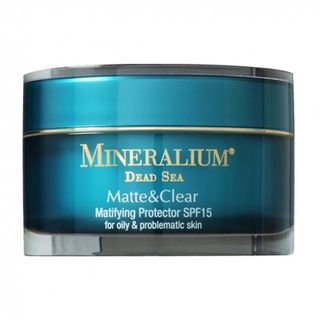
Mineralium Matifying Protector SPF15 For Oily Skin
Works for
1 of 2 advertised claims delivered
Sun protectionSPF 15 · 4 UV filters · Broad spectrumWeak protectionSPF under 30
This product offers broad spectrum sun protection, but it is weak. We recommend to use a broad spectrum sunscreen with at least SPF 30.
Moisturizing20 ingredients credited for this claimStrong support
“Hydration, sun protection and perfectly matte skin in one luxurious product that combines Dead Sea minerals with advanced UV protection.”
This product can help improve hydration of the skin with the two types of ingredients.
The first type is called “humectants”:
these ingredients help attract water.
When humectants are on the surface of the skin, they “pull in” the moisture from the outside environment, or from
within deeper layers of the skin. The following ingredients in this product do the job:
alanine, betaine.
This product also contains ingredients called “occlusives”. They help reduce the speed with which our skin loses moisture to the outside environment. These ingredients also help soften the upper layer of the skin, so it feels less tight and nicer to the touch. The following ingredients in this product do the job: caprylic/capric triglyceride, phenyl trimethicone.
The following ingredients in this product are especially good for supporting the skin barrier and helping with the hydration level: urea
Anti-oxidationNot advertised by the brand · 4 ingredients credited for this claimModerate support
This product contains antioxidants (creatine) that might be able to help neutralize free radicals in skin to lessen the damage it gets from the UV light (sun). There is not enough evidence to confirm their effectiveness in skin though.
Anti-agingNot advertised by the brand · 3 ingredients credited for this claimModerate support
This product contains creatine. This ingredient might be able to help reduce and prevent fine lines and wrinkles, improve skin elasticity and firmness, but there is not enough evidence that it actually works. The biggest anti-aging effect in this product comes from sun protection. Sun damage is the main factor causing early signs of skin aging. We, however, do not recommend using this product as a sunscreen because the protection it offers is not strong enough).
Can it cause trouble?
Irritancy3 strong irritants: Benzophenone-3, Parfum + 1 more — patch-test recommendedHigh risk
Comedogenic1 ingredient rated 2 or more on the 0–5 pore-clogging scale1 flagged
User reviews
Be the first — your take helps the next person decide.
Ingredients
Filter by role to see what each ingredient is doing.
Water~45–55%
Dimethicone/vinyl dimethicone crosspolymer~5.4–6.7%
- Irritation risk
- Low
Used to stabilize product formulations and create a nice product texture
More about Dimethicone/vinyl dimethicone crosspolymerC12-14 pareth-12~3.9–4.8%
Cyclopentasiloxane~3.3–4%
- Irritation risk
- Low
A silicone that helps improve the product texture and spreadability. Can absorb oil creating a short-term mattifying effect on the skin
More about CyclopentasiloxaneEthylhexyl methoxycinnamate~3.3–4.1%
- Irritation risk
- High
Octinoxate. When used in higher concentrations, works as a sunscreen protecting the skin from UVB rays. When used in lower concentration, helps to preserve the product formulation. Is shown to be harmful to coral reefs - consider avoiding bathing in coral reef areas when wearing a product with this ingredient. It can be irritating
More about Ethylhexyl methoxycinnamateTitanium dioxide~2.6–3.2%
- Irritation risk
- Low
Works as a UV filter when used in high concentrations. It is photostable and is effective mostly against the UVB light, with some protection in the UVA range. In small concentrations, used for its ability to improve the color of cosmetic products. Is usually well tolerated by the skin
More about Titanium dioxideGlyceryl stearate~1.8–2.2%
- Irritation risk
- Low
An emollient that softens the skin and forms a protective layer on its surface. Helps water and oil mix together
More about Glyceryl stearatePeg-100 stearate~1.6–1.9%
- Irritation risk
- Low
Helps oil and water mix togehter and creates a nice product texture
More about Peg-100 stearateCaprylic/capric triglyceride~1.3–1.6%
- Irritation risk
- Medium
A good mix of fatty acids that forms a protective layer on the skin. Improves the shelf life of products. Derived from coconut and glycerin
More about Caprylic/capric triglycerideGlycerin~1.1–1.3%
- Irritation risk
- Low
One of the best moisturizing ingredients. Naturally present in skin. It attracts water to the upper layer of the skin working as a humectant
More about GlycerinUrea~0.7–1.1%
- Irritation risk
- Low
Naturally present in skin (urea makes up about 7% of natural moisturizing factors in skin). Attracts water to the upper layer of the skin. Also has a positive effect on the skin barrier beyond the humectant action. Can enhance penetration of other ingredients. Is an exfoliating ingredient when used in high concentrations
More about UreaSaccharide hydrolysate~0.6–0.9%
Magnesium aspartate~0.55–0.8%
- Irritation risk
- Low
Might be helpful in restoring skin barrier function and calm down inflammation in skin
More about Magnesium aspartateGlycine~0.5–0.75%
- Irritation risk
- Low
Helps to attract water to the upper layer of the skin and can help restore the skin barrier function
More about GlycineAlanine~0.45–0.7%
- Irritation risk
- Low
An amino-acid that helps to attract water to the upper layer of the skin and might help to lighten the skin, but solid evidence is lacking
More about AlanineCreatine~0.45–0.7%
- Irritation risk
- Low
Can support skin's ability to neutralize free radicals and produce collagen, though further research is needed to confirm effectiveness
More about CreatineCetyl alcohol~0.5–0.8%
- Irritation risk
- Low
A non-drying alcohol that works to soften the skin and stabilize product formulations helping oil and water mix together
More about Cetyl alcoholButylene glycol~0.4–0.65%
- Irritation risk
- Low
Used to create a nice product texture and help delivery of other ingredients. Might be somewhat helpful in attracting water to the upper layer of the skin
More about Butylene glycolPeg-60 almond glycerides~0.4–0.65%
Caprylyl glycol~0.4–0.6%
- Irritation risk
- Medium
Helps preserve products and creates a nice product texture
More about Caprylyl glycolCarbomer~0.3–0.6%
- Irritation risk
- Low
Helps create a thicker or gel-like product texture. It is not a surfactant but can be used in gentle cleansing formulations
More about CarbomerNordihydroguaiaretic acid~0.3–0.6%
- Irritation risk
- Medium
Used to stabilize the formula of product formulation. Might be helpful in neutralizing free radicals in skin
More about Nordihydroguaiaretic acidOleanolic acid~0.3–0.5%
- Irritation risk
- Low
Might be helpful against blemishes, work as an anti-oxidant, reduce inflammation and improve skin's ability to hold on to moisture, but more research is needed to confirm its effectiveness when applied topically to human skin
More about Oleanolic acidBenzophenone-3~0.5–0.75%
- Irritation risk
- High
Same as oxybenzone. Protects in the UVB and short UVA range. In small concentrations, used to stabilize product formulation. Can be irritating. Is shown to be harmful to coral reefs - consider avoiding bathing in coral reef areas when wearing a product with this ingredient. It can penetrate the skin and get absorbed into bloodstream faster than other popular filters available in the US. The study that produced this finding did not address any potential health effects of the absorption
More about Benzophenone-3Butyl methoxydibenzoylmethane~0.5–0.75%
- Irritation risk
- Medium
Avobenzone. An organic, or so-called "chemical" UV filter. Protects against both UVA and UVB rays. Needs to be combined with other filters in a formulation to be stable.
More about Butyl methoxydibenzoylmethaneCetearyl alcohol~0.35–0.6%
- Irritation risk
- Low
- Comedogenicity
- 2/5
A non-drying alcohol. Works as an emollient. Helps water and oil mix together and creates a nice product texture
More about Cetearyl alcoholCetearyl glucoside~0.3–0.55%
- Irritation risk
- Medium
Helps water and oil in the product mix well together and improves product texture
More about Cetearyl glucosidePhenyl trimethicone~0.3–0.55%
- Irritation risk
- Low
A type of silicone that can decrease loss of moisture from the skin surface. It helps create a nice product texture
More about Phenyl trimethiconeSilt extract~0.3–0.5%
- Irritation risk
- Low
Maris sal~0.25–0.5%
- Irritation risk
- Medium
Used to thicken the product formulation and might help to add minerals to the surface of the skin. It is used in scrubs as a physical exfoliant. Can increase sensitivity to other ingredients if left on the skin or used in high concentration
More about Maris salBetaine~0.25–0.5%
- Irritation risk
- Low
Helps attract water to the upper layer of the skin and improves the product texture
More about BetaineCarbomer~0.3–0.5%
- Irritation risk
- Low
Helps create a thicker or gel-like product texture. It is not a surfactant but can be used in gentle cleansing formulations
More about CarbomerPanthenol~0.25–0.5%
- Irritation risk
- Low
Helps attract water to the upper layer of the skin and can help improve skin barrier function
More about PanthenolAloe barbadensis leaf juice~0.25–0.5%
- Irritation risk
- Medium
Traditionally used to treat sunburns, dermatitis and inflammation, but evidence for its effectiveness is lacking. The extract can contain humectants that help attract water into the skin
More about Aloe barbadensis leaf juiceBenzoic acid~0.25–0.5%
Phenoxyethanol~0.25–0.5%
- Irritation risk
- Low
A preservative. It helps prevent bacterial growth in cosmetic products
More about PhenoxyethanolSodium hydroxide~0.25–0.45%
Parfum~0.2–0.35%
- Irritation risk
- High
An aromatic blend of unspecified and possibly irritating ingredients
More about ParfumAllantoin~0.2–0.35%
- Irritation risk
- Low
Helps calm down inflammation in skin and can help reduce itching. Helps to repair the skin barrier and keep skin hydrated
More about AllantoinChamomilla recutita flower extract~0.2–0.35%
- Irritation risk
- High
Plant extract that can have healing and anti-inflammatory properties. It is a potential allergen and can be irritating
More about Chamomilla recutita flower extractTocopheryl acetate~0.2–0.35%
- Irritation risk
- Medium
A more stable but less bio-available form of vitamin E compared to Tocopherol. Might help moisturize and protect the skin from free radicals, but mostly used in low concentrations to stabilize other ingredients.
More about Tocopheryl acetateBisabolol~0.15–0.3%
- Irritation risk
- Low
An active component of chamomile plant that historically has been used to calm down irritated skin. A recent study shows that bisabolol indeed can have some anti-inflammatory effect on skin, even though conclusive data is lacking. Bisabolol has a sweet floral scent and can be added to products for its aromatic properties
More about BisabololDipotassium glycyrrhizate~0.1–0.2%
- Irritation risk
- Low
A salt derived from licorice. Works as an emollient to soften the upper layer of the skin and can help calm down inflammation. Might be helpful for skin lightening
More about Dipotassium glycyrrhizateMethylisothiazolinone~0.00075–0.0015%
Ingredient list view
Water, Dimethicone/vinyl dimethicone crosspolymer, C12-14 pareth-12, Cyclopentasiloxane, Ethylhexyl methoxycinnamate, Titanium dioxide, Glyceryl stearate, Peg-100 stearate, Caprylic/capric triglyceride, Glycerin, Urea, Saccharide hydrolysate, Magnesium aspartate, Glycine, Alanine, Creatine, Cetyl alcohol, Butylene glycol, Peg-60 almond glycerides, Caprylyl glycol, Carbomer, Nordihydroguaiaretic acid, Oleanolic acid, Benzophenone-3, Butyl methoxydibenzoylmethane, Cetearyl alcohol, Cetearyl glucoside, Phenyl trimethicone, Silt extract, Maris sal, Betaine, Carbomer, Panthenol, Aloe barbadensis leaf juice, Benzoic acid, Phenoxyethanol, Sodium hydroxide, Parfum, Allantoin, Chamomilla recutita flower extract, Tocopheryl acetate, Bisabolol, Dipotassium glycyrrhizate, Methylisothiazolinone
Compare prices
Retailers ranked by price — lowest first.
Affiliate links · prices updated regularly · As an Amazon Associate, WIMJ earns from qualifying purchases.
Product summary
"Mineralium - Matifying Protector SPF15 For Oily Skin" offers broad spectrum protection. It means that it protects from both UVA and UVB rays (you can remember UVB as "burning" sunlight - they cause sunburn. You can remember UVA rays as "aging" - they do not lead to sunburn, but they cause photodamage and contribute to early signs of skin aging and hyperpigmentation). On the negative side, the SPF of it is not high enough. We recommend to use a sunscreen with at least SPF 30 daily.
It contains good moisturizing ingredients and can double as a hydrating day cream.
Sunscreen filters
This is a "mixed" sunscreen in the sense that it uses both mineral and organic (so-called "chemical") sun filters. The organic filters in the product are: oxybenzone, avobenzone and octinoxate. As for the mineral filters, this sunscreen uses titanium dioxide.
Irritation risk
This product contains some common irritants, including those without a benefit for the skin. We assess the overall irritancy of this product to be high. For a detailed overview of all potential irritants: click here
You can see the detailed formula review with the breakdown of all actives in the product and the full ingredient list with estimated concentrations in the tables below.
Price
The product retails for 149.00£ in the United Kingdom.
For a detailed price comparison: click here.
Sources cited in this review
Every concentration estimate and effectiveness label is anchored to one of these 25 studies and safety reviews.
- 1
- 2Topical urea in skincare: A reviewpubmed.ncbi.nlm.nih.gov
- 3
- 4
- 5Functional glycine receptor in cultured human keratinocytesonlinelibrary.wiley.com
- 6

Affiliate links · As an Amazon Associate, WIMJ earns from qualifying purchases.