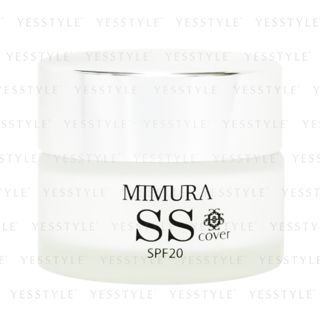
MIMURA Smooth Skin Cover SPF 20
Works for
0 of 1 advertised claim delivered
Sun protectionSPF 20 · 2 UV filters · Broad spectrumWeak protectionSPF under 30
This product offers broad spectrum sun protection, but it is weak. We recommend to use a broad spectrum sunscreen with at least SPF 30.
MoisturizingNot advertised by the brand · 9 ingredients credited for this claimStrong support
This product can help improve hydration of the skin with the two types of ingredients.
The first type is called “humectants”:
these ingredients help attract water.
When humectants are on the surface of the skin, they “pull in” the moisture from the outside environment, or from
within deeper layers of the skin. The following ingredients in this product do the job:
glycerin, butylene glycol.
This product also contains ingredients called “occlusives”. They help reduce the speed with which our skin loses moisture to the outside environment. These ingredients also help soften the upper layer of the skin, so it feels less tight and nicer to the touch. The following ingredients in this product do the job: dimethicone, peg-10 dimethicone.
The following ingredients in this product are especially good for supporting the skin barrier and helping with the hydration level: palmitoyl pentapeptide-4
Anti-agingNot advertised by the brand · 3 ingredients credited for this claimModerate support
This product contains palmitoyl pentapeptide-4. This ingredient might be able to help reduce and prevent fine lines and wrinkles, improve skin elasticity and firmness, but there is not enough evidence that it actually works. The biggest anti-aging effect in this product comes from sun protection. Sun damage is the main factor causing early signs of skin aging. We, however, do not recommend using this product as a sunscreen because the protection it offers is not strong enough).
Can it cause trouble?
Irritancy2 flagged ingredientsLow risk
ComedogenicClean of flagged comedogenic ingredientsNone flagged
User reviews
Be the first — your take helps the next person decide.
Ingredients
Filter by role to see what each ingredient is doing.
Dimethicone~22–33%
- Irritation risk
- Low
A silicone that helps to reduce water loss from the surface of the skin. Can temporarily "fill in" lines and wrinkles, absorb oil, and create a nice product finish
More about DimethiconeCyclopentasiloxane~6–9%
- Irritation risk
- Low
A silicone that helps improve the product texture and spreadability. Can absorb oil creating a short-term mattifying effect on the skin
More about CyclopentasiloxanePolysilicone-1 crosspolymer~4.6–6.9%
- Irritation risk
- Low
Isononyl isononanoate~3.9–5.9%
- Irritation risk
- Low
Forms a protective film on the surface of the skin to prevent moisture loss. Gives a velvety feel to products while reducing tackiness
More about Isononyl isononanoateEthylhexyl methoxycinnamate~3.4–5.1%
- Irritation risk
- High
Octinoxate. When used in higher concentrations, works as a sunscreen protecting the skin from UVB rays. When used in lower concentration, helps to preserve the product formulation. Is shown to be harmful to coral reefs - consider avoiding bathing in coral reef areas when wearing a product with this ingredient. It can be irritating
More about Ethylhexyl methoxycinnamateZinc oxide~2.9–4.3%
- Irritation risk
- Low
A broad spectrum sunblock (protects from both UVA and UVB rays). Is suitable for most sensitive skins. In small concentrations, can be used as a colorant
More about Zinc oxideDimethicone/vinyl dimethicone crosspolymer~1.6–2.4%
- Irritation risk
- Low
Used to stabilize product formulations and create a nice product texture
More about Dimethicone/vinyl dimethicone crosspolymerSilica~1.5–2.3%
Peg-10 dimethicone~1.3–2%
- Irritation risk
- Low
A silicone that works to soften the upper layer of the skin and reduce its water loss
More about Peg-10 dimethiconePalmitoyl pentapeptide-4~0.9–1.35%
- Irritation risk
- Low
A type of peptide. Peptides are excellent moisturizers and might be able support collagen production reducing fine lines and wrinkles
More about Palmitoyl pentapeptide-4Acetic acid~0.55–1.25%
- Irritation risk
- Low
Dipeptide-10~0.5–1.15%
- Irritation risk
- Low
Ascorbyl tetraisopalmitate~0.5–1.15%
- Irritation risk
- Medium
A vitamin C derivative. Studies show that is might be effective in reducing hyperpigmentation, but there are no studies confirming that it is effectively converted into the bioavailable form of Vitamin C in skin. It is not clear how this derivative compares in effectiveness to the topical application of bioavailable form of vitamin C (L-ascorbic acid)
More about Ascorbyl tetraisopalmitateButylene glycol~0.35–0.8%
- Irritation risk
- Low
Used to create a nice product texture and help delivery of other ingredients. Might be somewhat helpful in attracting water to the upper layer of the skin
More about Butylene glycolGlycerin~0.35–0.8%
- Irritation risk
- Low
One of the best moisturizing ingredients. Naturally present in skin. It attracts water to the upper layer of the skin working as a humectant
More about GlycerinWater~0.15–0.7%
Carbomer~0.15–0.55%
- Irritation risk
- Low
Helps create a thicker or gel-like product texture. It is not a surfactant but can be used in gentle cleansing formulations
More about CarbomerPolysorbate 20~0.1–0.5%
Tocopherol~0.1–0.4%
- Irritation risk
- Low
Pure form of vitamin E. Can help moisturise and protect the skin from free radicals. Often used to help stabilise other ingredients or the formula itself
More about TocopherolTriethoxycaprylylsilane~0.1–0.35%
- Irritation risk
- Low
A type of silicone that helps oil and water mix well together. Helps to disperse other ingredients, e.g. pigments, evenly in a formulation
More about TriethoxycaprylylsilaneIngredient list view
Dimethicone, Cyclopentasiloxane, Polysilicone-1 crosspolymer, Isononyl isononanoate, Ethylhexyl methoxycinnamate, Zinc oxide, Dimethicone/vinyl dimethicone crosspolymer, Silica, Peg-10 dimethicone, Palmitoyl pentapeptide-4, Unknown, Acetic acid, Dipeptide-10, Ascorbyl tetraisopalmitate, Butylene glycol, Glycerin, Water, Carbomer, Polysorbate 20, Tocopherol, Triethoxycaprylylsilane, Unknown
Compare prices
Retailers ranked by price — lowest first.

Affiliate links · prices updated regularly
Product summary
"MIMURA - Smooth Skin Cover SPF 20" "is a broad spectrum sunscreen meaning that it protects both from UVB rays (" burning "- they cause sunburn) and UVA rays (" aging "- they don't cause sunburn but lead to premature aging and pigmentation issues). However, this sunscreen does not offer enough sun protection. We recommend to use a sunscreen with at least SPF 30 daily.
Its formula is also hydrating, so you might not need an additional moistruizer during the day.
Sunscreen filters
This sunscreen uses a mixture of both mineral and organic (so-called" chemical ") UV filters. The organic filters in the product are: octinoxate. As for the mineral filters, this sunscreen uses zinc oxide.
Irritation risk
This product contains actives that can be irritating. We assess the overall irritancy of this product to be low. For a detailed overview of all potential irritants: click here
You can see the detailed formula review with the breakdown of all actives in the product and the full ingredient list with estimated concentrations in the tables below.
Price
The product retails for 67.35$ in the United States.
For a detailed price comparison: click here.
Sources cited in this review
Every concentration estimate and effectiveness label is anchored to one of these 14 studies and safety reviews.
- 1
- 2Final Report on the Safety Assessment of Dimethicone Copolyoljournals.sagepub.com
- 3A review of inorganic UV filters zinc oxide and titanium dioxideonlinelibrary.wiley.com
- 4
- 5
- 6

Affiliate links · As an Amazon Associate, WIMJ earns from qualifying purchases.