Works for
1 of 1 advertised claim delivered
Moisturizing11 ingredients credited for this claimGood support
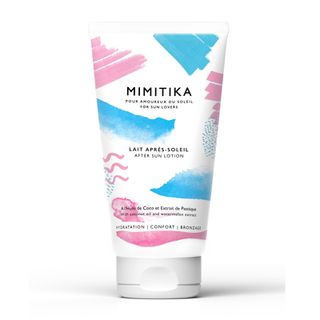
“Mimitika After-Sun Lotion 150 ml is a soothing, moisturizing lotion that prolongs the tan.”
This product can help improve hydration of the skin with the two types of ingredients.
The first type is called “humectants”:
these ingredients help attract water.
When humectants are on the surface of the skin, they “pull in” the moisture from the outside environment, or from
within deeper layers of the skin. The following ingredients in this product do the job:
glycerin, hydrolyzed algin.
This product also contains ingredients called “occlusives”. They help reduce the speed with which our skin loses moisture to the outside environment. These ingredients also help soften the upper layer of the skin, so it feels less tight and nicer to the touch. The following ingredients in this product do the job: butyrospermum parkii butter, cocos nucifera oil.
Anti-oxidationNot advertised by the brand · 4 ingredients credited for this claimModerate support
This product contains antioxidants (squalene) that might be able to help neutralize free radicals in skin to lessen the damage it gets from the UV light (sun). There is not enough evidence to confirm their effectiveness in skin though.
Can it cause trouble?
Irritancy1 strong irritant: ParfumMedium risk
Comedogenic4 ingredients rated 2 or more on the 0–5 pore-clogging scale4 flagged
User reviews
Be the first — your take helps the next person decide.
Ingredients
Filter by role to see what each ingredient is doing.
Water~45–55%
Cyclopentasiloxane~7.2–8.8%
- Irritation risk
- Low
A silicone that helps improve the product texture and spreadability. Can absorb oil creating a short-term mattifying effect on the skin
More about CyclopentasiloxaneParfum~4.4–5.4%
- Irritation risk
- High
An aromatic blend of unspecified and possibly irritating ingredients
More about ParfumCocos nucifera oil~3.2–3.9%
- Irritation risk
- Low
- Comedogenicity
- 3/5
An emollient. Found to be as effective as a moisturizer for dry skin as mineral oil. Could be comedogenic
More about Cocos nucifera oilGlycerin~2.4–3%
- Irritation risk
- Low
One of the best moisturizing ingredients. Naturally present in skin. It attracts water to the upper layer of the skin working as a humectant
More about GlycerinC10-18 triglycerides~2–2.4%
- Irritation risk
- Low
Helps soften the skin and attract water to its upper layer. Helps create nice product texture
More about C10-18 triglyceridesButyrospermum parkii butter~1.8–2.2%
- Irritation risk
- Low
- Comedogenicity
- 3/5
A great moisturising ingredient that softens the skin and reduces water loss from its upper layer. It also can be helpful in protecting skin from free radicals
More about Butyrospermum parkii butterHelianthus annuus seed oil~1.6–2%
- Irritation risk
- Low
A great emollient due to its high linoleic acid content. One of the most effective plant oils in helping skin hydration and repairing skin barrier function
More about Helianthus annuus seed oilCitrullus lanatus fruit extract~1.2–1.5%
- Irritation risk
- Medium
A plant extract that can contain an antioxidant compound
More about Citrullus lanatus fruit extractAloe barbadensis leaf extract~1.1–1.3%
- Irritation risk
- Medium
Traditionally used to treat sunburns, dermatitis and inflammation, but evidence for its effectiveness is lacking. The extract can contain humectants that help attract water into the skin
More about Aloe barbadensis leaf extractTocopherol~0.7–1.05%
- Irritation risk
- Low
Pure form of vitamin E. Can help moisturise and protect the skin from free radicals. Often used to help stabilise other ingredients or the formula itself
More about TocopherolBeta-sitosterol~0.65–0.95%
- Irritation risk
- Low
A phytosterol that can support skin's barrier function and help the skin stay hydrated
More about Beta-sitosterolSqualene~0.6–0.9%
- Irritation risk
- Low
- Comedogenicity
- 2/5
An oil that is naturally part of skin sebum that helps to soften its upper layer, reduce water loss and neutralize free radicals. It might be comedogenic. Avoid applying large concentrations (or pure oil) before sun exposure as oxidized squalene can clog pores and lead to skin irritation. Today squalene is mostly derived from vegetable oils or synthetized by yeast
More about SqualeneXanthan gum~0.5–0.75%
- Irritation risk
- Low
Used to create a thicker product consistency
More about Xanthan gumSodium stearoyl glutamate~0.5–0.75%
- Irritation risk
- Medium
Helps oil and water mix together
More about Sodium stearoyl glutamateHydrolyzed algin~0.3–0.6%
- Irritation risk
- Low
- Comedogenicity
- 3/5
Derived from brown algae. Helps attract water to the upper layer of the skin
More about Hydrolyzed alginMagnesium sulfate~0.3–0.55%
Manganese sulfate~0.25–0.45%
- Irritation risk
- Low
Potassium sorbate~0.2–0.35%
Sodium benzoate~0.15–0.3%
Citric acid~0.15–0.3%
- Irritation risk
- Medium
Can work as an exfoliant but is typically used to adjust the product pH
More about Citric acidDehydroacetic acid~0.15–0.25%
Bht~0.1–0.15%
Benzyl alcohol~0.1–0.15%
- Irritation risk
- High
A preservative. Can be used to mask unpleasant smell. Can be irritating
More about Benzyl alcoholIngredient list view
Water, Cyclopentasiloxane, Parfum, Cocos nucifera oil, Glycerin, C10-18 triglycerides, Butyrospermum parkii butter, Helianthus annuus seed oil, Citrullus lanatus fruit extract, Aloe barbadensis leaf extract, Tocopherol, Beta-sitosterol, Squalene, Xanthan gum, Sodium stearoyl glutamate, Hydrolyzed algin, Magnesium sulfate, Manganese sulfate, Potassium sorbate, Sodium benzoate, Citric acid, Dehydroacetic acid, Bht, Benzyl alcohol
Compare prices
Retailers ranked by price — lowest first.

Sources cited in this review
Every concentration estimate and effectiveness label is anchored to one of these 16 studies and safety reviews.
- 1
- 2
- 3
- 4Effect of topically applied lipids on surfactant-irritated skinonlinelibrary.wiley.com
- 5
- 6Analyzing Lycopene Content in Fruitssciencedirect.com

Affiliate links · As an Amazon Associate, WIMJ earns from qualifying purchases.