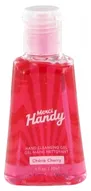
Merci Handy Cleansing Hand Gel - Scent: Chérie Cherry
Works for
CleansingHydroxypropyl methylcelluloseCan be harsh
“Cleansing Hand Gel , Scent Chérie Cherry”
This product works by removing dirt and oil from the surface of the skin.
Keep in mind that cleansing can disrupt the skin barrier, and most people do not need to cleanse their skin more than once per day.
Can it cause trouble?
Irritancy13 strong irritants: Alcohol, Parfum + 11 more — patch-test recommendedHigh risk
Comedogenic8 ingredients rated 2 or more on the 0–5 pore-clogging scale8 flagged
User reviews
Be the first — your take helps the next person decide.
Ingredients
Filter by role to see what each ingredient is doing.
Alcohol~24–35%
- Irritation risk
- High
Can be drying and contribute to skin irritation. Used in formulars to dissolve other ingredients, create a thinner product consistency or for its antibacterial properties
More about AlcoholWater~11–16%
Parfum~4.8–7.2%
- Irritation risk
- High
An aromatic blend of unspecified and possibly irritating ingredients
More about ParfumAloe barbadensis leaf juice powder~3.5–5.3%
- Irritation risk
- Medium
Traditionally used to treat sunburns, dermatitis and inflammation, but evidence for its effectiveness is lacking. The extract can contain humectants that help attract water into the skin
More about Aloe barbadensis leaf juice powderGlycerin~2.6–3.9%
- Irritation risk
- Low
One of the best moisturizing ingredients. Naturally present in skin. It attracts water to the upper layer of the skin working as a humectant
More about GlycerinPropylene glycol~1.8–2.6%
- Irritation risk
- High
Helps oil and water mix together and can enhance the penetration of other ingredients into the skin. It can be irritating
More about Propylene glycolAcrylates/c10-30 alkyl acrylate crosspolymer~1.4–2.2%
- Irritation risk
- Medium
Maintains the texture of skincare products. Allows the product to spread evenly. Helps oil and water mix together
More about Acrylates/c10-30 alkyl acrylate crosspolymerAminomethyl propanol~1.2–1.8%
Mannitol~1–1.5%
- Irritation risk
- Low
Helps to attract water to the upper layer of the skin
More about MannitolMicrocrystalline cellulose~1–1.6%
Sucrose~0.5–1.2%
- Irritation risk
- Low
Can help attract water to the upper layer of the skin. In crystal form, it can work as a gentle exfoliant, gentler than the salt scrub. Helps stabilize the emulsion
More about SucroseZea mays starch~0.45–1.1%
- Irritation risk
- Medium
- Comedogenicity
- 3/5
Used to thicken the product's consistency
More about Zea mays starchDenatonium benzoate~0.45–1.05%
- Irritation risk
- Low
Tocopheryl acetate~0.4–1%
- Irritation risk
- Medium
A more stable but less bio-available form of vitamin E compared to Tocopherol. Might help moisturize and protect the skin from free radicals, but mostly used in low concentrations to stabilize other ingredients.
More about Tocopheryl acetateMaltodextrin~0.45–1%
- Irritation risk
- Low
Used to stabilize the product formulation and can help absorb oil
More about MaltodextrinHydroxypropyl methylcellulose~0.45–1%
- Irritation risk
- Medium
Used to create a thicker product consistency and stabilize the formulation
More about Hydroxypropyl methylcellulosePotassium sorbate~0.3–0.6%
Sodium benzoate~0.25–0.5%
Eugenol~0.3–0.7%
Coumarin~0.2–0.8%
Isoeugenol~0.2–0.75%
- Irritation risk
- High
Limonene~0.2–0.75%
- Irritation risk
- High
A common frangrance that can easily irritate skin, especially if exposed to air, light or heat
More about LimoneneCi 14700~0.2–0.75%
Ci 17200~0.2–0.75%
Ci 73360~0.2–0.75%
Ci 17200~0.2–0.75%
Alcohol~0.2–0.75%
- Irritation risk
- High
Can be drying and contribute to skin irritation. Used in formulars to dissolve other ingredients, create a thinner product consistency or for its antibacterial properties
More about AlcoholWater~0.2–0.75%
Parfum~0.15–0.7%
- Irritation risk
- High
An aromatic blend of unspecified and possibly irritating ingredients
More about ParfumAloe barbadensis leaf juice powder~0.2–0.75%
- Irritation risk
- Medium
Traditionally used to treat sunburns, dermatitis and inflammation, but evidence for its effectiveness is lacking. The extract can contain humectants that help attract water into the skin
More about Aloe barbadensis leaf juice powderGlycerin~0.3–0.7%
- Irritation risk
- Low
One of the best moisturizing ingredients. Naturally present in skin. It attracts water to the upper layer of the skin working as a humectant
More about GlycerinPropylene glycol~0.2–0.7%
- Irritation risk
- High
Helps oil and water mix together and can enhance the penetration of other ingredients into the skin. It can be irritating
More about Propylene glycolAcrylates/c10-30 alkyl acrylate crosspolymer~0.35–0.8%
- Irritation risk
- Medium
Maintains the texture of skincare products. Allows the product to spread evenly. Helps oil and water mix together
More about Acrylates/c10-30 alkyl acrylate crosspolymerAminomethyl propanol~0.2–0.75%
Mannitol~0.2–0.7%
- Irritation risk
- Low
Helps to attract water to the upper layer of the skin
More about MannitolMicrocrystalline cellulose~0.35–0.75%
Sucrose~0.15–0.7%
- Irritation risk
- Low
Can help attract water to the upper layer of the skin. In crystal form, it can work as a gentle exfoliant, gentler than the salt scrub. Helps stabilize the emulsion
More about SucroseZea mays starch~0.2–0.75%
- Irritation risk
- Medium
- Comedogenicity
- 3/5
Used to thicken the product's consistency
More about Zea mays starchDenatonium benzoate~0.2–0.75%
- Irritation risk
- Low
Tocopheryl acetate~0.2–0.8%
- Irritation risk
- Medium
A more stable but less bio-available form of vitamin E compared to Tocopherol. Might help moisturize and protect the skin from free radicals, but mostly used in low concentrations to stabilize other ingredients.
More about Tocopheryl acetateMaltodextrin~0.3–0.75%
- Irritation risk
- Low
Used to stabilize the product formulation and can help absorb oil
More about MaltodextrinHydroxypropyl methylcellulose~0.35–0.75%
- Irritation risk
- Medium
Used to create a thicker product consistency and stabilize the formulation
More about Hydroxypropyl methylcellulosePotassium sorbate~0.3–0.6%
Sodium benzoate~0.25–0.5%
Amyl cinnamal~0.15–0.7%
- Irritation risk
- High
Benzyl salicylate~0.15–0.7%
Alpha-isomethyl ionone~0.15–0.65%
- Irritation risk
- High
A fragrance. Potential allergen and can be irritating
More about Alpha-isomethyl iononeLimonene~0.15–0.7%
- Irritation risk
- High
A common frangrance that can easily irritate skin, especially if exposed to air, light or heat
More about LimoneneCi 17200~0.2–0.75%
Ci 73360~0.2–0.75%
Ci 17200~0.2–0.75%
Alcohol~0.2–0.75%
- Irritation risk
- High
Can be drying and contribute to skin irritation. Used in formulars to dissolve other ingredients, create a thinner product consistency or for its antibacterial properties
More about AlcoholWater~0.2–0.75%
Parfum~0.15–0.7%
- Irritation risk
- High
An aromatic blend of unspecified and possibly irritating ingredients
More about ParfumAloe barbadensis leaf juice powder~0.2–0.75%
- Irritation risk
- Medium
Traditionally used to treat sunburns, dermatitis and inflammation, but evidence for its effectiveness is lacking. The extract can contain humectants that help attract water into the skin
More about Aloe barbadensis leaf juice powderGlycerin~0.3–0.7%
- Irritation risk
- Low
One of the best moisturizing ingredients. Naturally present in skin. It attracts water to the upper layer of the skin working as a humectant
More about GlycerinPropylene glycol~0.2–0.7%
- Irritation risk
- High
Helps oil and water mix together and can enhance the penetration of other ingredients into the skin. It can be irritating
More about Propylene glycolAcrylates/c10-30 alkyl acrylate crosspolymer~0.35–0.8%
- Irritation risk
- Medium
Maintains the texture of skincare products. Allows the product to spread evenly. Helps oil and water mix together
More about Acrylates/c10-30 alkyl acrylate crosspolymerAminomethyl propanol~0.2–0.75%
Mannitol~0.2–0.7%
- Irritation risk
- Low
Helps to attract water to the upper layer of the skin
More about MannitolMicrocrystalline cellulose~0.35–0.75%
Sucrose~0.15–0.7%
- Irritation risk
- Low
Can help attract water to the upper layer of the skin. In crystal form, it can work as a gentle exfoliant, gentler than the salt scrub. Helps stabilize the emulsion
More about SucroseZea mays starch~0.2–0.75%
- Irritation risk
- Medium
- Comedogenicity
- 3/5
Used to thicken the product's consistency
More about Zea mays starchDenatonium benzoate~0.2–0.75%
- Irritation risk
- Low
Tocopheryl acetate~0.2–0.8%
- Irritation risk
- Medium
A more stable but less bio-available form of vitamin E compared to Tocopherol. Might help moisturize and protect the skin from free radicals, but mostly used in low concentrations to stabilize other ingredients.
More about Tocopheryl acetateMaltodextrin~0.3–0.75%
- Irritation risk
- Low
Used to stabilize the product formulation and can help absorb oil
More about MaltodextrinHydroxypropyl methylcellulose~0.35–0.75%
- Irritation risk
- Medium
Used to create a thicker product consistency and stabilize the formulation
More about Hydroxypropyl methylcellulosePotassium sorbate~0.3–0.6%
Sodium benzoate~0.25–0.5%
Synthetic fluorphlogopite~0.3–0.7%
- Irritation risk
- Low
A mineral that is used as an optical filter (makes the skin looks nicer through light reflection) and to improve the texture of cosmetic products
More about Synthetic fluorphlogopiteCoumarin~0.15–0.7%
Limonene~0.15–0.7%
- Irritation risk
- High
A common frangrance that can easily irritate skin, especially if exposed to air, light or heat
More about LimoneneAlpha-isomethyl ionone~0.15–0.65%
- Irritation risk
- High
A fragrance. Potential allergen and can be irritating
More about Alpha-isomethyl iononeCinnamyl alcohol~0.15–0.7%
- Irritation risk
- High
Isoeugenol~0.15–0.7%
- Irritation risk
- High
Ci 77891~0.2–0.75%
- Irritation risk
- Low
Titanium dioxide~0.3–0.7%
- Irritation risk
- Low
Works as a UV filter when used in high concentrations. It is photostable and is effective mostly against the UVB light, with some protection in the UVA range. In small concentrations, used for its ability to improve the color of cosmetic products. Is usually well tolerated by the skin
More about Titanium dioxideCi 19140~0.2–0.75%
Ci 77492~0.2–0.75%
Iron oxides~0.2–0.75%
- Irritation risk
- Low
An umbrella term for the following three colorants: CI 77491, CI 77492, CI 77499. They might be able to offer some protection against visible light, but the degree of the protection is not clear
More about Iron oxidesCi 14700~0.2–0.75%
Alcohol~0.2–0.75%
- Irritation risk
- High
Can be drying and contribute to skin irritation. Used in formulars to dissolve other ingredients, create a thinner product consistency or for its antibacterial properties
More about AlcoholWater~0.2–0.75%
Parfum~0.15–0.7%
- Irritation risk
- High
An aromatic blend of unspecified and possibly irritating ingredients
More about ParfumAloe barbadensis leaf juice powder~0.2–0.75%
- Irritation risk
- Medium
Traditionally used to treat sunburns, dermatitis and inflammation, but evidence for its effectiveness is lacking. The extract can contain humectants that help attract water into the skin
More about Aloe barbadensis leaf juice powderGlycerin~0.3–0.7%
- Irritation risk
- Low
One of the best moisturizing ingredients. Naturally present in skin. It attracts water to the upper layer of the skin working as a humectant
More about GlycerinPropylene glycol~0.2–0.8%
- Irritation risk
- High
Helps oil and water mix together and can enhance the penetration of other ingredients into the skin. It can be irritating
More about Propylene glycolAcrylates/c10-30 alkyl acrylate crosspolymer~0.4–0.9%
- Irritation risk
- Medium
Maintains the texture of skincare products. Allows the product to spread evenly. Helps oil and water mix together
More about Acrylates/c10-30 alkyl acrylate crosspolymerAminomethyl propanol~0.3–0.75%
Mannitol~0.2–0.8%
- Irritation risk
- Low
Helps to attract water to the upper layer of the skin
More about MannitolMicrocrystalline cellulose~0.35–0.85%
Sucrose~0.2–0.75%
- Irritation risk
- Low
Can help attract water to the upper layer of the skin. In crystal form, it can work as a gentle exfoliant, gentler than the salt scrub. Helps stabilize the emulsion
More about SucroseZea mays starch~0.3–0.7%
- Irritation risk
- Medium
- Comedogenicity
- 3/5
Used to thicken the product's consistency
More about Zea mays starchDenatonium benzoate~0.3–0.75%
- Irritation risk
- Low
Tocopheryl acetate~0.3–0.75%
- Irritation risk
- Medium
A more stable but less bio-available form of vitamin E compared to Tocopherol. Might help moisturize and protect the skin from free radicals, but mostly used in low concentrations to stabilize other ingredients.
More about Tocopheryl acetateMaltodextrin~0.35–0.8%
- Irritation risk
- Low
Used to stabilize the product formulation and can help absorb oil
More about MaltodextrinHydroxypropyl methylcellulose~0.35–0.85%
- Irritation risk
- Medium
Used to create a thicker product consistency and stabilize the formulation
More about Hydroxypropyl methylcellulosePotassium sorbate~0.3–0.6%
Sodium benzoate~0.25–0.5%
Amyl cinnamal~0.2–0.75%
- Irritation risk
- High
Hexyl cinnamal~0.2–0.75%
Benzyl salicylate~0.2–0.75%
Alpha-isomethyl ionone~0.2–0.75%
- Irritation risk
- High
A fragrance. Potential allergen and can be irritating
More about Alpha-isomethyl iononeAmylcinnamyl alcohol~0.2–0.75%
- Irritation risk
- Low
Ci 19140~0.3–0.75%
Ci 14700~0.3–0.75%
Ci 77492~0.3–0.75%
Iron oxides~0.3–0.7%
- Irritation risk
- Low
An umbrella term for the following three colorants: CI 77491, CI 77492, CI 77499. They might be able to offer some protection against visible light, but the degree of the protection is not clear
More about Iron oxidesAlcohol~0.3–0.75%
- Irritation risk
- High
Can be drying and contribute to skin irritation. Used in formulars to dissolve other ingredients, create a thinner product consistency or for its antibacterial properties
More about AlcoholWater~0.3–0.7%
Parfum~0.2–0.75%
- Irritation risk
- High
An aromatic blend of unspecified and possibly irritating ingredients
More about ParfumAloe barbadensis leaf juice powder~0.3–0.7%
- Irritation risk
- Medium
Traditionally used to treat sunburns, dermatitis and inflammation, but evidence for its effectiveness is lacking. The extract can contain humectants that help attract water into the skin
More about Aloe barbadensis leaf juice powderGlycerin~0.35–0.8%
- Irritation risk
- Low
One of the best moisturizing ingredients. Naturally present in skin. It attracts water to the upper layer of the skin working as a humectant
More about GlycerinPropylene glycol~0.2–0.8%
- Irritation risk
- High
Helps oil and water mix together and can enhance the penetration of other ingredients into the skin. It can be irritating
More about Propylene glycolAcrylates/c10-30 alkyl acrylate crosspolymer~0.4–0.9%
- Irritation risk
- Medium
Maintains the texture of skincare products. Allows the product to spread evenly. Helps oil and water mix together
More about Acrylates/c10-30 alkyl acrylate crosspolymerAminomethyl propanol~0.3–0.75%
Mannitol~0.2–0.8%
- Irritation risk
- Low
Helps to attract water to the upper layer of the skin
More about MannitolMicrocrystalline cellulose~0.35–0.8%
Sucrose~0.2–0.75%
- Irritation risk
- Low
Can help attract water to the upper layer of the skin. In crystal form, it can work as a gentle exfoliant, gentler than the salt scrub. Helps stabilize the emulsion
More about SucroseZea mays starch~0.2–0.75%
- Irritation risk
- Medium
- Comedogenicity
- 3/5
Used to thicken the product's consistency
More about Zea mays starchDenatonium benzoate~0.2–0.8%
- Irritation risk
- Low
Tocopheryl acetate~0.2–0.8%
- Irritation risk
- Medium
A more stable but less bio-available form of vitamin E compared to Tocopherol. Might help moisturize and protect the skin from free radicals, but mostly used in low concentrations to stabilize other ingredients.
More about Tocopheryl acetateMaltodextrin~0.3–0.75%
- Irritation risk
- Low
Used to stabilize the product formulation and can help absorb oil
More about MaltodextrinHydroxypropyl methylcellulose~0.3–0.75%
- Irritation risk
- Medium
Used to create a thicker product consistency and stabilize the formulation
More about Hydroxypropyl methylcellulosePotassium sorbate~0.3–0.6%
Sodium benzoate~0.25–0.5%
Hexyl cinnamal~0.15–0.6%
Benzyl benzoate~0.15–0.55%
- Irritation risk
- High
Fragrance with sweet balsamic smell. Help to preserve products and dissolve other ingredients. Could trigger allergic reactions and be irritating
More about Benzyl benzoateLinalool~0.15–0.55%
Limonene~0.15–0.5%
- Irritation risk
- High
A common frangrance that can easily irritate skin, especially if exposed to air, light or heat
More about LimoneneCi 77510~0.1–0.4%
- Irritation risk
- Low
Ci 17200~0.1–0.35%
Ci 73360~0.1–0.35%
Ci 17200~0.05–0.25%
Ci 42090~0.05–0.25%
Ingredient list view
Alcohol, Water, Parfum, Aloe barbadensis leaf juice powder, Glycerin, Propylene glycol, Acrylates/c10-30 alkyl acrylate crosspolymer, Aminomethyl propanol, Mannitol, Microcrystalline cellulose, Sucrose, Zea mays starch, Denatonium benzoate, Tocopheryl acetate, Maltodextrin, Hydroxypropyl methylcellulose, Potassium sorbate, Sodium benzoate, Eugenol, Coumarin, Isoeugenol, Limonene, Ci 14700, Ci 17200, Ci 73360, Ci 17200, Alcohol, Water, Parfum, Aloe barbadensis leaf juice powder, Glycerin, Propylene glycol, Acrylates/c10-30 alkyl acrylate crosspolymer, Aminomethyl propanol, Mannitol, Microcrystalline cellulose, Sucrose, Zea mays starch, Denatonium benzoate, Tocopheryl acetate, Maltodextrin, Hydroxypropyl methylcellulose, Potassium sorbate, Sodium benzoate, Amyl cinnamal, Benzyl salicylate, Alpha-isomethyl ionone, Limonene, Ci 17200, Ci 73360, Ci 17200, Alcohol, Water, Parfum, Aloe barbadensis leaf juice powder, Glycerin, Propylene glycol, Acrylates/c10-30 alkyl acrylate crosspolymer, Aminomethyl propanol, Mannitol, Microcrystalline cellulose, Sucrose, Zea mays starch, Denatonium benzoate, Tocopheryl acetate, Maltodextrin, Hydroxypropyl methylcellulose, Potassium sorbate, Sodium benzoate, Synthetic fluorphlogopite, Coumarin, Limonene, Alpha-isomethyl ionone, Cinnamyl alcohol, Isoeugenol, Ci 77891, Titanium dioxide, Ci 19140, Ci 77492, Iron oxides, Ci 14700, Alcohol, Water, Parfum, Aloe barbadensis leaf juice powder, Glycerin, Propylene glycol, Acrylates/c10-30 alkyl acrylate crosspolymer, Aminomethyl propanol, Mannitol, Microcrystalline cellulose, Sucrose, Zea mays starch, Denatonium benzoate, Tocopheryl acetate, Maltodextrin, Hydroxypropyl methylcellulose, Potassium sorbate, Sodium benzoate, Amyl cinnamal, Hexyl cinnamal, Benzyl salicylate, Alpha-isomethyl ionone, Amylcinnamyl alcohol, Ci 19140, Ci 14700, Ci 77492, Iron oxides, Alcohol, Water, Parfum, Aloe barbadensis leaf juice powder, Glycerin, Propylene glycol, Acrylates/c10-30 alkyl acrylate crosspolymer, Aminomethyl propanol, Mannitol, Microcrystalline cellulose, Sucrose, Zea mays starch, Denatonium benzoate, Tocopheryl acetate, Maltodextrin, Hydroxypropyl methylcellulose, Potassium sorbate, Sodium benzoate, Hexyl cinnamal, Benzyl benzoate, Linalool, Limonene, Ci 77510, Ci 17200, Ci 73360, Ci 17200, Ci 42090
Compare prices
Retailers ranked by price — lowest first.
Worth comparing, line by line.
Match % combines shared ingredients, the first five ingredients, shared actives and hero ingredients, irritancy (lower counts in the alternative's favour), texture and body area. Only products in the same routine step are compared.
| Merci HandyCleansing Hand Gel - Scent: Chérie CherryYOUR PRODUCT | LEAF & BOTANICSGrapefruit Hand Soap | AntipodesNirvana Hand & Body Wash | Clean & ClearMorning Burst Hydrating Facial Cleanser | |
|---|---|---|---|---|
| Match | — | 30% | 29% | 28% |
| Price | — | $9.90 | $23.51 | $5.37 |
| Shared key ingredients | — | 2 of 5 | 1 of 5 | 3 of 5 |
| Key difference | — | Vitamin E | Camellia Sinensis Leaf Extract | Cocamidopropyl Betaine |
| Irritancy | High | Medium | High | Medium |
| Drying alcohol | Contains drying alcohol | — | Contains drying alcohol | — |
| View product | Shop | Shop | Shop |


More alternatives: SIDIA Braless Hydrating Wash with Plant-Based RetinolBabo Botanicals 3-in-1 Sensitive Baby Face, Hands & Body Wipes - Oatmilk & Calendula
Sources cited in this review
Every concentration estimate and effectiveness label is anchored to one of these 5 studies and safety reviews.
- 1
- 2Surfactants and experimental irritant contact dermatitisncbi.nlm.nih.gov
- 3Propylene Glycolpubmed.ncbi.nlm.nih.gov
- 4Skin-sensitizing and irritant properties of propylene glycolonlinelibrary.wiley.com
- 5

Affiliate links · As an Amazon Associate, WIMJ earns from qualifying purchases.