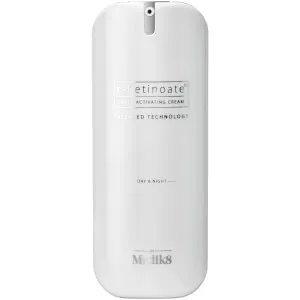
Works for
Anti-agingRetinyl retinoate, Tetrahexyldecyl ascorbate + 1 moreWorks well
“Clinically proven to deliver visible improvements with continued use, the appearance of fine lines and wrinkles are reduced, with the look of discolouration and hyperpigmentation minimised.”
This product can help reduce and prevent fine lines and wrinkles, improve skin elasticity and firmness because it contains retinyl retinoate, tetrahexyldecyl ascorbate.
Keep in mind that it typically takes at least 6 weeks to notice any results because the changes that are needed to improve fine lines and elasticity happen in the deeper layers of the skin. No topical anti-aging product can “erase” wrinkles or fully reverse signs of aging.
Evens skin toneRetinyl retinoate, Tetrahexyldecyl ascorbate + 1 moreWorks well
“Stimulating collagen synthesis and cell turnover, it gently exfoliates to improve the look of unevenness and tone, while Vitamin C and E combine to deliver an antioxidant boost with essential free radical protection.”
This product can help reduce hypepigmentation and even out the skin tone because it contains the following effective ingredients: retinyl retinoate.
In addition, this product contains tetrahexyldecyl ascorbate. This ingredient (ingredients) might help reduce hyperpigmentation, but the effect, if any, is likely to be small.
The following ingredient (ingredients) in this product might be helpful, but there is no evidence to confirm that it actually can help even out the skin tone: retinyl retinoate.
Keep in mind that you would need to apply any topical skincare targetted at hypigmentation consistently for a couple of months to get a result. No topical skincare product can help get rid of hyperpigmentation (including post-acne marks and age spots) instantly.
MoisturizingHeptyl undecylenate, Caprylic/capric triglyceride + 6 moreWorks
“Hyaluronic Acid and Glycerin work in synergy to intensively hydrate and support skin’s natural barrier function for long lasting effects.”
This product can help improve hydration of the skin with the two types of ingredients.
The first type is called “humectants”:
these ingredients help attract water.
When humectants are on the surface of the skin, they “pull in” the moisture from the outside environment, or from
within deeper layers of the skin. The following ingredients in this product do the job:
glycerin, sodium hyaluronate.
This product also contains ingredients called “occlusives”. They help reduce the speed with which our skin loses moisture to the outside environment. These ingredients also help soften the upper layer of the skin, so it feels less tight and nicer to the touch. The following ingredients in this product do the job: caprylic/capric triglyceride, heptyl undecylenate.
ExfoliationSide benefit the brand mentions · Retinyl retinoate, Polylactic acidWorks well
“Stimulating collagen synthesis and cell turnover, it gently exfoliates to improve the look of unevenness and tone, while Vitamin C and E combine to deliver an antioxidant boost with essential free radical protection.”
This product can help exfoliate the skin. In other words, it helps break down the bonds between dead cells on the surface of the skin and speed up the skin turnover. Skin often appears softer and brighter after exfoliation, but overdoing it can result in disrupted skin barrier. The following ingredient is doing the exfoliating job in this product: retinyl retinoate.
Anti-oxidationNot advertised by the brand · Tetrahexyldecyl ascorbate, Tocopheryl acetate + 1 moreWorks well
This product contains antioxidants (tetrahexyldecyl ascorbate) that can help neutralize free radicals in skin. By doing so, they can lessen the damage the skin gets from the UV light (sun).
Anti-blemishNot advertised by the brand · Retinyl retinoateWorks well
This product can help reduce breakouts and clogged pores because it contains the following ingredient: retinyl retinoate. This ingredient is used for treating acne and can have a noticeable effect.
Can it cause trouble?
Irritancy2 strong irritants: Retinyl retinoate, Vanilla planifolia fruit extractMedium risk
Comedogenic1 ingredient rated 2 or more on the 0–5 pore-clogging scale1 flagged


User reviews
Be the first — your take helps the next person decide.
Ingredients
Filter by role to see what each ingredient is doing.
Water~45–55%
Tetrahexyldecyl ascorbate~8.4–10.3%
- Irritation risk
- Medium
Being a lipid soluble form of vitamin C, it is more stable than ascorbic acid, but still degrades quickly and needs to be stabilized in a formulation with another ingredient. It is claimed to penetrate skin better than pure vitamin C and have the the similar benefits, but solid studies of its effectiveness are lacking. Is likely to require a higher concentration in a product than pure vitamin C to be effective. It might be able to help reduce pore clogging.
More about Tetrahexyldecyl ascorbateHeptyl undecylenate~4.8–5.8%
- Irritation risk
- Medium
Helps soften the upper layer of the skin, reduce water loss from the skin surface over time and create a nice product finish
More about Heptyl undecylenateCaprylic/capric triglyceride~3.6–4.4%
- Irritation risk
- Medium
A good mix of fatty acids that forms a protective layer on the skin. Improves the shelf life of products. Derived from coconut and glycerin
More about Caprylic/capric triglycerideMethylpropanediol~2.7–3.2%
Polylactic acid~2.4–2.9%
- Irritation risk
- Medium
Used as an abrasive ingredient for physical (mechanical) exfoliation
More about Polylactic acidCetearyl olivate~2–2.4%
Sodium polyacryloyldimethyl taurate~1.7–2.1%
- Irritation risk
- Medium
Helps oil and water mix together
More about Sodium polyacryloyldimethyl taurateCetearyl isononanoate~1.5–1.8%
- Irritation risk
- Low
An emollient that softens the skin and helps prevent moisture loss.
More about Cetearyl isononanoateDistarch phosphate~1.2–1.4%
- Irritation risk
- Low
Tocopheryl acetate~0.95–1.2%
- Irritation risk
- Medium
A more stable but less bio-available form of vitamin E compared to Tocopherol. Might help moisturize and protect the skin from free radicals, but mostly used in low concentrations to stabilize other ingredients.
More about Tocopheryl acetateSorbitan olivate~0.75–1.1%
Hydrogenated polydecene~0.7–1%
- Irritation risk
- Low
Helps to soften the upper layer of the skin and create a nice product texture
More about Hydrogenated polydeceneRetinyl retinoate~0.65–0.95%
- Irritation risk
- High
A "hybrid" of retinol and retinoic acid. It is more stable than retinol and is likely to be more effective based on the early research data available. Is as irritating as retinol
More about Retinyl retinoateGlycerin~0.65–0.95%
- Irritation risk
- Low
One of the best moisturizing ingredients. Naturally present in skin. It attracts water to the upper layer of the skin working as a humectant
More about GlycerinCaprylyl glycol~0.65–0.95%
- Irritation risk
- Medium
Helps preserve products and creates a nice product texture
More about Caprylyl glycolSodium hyaluronate~0.55–0.85%
- Irritation risk
- Low
One of the best moisturizing ingredients. Attracts water into the upper layer of the skin
More about Sodium hyaluronateCholesteryl nonanoate~0.55–0.85%
- Irritation risk
- Low
Disodium edta~0.5–0.75%
Hydroxyacetophenone~0.45–0.65%
Canola oil~0.45–0.65%
- Irritation risk
- Medium
A plant oil that can help soften the upper layer of the skin
More about Canola oilCetearyl alcohol~0.45–0.65%
- Irritation risk
- Low
- Comedogenicity
- 2/5
A non-drying alcohol. Works as an emollient. Helps water and oil mix together and creates a nice product texture
More about Cetearyl alcoholPhenylpropanol~0.25–0.5%
- Irritation risk
- High
Helps mask the smell of other ingredients and helps preserve the product formulation
More about PhenylpropanolVanilla planifolia fruit extract~0.25–0.45%
- Irritation risk
- High
A plant extract used as a fragrance. Can be irritating
More about Vanilla planifolia fruit extract3-o-ethyl ascorbic acid~0.2–0.4%
- Irritation risk
- High
A vitamin C derivative that is more stable but less potent than pure form of vitamin C. Can help neutralize free radicals and help reduce hyperpigmentation, but the required concentration is likely to be much higher than for the pure form of vitamin C, limiting the ingredient's effectiveness in products
More about 3-o-ethyl ascorbic acidSodium metabisulfite~0.1–0.2%
Bht~0.15–0.25%
Sodium hydroxide~0.15–0.25%
Trideceth-10~0.2–0.4%
Ingredient list view
Water, Tetrahexyldecyl ascorbate, Heptyl undecylenate, Caprylic/capric triglyceride, Methylpropanediol, Polylactic acid, Cetearyl olivate, Sodium polyacryloyldimethyl taurate, Cetearyl isononanoate, Distarch phosphate, Tocopheryl acetate, Sorbitan olivate, Hydrogenated polydecene, Retinyl retinoate, Glycerin, Caprylyl glycol, Sodium hyaluronate, Cholesteryl nonanoate, Disodium edta, Hydroxyacetophenone, Canola oil, Cetearyl alcohol, Phenylpropanol, Vanilla planifolia fruit extract, 3-o-ethyl ascorbic acid, Sodium metabisulfite, Bht, Sodium hydroxide, Trideceth-10
Compare prices
Retailers ranked by price — lowest first.

Worth comparing, line by line.
Match % combines shared ingredients, the first five ingredients, shared actives and hero ingredients, irritancy (lower counts in the alternative's favour), texture and body area. Only products in the same routine step are compared.
| Medik8r-Retinoate SerumYOUR PRODUCT | VERSOSuper Facial Serum | TheramidA-Retinoate | DermaquestStem Cell 3D Active Retinol Repair Serum - 1% | |
|---|---|---|---|---|
| Match | — | 66% | 65% | 60% |
| Price | $182.00 | $99.01−$82.99 | $47.25−$134.75 | — |
| Shared key ingredients | — | 3 of 6 | 3 of 6 | 4 of 6 |
| Key difference | — | Ceramide Np | Retinal | Niacinamide |
| Irritancy | Medium | Medium | Medium | High |
| Drying alcohol | — | — | — | — |
| View product | Shop | Shop | Shop |

More alternatives: Medicube Deep Reviving Bakuchiol Retinol SerumINNBEAUTY PROJECT Pro C Serum
Sources cited in this review
Every concentration estimate and effectiveness label is anchored to one of these 11 studies and safety reviews.
- 1
- 2
- 3Safety Assessment of Polyene Group as Used in Cosmeticscir-safety.org
- 4
- 5
- 6

Affiliate links · As an Amazon Associate, WIMJ earns from qualifying purchases.