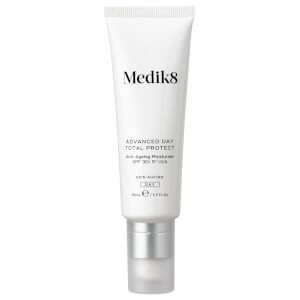
Medik8 Advanced Day Total Protect SPF30
Works for
3 of 3 advertised claims delivered
Sun protectionSPF 30 · 3 UV filtersBroad spectrum
This product offers a good level of protection against both UVB and UVA rays.
This sunscreen uses organic (so-called "chemical") sunscreen filters. Organic, or "chemical" filters usually provide reliable sun protection and rarely leave a white cast. Sunscreens with organic filters can sting eyes.
This product can be considered "reef safe" because it does not contain the UV filters (oxybenzone and octinoxate) that can be harmful to coral reefs when present in the water in high concentrations.
Anti-aging2 ingredients credited for this claimStrong support
“Enriched with premium UV filters, moringa extract and carnosine, this face SPF helps to minimise the appearance of fine lines, wrinkles and uneven texture.”
This product can help prevent early signs of skin aging because it offers a good level of broad spectrum sun protection. Sun damage is the main cause of premature skin aging, and protecting your skin from the sun is the best anti-aging strategy.
These ingredients in the product might also be helpful for reducing and preventing fine lines, wrinkles, and skin elasticity, even though there is no conclusive evidence for their effectiveness: carnosine.
Evens skin tone1 ingredient credited for this claimStrong support
“On top of it all, this powerful formula also works to hydrate and smooth your complexion by reducing the appearance of fine lines, wrinkles, dark spots and uneven skin texture.”
This product offers broad spectrum sun protection. It means that it can prevent hyperpigmentation and help keep the skin tone even (sun damage is the main factor causing age spots, darkening of post-acne marks and other discolorations).
Anti-oxidationNot advertised by the brand · 7 ingredients credited for this claimStrong support
This product contains antioxidants (carnosine, superoxide dismutase) that can help neutralize free radicals in skin. By doing so, they can lessen the damage the skin gets from the UV light (sun).
MoisturizingNot advertised by the brand · 13 ingredients credited for this claimGood support
This product can help improve hydration of the skin with the two types of ingredients.
The first type is called “humectants”:
these ingredients help attract water.
When humectants are on the surface of the skin, they “pull in” the moisture from the outside environment, or from
within deeper layers of the skin. The following ingredients in this product do the job:
carnosine, glycerin.
This product also contains ingredients called “occlusives”. They help reduce the speed with which our skin loses moisture to the outside environment. These ingredients also help soften the upper layer of the skin, so it feels less tight and nicer to the touch. The following ingredients in this product do the job: dimethicone, c12-15 alkyl benzoate.
Can it cause trouble?
Irritancy18 strong irritants: Citrus limon peel oil, Citrus grandis peel oil + 16 more — patch-test recommendedHigh risk
Comedogenic2 ingredients rated 2 or more on the 0–5 pore-clogging scale2 flagged
User reviews
Be the first — your take helps the next person decide.
Ingredients
Filter by role to see what each ingredient is doing.
Water~45–55%
Diethylamino hydroxybenzoyl hexyl benzoate~6.2–7.6%
- Irritation risk
- Medium
Uvinul A Plus. A new generation broad spectrum sunscreen that offers an effective protection especially in the UVA range. It is stable in formulations. Unfortunately, is not approved by the FDA (US) yet
More about Diethylamino hydroxybenzoyl hexyl benzoateDibutyl adipate~4.2–5.2%
- Irritation risk
- Low
Helps soften the upper layer of the skin and create a nice product consistency
More about Dibutyl adipateBis-ethylhexyloxyphenol methoxyphenyl triazine~3.4–4.2%
- Irritation risk
- Medium
Tinosorb S. One of the most effective broad spectrum sunscreen ingredients. Protects from both UVA and UVB rays. It is photostable. Unfortunately, not approved by FDA (US) yet.
More about Bis-ethylhexyloxyphenol methoxyphenyl triazineC12-15 alkyl benzoate~2.4–2.9%
- Irritation risk
- Low
Enhances the product texture and makes it more spreadable. Helps reduce water loss from the outer layer of skin. Extands the shelf life by preventing bacteria growth
More about C12-15 alkyl benzoateDicaprylyl carbonate~2–2.5%
- Irritation risk
- Low
Helps products spread more easily and works as an emollient to soften skin
More about Dicaprylyl carbonateGlycerin~1.8–2.2%
- Irritation risk
- Low
One of the best moisturizing ingredients. Naturally present in skin. It attracts water to the upper layer of the skin working as a humectant
More about GlycerinPotassium cetyl phosphate~1.5–1.8%
- Irritation risk
- Medium
Helps oil and water mix together
More about Potassium cetyl phosphateCetearyl alcohol~1.3–1.6%
- Irritation risk
- Low
- Comedogenicity
- 2/5
A non-drying alcohol. Works as an emollient. Helps water and oil mix together and creates a nice product texture
More about Cetearyl alcoholEthylhexyl triazone~1.5–1.8%
- Irritation risk
- Medium
Uvinul T. A UV filter. Effective against UVB rays. It is photostable. Can increase water resistance properties of the sunscreen. Unfortunately, not approved by the FDA (US) yet
More about Ethylhexyl triazoneCeteareth-6 olivate~0.65–1%
Dimethicone~0.6–0.95%
- Irritation risk
- Low
A silicone that helps to reduce water loss from the surface of the skin. Can temporarily "fill in" lines and wrinkles, absorb oil, and create a nice product finish
More about DimethiconeSodium polyacrylate~0.55–0.85%
- Irritation risk
- Low
Used to create a gel-like product texture, as well as to stabilize emulsions
More about Sodium polyacrylateCoco-glucoside~0.55–0.8%
- Irritation risk
- High
Used as a cleansing agent (surfactant) in cleansers. Helps water and oil mix together in lotions. Can be irritating
More about Coco-glucosideCarnosine~0.4–0.65%
- Irritation risk
- Low
A type of peptide. It attracts water to the upper layer of the skin. It can help neutralize free radicals in skin combatting the sun damage
More about CarnosineCetearyl glucoside~0.45–0.65%
- Irritation risk
- Medium
Helps water and oil in the product mix well together and improves product texture
More about Cetearyl glucosideXanthan gum~0.4–0.65%
- Irritation risk
- Low
Used to create a thicker product consistency
More about Xanthan gumPhenoxyethanol~0.35–0.65%
- Irritation risk
- Low
A preservative. It helps prevent bacterial growth in cosmetic products
More about PhenoxyethanolSodium hyaluronate~0.3–0.55%
- Irritation risk
- Low
One of the best moisturizing ingredients. Attracts water into the upper layer of the skin
More about Sodium hyaluronateTetrahexyldecyl ascorbate~0.3–0.55%
- Irritation risk
- Medium
Being a lipid soluble form of vitamin C, it is more stable than ascorbic acid, but still degrades quickly and needs to be stabilized in a formulation with another ingredient. It is claimed to penetrate skin better than pure vitamin C and have the the similar benefits, but solid studies of its effectiveness are lacking. Is likely to require a higher concentration in a product than pure vitamin C to be effective. It might be able to help reduce pore clogging.
More about Tetrahexyldecyl ascorbateMoringa oleifera seed extract~0.25–0.45%
- Irritation risk
- Medium
Helps soften the upper layer of the skin and might have some antioxidant effect
More about Moringa oleifera seed extractEthylhexylglycerin~0.25–0.45%
Disodium phosphate~0.2–0.4%
- Irritation risk
- Low
Helps adjust the product pH and stabilize the formulation
More about Disodium phosphateCitrus limon peel oil~0.2–0.35%
Citrus grandis peel oil~0.2–0.35%
- Irritation risk
- High
A plant oil with high content of volatile compounds that, especially when exposed to air, can cause allergic reactions and irritate the skin
More about Citrus grandis peel oilCitrus aurantium bergamia fruit oil~0.2–0.35%
- Irritation risk
- High
A plant oil with a high content of volatile compounds that can irritate the skin and lead to allergic reactions. Can lead to photosensitivity
More about Citrus aurantium bergamia fruit oilCitrus aurantium dulcis peel oil expressed~0.2–0.35%
- Irritation risk
- High
Hydroxyacetophenone~0.2–0.4%
Citric acid~0.2–0.4%
- Irritation risk
- Medium
Can work as an exfoliant but is typically used to adjust the product pH
More about Citric acidEctoin~0.2–0.4%
- Irritation risk
- Low
Softens the upper layer of the skin and can support skin barrier function
More about EctoinTheobroma cacao seed extract~0.25–0.4%
- Irritation risk
- Low
- Comedogenicity
- 3/5
Pelargonium graveolens flower oil~0.25–0.45%
- Irritation risk
- High
An essential oil. Can be irritating. Can become an allergen with oxidation
More about Pelargonium graveolens flower oilBenzoic acid~0.25–0.45%
Citrus nobilis peel oil~0.2–0.35%
- Irritation risk
- High
A plant oil with high content of volatile compounds that, especially when exposed to air, can cause allergic reactions and irritate the skin
More about Citrus nobilis peel oilPentylene glycol~0.25–0.5%
- Irritation risk
- Medium
Used to preserve products, dissolve other ingredients and create a nice product texture
More about Pentylene glycolCitrus aurantium amara leaf/twig oil~0.2–0.4%
- Irritation risk
- High
Cananga odorata flower oil~0.2–0.35%
Disodium edta~0.2–0.4%
Pelargonium graveolens oil~0.2–0.4%
Litsea cubeba fruit oil~0.2–0.35%
- Irritation risk
- High
An essential oil with a lemon-like smell that is extracted from a fruit grown in Asia. Used as a fragrance
More about Litsea cubeba fruit oilDehydroacetic acid~0.2–0.4%
Superoxide dismutase~0.2–0.4%
- Irritation risk
- Low
An antioxidant enzyme that is naturally present in skin. It can help support skin barrier function and reduce inflammation in skin. It is used in topical medications for inflammatory skin conditions including atopic dermatitis (eczema) and psoriasis. There are three types of natural Superoxide Dismutase in human skin. The compound used in topical treatments and cosmetics are mimics of typically one of these natural variants
More about Superoxide dismutaseTromethamine~0.25–0.4%
Juniperus virginiana wood oil~0.2–0.35%
- Irritation risk
- Low
Vetiveria zizanoides root oil~0.2–0.35%
- Irritation risk
- Low
Zingiber officinale root extract~0.15–0.3%
- Irritation risk
- High
A plant extract that can contain an irritating essential oil. Might have some anti-oxidant effect, but evidence is lacking
More about Zingiber officinale root extractBoswellia carterii oil~0.2–0.35%
Salvia sclarea oil~0.2–0.35%
- Irritation risk
- High
Acacia decurrens flower extract~0.15–0.3%
- Irritation risk
- High
A plant extract that might have some anti-oxidant benefits but research on effectiveness in skin is lacking
More about Acacia decurrens flower extractPhenethyl alcohol~0.2–0.35%
Butylene glycol~0.15–0.3%
- Irritation risk
- Low
Used to create a nice product texture and help delivery of other ingredients. Might be somewhat helpful in attracting water to the upper layer of the skin
More about Butylene glycolLimonene~0.15–0.25%
- Irritation risk
- High
A common frangrance that can easily irritate skin, especially if exposed to air, light or heat
More about LimoneneCitronellol~0.15–0.3%
Linalool~0.15–0.25%
Geraniol~0.1–0.15%
Citral~0.1–0.15%
Ingredient list view
Water, Diethylamino hydroxybenzoyl hexyl benzoate, Dibutyl adipate, Bis-ethylhexyloxyphenol methoxyphenyl triazine, C12-15 alkyl benzoate, Dicaprylyl carbonate, Glycerin, Potassium cetyl phosphate, Cetearyl alcohol, Ethylhexyl triazone, Ceteareth-6 olivate, Dimethicone, Sodium polyacrylate, Coco-glucoside, Carnosine, Cetearyl glucoside, Xanthan gum, Phenoxyethanol, Sodium hyaluronate, Tetrahexyldecyl ascorbate, Moringa oleifera seed extract, Ethylhexylglycerin, Disodium phosphate, Citrus limon peel oil, Citrus grandis peel oil, Citrus aurantium bergamia fruit oil, Citrus aurantium dulcis peel oil expressed, Hydroxyacetophenone, Citric acid, Ectoin, Theobroma cacao seed extract, Pelargonium graveolens flower oil, Benzoic acid, Citrus nobilis peel oil, Pentylene glycol, Citrus aurantium amara leaf/twig oil, Cananga odorata flower oil, Disodium edta, Pelargonium graveolens oil, Litsea cubeba fruit oil, Dehydroacetic acid, Superoxide dismutase, Tromethamine, Juniperus virginiana wood oil, Vetiveria zizanoides root oil, Zingiber officinale root extract, Boswellia carterii oil, Salvia sclarea oil, Acacia decurrens flower extract, Phenethyl alcohol, Butylene glycol, Limonene, Citronellol, Linalool, Geraniol, Citral
Compare prices
Retailers ranked by price — lowest first.


Product summary
Based on the ingredients included, we believe that "Medik8 - Advanced Day Total Protect SPF30" can offer reliable sun protection. We love that it can protect from both UVA and UVB rays (not all sunscreens with SPF ratings give UVA protection. UVA rays do not cause sunburn, but still damage our skin and lead to early aging).
It contains good moisturizing ingredients and can double as a hydrating day cream. Like all broad-spectrum sunscreens, this product has an anti-aging benefit.
Sunscreen filters
This is a so-called "chemical" sunscreen. It means that it uses organic UV filters. They typically offer good sun protection and rarely leave a white cast, but they can be irritating for some people with sensitive skin. Here are the exact UV filters in this sunscreen: tinosorb s 3.40% - 4.20%, uvinul a plus 6.20% - 7.60% and uvinul t 1.50% - 1.80%.
Irritation risk
This product contains a bunch of common irritants, including ingredients that do not provide any known benefit for the skin. It might not be the best choice if your skin is sensitive. We assess the overall irritancy of this product to be high. For a detailed overview of all potential irritants: click here
You can see the detailed formula review with the breakdown of all actives in the product and the full ingredient list with estimated concentrations in the tables below.
Price
The product retails from 55.00£ up to 87.50£ in the United Kingdom.
For a detailed price comparison: click here.
Sources cited in this review
Every concentration estimate and effectiveness label is anchored to one of these 30 studies and safety reviews.
- 1
- 2
- 3Final Report on the Safety Assessment of Dimethicone Copolyoljournals.sagepub.com
- 4
- 5Allergen of the Year—Alkyl Glucosidepracticeupdate.com
- 6

Affiliate links · As an Amazon Associate, WIMJ earns from qualifying purchases.