Works for
MoisturizingPanthenol, Sh-polypeptide-1 + 18 moreWorks well
“Rich in hydrolyzed collagen and adenosine to combat signs of aging, this firming cream is also packed with vitamin tree fruit capsules and hyaluronic acid to rejuvenate skin with moisture and nutrients.”
This product can help improve hydration of the skin with the two types of ingredients.
The first type is called “humectants”:
these ingredients help attract water.
When humectants are on the surface of the skin, they “pull in” the moisture from the outside environment, or from
within deeper layers of the skin. The following ingredients in this product do the job:
glycerin, hyaluronic acid.
This product also contains ingredients called “occlusives”. They help reduce the speed with which our skin loses moisture to the outside environment. These ingredients also help soften the upper layer of the skin, so it feels less tight and nicer to the touch. The following ingredients in this product do the job: caprylic/capric triglyceride, glycosaminoglycans.
The following ingredients in this product are especially good for supporting the skin barrier and helping with the hydration level: panthenol, sh-polypeptide-1
Anti-agingAdenosine, Sh-polypeptide-1 + 2 moreWorks well
“Rich in hydrolyzed collagen and adenosine to combat signs of aging, this firming cream is also packed with vitamin tree fruit capsules and hyaluronic acid to rejuvenate skin with moisture and nutrients.”
This product can help reduce and prevent fine lines and wrinkles, improve skin elasticity and firmness because it contains adenosine.
These ingredients in the product can also be helpful, even though there is less evidence for their effectiveness: sh-polypeptide-1.
Keep in mind that it typically takes at least 6 weeks to notice any results because the changes that are needed to improve fine lines and elasticity happen in the deeper layers of the skin. No topical anti-aging product can “erase” wrinkles or fully reverse signs of aging.
Can it cause trouble?
Irritancy3 strong irritants: Parfum, Limonene + 1 more — patch-test recommendedHigh risk
Comedogenic1 ingredient rated 2 or more on the 0–5 pore-clogging scale1 flagged


User reviews
Be the first — your take helps the next person decide.
Ingredients
Filter by role to see what each ingredient is doing.
Water~40–60%
Glycerin~4.1–6.1%
- Irritation risk
- Low
One of the best moisturizing ingredients. Naturally present in skin. It attracts water to the upper layer of the skin working as a humectant
More about GlycerinPropanediol~3.2–4.8%
- Irritation risk
- Low
Acts as a solvent for other ingredients. Speeds up the absorption of other ingredients into the skin
More about PropanediolCaprylic/capric triglyceride~2.6–4%
- Irritation risk
- Medium
A good mix of fatty acids that forms a protective layer on the skin. Improves the shelf life of products. Derived from coconut and glycerin
More about Caprylic/capric triglyceride1,2-hexanediol~1–1.5%
Isopropyl myristate~1.6–2.5%
- Irritation risk
- Low
- Comedogenicity
- 3/5
An emollient that helps soften the skin. Could be comedogenic
More about Isopropyl myristateHydrogenated poly(c6-20 olefin)~1.5–2.2%
- Irritation risk
- Low
Hippophae rhamnoides fruit oil~1.2–1.8%
- Irritation risk
- High
A plant oil that might somewhat help to neutralize free radicals. It could be irritating
More about Hippophae rhamnoides fruit oilAcrylates/c10-30 alkyl acrylate crosspolymer~1–1.6%
- Irritation risk
- Medium
Maintains the texture of skincare products. Allows the product to spread evenly. Helps oil and water mix together
More about Acrylates/c10-30 alkyl acrylate crosspolymerXanthan gum~0.55–1.3%
- Irritation risk
- Low
Used to create a thicker product consistency
More about Xanthan gumTromethamine~0.4–1%
Panthenol~0.3–0.75%
- Irritation risk
- Low
Helps attract water to the upper layer of the skin and can help improve skin barrier function
More about PanthenolHdi/trimethylol hexyllactone crosspolymer~0.15–0.65%
- Irritation risk
- Low
Used to create a silky product texture and add volume to products
More about Hdi/trimethylol hexyllactone crosspolymerParfum~0.15–0.5%
- Irritation risk
- High
An aromatic blend of unspecified and possibly irritating ingredients
More about ParfumAdenosine~0.1–0.5%
- Irritation risk
- Low
Might help improve cell turnover and reduce inflammation in skin. One study shows that the ingredients might be able to help reduce dynamic wrinkles (for example, in the corners of the eyes or on the forehead)
More about AdenosineDisodium edta~0.15–0.5%
Tocopherol~0.15–0.55%
- Irritation risk
- Low
Pure form of vitamin E. Can help moisturise and protect the skin from free radicals. Often used to help stabilise other ingredients or the formula itself
More about TocopherolSodium hyaluronate~0.15–0.55%
- Irritation risk
- Low
One of the best moisturizing ingredients. Attracts water into the upper layer of the skin
More about Sodium hyaluronateHydrolyzed hyaluronic acid~0.15–0.5%
- Irritation risk
- Low
One of the best moisturizing ingredients. Attracts water into the upper layer of the skin. A version of it is naturally present in skin
More about Hydrolyzed hyaluronic acidHyaluronic acid~0.1–0.45%
- Irritation risk
- Low
One of the best moisturizing ingredients. Attracts water into the upper layer of the skin. Naturally present in skin. Typically has large molecule size unless advertised otherwise on the product label. Helps support skin's barrier function and may help to reduce inflammation
More about Hyaluronic acidCollagen~0.1–0.4%
- Irritation risk
- Low
Cannot penetrate the skin barrier so is not particularly useful in skincare products
More about CollagenButylene glycol~0.1–0.4%
- Irritation risk
- Low
Used to create a nice product texture and help delivery of other ingredients. Might be somewhat helpful in attracting water to the upper layer of the skin
More about Butylene glycolPolyglutamic acid~0.1–0.35%
- Irritation risk
- Low
Helps attract water to the upper layer of the skin.
More about Polyglutamic acidGlycosaminoglycans~0.1–0.4%
- Irritation risk
- Low
Long sugars that help attract water to the upper layer of the skin
More about GlycosaminoglycansHydrolyzed elastin~0.1–0.4%
- Irritation risk
- Low
Hydrolyzed collagen~0.1–0.4%
- Irritation risk
- Low
A typically plant-derived compound that is supposed mimic human collagen. Cannot penetrate the skin barrier so is not particularly useful in skincare products beyond attracting water to the upper layer of the skin
More about Hydrolyzed collagenPhenoxyethanol~0.1–0.35%
- Irritation risk
- Low
A preservative. It helps prevent bacterial growth in cosmetic products
More about PhenoxyethanolSodium hyaluronate crosspolymer~0.05–0.3%
- Irritation risk
- Medium
Attracts water into the upper layer of the skin
More about Sodium hyaluronate crosspolymerPotassium hyaluronate~0.1–0.35%
- Irritation risk
- Low
Hydroxypropyltrimonium hyaluronate~0.1–0.35%
- Irritation risk
- Low
Hydrolyzed sodium hyaluronate~0.1–0.35%
- Irritation risk
- Low
Attracts water into the upper layer of the skin
More about Hydrolyzed sodium hyaluronateBenzoic acid~0.1–0.3%
Dehydroacetic acid~0.05–0.25%
Pentylene glycol~0.1–0.45%
- Irritation risk
- Medium
Used to preserve products, dissolve other ingredients and create a nice product texture
More about Pentylene glycolSodium acetylated hyaluronate~0.05–0.25%
- Irritation risk
- Low
A type of hyaluronic acid that works as an excellent moisturizer by attracting water into the upper layer of the skin. Is typically feels less sticky on the skin compared to the usual hyaluronic acid
More about Sodium acetylated hyaluronateSh-polypeptide-1~0.05–0.2%
- Irritation risk
- Low
A type of peptide. Peptides are excellent moisturizers and might be able support collagen production reducing fine lines and wrinkles
More about Sh-polypeptide-1Limonene~0.05–0.15%
- Irritation risk
- High
A common frangrance that can easily irritate skin, especially if exposed to air, light or heat
More about LimoneneLinalool~0.01–0.1%
Ingredient list view
Water, Glycerin, Propanediol, Caprylic/capric triglyceride, 1,2-hexanediol, Isopropyl myristate, Hydrogenated poly(c6-20 olefin), Hippophae rhamnoides fruit oil, Acrylates/c10-30 alkyl acrylate crosspolymer, Xanthan gum, Tromethamine, Panthenol, Hdi/trimethylol hexyllactone crosspolymer, Parfum, Adenosine, Disodium edta, Tocopherol, Sodium hyaluronate, Hydrolyzed hyaluronic acid, Hyaluronic acid, Collagen, Butylene glycol, Polyglutamic acid, Glycosaminoglycans, Hydrolyzed elastin, Hydrolyzed collagen, Phenoxyethanol, Sodium hyaluronate crosspolymer, Potassium hyaluronate, Hydroxypropyltrimonium hyaluronate, Hydrolyzed sodium hyaluronate, Benzoic acid, Dehydroacetic acid, Pentylene glycol, Sodium acetylated hyaluronate, Sh-polypeptide-1, Limonene, Linalool
Compare prices
Retailers ranked by price — lowest first.

Worth comparing, line by line.
Match % combines shared ingredients, the first five ingredients, shared actives and hero ingredients, irritancy (lower counts in the alternative's favour), texture and body area. Only products in the same routine step are compared.
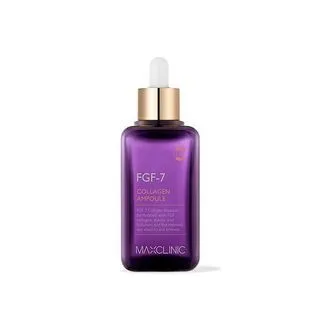
| MAXCLINICFGF-7 Collagen AmpouleYOUR PRODUCT | NACIFICUyu Cream Ampoule | ArenciaPDRN Booster Shot Cream with Peptides for Skin Recovery and Radiance | ArocellMilky Drop Ampoule | |
|---|---|---|---|---|
| Match | — | 59% | 58% | 55% |
| Price | — | $7.52 | $22.00 | — |
| Shared key ingredients | — | 10 of 15 | 9 of 15 | 11 of 15 |
| Key difference | — | Niacinamide | Copper Tripeptide-1 | Niacinamide |
| Irritancy | High | Low | Medium | Medium |
| Drying alcohol | — | — | — | — |
| View product | Shop | Shop | Shop |


More alternatives: Dr.G Black Snail Collagen To Mist SerumBIODANCE Hydro Cera-nol Ampoule
Product summary
"MAXCLINIC - FGF-7 Collagen Ampoule" is effective for: Anti-aging and Moisturizing
Ingredient callouts
- Peptides (sh-polypeptide-1 0.05% - 0.20%). There are many different kind of Peptides and they are naturally present in our skin. They all are a combination of aminoacids. Some of them work as natural antibiotics, promote wound-healing and production of collagen. The science is still not settled on how effective Peptides are in skincare, but it is very likely that they have a benefit. They might help restore the skin barrier and fight the signs of aging. At the very least, Peptides work as humectants: they attract water to the upper layer of the skin and improve its hydration.
- Adenosine 0.10% - 0.50%. It is a chemical present inside our skin cells. A clinical trial confirmed that topical application of Adenosine in a low concentration can reduce dynamic wrinkles (these are the wrinkles that appear with age in a places where our mimic is the most active, for example, in the corners of the eyes or on the forehead).
- Humectants (sodium acetylated hyaluronate 0.05% - 0.25%, hydrolyzed collagen 0.10% - 0.40%, polyglutamic acid 0.10% - 0.35%, hyaluronic acid 0.10% - 0.45%, hydrolyzed hyaluronic acid 0.15% - 0.50%, sodium hyaluronate 0.15% - 0.55%, panthenol 0.30% - 0.75% and glycerin 4.10% - 6.10%). These ingredients help attract water to the upper layer of the skin and improve the skin hydration.
Price
The product retails from 15.99$ up to 21.70$ in the United States and for 16.50£ in the United Kingdom.
For a detailed price comparison: click here.
Sources cited in this review
Every concentration estimate and effectiveness label is anchored to one of these 17 studies and safety reviews.
- 1
- 2
- 3Safety Assessment of Tromethamine as Used in Cosmeticscir-safety.org
- 4Skin moisturizing effects of panthenol-based formulationspdfs.semanticscholar.org
- 5
- 6

Affiliate links · As an Amazon Associate, WIMJ earns from qualifying purchases.