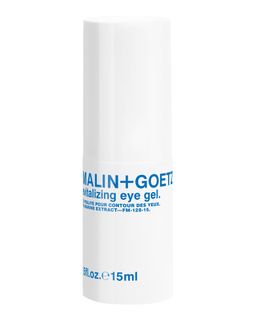
MALIN + GOETZ Revitalizing Eye Gel
Works for
2 of 2 advertised claims delivered
Anti-aging3 ingredients credited for this claimModerate support
“The unique gel texture absorbs instantly, nourishing the delicate skin under the eyes and improving the appearance of dark circles and fine lines.”
This product contains camellia oleifera leaf extract, superoxide dismutase. These ingredients help neutralize free radicals in skin. By doing so, they might be able to prevent early signs of aging (like fine lines and wrinkles), at least to some extent. These ingredients will not be able to "reverse" signs of aging.
Moisturizing17 ingredients credited for this claimGood support
“An antioxidant-rich blend of marine extracts hydrates and replenishes moisture.”
This product can help improve hydration of the skin with the two types of ingredients.
The first type is called “humectants”:
these ingredients help attract water.
When humectants are on the surface of the skin, they “pull in” the moisture from the outside environment, or from
within deeper layers of the skin. The following ingredients in this product do the job:
glycerin, sodium hyaluronate.
This product also contains ingredients called “occlusives”. They help reduce the speed with which our skin loses moisture to the outside environment. These ingredients also help soften the upper layer of the skin, so it feels less tight and nicer to the touch. The following ingredients in this product do the job: chondrus crispus extract, glycosaminoglycans.
Anti-oxidationNot advertised by the brand · 8 ingredients credited for this claimStrong support
This product contains antioxidants (camellia oleifera leaf extract, superoxide dismutase) that can help neutralize free radicals in skin. By doing so, they can lessen the damage the skin gets from the UV light (sun).
Can it cause trouble?
Irritancy1 strong irritant: Sd alcohol 40-bMedium risk
Comedogenic1 ingredient rated 2 or more on the 0–5 pore-clogging scale1 flagged
User reviews
Be the first — your take helps the next person decide.
Ingredients
Filter by role to see what each ingredient is doing.
Water~40–60%
Glyceryl polymethacrylate~4.9–7.4%
- Irritation risk
- Low
Used to create a nice product texture
More about Glyceryl polymethacrylateGlycerin~3.5–5.3%
- Irritation risk
- Low
One of the best moisturizing ingredients. Naturally present in skin. It attracts water to the upper layer of the skin working as a humectant
More about GlycerinPolysorbate 20~2.4–3.6%
Propylene glycol~2–3%
- Irritation risk
- High
Helps oil and water mix together and can enhance the penetration of other ingredients into the skin. It can be irritating
More about Propylene glycolDiamond powder~1.7–2.6%
- Irritation risk
- Low
Does not have known skin benefits. Might help create an optical illusion of smoother skin
More about Diamond powderAscophyllum nodosum extract~1.4–2.1%
- Irritation risk
- Low
Brown seaweed extract. Can help attract water to the upper layer of the skin and might have some antioxidant effect
More about Ascophyllum nodosum extractCamellia oleifera leaf extract~1.2–1.8%
- Irritation risk
- Low
A plant extract that can help neutralize free radicals and reduce inflammation, even though it is not usually used in sufficient concentration in cosmetics
More about Camellia oleifera leaf extractChamomilla recutita flower extract~1–1.5%
- Irritation risk
- High
Plant extract that can have healing and anti-inflammatory properties. It is a potential allergen and can be irritating
More about Chamomilla recutita flower extractAloe barbadensis leaf juice~0.6–1.4%
- Irritation risk
- Medium
Traditionally used to treat sunburns, dermatitis and inflammation, but evidence for its effectiveness is lacking. The extract can contain humectants that help attract water into the skin
More about Aloe barbadensis leaf juiceCucumis sativus fruit extract~0.5–1.1%
- Irritation risk
- Medium
Might be somewhat helpful in reducing hyperpigmentation and neutralizing free radicals but its typical concentration in a product is too low for having an effect
More about Cucumis sativus fruit extractHydrolyzed rice bran protein~0.4–0.9%
- Irritation risk
- Low
Asparagopsis armata extract~0.35–0.85%
- Irritation risk
- Low
Red seaweed extract. Can help attract water to the upper layer of the skin and might have some antioxidant effect
More about Asparagopsis armata extractGlycine soja protein~0.35–0.8%
- Irritation risk
- Low
A plant extract that helps to attract water to the upper layer of the skin and soften it. It might be helpful in neutralizing free radicals. It might be somewhat helpful for evening out the skin tone. It might be able to support elastin production but solid research is lacking
More about Glycine soja proteinChondrus crispus extract~0.3–0.75%
- Irritation risk
- Low
- Comedogenicity
- 3/5
Red algae extract that helps attract water to the upper layer of the skin and create a nicer product consistency
More about Chondrus crispus extractSuperoxide dismutase~0.2–0.8%
- Irritation risk
- Low
An antioxidant enzyme that is naturally present in skin. It can help support skin barrier function and reduce inflammation in skin. It is used in topical medications for inflammatory skin conditions including atopic dermatitis (eczema) and psoriasis. There are three types of natural Superoxide Dismutase in human skin. The compound used in topical treatments and cosmetics are mimics of typically one of these natural variants
More about Superoxide dismutaseSodium hyaluronate~0.2–0.75%
- Irritation risk
- Low
One of the best moisturizing ingredients. Attracts water into the upper layer of the skin
More about Sodium hyaluronateAllantoin~0.15–0.65%
- Irritation risk
- Low
Helps calm down inflammation in skin and can help reduce itching. Helps to repair the skin barrier and keep skin hydrated
More about AllantoinTocopheryl acetate~0.15–0.65%
- Irritation risk
- Medium
A more stable but less bio-available form of vitamin E compared to Tocopherol. Might help moisturize and protect the skin from free radicals, but mostly used in low concentrations to stabilize other ingredients.
More about Tocopheryl acetateAcrylates/c10-30 alkyl acrylate crosspolymer~0.15–0.65%
- Irritation risk
- Medium
Maintains the texture of skincare products. Allows the product to spread evenly. Helps oil and water mix together
More about Acrylates/c10-30 alkyl acrylate crosspolymerSorbitol~0.15–0.55%
- Irritation risk
- Low
Helps attract water to the upper layer of the skin and improves the product texture
More about SorbitolGlycosaminoglycans~0.15–0.6%
- Irritation risk
- Low
Long sugars that help attract water to the upper layer of the skin
More about GlycosaminoglycansCaprylic/capric triglyceride~0.15–0.6%
- Irritation risk
- Medium
A good mix of fatty acids that forms a protective layer on the skin. Improves the shelf life of products. Derived from coconut and glycerin
More about Caprylic/capric triglyceridePolymethylsilsesquioxane~0.15–0.55%
- Irritation risk
- Low
A silicone that improves product texture and helps dissolve other ingredients. Can form a non-greasy film on the skin to prevent moisture loss
More about PolymethylsilsesquioxaneCaprylyl glycol~0.15–0.5%
- Irritation risk
- Medium
Helps preserve products and creates a nice product texture
More about Caprylyl glycolSodium polyacrylate~0.15–0.55%
- Irritation risk
- Low
Used to create a gel-like product texture, as well as to stabilize emulsions
More about Sodium polyacrylateMethyl gluceth-20~0.1–0.4%
- Irritation risk
- Low
Helps attract water to the upper layer of the skin and soften it
More about Methyl gluceth-20Tetrahexyldecyl ascorbate~0.1–0.4%
- Irritation risk
- Medium
Being a lipid soluble form of vitamin C, it is more stable than ascorbic acid, but still degrades quickly and needs to be stabilized in a formulation with another ingredient. It is claimed to penetrate skin better than pure vitamin C and have the the similar benefits, but solid studies of its effectiveness are lacking. Is likely to require a higher concentration in a product than pure vitamin C to be effective. It might be able to help reduce pore clogging.
More about Tetrahexyldecyl ascorbateTetrasodium glutamate diacetate~0.1–0.3%
- Irritation risk
- Low
Helps stabilize the product formulation
More about Tetrasodium glutamate diacetateSodium hydroxide~0.05–0.3%
Potassium sorbate~0.05–0.25%
Trisodium edta~0.05–0.15%
Sd alcohol 40-b~0.05–0.15%
- Irritation risk
- High
Can be drying and contribute to skin irritation. Used in formulars to dissolve other ingredients, create a thinner product consistency or for its antibacterial properties
More about Sd alcohol 40-bPhenoxyethanol~0.05–0.15%
- Irritation risk
- Low
A preservative. It helps prevent bacterial growth in cosmetic products
More about PhenoxyethanolIngredient list view
Water, Glyceryl polymethacrylate, Glycerin, Polysorbate 20, Propylene glycol, Diamond powder, Ascophyllum nodosum extract, Camellia oleifera leaf extract, Chamomilla recutita flower extract, Aloe barbadensis leaf juice, Cucumis sativus fruit extract, Hydrolyzed rice bran protein, Asparagopsis armata extract, Glycine soja protein, Chondrus crispus extract, Superoxide dismutase, Sodium hyaluronate, Allantoin, Tocopheryl acetate, Acrylates/c10-30 alkyl acrylate crosspolymer, Sorbitol, Glycosaminoglycans, Caprylic/capric triglyceride, Polymethylsilsesquioxane, Caprylyl glycol, Sodium polyacrylate, Methyl gluceth-20, Tetrahexyldecyl ascorbate, Tetrasodium glutamate diacetate, Sodium hydroxide, Potassium sorbate, Trisodium edta, Sd alcohol 40-b, Phenoxyethanol
Compare prices
Retailers ranked by price — lowest first.
.png)

Sources cited in this review
Every concentration estimate and effectiveness label is anchored to one of these 19 studies and safety reviews.
- 1
- 2Surfactants and experimental irritant contact dermatitisncbi.nlm.nih.gov
- 3Propylene Glycolpubmed.ncbi.nlm.nih.gov
- 4Skin-sensitizing and irritant properties of propylene glycolonlinelibrary.wiley.com
- 5
- 6Extracts from Glycine max (soybean) induce elastin synthesis and inhibit elastase activityonlinelibrary.wiley.com

Affiliate links · As an Amazon Associate, WIMJ earns from qualifying purchases.