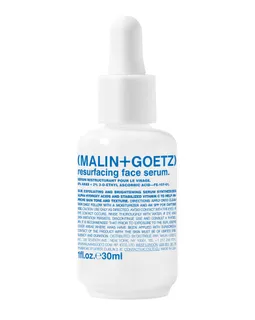
MALIN + GOETZ Resurfacing Serum

MALIN + GOETZ Resurfacing Serum

Efficacy100/100IrritancyHigh

Works for

Exfoliation
Glycolic acid, Lactic acid
Works well
What the product description says
“Resurfacing Serum”
Source: Cultbeauty

This product can help exfoliate the skin. In other words, it helps break down the bonds between dead cells on the surface of the skin and speed up the skin turnover. Skin often appears softer and brighter after exfoliation, but overdoing it can result in disrupted skin barrier. The following ingredient is doing the exfoliating job in this product: glycolic acid, lactic acid.

Glycolic acidKey activeEffect: HighAn alpha-hydroxy acid (AHA) that helps to remove the dead skin cells on the surface of the skin reveling a more even, smoother complexation. It is also able to stimulate collagen production with long-term use. Could help to reduce pore congestion. It can be irritating to the skin. Apply sunscreen daily if using products with glycolic acid~6–7.3%
Lactic acidKey activeEffect: HighAn exfoliating and moisturizing alpha-hydroxy acid (AHA). Typically causes less irritation than other AHAs, for example, glycolic acid. At high concentrations (about 15%), lactic acid can help reduce lines and wrinkles. Recent studies show that lactic acid can support the "good" bacteria living on skin's surface (healthy skin microbiome)~1.8–2.2%
Evens skin tone
Glycolic acid, Lactic acid + 2 more
Works well
What the product description says
“The 2% vitamin C works to brighten your tone and protect your skin from free radicals (what would we do without antioxidants?), while a niacinamide and phytic acid blend helps to balance your skin and diminish the look of visible pores.”
Source: Cultbeauty

This product can help reduce hypepigmentation and even out the skin tone because it contains the following effective ingredients: glycolic acid, lactic acid, niacinamide

The following ingredient (ingredients) in this product might be helpful, but there is no evidence to confirm that it actually can help even out the skin tone: 3-o-ethyl ascorbic acid.

Keep in mind that you would need to apply any topical skincare targetted at hypigmentation consistently for a couple of months to get a result. No topical skincare product can help get rid of hyperpigmentation (including post-acne marks and age spots) instantly.

Glycolic acidKey activeEffect: HighAn alpha-hydroxy acid (AHA) that helps to remove the dead skin cells on the surface of the skin reveling a more even, smoother complexation. It is also able to stimulate collagen production with long-term use. Could help to reduce pore congestion. It can be irritating to the skin. Apply sunscreen daily if using products with glycolic acid~6–7.3%
Lactic acidKey activeEffect: HighAn exfoliating and moisturizing alpha-hydroxy acid (AHA). Typically causes less irritation than other AHAs, for example, glycolic acid. At high concentrations (about 15%), lactic acid can help reduce lines and wrinkles. Recent studies show that lactic acid can support the "good" bacteria living on skin's surface (healthy skin microbiome)~1.8–2.2%
3-o-ethyl ascorbic acidKey activeEffect: MediumA vitamin C derivative that is more stable but less potent than pure form of vitamin C. Can help neutralize free radicals and help reduce hyperpigmentation, but the required concentration is likely to be much higher than for the pure form of vitamin C, limiting the ingredient's effectiveness in products~1.6–1.9%
NiacinamideKey activeEffect: HighIs proven to be effective in reducing blemishes, evening out skin tone and helping to improve lines and wrinkles. It helps the skin to repair sun damage, calm down inflammation and keep maintain good levels of moisture. The concentration of about 2% is effective for supporting the skin barrier and evening out the skin tone. Concentration of 4-6% is better for helping with acne and balancing the sebum production~1.2–1.4%
Moisturizing
Side benefit the brand mentions · Niacinamide, Lactic acid + 6 more
Works well
What the product description says
“improving your texture, tone and regulating excess oil.”
Source: Cultbeauty

This product contains good ingredients to attract water to the upper layer of the skin. These ingredients are called "humectants": betaine, glycerin.

When humectants are on the surface of the skin, they “pull in” the moisture from the outside environment, or from within deeper layers of the skin. If the air is dry, humectants can speed up the moisture loss from the skin. This is why it is a good idea to use another product on top of this one to help "seal in" the moisture (look for ingredients like dimethicone, squalane, oils and butters).

The following ingredients in this product are especially good for supporting the skin barrier and helping with the hydration level: niacinamide

NiacinamideHeroEffect: HighIs proven to be effective in reducing blemishes, evening out skin tone and helping to improve lines and wrinkles. It helps the skin to repair sun damage, calm down inflammation and keep maintain good levels of moisture. The concentration of about 2% is effective for supporting the skin barrier and evening out the skin tone. Concentration of 4-6% is better for helping with acne and balancing the sebum production~1.2–1.4%
Lactic acidKey active· HumectantEffect: HighAn exfoliating and moisturizing alpha-hydroxy acid (AHA). Typically causes less irritation than other AHAs, for example, glycolic acid. At high concentrations (about 15%), lactic acid can help reduce lines and wrinkles. Recent studies show that lactic acid can support the "good" bacteria living on skin's surface (healthy skin microbiome)~1.8–2.2%
BetaineKey active· HumectantEffect: HighHelps attract water to the upper layer of the skin and improves the product texture~1.3–1.6%
GlycerinKey active· HumectantEffect: HighOne of the best moisturizing ingredients. Naturally present in skin. It attracts water to the upper layer of the skin working as a humectant~0.25–0.45%
Sodium hyaluronateKey active· HumectantEffect: HighOne of the best moisturizing ingredients. Attracts water into the upper layer of the skin~0.15–0.3%
Butylene glycol· HumectantEffect: LowUsed to create a nice product texture and help delivery of other ingredients. Might be somewhat helpful in attracting water to the upper layer of the skin~0.45–0.65%
Caprylyl glycol· Humectant, EmollientEffect: LowHelps preserve products and creates a nice product texture~0.25–0.5%
Oleanolic acidUnder-dosedMight be helpful against blemishes, work as an anti-oxidant, reduce inflammation and improve skin's ability to hold on to moisture, but more research is needed to confirm its effectiveness when applied topically to human skin~0.1–0.15%
Anti-blemish
Side benefit the brand mentions · Niacinamide, Glycolic acid + 1 more
Works well
What the product description says
“), while a niacinamide and phytic acid blend helps to balance your skin and diminish the look of visible pores.”
Source: Cultbeauty

This product can help reduce breakouts and clogged pores because it contains the following ingredient: niacinamide. This ingredient is used for treating acne and can have a noticeable effect.

The following ingredient (ingredients) in this product might be helpful, but there is no evidence to confirm that it actually works: glycolic acid

NiacinamideHeroEffect: HighIs proven to be effective in reducing blemishes, evening out skin tone and helping to improve lines and wrinkles. It helps the skin to repair sun damage, calm down inflammation and keep maintain good levels of moisture. The concentration of about 2% is effective for supporting the skin barrier and evening out the skin tone. Concentration of 4-6% is better for helping with acne and balancing the sebum production~1.2–1.4%
Glycolic acidKey activeEffect: MediumAn alpha-hydroxy acid (AHA) that helps to remove the dead skin cells on the surface of the skin reveling a more even, smoother complexation. It is also able to stimulate collagen production with long-term use. Could help to reduce pore congestion. It can be irritating to the skin. Apply sunscreen daily if using products with glycolic acid~6–7.3%
Oleanolic acidUnder-dosedMight be helpful against blemishes, work as an anti-oxidant, reduce inflammation and improve skin's ability to hold on to moisture, but more research is needed to confirm its effectiveness when applied topically to human skin~0.1–0.15%
Anti-aging
Side benefit · Glycolic acid, Lactic acid + 3 more
Works well

This product can help reduce and prevent fine lines and wrinkles, improve skin elasticity and firmness because it contains glycolic acid, niacinamide.

These ingredients in the product can also be helpful, even though there is less evidence for their effectiveness: lactic acid.

Keep in mind that it typically takes at least 6 weeks to notice any results because the changes that are needed to improve fine lines and elasticity happen in the deeper layers of the skin. No topical anti-aging product can “erase” wrinkles or fully reverse signs of aging.

Glycolic acidKey activeEffect: HighAn alpha-hydroxy acid (AHA) that helps to remove the dead skin cells on the surface of the skin reveling a more even, smoother complexation. It is also able to stimulate collagen production with long-term use. Could help to reduce pore congestion. It can be irritating to the skin. Apply sunscreen daily if using products with glycolic acid~6–7.3%
Lactic acidKey activeEffect: MediumAn exfoliating and moisturizing alpha-hydroxy acid (AHA). Typically causes less irritation than other AHAs, for example, glycolic acid. At high concentrations (about 15%), lactic acid can help reduce lines and wrinkles. Recent studies show that lactic acid can support the "good" bacteria living on skin's surface (healthy skin microbiome)~1.8–2.2%
NiacinamideKey activeEffect: HighIs proven to be effective in reducing blemishes, evening out skin tone and helping to improve lines and wrinkles. It helps the skin to repair sun damage, calm down inflammation and keep maintain good levels of moisture. The concentration of about 2% is effective for supporting the skin barrier and evening out the skin tone. Concentration of 4-6% is better for helping with acne and balancing the sebum production~1.2–1.4%
3-o-ethyl ascorbic acidEffect: LowA vitamin C derivative that is more stable but less potent than pure form of vitamin C. Can help neutralize free radicals and help reduce hyperpigmentation, but the required concentration is likely to be much higher than for the pure form of vitamin C, limiting the ingredient's effectiveness in products~1.6–1.9%
Oleanolic acidUnder-dosedMight be helpful against blemishes, work as an anti-oxidant, reduce inflammation and improve skin's ability to hold on to moisture, but more research is needed to confirm its effectiveness when applied topically to human skin~0.1–0.15%
Anti-oxidation
Side benefit · 3-o-ethyl ascorbic acid, Oleanolic acid
May help

This product contains antioxidants (3-o-ethyl ascorbic acid) that can help neutralize free radicals in skin to lessen the damage it gets from the UV light (sun). There is some human evidence for this effect in skin, though it is smaller or less consistent than the evidence for the best antioxidants.

3-o-ethyl ascorbic acidKey activeEffect: MediumA vitamin C derivative that is more stable but less potent than pure form of vitamin C. Can help neutralize free radicals and help reduce hyperpigmentation, but the required concentration is likely to be much higher than for the pure form of vitamin C, limiting the ingredient's effectiveness in products~1.6–1.9%
Oleanolic acidUnder-dosedMight be helpful against blemishes, work as an anti-oxidant, reduce inflammation and improve skin's ability to hold on to moisture, but more research is needed to confirm its effectiveness when applied topically to human skin~0.1–0.15%

Can it cause trouble?

Irritancy
6 strong irritants: Hamamelis virginiana water, Citrus aurantium dulcis peel oil + 4 more — patch-test recommended
High risk
We flagged 16 ingredients with irritancy potential. Severity depends on your sensitivity threshold; the table lists the worst offenders first.
IngredientFunctionIrritationEst. amount
Glycolic acidAn alpha-hydroxy acid (AHA) that helps to remove the dead skin cells on the surface of the skin reveling a more even, smoother complexation. It is also able to stimulate collagen production with long-term use. Could help to reduce pore congestion. It can be irritating to the skin. Apply sunscreen daily if using products with glycolic acidHigh~6–7.3%est.
Hamamelis virginiana waterA plant extract that can help calm down inflammation in skin. Can, however, itself be irritatingHigh~2.9–3.5%est.
3-o-ethyl ascorbic acidA vitamin C derivative that is more stable but less potent than pure form of vitamin C. Can help neutralize free radicals and help reduce hyperpigmentation, but the required concentration is likely to be much higher than for the pure form of vitamin C, limiting the ingredient's effectiveness in productsHigh~1.6–1.9%est.
Citrus aurantium dulcis peel oilAn essentil oil from orange peel. Potential allergen and can be irritatingHigh~0.4–0.6%est.
Mentha piperita oilUsed as a fragrance and can be irritatingHigh~0.2–0.35%est.
Mentha viridis leaf oilUsed as a fragrance and can be irritatingHigh~0.2–0.35%est.
LimoneneA common frangrance that can easily irritate skin, especially if exposed to air, light or heatHigh~0.05–0.1%est.
LinaloolA fragrance. Can be irritatingHigh~0.05%est.
Lactic acidAn exfoliating and moisturizing alpha-hydroxy acid (AHA). Typically causes less irritation than other AHAs, for example, glycolic acid. At high concentrations (about 15%), lactic acid can help reduce lines and wrinkles. Recent studies show that lactic acid can support the "good" bacteria living on skin's surface (healthy skin microbiome)Medium~1.8–2.2%est.
Phytic acidAn alpha-hydroxy acid (AHA), but is mostly used to stabilize product formulations in cosmeticsMedium~0.45–0.7%est.
CarrageenanHelps thicken the product formula and create a nice product formulationMedium~0.4–0.65%est.
Potassium sorbateA preservativeMedium~0.3–0.6%est.
Sodium metabisulfiteA preservativeMedium~0.1–0.2%est.
Caprylyl glycolHelps preserve products and creates a nice product textureMedium~0.25–0.5%est.
EthylhexylglycerinA preservativeMedium~0.25–0.45%est.
Nordihydroguaiaretic acidUsed to stabilize the formula of product formulation. Might be helpful in neutralizing free radicals in skinMedium~0.1–0.2%est.
Comedogenic
1 ingredient rated 2 or more on the 0–5 pore-clogging scale
1 flagged
These ingredients have a comedogenic rating of 2 or more on a 0–5 scale; the table shows each one's rating. In leave-on products they can clog pores in acne-prone skin.
IngredientFunctionRatingEst. amount
CarrageenanHelps thicken the product formula and create a nice product formulation3/5~0.4–0.65%est.
Did this help you decide?

User reviews

Would you recommend?
No community reviews yet.

Be the first — your take helps the next person decide.

Ingredients

Filter by role to see what each ingredient is doing.

Water~45–55%
Formula
Irritation risk
Low

Plain old water

More about Water
Glycolic acid~6–7.3%
Key activeIrritant · high
Irritation risk
High
Works for
Evens skin toneExfoliationAnti-agingAnti-blemish

An alpha-hydroxy acid (AHA) that helps to remove the dead skin cells on the surface of the skin reveling a more even, smoother complexation. It is also able to stimulate collagen production with long-term use. Could help to reduce pore congestion. It can be irritating to the skin. Apply sunscreen daily if using products with glycolic acid

More about Glycolic acid
Propanediol~3.9–4.8%
Formula
Irritation risk
Low

Acts as a solvent for other ingredients. Speeds up the absorption of other ingredients into the skin

More about Propanediol
Hamamelis virginiana water~2.9–3.5%
Irritant · high
Irritation risk
High
Works for
Anti-inflammatory

A plant extract that can help calm down inflammation in skin. Can, however, itself be irritating

More about Hamamelis virginiana water
Sodium hydroxide~2.2–2.7%
Formula
Irritation risk
Low

Used to adjust the product's pH

More about Sodium hydroxide
Lactic acid~1.8–2.2%
Key activeIrritant · medium
Irritation risk
Medium
Works for
ExfoliationEvens skin toneMoisturizingAnti-aging

An exfoliating and moisturizing alpha-hydroxy acid (AHA). Typically causes less irritation than other AHAs, for example, glycolic acid. At high concentrations (about 15%), lactic acid can help reduce lines and wrinkles. Recent studies show that lactic acid can support the "good" bacteria living on skin's surface (healthy skin microbiome)

More about Lactic acid
3-o-ethyl ascorbic acid~1.6–1.9%
Key activeIrritant · high
Irritation risk
High
Works for
Evens skin toneAnti-oxidationAnti-aging

A vitamin C derivative that is more stable but less potent than pure form of vitamin C. Can help neutralize free radicals and help reduce hyperpigmentation, but the required concentration is likely to be much higher than for the pure form of vitamin C, limiting the ingredient's effectiveness in products

More about 3-o-ethyl ascorbic acid
Betaine~1.3–1.6%
Key active
Irritation risk
Low
Works for
Moisturizing

Helps attract water to the upper layer of the skin and improves the product texture

More about Betaine
Niacinamide~1.2–1.4%
Hero · Moisturizing, Anti-blemish
Irritation risk
Low
Works for
Anti-agingEvens skin toneMoisturizingAnti-blemishReduces irritationAnti-inflammatoryReduces rednessAntibacterial

Is proven to be effective in reducing blemishes, evening out skin tone and helping to improve lines and wrinkles. It helps the skin to repair sun damage, calm down inflammation and keep maintain good levels of moisture. The concentration of about 2% is effective for supporting the skin barrier and evening out the skin tone. Concentration of 4-6% is better for helping with acne and balancing the sebum production

More about Niacinamide
Succinic acid~0.95–1.15%
Formula
Irritation risk
Low
More about Succinic acid
Polysorbate 20~0.7–1.05%
Formula
Irritation risk
Low
Works for
Cleansing

Helps oil and water mix together

More about Polysorbate 20
Phenoxyethanol~0.55–0.85%
Formula
Irritation risk
Low

A preservative. It helps prevent bacterial growth in cosmetic products

More about Phenoxyethanol
Xanthan gum~0.5–0.75%
Formula
Irritation risk
Low
Works for
Cleansing

Used to create a thicker product consistency

More about Xanthan gum
Phytic acid~0.45–0.7%
Irritant · medium
Irritation risk
Medium

An alpha-hydroxy acid (AHA), but is mostly used to stabilize product formulations in cosmetics

More about Phytic acid
Citrus aurantium dulcis peel oil~0.4–0.6%
Irritant · high
Irritation risk
High

An essentil oil from orange peel. Potential allergen and can be irritating

More about Citrus aurantium dulcis peel oil
Butylene glycol~0.45–0.65%
Formula
Irritation risk
Low
Works for
Moisturizing

Used to create a nice product texture and help delivery of other ingredients. Might be somewhat helpful in attracting water to the upper layer of the skin

More about Butylene glycol
Carrageenan~0.4–0.65%
Comedogenic 3/5Irritant · medium
Irritation risk
Medium
Comedogenicity
3/5

Helps thicken the product formula and create a nice product formulation

More about Carrageenan
Tetrasodium glutamate diacetate~0.35–0.6%
Formula
Irritation risk
Low

Helps stabilize the product formulation

More about Tetrasodium glutamate diacetate
Potassium sorbate~0.3–0.6%
Irritant · medium
Irritation risk
Medium

A preservative

More about Potassium sorbate
Sodium metabisulfite~0.1–0.2%
Irritant · medium
Irritation risk
Medium

A preservative

More about Sodium metabisulfite
Peg-60 almond glycerides~0.3–0.55%
Formula
Irritation risk
Low
Works for
Cleansing
More about Peg-60 almond glycerides
Caprylyl glycol~0.25–0.5%
Irritant · medium
Irritation risk
Medium
Works for
Moisturizing

Helps preserve products and creates a nice product texture

More about Caprylyl glycol
Ethylhexylglycerin~0.25–0.45%
Irritant · medium
Irritation risk
Medium

A preservative

More about Ethylhexylglycerin
Mentha piperita oil~0.2–0.35%
Irritant · high
Irritation risk
High

Used as a fragrance and can be irritating

More about Mentha piperita oil
Glycerin~0.25–0.45%
Key active
Irritation risk
Low
Works for
Moisturizing

One of the best moisturizing ingredients. Naturally present in skin. It attracts water to the upper layer of the skin working as a humectant

More about Glycerin
Mentha viridis leaf oil~0.2–0.35%
Irritant · high
Irritation risk
High

Used as a fragrance and can be irritating

More about Mentha viridis leaf oil
Artemisia absinthium oil~0.2–0.35%
Formula
Tagetes minuta flower oil~0.15–0.3%
Formula
Sodium hyaluronate~0.15–0.3%
Key active
Irritation risk
Low
Works for
Moisturizing

One of the best moisturizing ingredients. Attracts water into the upper layer of the skin

More about Sodium hyaluronate
Carbomer~0.15–0.25%
Formula
Irritation risk
Low
Works for
Cleansing

Helps create a thicker or gel-like product texture. It is not a surfactant but can be used in gentle cleansing formulations

More about Carbomer
Nordihydroguaiaretic acid~0.1–0.2%
Irritant · medium
Irritation risk
Medium

Used to stabilize the formula of product formulation. Might be helpful in neutralizing free radicals in skin

More about Nordihydroguaiaretic acid
Oleanolic acid~0.1–0.15%
Under-dosed
Irritation risk
Low
Works for
Anti-agingAnti-inflammatoryAnti-oxidationMoisturizingAnti-blemish

Might be helpful against blemishes, work as an anti-oxidant, reduce inflammation and improve skin's ability to hold on to moisture, but more research is needed to confirm its effectiveness when applied topically to human skin

More about Oleanolic acid
Limonene~0.05–0.1%
Irritant · high
Irritation risk
High

A common frangrance that can easily irritate skin, especially if exposed to air, light or heat

More about Limonene
Linalool~0.05%
Irritant · high
Irritation risk
High

A fragrance. Can be irritating

More about Linalool
Ingredient list view

Water, Glycolic acid, Propanediol, Hamamelis virginiana water, Sodium hydroxide, Lactic acid, 3-o-ethyl ascorbic acid, Betaine, Niacinamide, Succinic acid, Polysorbate 20, Phenoxyethanol, Xanthan gum, Phytic acid, Citrus aurantium dulcis peel oil, Butylene glycol, Carrageenan, Tetrasodium glutamate diacetate, Potassium sorbate, Sodium metabisulfite, Peg-60 almond glycerides, Caprylyl glycol, Ethylhexylglycerin, Mentha piperita oil, Glycerin, Mentha viridis leaf oil, Artemisia absinthium oil, Tagetes minuta flower oil, Sodium hyaluronate, Carbomer, Nordihydroguaiaretic acid, Oleanolic acid, Limonene, Linalool

Compare prices

Retailers ranked by price — lowest first.

SpaceNK US
$70.00 Out of stock
Check

Affiliate links

Worth comparing, line by line.

Match % combines shared ingredients, the first five ingredients, shared actives and hero ingredients, irritancy (lower counts in the alternative's favour), texture and body area. Only products in the same routine step are compared.

Side-by-side comparison of this product against its closest alternatives
MALIN + GOETZResurfacing SerumYOUR PRODUCTCeraVeSalicylic Acid Acne Control Gel, Acne Treatment for FaceGlossierSolution Skin-Perfecting Daily Chemical ExfoliatorSummer FridaysSoft Reset AHA Exfoliating Solution
Match—90%83%83%
Price—$11.94—$54.00
Shared key ingredients—5 of 75 of 75 of 7
Key difference—Salicylic AcidSalicylic AcidCamellia Sinensis Leaf Extract
Irritancy High Low Medium Medium
Drying alcohol————
View product Shop Shop Shop

More alternatives: Civant AHA Exfoliating SerumFacile Clear Serum

Cheaper alternatives? See how this stacks up against similar formulas.
We compare ingredient profiles across our catalog — pick the closest match for your budget.
Open dupe finder

Sources cited in this review

Every concentration estimate and effectiveness label is anchored to one of these 20 studies and safety reviews.

  1. 1
  2. 2
  3. 3
  4. 4
  5. 5
  6. 6
MALIN + GOETZ Resurfacing Serum
MALIN + GOETZResurfacing Serum

Affiliate links · As an Amazon Associate, WIMJ earns from qualifying purchases.

As an Amazon Associate, WIMJ earns from qualifying purchases.