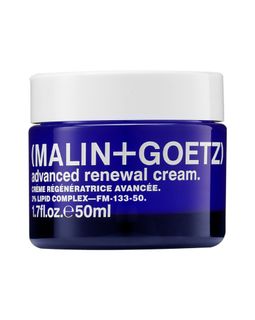
MALIN + GOETZ Advanced Renewal Cream
Works for
1 of 3 advertised claims delivered
Moisturizing21 ingredients credited for this claimGood support
“Advanced Renewal Cream”
This product can help improve hydration of the skin with the two types of ingredients.
The first type is called “humectants”:
these ingredients help attract water.
When humectants are on the surface of the skin, they “pull in” the moisture from the outside environment, or from
within deeper layers of the skin. The following ingredients in this product do the job:
glycerin, sodium lactate.
This product also contains ingredients called “occlusives”. They help reduce the speed with which our skin loses moisture to the outside environment. These ingredients also help soften the upper layer of the skin, so it feels less tight and nicer to the touch. The following ingredients in this product do the job: butyrospermum parkii butter, caprylic/capric triglyceride.
Anti-aging2 ingredients credited for this claimLimited support
“Hydrating fruit complex helps to increase skin's water retention and soften fine lines”
This product does not contain ingredients that are able to reduce fine lines and wrinkles or help with skin elasticity, but it can improve the look of the skin temporarily through moisturization. Well-moisturized skin might also be able to repair the sun damage better.This ingredient - butyrospermum parkii butter - could be helpful for preventing or repairing signs of aging in theory, but there is no evidence that it actually works.
This ingredient squalene might be able to help neutralize free radicals in skin and help it fight off some of the sun damage.
Evens skin toneNo ingredient credited for this claimNo support
“Fine Lines and Wrinkles, Dryness, and Dullness and Uneven Texture Formulation.”
Effective ingredients missing or their concentration is too low
Anti-oxidationNot advertised by the brand · 7 ingredients credited for this claimModerate support
This product contains antioxidants (squalene) that might be able to help neutralize free radicals in skin to lessen the damage it gets from the UV light (sun). There is not enough evidence to confirm their effectiveness in skin though.
Can it cause trouble?
Irritancy14 strong irritants: Citrus aurantifolia peel extract, Cymbopogon martini herb extract + 12 more — patch-test recommendedHigh risk
Comedogenic4 ingredients rated 2 or more on the 0–5 pore-clogging scale4 flagged
User reviews
Be the first — your take helps the next person decide.
Ingredients
Filter by role to see what each ingredient is doing.
Water~45–55%
Octyldodecanol~4.6–5.6%
- Irritation risk
- Low
An emollient that helps to soften the skin and create a pleasant product texture and stabilize the formulation
More about OctyldodecanolGlycerin~4–4.9%
- Irritation risk
- Low
One of the best moisturizing ingredients. Naturally present in skin. It attracts water to the upper layer of the skin working as a humectant
More about GlycerinPropanediol~3.1–3.7%
- Irritation risk
- Low
Acts as a solvent for other ingredients. Speeds up the absorption of other ingredients into the skin
More about PropanediolJojoba oil/macadamia seed oil esters~2.4–2.9%
- Irritation risk
- Low
Butyrospermum parkii butter~2–2.5%
- Irritation risk
- Low
- Comedogenicity
- 3/5
A great moisturising ingredient that softens the skin and reduces water loss from its upper layer. It also can be helpful in protecting skin from free radicals
More about Butyrospermum parkii butterBeheneth-10~1.7–2%
Cetyl alcohol~1.5–1.8%
- Irritation risk
- Low
A non-drying alcohol that works to soften the skin and stabilize product formulations helping oil and water mix together
More about Cetyl alcoholCaprylic/capric triglyceride~1.3–1.5%
- Irritation risk
- Medium
A good mix of fatty acids that forms a protective layer on the skin. Improves the shelf life of products. Derived from coconut and glycerin
More about Caprylic/capric triglycerideSimmondsia chinensis seed oil~1–1.3%
- Irritation risk
- Medium
Softens the upper layer of skin and helps restore the healthy skin barrier. Has shown to help calm down inflammation in skin. It is a stable oil, meaning that it retains its properties even when exposed to air.
More about Simmondsia chinensis seed oilGlycol stearate~0.9–1.1%
Citrus aurantifolia peel extract~0.65–0.95%
- Irritation risk
- High
Cymbopogon martini herb extract~0.55–0.8%
- Irritation risk
- High
Geranium maculatum extract~0.5–0.8%
- Irritation risk
- High
Contains an essential oil. Can be irritating
More about Geranium maculatum extractLavandula angustifolia flower/leaf/stem extract~0.5–0.75%
Mentha viridis extract~0.55–0.8%
Citrullus lanatus fruit extract~0.45–0.7%
- Irritation risk
- Medium
A plant extract that can contain an antioxidant compound
More about Citrullus lanatus fruit extractEvodia rutaecarpa fruit extract~0.45–0.65%
- Irritation risk
- Low
Pyrus malus fruit extract~0.4–0.6%
- Irritation risk
- Medium
Can have some moisturizing properties due to its sugar content
More about Pyrus malus fruit extractLens esculenta fruit extract~0.35–0.6%
- Irritation risk
- Medium
A plant extract containing sugars that might help attract water to the upper layer of the skin. Is claimed by the manufacturer to help reduce pore size but evidence is lacking
More about Lens esculenta fruit extractGeranium maculatum oil~0.35–0.6%
Lavandula angustifolia oil~0.3–0.6%
- Irritation risk
- High
An essential oil. Potential allergen and can be irritating. It has some anti-bacterial properties
More about Lavandula angustifolia oilCitrus aurantium dulcis peel extract~0.25–0.5%
Glycine soja oil~0.3–0.6%
- Irritation risk
- Medium
- Comedogenicity
- 2/5
A good emollient that helps soften the skin and helps repair its barrier function. It can clog pores if used in high concentrations.
More about Glycine soja oilPelargonium graveolens extract~0.3–0.55%
- Irritation risk
- Low
Citrus grandis fruit extract~0.25–0.5%
- Irritation risk
- High
Rose extract~0.3–0.55%
Phytosteryl macadamiate~0.35–0.6%
- Irritation risk
- Low
Helps soften the upper layer of the skin
More about Phytosteryl macadamiateSpilanthes acmella flower extract~0.3–0.55%
- Irritation risk
- High
Plant extract that might hep calm down inflammation in skin
More about Spilanthes acmella flower extractHydrolyzed jojoba esters~0.3–0.6%
- Irritation risk
- Low
Helps soften the upper layer of the skin
More about Hydrolyzed jojoba estersTocopheryl acetate~0.3–0.6%
- Irritation risk
- Medium
A more stable but less bio-available form of vitamin E compared to Tocopherol. Might help moisturize and protect the skin from free radicals, but mostly used in low concentrations to stabilize other ingredients.
More about Tocopheryl acetatePhytosterols~0.35–0.65%
- Irritation risk
- Medium
Lipids that work as an emollient and can be helpful in repairing skin barrier function
More about PhytosterolsTocopherol~0.3–0.55%
- Irritation risk
- Low
Pure form of vitamin E. Can help moisturise and protect the skin from free radicals. Often used to help stabilise other ingredients or the formula itself
More about TocopherolSqualene~0.35–0.65%
- Irritation risk
- Low
- Comedogenicity
- 2/5
An oil that is naturally part of skin sebum that helps to soften its upper layer, reduce water loss and neutralize free radicals. It might be comedogenic. Avoid applying large concentrations (or pure oil) before sun exposure as oxidized squalene can clog pores and lead to skin irritation. Today squalene is mostly derived from vegetable oils or synthetized by yeast
More about SqualeneSodium lactate~0.3–0.55%
- Irritation risk
- Medium
Helps attract water to the upper layer of the skin. Is often used to adjust the pH level of the product
More about Sodium lactateCetearyl alcohol~0.35–0.65%
- Irritation risk
- Low
- Comedogenicity
- 2/5
A non-drying alcohol. Works as an emollient. Helps water and oil mix together and creates a nice product texture
More about Cetearyl alcoholGlyceryl stearate~0.4–0.6%
- Irritation risk
- Low
An emollient that softens the skin and forms a protective layer on its surface. Helps water and oil mix together
More about Glyceryl stearatePeg-100 stearate~0.45–0.65%
- Irritation risk
- Low
Helps oil and water mix togehter and creates a nice product texture
More about Peg-100 stearateCaprylyl glycol~0.35–0.6%
- Irritation risk
- Medium
Helps preserve products and creates a nice product texture
More about Caprylyl glycolDimethicone~0.4–0.6%
- Irritation risk
- Low
A silicone that helps to reduce water loss from the surface of the skin. Can temporarily "fill in" lines and wrinkles, absorb oil, and create a nice product finish
More about DimethiconeCetearyl glucoside~0.3–0.6%
- Irritation risk
- Medium
Helps water and oil in the product mix well together and improves product texture
More about Cetearyl glucosideXanthan gum~0.3–0.55%
- Irritation risk
- Low
Used to create a thicker product consistency
More about Xanthan gumCarbomer~0.3–0.55%
- Irritation risk
- Low
Helps create a thicker or gel-like product texture. It is not a surfactant but can be used in gentle cleansing formulations
More about CarbomerDisodium edta~0.25–0.5%
Polyacrylamide~0.3–0.55%
- Irritation risk
- Medium
Used to improve product texture and help oil and water mix together
More about PolyacrylamideC13-14 isoparaffin~0.3–0.55%
- Irritation risk
- Low
Helps soften the upper layer of the skin, dissolve other ingredients and create a thicker product consistency
More about C13-14 isoparaffinSodium hydroxide~0.25–0.45%
Sodium pca~0.2–0.4%
- Irritation risk
- Low
Naturally present in skin and helps to attract water to its upper layer
More about Sodium pcaLaureth-7~0.2–0.4%
Phenoxyethanol~0.15–0.3%
- Irritation risk
- Low
A preservative. It helps prevent bacterial growth in cosmetic products
More about PhenoxyethanolCitral~0.15–0.25%
Citronellol~0.15–0.25%
Geraniol~0.15–0.25%
Limonene~0.1–0.15%
- Irritation risk
- High
A common frangrance that can easily irritate skin, especially if exposed to air, light or heat
More about LimoneneLinalool~0.1–0.15%
Ingredient list view
Water, Octyldodecanol, Glycerin, Propanediol, Jojoba oil/macadamia seed oil esters, Butyrospermum parkii butter, Beheneth-10, Cetyl alcohol, Caprylic/capric triglyceride, Simmondsia chinensis seed oil, Glycol stearate, Citrus aurantifolia peel extract, Cymbopogon martini herb extract, Geranium maculatum extract, Lavandula angustifolia flower/leaf/stem extract, Mentha viridis extract, Citrullus lanatus fruit extract, Evodia rutaecarpa fruit extract, Pyrus malus fruit extract, Lens esculenta fruit extract, Geranium maculatum oil, Lavandula angustifolia oil, Citrus aurantium dulcis peel extract, Glycine soja oil, Pelargonium graveolens extract, Citrus grandis fruit extract, Rose extract, Phytosteryl macadamiate, Spilanthes acmella flower extract, Hydrolyzed jojoba esters, Tocopheryl acetate, Phytosterols, Tocopherol, Squalene, Sodium lactate, Cetearyl alcohol, Glyceryl stearate, Peg-100 stearate, Caprylyl glycol, Dimethicone, Cetearyl glucoside, Xanthan gum, Carbomer, Disodium edta, Polyacrylamide, C13-14 isoparaffin, Sodium hydroxide, Sodium pca, Laureth-7, Phenoxyethanol, Citral, Citronellol, Geraniol, Limonene, Linalool
Compare prices
Retailers ranked by price — lowest first.
.png)

Sources cited in this review
Every concentration estimate and effectiveness label is anchored to one of these 13 studies and safety reviews.
- 1
- 2Analyzing Lycopene Content in Fruitssciencedirect.com
- 3Safety Assessment of Phytosterols as Used in Cosmeticscir-safety.org
- 4
- 5Vitamin E in dermatologyncbi.nlm.nih.gov
- 6Vitamin E and Skin Healthlpi.oregonstate.edu

Affiliate links · As an Amazon Associate, WIMJ earns from qualifying purchases.