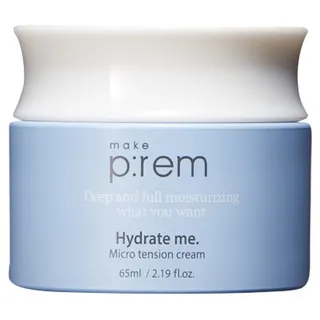
Works for
MoisturizingCeramide np, Glycerin + 34 moreWorks well
“This non-irritant cream penetrates skin to deliver long-lasting hydration that leaves a dewy and youthful complexion.”
This product can help improve hydration of the skin with the two types of ingredients.
The first type is called “humectants”:
these ingredients help attract water.
When humectants are on the surface of the skin, they “pull in” the moisture from the outside environment, or from
within deeper layers of the skin. The following ingredients in this product do the job:
cyclomethicone, glycerin.
This product also contains ingredients called “occlusives”. They help reduce the speed with which our skin loses moisture to the outside environment. These ingredients also help soften the upper layer of the skin, so it feels less tight and nicer to the touch. The following ingredients in this product do the job: caprylic/capric triglyceride, dimethicone.
The following ingredients in this product are especially good for supporting the skin barrier and helping with the hydration level: ceramide np
Anti-agingHyaluronic acid, Thermus thermophillus ferment + 1 moreNot delivered
“This non-irritant cream penetrates skin to deliver long-lasting hydration that leaves a dewy and youthful complexion.”
This product does not contain ingredients that are able to reduce fine lines and wrinkles or help with skin elasticity, but it can improve the look of the skin temporarily through moisturization. Well-moisturized skin might also be able to repair the sun damage better.These ingredients - hyaluronic acid, thermus thermophillus ferment - could be helpful for preventing or repairing signs of aging in theory, but there is no evidence that it actually works.
Can it cause trouble?
Irritancy13 strong irritants: Thymus vulgaris extract, Limonene + 11 more — patch-test recommendedHigh risk
Comedogenic2 ingredients rated 2 or more on the 0–5 pore-clogging scale2 flagged
User reviews
Be the first — your take helps the next person decide.
Ingredients
Filter by role to see what each ingredient is doing.
Water~45–55%
Glycerin~5–6.2%
- Irritation risk
- Low
One of the best moisturizing ingredients. Naturally present in skin. It attracts water to the upper layer of the skin working as a humectant
More about GlycerinCyclopentasiloxane~3.8–4.7%
- Irritation risk
- Low
A silicone that helps improve the product texture and spreadability. Can absorb oil creating a short-term mattifying effect on the skin
More about Cyclopentasiloxane1,2-hexanediol~2.1–2.6%
Caprylic/capric triglyceride~2.2–2.7%
- Irritation risk
- Medium
A good mix of fatty acids that forms a protective layer on the skin. Improves the shelf life of products. Derived from coconut and glycerin
More about Caprylic/capric triglycerideCetyl ethylhexanoate~1.8–2.2%
- Irritation risk
- Medium
An emollient that helps soften the skin and creates a thicker product texture
More about Cetyl ethylhexanoateCyclomethicone~1.4–1.7%
- Irritation risk
- Low
A type of silicone that leaves a nice silky finish on the skin and can help soften its upper layer
More about CyclomethiconeDimethicone~1.4–1.7%
- Irritation risk
- Low
A silicone that helps to reduce water loss from the surface of the skin. Can temporarily "fill in" lines and wrinkles, absorb oil, and create a nice product finish
More about DimethiconeGlycereth-26~1–1.2%
Macadamia integrifolia seed oil~0.75–1.1%
- Irritation risk
- Low
A plant oil that helps soften the upper layer of the skin
More about Macadamia integrifolia seed oilBrassica campestris sterols~0.55–0.85%
- Irritation risk
- Low
Help soften the upper layer of the skin
More about Brassica campestris sterolsCholesterol~0.5–0.7%
- Irritation risk
- Low
An emollient that is naturally found in skin
More about CholesterolPeg-5 rapeseed sterol~0.5–0.75%
Cyclohexasiloxane~0.35–0.6%
- Irritation risk
- Low
A silicone that serves as an emollient. Helps create a nice non-greasy feels
More about CyclohexasiloxaneHydrogenated polydecene~0.25–0.5%
- Irritation risk
- Low
Helps to soften the upper layer of the skin and create a nice product texture
More about Hydrogenated polydecenePentylene glycol~0.3–0.55%
- Irritation risk
- Medium
Used to preserve products, dissolve other ingredients and create a nice product texture
More about Pentylene glycolCeteth-3~0.25–0.5%
Ceteth-5~0.25–0.45%
Peg-240/hdi copolymer bis-decyltetradeceth-20 ether~0.2–0.4%
- Irritation risk
- Medium
Helps create a gel-like product texture
More about Peg-240/hdi copolymer bis-decyltetradeceth-20 etherC14-22 alcohols~0.15–0.3%
- Irritation risk
- Low
A non-drying alcohol that helps stabilize product formulations
More about C14-22 alcoholsAmmonium acryloyldimethyltaurate/vp copolymer~0.15–0.3%
- Irritation risk
- Low
Increases thickness of a product. Texture enhancer for oil-in-water emulsions
More about Ammonium acryloyldimethyltaurate/vp copolymerCetearyl alcohol~0.2–0.35%
- Irritation risk
- Low
- Comedogenicity
- 2/5
A non-drying alcohol. Works as an emollient. Helps water and oil mix together and creates a nice product texture
More about Cetearyl alcoholRubus idaeus fruit extract~0.1–0.15%
- Irritation risk
- Medium
A fruit extract that might have some anti-oxidant properties but evidence of effectiveness in skin is lacking
More about Rubus idaeus fruit extractHydrogenated lecithin~0.15–0.25%
- Irritation risk
- Low
Helps to retain moisture by creating a protective barrier on the skin. Rich in fatty acids. Improves product texture and helps with the penetration of other ingredients.
More about Hydrogenated lecithinSodium hyaluronate~0.1–0.2%
- Irritation risk
- Low
One of the best moisturizing ingredients. Attracts water into the upper layer of the skin
More about Sodium hyaluronateCaprylyl glycol~0.15–0.25%
- Irritation risk
- Medium
Helps preserve products and creates a nice product texture
More about Caprylyl glycolSorbitan stearate~0.15–0.25%
Dimethiconol~0.15–0.3%
- Irritation risk
- Low
A silicone that makes products more spreadable and keeps skin smooth. Helps to add gloss to skin and may visually fill in fine lines/wrinkles for short time
More about DimethiconolGlyceryl stearate~0.15–0.3%
- Irritation risk
- Low
An emollient that softens the skin and forms a protective layer on its surface. Helps water and oil mix together
More about Glyceryl stearatePeg-100 stearate~0.2–0.35%
- Irritation risk
- Low
Helps oil and water mix togehter and creates a nice product texture
More about Peg-100 stearatePanthenol~0.1–0.2%
- Irritation risk
- Low
Helps attract water to the upper layer of the skin and can help improve skin barrier function
More about PanthenolPolyglutamic acid~0.15–0.25%
- Irritation risk
- Low
Helps attract water to the upper layer of the skin.
More about Polyglutamic acidC12-20 alkyl glucoside~0.15–0.3%
- Irritation risk
- Medium
Helps water and oil mix together
More about C12-20 alkyl glucosideCeramide np~0.2–0.35%
- Irritation risk
- Low
A type of lipid similar to ceramides naturally present in skin. Helps to soften the upper layer of the skin and supports the skin barrier function to keep it hydrated. Can help to prevent inflammation in skin
More about Ceramide npAcrylates/c10-30 alkyl acrylate crosspolymer~0.15–0.3%
- Irritation risk
- Medium
Maintains the texture of skincare products. Allows the product to spread evenly. Helps oil and water mix together
More about Acrylates/c10-30 alkyl acrylate crosspolymerEthylhexylglycerin~0.15–0.3%
Olea europaea fruit oil~0.15–0.3%
- Irritation risk
- Medium
An emollient that helps soften the skin but is not effective for restoring its barrier function. Might be helpful to calm down inflammation
More about Olea europaea fruit oilStearic acid~0.25–0.5%
- Irritation risk
- Low
Helps oil and water mix together and works as an emollient
More about Stearic acidTromethamine~0.15–0.25%
Aspalathus linearis leaf extract~0.15–0.25%
- Irritation risk
- Low
Plant extract that might have help to neutralize free radicals in skin, but evidence of effectiveness is skin is lacking
More about Aspalathus linearis leaf extractFoeniculum vulgare leaf extract~0.15–0.25%
- Irritation risk
- Low
Thymus vulgaris extract~0.1–0.2%
- Irritation risk
- High
Oleic acid~0.2–0.35%
- Irritation risk
- Medium
Helps soften the upper layer of the skin. At the same time, it can weaken the skin's barrier enhancing penetration of other ingredients and increasing the risk of skin dryness
More about Oleic acidTocopheryl acetate~0.15–0.3%
- Irritation risk
- Medium
A more stable but less bio-available form of vitamin E compared to Tocopherol. Might help moisturize and protect the skin from free radicals, but mostly used in low concentrations to stabilize other ingredients.
More about Tocopheryl acetateLimonene~0.15–0.25%
- Irritation risk
- High
A common frangrance that can easily irritate skin, especially if exposed to air, light or heat
More about LimoneneDimethicone crosspolymer~0.15–0.3%
- Irritation risk
- Low
Used to create a thicker product texture. Helps soften the upper layer of the skin and might be able to prevent moisture loss from its surface
More about Dimethicone crosspolymerPolyglyceryl-10 oleate~0.15–0.25%
- Irritation risk
- Low
Helps soften the upper layer of the skin
More about Polyglyceryl-10 oleatePropanediol~0.15–0.3%
- Irritation risk
- Low
Acts as a solvent for other ingredients. Speeds up the absorption of other ingredients into the skin
More about PropanediolButylene glycol~0.15–0.25%
- Irritation risk
- Low
Used to create a nice product texture and help delivery of other ingredients. Might be somewhat helpful in attracting water to the upper layer of the skin
More about Butylene glycolParfum~0.15–0.25%
- Irritation risk
- High
An aromatic blend of unspecified and possibly irritating ingredients
More about ParfumAlcohol~0.15–0.3%
- Irritation risk
- High
Can be drying and contribute to skin irritation. Used in formulars to dissolve other ingredients, create a thinner product consistency or for its antibacterial properties
More about AlcoholLavandula angustifolia oil~0.15–0.25%
- Irritation risk
- High
An essential oil. Potential allergen and can be irritating. It has some anti-bacterial properties
More about Lavandula angustifolia oilPinus sylvestris leaf oil~0.15–0.3%
- Irritation risk
- High
An essential oil from pine tree. Can be irritating
More about Pinus sylvestris leaf oilLinalool~0.15–0.25%
Lecithin~0.2–0.35%
- Irritation risk
- Low
Used mostly for creating emulsions - helping oil and water mix together. Helps soften the upper layer of the skin
More about LecithinSodium dilauramidoglutamide lysine~0.15–0.25%
- Irritation risk
- Low
Thermus thermophillus ferment~0.15–0.25%
- Irritation risk
- Medium
Might be helpful in neutralising free radicals in skin and have some hydration properties
More about Thermus thermophillus fermentDisodium edta~0.15–0.25%
Cananga odorata flower oil~0.15–0.25%
Rosmarinus officinalis leaf oil~0.15–0.25%
- Irritation risk
- High
A plant oil with high content of volatile compounds that can irritate the skin. Can be used as a fragrance. Has anti-bacterial properties and might help neutralize free radicals on the surface of the skin
More about Rosmarinus officinalis leaf oilLysolecithin~0.15–0.3%
- Irritation risk
- Low
Lecithin derivative. It helps oil and water mix together and can enhance penetration of other ingredients. It helps soften the upper layer of the skin
More about LysolecithinPhytosterols~0.2–0.35%
- Irritation risk
- Medium
Lipids that work as an emollient and can be helpful in repairing skin barrier function
More about PhytosterolsDextrin~0.15–0.3%
- Irritation risk
- Low
A sugar that is used to stabilize the product formulation. Can help attract water to the upper layer of the skin
More about DextrinTheobroma cacao extract~0.15–0.25%
- Irritation risk
- Low
- Comedogenicity
- 3/5
Sodium ascorbyl phosphate~0.15–0.3%
- Irritation risk
- Medium
A stable derivative of vitamin C. It is oil-soluble which means it is more likely to penetrate the skin compared to the pure form of vitamin C (which is water-soluble), but it is less bio-available and is way less effective in stimulating collagen and reducing wrinkles compared to the pure form of vitamin C (L-ascorbic acid) and its other derivatives (for example, magnesium ascorbyl phosphate). At the same time, this vitamin C derivative has been shown in studies to be effective in reducing acne, blemishes and clogged pores. It is less irritating then the pure form of vitamin C
More about Sodium ascorbyl phosphateMelaleuca alternifolia leaf oil~0.15–0.25%
- Irritation risk
- High
An essential oil that can be irritating. Has some anti-bacterial properties
More about Melaleuca alternifolia leaf oilCitronellol~0.15–0.25%
Geraniol~0.15–0.25%
Ascophyllum nodosum extract~0.15–0.25%
- Irritation risk
- Low
Brown seaweed extract. Can help attract water to the upper layer of the skin and might have some antioxidant effect
More about Ascophyllum nodosum extractPelargonium graveolens flower oil~0.15–0.25%
- Irritation risk
- High
An essential oil. Can be irritating. Can become an allergen with oxidation
More about Pelargonium graveolens flower oilDisodium phosphate~0.15–0.25%
- Irritation risk
- Low
Helps adjust the product pH and stabilize the formulation
More about Disodium phosphateXanthan gum~0.15–0.25%
- Irritation risk
- Low
Used to create a thicker product consistency
More about Xanthan gumSodium phosphate~0.1–0.2%
Potassium laurate~0.15–0.25%
- Irritation risk
- Medium
Helps water and oil mix together
More about Potassium laurateSaccharide isomerate~0.1–0.2%
- Irritation risk
- Low
Helps attract water to the upper layer of the skin
More about Saccharide isomerateGlyceryl caprylate~0.15–0.3%
- Irritation risk
- Low
An emollient that can also help water and oil mix together, as well as prevent bacteria growth in products
More about Glyceryl caprylateBht~0.05–0.15%
Leuconostoc/radish root ferment filtrate~0.1–0.15%
- Irritation risk
- Medium
A preservative that comes from radishes fermented by a bacteria. New research suggests that the preservation properties in the ingredient come from an ammonium salt that is not present naturally in radish root but used in its cultivation. Is problematic because the exact amount of the preservative agents is difficult to determine
More about Leuconostoc/radish root ferment filtrateHyaluronic acid~0.15–0.25%
- Irritation risk
- Low
One of the best moisturizing ingredients. Attracts water into the upper layer of the skin. Naturally present in skin. Typically has large molecule size unless advertised otherwise on the product label. Helps support skin's barrier function and may help to reduce inflammation
More about Hyaluronic acidPotassium sorbate~0.15–0.25%
Citric acid~0.05–0.1%
- Irritation risk
- Medium
Can work as an exfoliant but is typically used to adjust the product pH
More about Citric acidHydrolyzed hyaluronic acid~0.05–0.15%
- Irritation risk
- Low
One of the best moisturizing ingredients. Attracts water into the upper layer of the skin. A version of it is naturally present in skin
More about Hydrolyzed hyaluronic acidIngredient list view
Water, Glycerin, Cyclopentasiloxane, 1,2-hexanediol, Caprylic/capric triglyceride, Cetyl ethylhexanoate, Cyclomethicone, Dimethicone, Glycereth-26, Macadamia integrifolia seed oil, Brassica campestris sterols, Cholesterol, Peg-5 rapeseed sterol, Cyclohexasiloxane, Hydrogenated polydecene, Pentylene glycol, Ceteth-3, Ceteth-5, Peg-240/hdi copolymer bis-decyltetradeceth-20 ether, C14-22 alcohols, Ammonium acryloyldimethyltaurate/vp copolymer, Cetearyl alcohol, Rubus idaeus fruit extract, Hydrogenated lecithin, Sodium hyaluronate, Caprylyl glycol, Sorbitan stearate, Dimethiconol, Glyceryl stearate, Peg-100 stearate, Panthenol, Polyglutamic acid, C12-20 alkyl glucoside, Ceramide np, Acrylates/c10-30 alkyl acrylate crosspolymer, Ethylhexylglycerin, Olea europaea fruit oil, Stearic acid, Tromethamine, Aspalathus linearis leaf extract, Foeniculum vulgare leaf extract, Thymus vulgaris extract, Oleic acid, Tocopheryl acetate, Limonene, Dimethicone crosspolymer, Polyglyceryl-10 oleate, Propanediol, Butylene glycol, Parfum, Alcohol, Lavandula angustifolia oil, Pinus sylvestris leaf oil, Linalool, Lecithin, Sodium dilauramidoglutamide lysine, Thermus thermophillus ferment, Disodium edta, Cananga odorata flower oil, Rosmarinus officinalis leaf oil, Lysolecithin, Phytosterols, Dextrin, Theobroma cacao extract, Sodium ascorbyl phosphate, Melaleuca alternifolia leaf oil, Citronellol, Geraniol, Ascophyllum nodosum extract, Pelargonium graveolens flower oil, Disodium phosphate, Xanthan gum, Sodium phosphate, Potassium laurate, Saccharide isomerate, Glyceryl caprylate, Bht, Leuconostoc/radish root ferment filtrate, Hyaluronic acid, Potassium sorbate, Citric acid, Hydrolyzed hyaluronic acid
Compare prices
Retailers ranked by price — lowest first.


Worth comparing, line by line.
Match % combines shared ingredients, the first five ingredients, shared actives and hero ingredients, irritancy (lower counts in the alternative's favour), texture and body area. Only products in the same routine step are compared.
| Make P:remHydrate Me Micro Tension CreamYOUR PRODUCT | COSRXSkin Barrier Moisturizing Cream | AbibSedum Hyaluron Crème Hydrating Pot | EvercellRadiance Lifting Cream | |
|---|---|---|---|---|
| Match | — | 62% | 62% | 62% |
| Price | $17.99 | $12.66−$5.33 | $19.00+$1.01 | $12.35−$5.64 |
| Shared key ingredients | — | 9 of 17 | 9 of 17 | 9 of 17 |
| Key difference | — | Ceramide Ap | Madecassoside | Niacinamide |
| Irritancy | High | Medium | Medium | Medium |
| Drying alcohol | Contains drying alcohol | — | — | — |
| View product | Shop | Shop | Shop |


More alternatives: TOSOWOONG Jeju Mayu CreamSUNGBOON EDITOR Alaska Salmon PDRN Ultra Moisturizing Barrier Cream
Product summary
Based on the ingredient list, "Make P: rem - Hydrate Me Micro Tension Cream" can work well for skin moisturization. This moisturizer uses a good combo of humectants and emollients. These both types of ingredients are essentials for improving the skin hydration and keeping the skin barrier healthy. Humectants in this product (cyclomethicone, glycerin, hyaluronic acid, hydrolyzed hyaluronic acid and saccharide isomerate) help to increase the water content in the upper layer of the skin. (These ingredients do so by "capturing" water molecules from the outside air or from within the deeper layers of the skin). Emollients in this formulation (ceramide np, cholesterol, cyclomethicone, caprylic/capric triglyceride and dimethicone) help to reduce the moisture loss from the skin. They also soften the skin surface and relieve the feeling of dryness and tightness.
Ingredient callouts
- As a plus, this moisturizer also contains ceramides (ceramide np 0.20% - 0.35%). Ceramides are a type of lipids that our skin produces itself. They are a building block of the skin's barrier. Ceramides used in skincare are synthetic or extracted from plants. They work well for softening the skin surface and "patch holes" in the skin's barrier.
Irritation risk
This moisturizer contains a bunch of common irritants, including ingredients that do not provide any known benefit for the skin. It might not be the best choice if your skin is sensitive. We assess the overall irritancy of this moisturizer to be high. For a detailed overview of all potential irritants: click here
You can see the detailed formula review with the breakdown of all actives in the product and the full ingredient list with estimated concentrations in the tables below.
Price
The product retails for 54.00A$ in Australia and from 20.35$ up to 29.99$ in the United States.
For a detailed price comparison: click here.
Sources cited in this review
Every concentration estimate and effectiveness label is anchored to one of these 39 studies and safety reviews.
- 1
- 2
- 3
- 4Final Report on the Safety Assessment of Dimethicone Copolyoljournals.sagepub.com
- 5
- 6

Affiliate links · As an Amazon Associate, WIMJ earns from qualifying purchases.