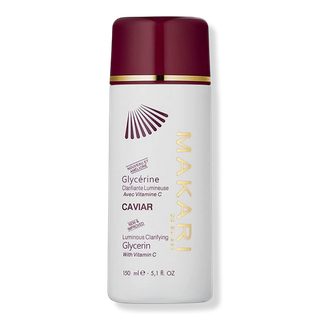
Makari Caviar Luminous Body Glycerin

Makari Caviar Luminous Body Glycerin

Efficacy87/100IrritancyHigh
Edit

Works for

2 of 2 advertised claims delivered

Moisturizing
17 ingredients credited for this claim
Strong support
What the product description says
“Give your body the ultimate glow, and seal in moisture while fading discoloration and age spots.”
Source: Ulta

This product can help improve hydration of the skin with the two types of ingredients.

The first type is called “humectants”:
these ingredients help attract water. When humectants are on the surface of the skin, they “pull in” the moisture from the outside environment, or from within deeper layers of the skin. The following ingredients in this product do the job: cyclomethicone, hyaluronic acid.

This product also contains ingredients called “occlusives”. They help reduce the speed with which our skin loses moisture to the outside environment. These ingredients also help soften the upper layer of the skin, so it feels less tight and nicer to the touch. The following ingredients in this product do the job: caprylic/capric triglyceride, dimethicone.

The following ingredients in this product are especially good for supporting the skin barrier and helping with the hydration level: panthenol, paraffinum liquidum

Hyaluronic acidKey active· HumectantEffect: HighOne of the best moisturizing ingredients. Attracts water into the upper layer of the skin. Naturally present in skin. Typically has large molecule size unless advertised otherwise on the product label. Helps support skin's barrier function and may help to reduce inflammation~0.3–0.55%
CyclomethiconeKey active· Humectant, EmollientEffect: HighA type of silicone that leaves a nice silky finish on the skin and can help soften its upper layer~3.2–3.9%
Caprylic/capric triglycerideKey active· Emollient, OcclusiveEffect: HighA good mix of fatty acids that forms a protective layer on the skin. Improves the shelf life of products. Derived from coconut and glycerin~5.3–6.4%
DimethiconeKey active· Emollient, OcclusiveEffect: HighA silicone that helps to reduce water loss from the surface of the skin. Can temporarily "fill in" lines and wrinkles, absorb oil, and create a nice product finish~0.35–0.6%
PanthenolHero· HumectantEffect: HighHelps attract water to the upper layer of the skin and can help improve skin barrier function~0.3–0.5%
Paraffinum liquidumHero· Emollient, OcclusiveEffect: HighMineral oil. One of the most effective and well studied occlusive and emollient moisturizing ingredients. Helps reduce moisture loss in skin and repair skin barrier function~1.7–2.1%
Phenyl trimethiconeKey active· OcclusiveEffect: HighA type of silicone that can decrease loss of moisture from the skin surface. It helps create a nice product texture~1.5–1.9%
Hydrolyzed wheat proteinKey active· HumectantEffect: MediumCan help attract water to the upper layer of the skin. Avoid if sensitive to gluten~0.35–0.6%
LactoseKey active· HumectantEffect: MediumHelps attract water to the upper layer of the skin~0.25–0.5%
Olea europaea fruit oilKey active· EmollientEffect: MediumAn emollient that helps soften the skin but is not effective for restoring its barrier function. Might be helpful to calm down inflammation~0.5–0.8%
Cetearyl alcoholKey active· EmollientEffect: MediumA non-drying alcohol. Works as an emollient. Helps water and oil mix together and creates a nice product texture~0.7–1.05%
Ethylhexyl palmitateKey active· EmollientEffect: MediumAn emollient that helps soften the skin and create a nice product texture~1.2–1.5%
Propylene glycol· HumectantEffect: LowHelps oil and water mix together and can enhance the penetration of other ingredients into the skin. It can be irritating~4.2–5.2%
Glyceryl stearate· EmollientEffect: LowAn emollient that softens the skin and forms a protective layer on its surface. Helps water and oil mix together~1–1.3%
Ppg-15 stearyl ether· EmollientEffect: LowHelp soften the upper layer of the skin and create a nice product consistency~0.75–1.15%
Myristyl myristateUnder-dosedEffect: HighAn emollient. Is not recommended for acne-prone skin as it can be comedogenic~0.5–0.75%
Ascorbyl tetraisopalmitateEffect: Low, below effective doseA vitamin C derivative. Studies show that is might be effective in reducing hyperpigmentation, but there are no studies confirming that it is effectively converted into the bioavailable form of Vitamin C in skin. It is not clear how this derivative compares in effectiveness to the topical application of bioavailable form of vitamin C (L-ascorbic acid)~0.3–0.55%
Evens skin tone
5 ingredients credited for this claim
Moderate support
What the product description says
“Give your body the ultimate glow, and seal in moisture while fading discoloration and age spots.”
Source: Ulta

This product might be able to help reduce hyperpigmentation and even out the skin tone because it contains salicylic acid. The effect, if any, is likely to be small. Keep in mind that you would need to apply any topical skincare targetted at hypigmentation consistently for a couple of months to get a result. No topical skincare product can help get rid of hyperpigmentation (including post-acne marks and age spots) instantly.

The following ingredient (ingredients) in this product might be helpful, but there is no evidence to confirm that it actually works: glycyrrhetinic acid, glycyrrhiza glabra root extract, retinyl palmitate.

Retinyl palmitateKey activeEffect: MediumThree steps removed from the active form of vitamin A - retinoic acid. To have an effect in the skin, it first needs to be converted twice to become the retinoic acid. This means it is less potent than retinol, but could also be less irritating. Once converted to the retinoic acid in the skin, it helps against all signs of aging, improves skin cell turnover and helps fight blemishes and clogged pores. However, in many cosmetic formulations, it is used in a concentration that is too low to have the full effect~0.3–0.5%
Glycyrrhetinic acidKey activeEffect: MediumActive compound of licorice root. Works to calm down inflammation, as an anti-oxidant, and might be helpful in lightening the skin and reducing hyperpigmentation~0.25–0.5%
Glycyrrhiza glabra root extractEffect: LowA plant extract that can help lighten the skin and calm down inflammation. Might be helpful in neutralizing free radicals~0.35–0.65%
Salicylic acidEffect: LowUsed for skin exfoliation. It has an anti-inflammatory and anti-bacterial effect, helps to unclog pores, prevent blemishes and speed up healing of the existing ones. Sometimes referred to as a BHA (beta-hydroxy acid)~0.3–0.55%
Ascorbyl tetraisopalmitateUnder-dosedEffect: MediumA vitamin C derivative. Studies show that is might be effective in reducing hyperpigmentation, but there are no studies confirming that it is effectively converted into the bioavailable form of Vitamin C in skin. It is not clear how this derivative compares in effectiveness to the topical application of bioavailable form of vitamin C (L-ascorbic acid)~0.3–0.55%
Anti-oxidation
Not advertised by the brand · 5 ingredients credited for this claim
Strong support

This product contains antioxidants (glycyrrhetinic acid) that can help neutralize free radicals in skin. By doing so, they can lessen the damage the skin gets from the UV light (sun).

Glycyrrhetinic acidKey activeEffect: HighActive compound of licorice root. Works to calm down inflammation, as an anti-oxidant, and might be helpful in lightening the skin and reducing hyperpigmentation~0.25–0.5%
Glycyrrhiza glabra root extractEffect: LowA plant extract that can help lighten the skin and calm down inflammation. Might be helpful in neutralizing free radicals~0.35–0.65%
Ocimum sanctum leaf extractEffect: LowA plant extract that is rich in a fragrance compound eugenol that is a frequent allergen and can be irritating. It might also contain anti-oxidants to help neutralize free radicals~0.25–0.5%
Ascorbyl tetraisopalmitateUnder-dosedEffect: HighA vitamin C derivative. Studies show that is might be effective in reducing hyperpigmentation, but there are no studies confirming that it is effectively converted into the bioavailable form of Vitamin C in skin. It is not clear how this derivative compares in effectiveness to the topical application of bioavailable form of vitamin C (L-ascorbic acid)~0.3–0.55%
Tocopheryl acetateEffect: Low, below effective doseA more stable but less bio-available form of vitamin E compared to Tocopherol. Might help moisturize and protect the skin from free radicals, but mostly used in low concentrations to stabilize other ingredients.~0.3–0.55%
Exfoliation
Not advertised by the brand · 2 ingredients credited for this claim
Strong support

This product can help exfoliate the skin. In other words, it helps break down the bonds between dead cells on the surface of the skin and speed up the skin turnover. Skin often appears softer and brighter after exfoliation, but overdoing it can result in disrupted skin barrier. The following ingredient is doing the exfoliating job in this product: salicylic acid.

Salicylic acidKey activeEffect: HighUsed for skin exfoliation. It has an anti-inflammatory and anti-bacterial effect, helps to unclog pores, prevent blemishes and speed up healing of the existing ones. Sometimes referred to as a BHA (beta-hydroxy acid)~0.3–0.55%
Retinyl palmitateEffect: LowThree steps removed from the active form of vitamin A - retinoic acid. To have an effect in the skin, it first needs to be converted twice to become the retinoic acid. This means it is less potent than retinol, but could also be less irritating. Once converted to the retinoic acid in the skin, it helps against all signs of aging, improves skin cell turnover and helps fight blemishes and clogged pores. However, in many cosmetic formulations, it is used in a concentration that is too low to have the full effect~0.3–0.5%
Anti-blemish
Not advertised by the brand · 3 ingredients credited for this claim
Strong support

This product can help reduce breakouts and clogged pores because it contains the following ingredient: salicylic acid. This ingredient is used for treating acne and can have a noticeable effect.

The following ingredient (ingredients) in this product might be helpful, but there is no evidence to confirm that it actually works: retinyl palmitate

Salicylic acidHeroEffect: HighUsed for skin exfoliation. It has an anti-inflammatory and anti-bacterial effect, helps to unclog pores, prevent blemishes and speed up healing of the existing ones. Sometimes referred to as a BHA (beta-hydroxy acid)~0.3–0.55%
Retinyl palmitateKey activeEffect: MediumThree steps removed from the active form of vitamin A - retinoic acid. To have an effect in the skin, it first needs to be converted twice to become the retinoic acid. This means it is less potent than retinol, but could also be less irritating. Once converted to the retinoic acid in the skin, it helps against all signs of aging, improves skin cell turnover and helps fight blemishes and clogged pores. However, in many cosmetic formulations, it is used in a concentration that is too low to have the full effect~0.3–0.5%
Octadecenedioic acidEffect: LowHelps oil and water mix together. Might help suppress growth of acne-triggering bacteria in skin~0.3–0.55%
Anti-aging
Not advertised by the brand · 3 ingredients credited for this claim
Moderate support

This product contains retinyl palmitate. This ingredient might be able to help reduce and prevent fine lines and wrinkles, improve skin elasticity and firmness, but there is not enough evidence that it actually works.

Retinyl palmitateKey activeEffect: MediumThree steps removed from the active form of vitamin A - retinoic acid. To have an effect in the skin, it first needs to be converted twice to become the retinoic acid. This means it is less potent than retinol, but could also be less irritating. Once converted to the retinoic acid in the skin, it helps against all signs of aging, improves skin cell turnover and helps fight blemishes and clogged pores. However, in many cosmetic formulations, it is used in a concentration that is too low to have the full effect~0.3–0.5%
Hyaluronic acidEffect: LowOne of the best moisturizing ingredients. Attracts water into the upper layer of the skin. Naturally present in skin. Typically has large molecule size unless advertised otherwise on the product label. Helps support skin's barrier function and may help to reduce inflammation~0.3–0.55%
Ascorbyl tetraisopalmitateUnder-dosedEffect: MediumA vitamin C derivative. Studies show that is might be effective in reducing hyperpigmentation, but there are no studies confirming that it is effectively converted into the bioavailable form of Vitamin C in skin. It is not clear how this derivative compares in effectiveness to the topical application of bioavailable form of vitamin C (L-ascorbic acid)~0.3–0.55%

Can it cause trouble?

Irritancy
10 strong irritants: Ocimum sanctum leaf extract, Retinyl palmitate + 8 more — patch-test recommended
High risk
We flagged 28 ingredients with irritancy potential. Severity depends on your sensitivity threshold; the table lists the worst offenders first.
IngredientFunctionIrritationEst. amount
Propylene glycolHelps oil and water mix together and can enhance the penetration of other ingredients into the skin. It can be irritatingHigh~4.2–5.2%est.
Salicylic acidUsed for skin exfoliation. It has an anti-inflammatory and anti-bacterial effect, helps to unclog pores, prevent blemishes and speed up healing of the existing ones. Sometimes referred to as a BHA (beta-hydroxy acid)High~0.3–0.55%est.
Ocimum sanctum leaf extractA plant extract that is rich in a fragrance compound eugenol that is a frequent allergen and can be irritating. It might also contain anti-oxidants to help neutralize free radicalsHigh~0.25–0.5%est.
Retinyl palmitateThree steps removed from the active form of vitamin A - retinoic acid. To have an effect in the skin, it first needs to be converted twice to become the retinoic acid. This means it is less potent than retinol, but could also be less irritating. Once converted to the retinoic acid in the skin, it helps against all signs of aging, improves skin cell turnover and helps fight blemishes and clogged pores. However, in many cosmetic formulations, it is used in a concentration that is too low to have the full effectHigh~0.3–0.5%est.
Dmdm hydantoinA preservative that releases formaldehyde and can be irritatingHigh~0.25–0.45%est.
Iodopropynyl butylcarbamateA preservative. Can be irritatingHigh~0.01–0.02%est.
ParfumAn aromatic blend of unspecified and possibly irritating ingredientsHigh~0.2–0.35%est.
Benzyl alcoholA preservative. Can be used to mask unpleasant smell. Can be irritatingHigh~0.1–0.25%est.
Hexyl cinnamalA fragrance with jasmine smell. A likely irritantHigh~0.15–0.25%est.
Alpha-isomethyl iononeA fragrance. Potential allergen and can be irritatingHigh~0.15–0.3%est.
CoumarinA fragrance. Is a likely skin allergen and can be irritatingHigh~0.15–0.25%est.
Butylphenyl methylpropionalA fragrance. Can trigger allergic reactions and be irritatingHigh~0.1–0.2%est.
LimoneneA common frangrance that can easily irritate skin, especially if exposed to air, light or heatHigh~0.1–0.15%est.
Caprylic/capric triglycerideA good mix of fatty acids that forms a protective layer on the skin. Improves the shelf life of products. Derived from coconut and glycerinMedium~5.3–6.4%est.
Isostearyl isostearateHelps soften the upper layer of the skin and improve the product texture. It can be comedogenicMedium~2.4–3%est.
Olea europaea fruit oilAn emollient that helps soften the skin but is not effective for restoring its barrier function. Might be helpful to calm down inflammationMedium~0.5–0.8%est.
Myristyl myristateAn emollient. Is not recommended for acne-prone skin as it can be comedogenicMedium~0.5–0.75%est.
Ceratonia siliqua gumUsed to stabilize product formulations and create thicker consistencyMedium~0.5–0.75%est.
Glycyrrhiza glabra root extractA plant extract that can help lighten the skin and calm down inflammation. Might be helpful in neutralizing free radicalsMedium~0.35–0.65%est.
Hydrolyzed wheat proteinCan help attract water to the upper layer of the skin. Avoid if sensitive to glutenMedium~0.35–0.6%est.
Glycyrrhetinic acidActive compound of licorice root. Works to calm down inflammation, as an anti-oxidant, and might be helpful in lightening the skin and reducing hyperpigmentationMedium~0.25–0.5%est.
Ascorbyl tetraisopalmitateA vitamin C derivative. Studies show that is might be effective in reducing hyperpigmentation, but there are no studies confirming that it is effectively converted into the bioavailable form of Vitamin C in skin. It is not clear how this derivative compares in effectiveness to the topical application of bioavailable form of vitamin C (L-ascorbic acid)Medium~0.3–0.55%est.
Tocopheryl acetateA more stable but less bio-available form of vitamin E compared to Tocopherol. Might help moisturize and protect the skin from free radicals, but mostly used in low concentrations to stabilize other ingredients.Medium~0.3–0.55%est.
Cetyl phosphateHelps oil and water mix togetherMedium~0.3–0.55%est.
Steareth-2Helps oil and water mix togetherMedium~0.3–0.55%est.
Steareth-20Helps oil and water mix togetherMedium~0.4–0.6%est.
Disodium edtaStabilizes the product formulationMedium~0.25–0.45%est.
TriethanolamineUsed to adjust pH of the product and can help improve the product's smellMedium~0.25–0.5%est.
Comedogenic
4 ingredients rated 2 or more on the 0–5 pore-clogging scale
4 flagged
These ingredients have a comedogenic rating of 2 or more on a 0–5 scale; the table shows each one's rating. In leave-on products they can clog pores in acne-prone skin.
IngredientFunctionRatingEst. amount
Isostearyl isostearateHelps soften the upper layer of the skin and improve the product texture. It can be comedogenic3/5~2.4–3%est.
Ethylhexyl palmitateAn emollient that helps soften the skin and create a nice product texture3/5~1.2–1.5%est.
Myristyl myristateAn emollient. Is not recommended for acne-prone skin as it can be comedogenic3/5~0.5–0.75%est.
Cetearyl alcoholA non-drying alcohol. Works as an emollient. Helps water and oil mix together and creates a nice product texture2/5~0.7–1.05%est.
Edit

User reviews

Would you recommend?
No community reviews yet.

Be the first — your take helps the next person decide.

Write a review · ~30s

Ingredients

Filter by role to see what each ingredient is doing.

Water~45–55%
Formula
Irritation risk
Low

Plain old water

More about Water
Caprylic/capric triglyceride~5.3–6.4%
Key activeIrritant · medium
Irritation risk
Medium
Works for
Moisturizing

A good mix of fatty acids that forms a protective layer on the skin. Improves the shelf life of products. Derived from coconut and glycerin

More about Caprylic/capric triglyceride
Propylene glycol~4.2–5.2%
Irritant · high
Irritation risk
High
Works for
Moisturizing

Helps oil and water mix together and can enhance the penetration of other ingredients into the skin. It can be irritating

More about Propylene glycol
Cyclomethicone~3.2–3.9%
Key active
Irritation risk
Low
Works for
Moisturizing

A type of silicone that leaves a nice silky finish on the skin and can help soften its upper layer

More about Cyclomethicone
Isostearyl isostearate~2.4–3%
Comedogenic 3/5Irritant · medium
Irritation risk
Medium
Comedogenicity
3/5

Helps soften the upper layer of the skin and improve the product texture. It can be comedogenic

More about Isostearyl isostearate
Cetearyl isononanoate~2.1–2.5%
Formula
Irritation risk
Low

An emollient that softens the skin and helps prevent moisture loss.

More about Cetearyl isononanoate
Paraffinum liquidum~1.7–2.1%
Hero · Moisturizing
Irritation risk
Low
Works for
Moisturizing

Mineral oil. One of the most effective and well studied occlusive and emollient moisturizing ingredients. Helps reduce moisture loss in skin and repair skin barrier function

More about Paraffinum liquidum
Phenyl trimethicone~1.5–1.9%
Key active
Irritation risk
Low
Works for
Moisturizing

A type of silicone that can decrease loss of moisture from the skin surface. It helps create a nice product texture

More about Phenyl trimethicone
Ethylhexyl palmitate~1.2–1.5%
Key activeComedogenic 3/5
Irritation risk
Low
Comedogenicity
3/5
Works for
Moisturizing

An emollient that helps soften the skin and create a nice product texture

More about Ethylhexyl palmitate
Glyceryl stearate~1–1.3%
Formula
Irritation risk
Low
Works for
CleansingMoisturizing

An emollient that softens the skin and forms a protective layer on its surface. Helps water and oil mix together

More about Glyceryl stearate
Ppg-15 stearyl ether~0.75–1.15%
Formula
Irritation risk
Low
Works for
Moisturizing

Help soften the upper layer of the skin and create a nice product consistency

More about Ppg-15 stearyl ether
Cetearyl alcohol~0.7–1.05%
Key activeComedogenic 2/5
Irritation risk
Low
Comedogenicity
2/5
Works for
CleansingMoisturizing

A non-drying alcohol. Works as an emollient. Helps water and oil mix together and creates a nice product texture

More about Cetearyl alcohol
Peg-100 stearate~0.65–0.95%
Formula
Irritation risk
Low
Works for
Cleansing

Helps oil and water mix togehter and creates a nice product texture

More about Peg-100 stearate
Olea europaea fruit oil~0.5–0.8%
Key activeIrritant · medium
Irritation risk
Medium
Works for
Moisturizing

An emollient that helps soften the skin but is not effective for restoring its barrier function. Might be helpful to calm down inflammation

More about Olea europaea fruit oil
Myristyl myristate~0.5–0.75%
Under-dosedComedogenic 3/5Irritant · medium
Irritation risk
Medium
Comedogenicity
3/5
Works for
Moisturizing

An emollient. Is not recommended for acne-prone skin as it can be comedogenic

More about Myristyl myristate
Morus alba root extract~0.45–0.7%
Formula
Ceratonia siliqua gum~0.5–0.75%
Irritant · medium
Irritation risk
Medium

Used to stabilize product formulations and create thicker consistency

More about Ceratonia siliqua gum
Glycyrrhiza glabra root extract~0.35–0.65%
Irritant · medium
Irritation risk
Medium
Works for
Reduces rednessEvens skin toneAnti-oxidationAnti-inflammatoryAntibacterial

A plant extract that can help lighten the skin and calm down inflammation. Might be helpful in neutralizing free radicals

More about Glycyrrhiza glabra root extract
Hydrolyzed wheat protein~0.35–0.6%
Key activeIrritant · medium
Irritation risk
Medium
Works for
Moisturizing

Can help attract water to the upper layer of the skin. Avoid if sensitive to gluten

More about Hydrolyzed wheat protein
Caviar extract~0.3–0.6%
Formula
Irritation risk
Low
More about Caviar extract
Hyaluronic acid~0.3–0.55%
Key active
Irritation risk
Low
Works for
MoisturizingAnti-inflammatoryAnti-aging

One of the best moisturizing ingredients. Attracts water into the upper layer of the skin. Naturally present in skin. Typically has large molecule size unless advertised otherwise on the product label. Helps support skin's barrier function and may help to reduce inflammation

More about Hyaluronic acid
Salicylic acid~0.3–0.55%
Hero · Anti-blemishIrritant · high
Irritation risk
High
Works for
Anti-blemishExfoliationAnti-inflammatoryAntibacterialEvens skin tone

Used for skin exfoliation. It has an anti-inflammatory and anti-bacterial effect, helps to unclog pores, prevent blemishes and speed up healing of the existing ones. Sometimes referred to as a BHA (beta-hydroxy acid)

More about Salicylic acid
Octadecenedioic acid~0.3–0.55%
Formula
Irritation risk
Low
Works for
CleansingAnti-blemish

Helps oil and water mix together. Might help suppress growth of acne-triggering bacteria in skin

More about Octadecenedioic acid
Ocimum sanctum leaf extract~0.25–0.5%
Irritant · high
Irritation risk
High
Works for
Anti-oxidation

A plant extract that is rich in a fragrance compound eugenol that is a frequent allergen and can be irritating. It might also contain anti-oxidants to help neutralize free radicals

More about Ocimum sanctum leaf extract
Glycyrrhetinic acid~0.25–0.5%
Key activeIrritant · medium
Irritation risk
Medium
Works for
Anti-oxidationAnti-inflammatoryEvens skin tone

Active compound of licorice root. Works to calm down inflammation, as an anti-oxidant, and might be helpful in lightening the skin and reducing hyperpigmentation

More about Glycyrrhetinic acid
Ascorbyl tetraisopalmitate~0.3–0.55%
Under-dosedIrritant · medium
Irritation risk
Medium
Works for
Anti-oxidationEvens skin toneAnti-agingMoisturizing

A vitamin C derivative. Studies show that is might be effective in reducing hyperpigmentation, but there are no studies confirming that it is effectively converted into the bioavailable form of Vitamin C in skin. It is not clear how this derivative compares in effectiveness to the topical application of bioavailable form of vitamin C (L-ascorbic acid)

More about Ascorbyl tetraisopalmitate
Panthenol~0.3–0.5%
Hero · Moisturizing
Irritation risk
Low
Works for
MoisturizingReduces rednessReduces irritation

Helps attract water to the upper layer of the skin and can help improve skin barrier function

More about Panthenol
Tocopheryl acetate~0.3–0.55%
Irritant · medium
Irritation risk
Medium
Works for
Anti-oxidation

A more stable but less bio-available form of vitamin E compared to Tocopherol. Might help moisturize and protect the skin from free radicals, but mostly used in low concentrations to stabilize other ingredients.

More about Tocopheryl acetate
Retinyl palmitate~0.3–0.5%
Key activeIrritant · high
Irritation risk
High
Works for
Evens skin toneAnti-blemishAnti-agingExfoliation

Three steps removed from the active form of vitamin A - retinoic acid. To have an effect in the skin, it first needs to be converted twice to become the retinoic acid. This means it is less potent than retinol, but could also be less irritating. Once converted to the retinoic acid in the skin, it helps against all signs of aging, improves skin cell turnover and helps fight blemishes and clogged pores. However, in many cosmetic formulations, it is used in a concentration that is too low to have the full effect

More about Retinyl palmitate
Lactose~0.25–0.5%
Key active
Irritation risk
Low
Works for
Moisturizing

Helps attract water to the upper layer of the skin

More about Lactose
Dimethicone~0.35–0.6%
Key active
Irritation risk
Low
Works for
MoisturizingMattifying

A silicone that helps to reduce water loss from the surface of the skin. Can temporarily "fill in" lines and wrinkles, absorb oil, and create a nice product finish

More about Dimethicone
Cetyl phosphate~0.3–0.55%
Irritant · medium
Irritation risk
Medium
Works for
Cleansing

Helps oil and water mix together

More about Cetyl phosphate
Steareth-2~0.3–0.55%
Irritant · medium
Irritation risk
Medium
Works for
Cleansing

Helps oil and water mix together

More about Steareth-2
Steareth-20~0.4–0.6%
Irritant · medium
Irritation risk
Medium
Works for
Cleansing

Helps oil and water mix together

More about Steareth-20
Titanium dioxide~0.4–0.6%
Formula
Irritation risk
Low
Works for
Sun protection

Works as a UV filter when used in high concentrations. It is photostable and is effective mostly against the UVB light, with some protection in the UVA range. In small concentrations, used for its ability to improve the color of cosmetic products. Is usually well tolerated by the skin

More about Titanium dioxide
Carbomer~0.25–0.5%
Formula
Irritation risk
Low
Works for
Cleansing

Helps create a thicker or gel-like product texture. It is not a surfactant but can be used in gentle cleansing formulations

More about Carbomer
Disodium edta~0.25–0.45%
Irritant · medium
Irritation risk
Medium

Stabilizes the product formulation

More about Disodium edta
Triethanolamine~0.25–0.5%
Irritant · medium
Irritation risk
Medium
Works for
Cleansing

Used to adjust pH of the product and can help improve the product's smell

More about Triethanolamine
Dmdm hydantoin~0.25–0.45%
Irritant · high
Irritation risk
High

A preservative that releases formaldehyde and can be irritating

More about Dmdm hydantoin
Iodopropynyl butylcarbamate~0.01–0.02%
Irritant · high
Irritation risk
High

A preservative. Can be irritating

More about Iodopropynyl butylcarbamate
Parfum~0.2–0.35%
Irritant · high
Irritation risk
High

An aromatic blend of unspecified and possibly irritating ingredients

More about Parfum
Anise alcohol~0.2–0.35%
Formula
Irritation risk
Low
More about Anise alcohol
Benzyl alcohol~0.1–0.25%
Irritant · high
Irritation risk
High

A preservative. Can be used to mask unpleasant smell. Can be irritating

More about Benzyl alcohol
Hexyl cinnamal~0.15–0.25%
Irritant · high
Irritation risk
High

A fragrance with jasmine smell. A likely irritant

More about Hexyl cinnamal
Alpha-isomethyl ionone~0.15–0.3%
Irritant · high
Irritation risk
High

A fragrance. Potential allergen and can be irritating

More about Alpha-isomethyl ionone
Coumarin~0.15–0.25%
Irritant · high
Irritation risk
High

A fragrance. Is a likely skin allergen and can be irritating

More about Coumarin
Butylphenyl methylpropional~0.1–0.2%
Irritant · high
Irritation risk
High

A fragrance. Can trigger allergic reactions and be irritating

More about Butylphenyl methylpropional
Limonene~0.1–0.15%
Irritant · high
Irritation risk
High

A common frangrance that can easily irritate skin, especially if exposed to air, light or heat

More about Limonene
Ingredient list view

Water, Caprylic/capric triglyceride, Propylene glycol, Cyclomethicone, Isostearyl isostearate, Cetearyl isononanoate, Paraffinum liquidum, Phenyl trimethicone, Ethylhexyl palmitate, Glyceryl stearate, Ppg-15 stearyl ether, Cetearyl alcohol, Peg-100 stearate, Olea europaea fruit oil, Myristyl myristate, Morus alba root extract, Ceratonia siliqua gum, Glycyrrhiza glabra root extract, Hydrolyzed wheat protein, Caviar extract, Hyaluronic acid, Salicylic acid, Octadecenedioic acid, Ocimum sanctum leaf extract, Glycyrrhetinic acid, Ascorbyl tetraisopalmitate, Panthenol, Tocopheryl acetate, Retinyl palmitate, Lactose, Dimethicone, Cetyl phosphate, Steareth-2, Steareth-20, Titanium dioxide, Carbomer, Disodium edta, Triethanolamine, Dmdm hydantoin, Iodopropynyl butylcarbamate, Parfum, Anise alcohol, Benzyl alcohol, Hexyl cinnamal, Alpha-isomethyl ionone, Coumarin, Butylphenyl methylpropional, Limonene

Compare prices

Retailers ranked by price — lowest first.

Ulta
$38.00
Buy

Affiliate links · prices updated regularly

Worth comparing, line by line.

Match % combines shared ingredients, the first five ingredients, shared actives and hero ingredients, irritancy (lower counts in the alternative's favour), texture and body area. Only products in the same routine step are compared.

Side-by-side comparison of this product against its closest alternatives
MakariCaviar Luminous Body GlycerinYOUR PRODUCTSVRXERIAL 30 Body CreamEau Thermale AveneAkerat 10 Body CreamAvèneAkérat Body Cream
Match—76%76%76%
Price$38.00$19.83−$18.17$19.83−$18.17$14.54−$23.46
Shared key ingredients—3 of 122 of 122 of 12
Key difference—UreaUreaUrea
Irritancy High Low Low Low
Drying alcohol————
View product Shop Shop Shop
Cheaper alternatives? See how this stacks up against similar formulas.
We compare ingredient profiles across our catalog — pick the closest match for your budget.
Open dupe finder

Sources cited in this review

Every concentration estimate and effectiveness label is anchored to one of these 28 studies and safety reviews.

  1. 1
  2. 2
    Propylene Glycolpubmed.ncbi.nlm.nih.gov
  3. 3
  4. 4
  5. 5
  6. 6
Makari Caviar Luminous Body Glycerin
MakariCaviar Luminous Body Glycerin

Affiliate links · As an Amazon Associate, WIMJ earns from qualifying purchases.

As an Amazon Associate, WIMJ earns from qualifying purchases.