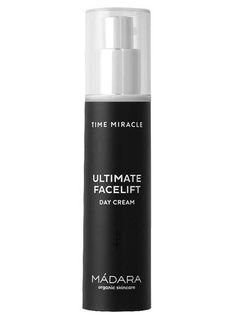
Madara Cosmetics Time Miracle Ultimate Facelift Day Cream
Works for
1 of 2 advertised claims delivered
MoisturizingRosa canina seed oil, Betaine + 13 moreGood evidence
“Time Miracle Ultimate Facelift Day Cream”
This product can help improve hydration of the skin with the two types of ingredients.
The first type is called “humectants”:
these ingredients help attract water.
When humectants are on the surface of the skin, they “pull in” the moisture from the outside environment, or from
within deeper layers of the skin. The following ingredients in this product do the job:
betaine, glycerin.
This product also contains ingredients called “occlusives”. They help reduce the speed with which our skin loses moisture to the outside environment. These ingredients also help soften the upper layer of the skin, so it feels less tight and nicer to the touch. The following ingredients in this product do the job: butyrospermum parkii butter, simmondsia chinensis seed oil.
Anti-agingButyrospermum parkii butter, Tocopherol + 2 moreLimited evidence
“Infused with rejuvenating Northern Birch Juice (clinically proven to improve signs of visibly ageing), Hyaluronic Acid and light reflecting particles, the moisturiser expertly plumps out wrinkles whilst blurring imperfections to reveal a smoother, renewed-looking complexion.”
This product does not contain ingredients that are able to reduce fine lines and wrinkles or help with skin elasticity, but it can improve the look of the skin temporarily through moisturization. Well-moisturized skin might also be able to repair the sun damage better.This ingredient - butyrospermum parkii butter - could be helpful for preventing or repairing signs of aging in theory, but there is no evidence that it actually works.
Can it cause trouble?
Irritancy7 strong irritants: Trifolium pratense flower extract, Rosa damascena extract + 5 more — patch-test recommendedHigh risk
Comedogenic1 ingredient rated 2 or more on the 0–5 pore-clogging scale1 flagged


User reviews
Be the first — your take helps the next person decide.
Ingredients
Filter by role to see what each ingredient is doing.
Betula alba juice~23–34%
- Irritation risk
- Low
Simmondsia chinensis seed oil~4.2–6.3%
- Irritation risk
- Medium
Softens the upper layer of skin and helps restore the healthy skin barrier. Has shown to help calm down inflammation in skin. It is a stable oil, meaning that it retains its properties even when exposed to air.
More about Simmondsia chinensis seed oilGlycerin~4.1–6.2%
- Irritation risk
- Low
One of the best moisturizing ingredients. Naturally present in skin. It attracts water to the upper layer of the skin working as a humectant
More about GlycerinRosa canina seed oil~3.8–5.7%
- Irritation risk
- Medium
A plant oil that helps soften the upper layer of the skin. It might have anti-oxidant properties. Might help reduce inflammation in skin and help against blemishes
More about Rosa canina seed oilDicaprylyl carbonate~2.8–4.2%
- Irritation risk
- Low
Helps products spread more easily and works as an emollient to soften skin
More about Dicaprylyl carbonateWater~1.9–2.9%
Polyglyceryl-6 distearate~1.5–2.3%
- Irritation risk
- Medium
Helps oil and water mix together while softening the upper layer of the skin
More about Polyglyceryl-6 distearateSilica~1.5–2.2%
Microcrystalline cellulose~1.2–1.8%
Butyrospermum parkii butter~1–1.5%
- Irritation risk
- Low
- Comedogenicity
- 3/5
A great moisturising ingredient that softens the skin and reduces water loss from its upper layer. It also can be helpful in protecting skin from free radicals
More about Butyrospermum parkii butterButter~0.6–1.35%
- Irritation risk
- Low
Jojoba esters~0.6–1.35%
- Irritation risk
- Medium
An emollient made of jojoba oil. Helps soften the skin and support its barrier function
More about Jojoba estersCi 77891~0.5–1.2%
- Irritation risk
- Low
Titanium dioxide~0.55–1.3%
- Irritation risk
- Low
Works as a UV filter when used in high concentrations. It is photostable and is effective mostly against the UVB light, with some protection in the UVA range. In small concentrations, used for its ability to improve the color of cosmetic products. Is usually well tolerated by the skin
More about Titanium dioxideHippophae rhamnoides fruit extract~0.45–1%
- Irritation risk
- Medium
A plant extract that might help neutralize free radicals in skin, but research on its effectiveness is lacking
More about Hippophae rhamnoides fruit extractTrifolium pratense flower extract~0.45–1%
- Irritation risk
- High
Red clover flower extract. Can contain anti-oxidants but also potential irritant compounds
More about Trifolium pratense flower extractRosa damascena extract~0.45–1%
- Irritation risk
- High
Oil of a very fragrant pink rose used as fragrance in cosmetics. Extensive research has shown it has mixed benefits. In the pro column, inhaling this flower’s scent seems to have relaxing properties and the plant’s petals contain skin-soothing and antioxidant compounds that can benefit skin. On the flipside, the numerous chemicals that create this rose’s distinctive fragrance pose a risk of causing skin aggravation.
More about Rosa damascena extractVaccinium myrtillus fruit extract~0.4–0.9%
- Irritation risk
- Medium
A plant extract that might help neutralize free radicals in skin, but research on its efficacy in skin is lacking
More about Vaccinium myrtillus fruit extractRosa damascena extract~0.4–0.9%
- Irritation risk
- High
Oil of a very fragrant pink rose used as fragrance in cosmetics. Extensive research has shown it has mixed benefits. In the pro column, inhaling this flower’s scent seems to have relaxing properties and the plant’s petals contain skin-soothing and antioxidant compounds that can benefit skin. On the flipside, the numerous chemicals that create this rose’s distinctive fragrance pose a risk of causing skin aggravation.
More about Rosa damascena extractAroma~0.35–0.85%
Benzyl alcohol~0.35–0.8%
- Irritation risk
- High
A preservative. Can be used to mask unpleasant smell. Can be irritating
More about Benzyl alcoholPolyglyceryl-3 beeswax~0.35–0.85%
- Irritation risk
- Medium
Helps water and oil mix together. Could be an allergen (beeswax)
More about Polyglyceryl-3 beeswaxCetyl alcohol~0.4–1%
- Irritation risk
- Low
A non-drying alcohol that works to soften the skin and stabilize product formulations helping oil and water mix together
More about Cetyl alcoholMica~0.4–0.9%
- Irritation risk
- Low
Creates an illusion of smoother and more radiant skin tone. Adds shimmer to the skin by reflecting light
More about MicaXanthan gum~0.35–0.8%
- Irritation risk
- Low
Used to create a thicker product consistency
More about Xanthan gumCellulose gum~0.4–0.9%
- Irritation risk
- Low
Used to create thicker product consistency and stabilize emulsions
More about Cellulose gumBetaine~0.3–0.75%
- Irritation risk
- Low
Helps attract water to the upper layer of the skin and improves the product texture
More about BetaineSodium pca~0.3–0.75%
- Irritation risk
- Low
Naturally present in skin and helps to attract water to its upper layer
More about Sodium pcaCyathea cumingii leaf extract~0.4–0.95%
- Irritation risk
- Low
Sodium benzoate~0.25–0.5%
Ascorbyl palmitate~0.35–0.8%
- Irritation risk
- Medium
Being a lipid soluble form of vitamin C, it is more stable and can penetrate the skin better than L-Ascorbic acid. It is effective in protecting the skin from free radicals, as well as evening the skin tone, but is less effective in stimulating collagen production compared to L-Ascorbic acid.
More about Ascorbyl palmitateTocopherol~0.35–0.8%
- Irritation risk
- Low
Pure form of vitamin E. Can help moisturise and protect the skin from free radicals. Often used to help stabilise other ingredients or the formula itself
More about TocopherolAesculus hippocastanum seed extract~0.35–0.8%
- Irritation risk
- High
Plant extract. Might have some anti-oxidant properties. Can be irritating
More about Aesculus hippocastanum seed extractRosa damascena extract~0.35–0.8%
- Irritation risk
- High
Oil of a very fragrant pink rose used as fragrance in cosmetics. Extensive research has shown it has mixed benefits. In the pro column, inhaling this flower’s scent seems to have relaxing properties and the plant’s petals contain skin-soothing and antioxidant compounds that can benefit skin. On the flipside, the numerous chemicals that create this rose’s distinctive fragrance pose a risk of causing skin aggravation.
More about Rosa damascena extractPotassium sorbate~0.3–0.6%
Lactic acid~0.3–0.75%
- Irritation risk
- Medium
An exfoliating and moisturizing alpha-hydroxy acid (AHA). Typically causes less irritation than other AHAs, for example, glycolic acid. At high concentrations (about 15%), lactic acid can help reduce lines and wrinkles. Recent studies show that lactic acid can support the "good" bacteria living on skin's surface (healthy skin microbiome)
More about Lactic acidCi 77288~0.3–0.75%
- Irritation risk
- Low
Sodium phytate~0.3–0.7%
Sodium hyaluronate~0.2–0.75%
- Irritation risk
- Low
One of the best moisturizing ingredients. Attracts water into the upper layer of the skin
More about Sodium hyaluronateAlteromonas ferment extract~0.2–0.7%
- Irritation risk
- Low
A marine extract that helps attract water to the upper layer of the skin. It is claimed to have anti-inflammatory properties but research is lacking
More about Alteromonas ferment extractPhenethyl alcohol~0.15–0.65%
Hydrolyzed hyaluronic acid~0.15–0.6%
- Irritation risk
- Low
One of the best moisturizing ingredients. Attracts water into the upper layer of the skin. A version of it is naturally present in skin
More about Hydrolyzed hyaluronic acidLimonene~0.15–0.6%
- Irritation risk
- High
A common frangrance that can easily irritate skin, especially if exposed to air, light or heat
More about LimoneneLinalool~0.1–0.45%
Eugenol~0.1–0.35%
Citral~0.05–0.3%
Ingredient list view
Betula alba juice, Simmondsia chinensis seed oil, Glycerin, Rosa canina seed oil, Dicaprylyl carbonate, Water, Polyglyceryl-6 distearate, Silica, Microcrystalline cellulose, Butyrospermum parkii butter, Butter, Jojoba esters, Ci 77891, Titanium dioxide, Hippophae rhamnoides fruit extract, Trifolium pratense flower extract, Rosa damascena extract, Vaccinium myrtillus fruit extract, Rosa damascena extract, Aroma, Benzyl alcohol, Polyglyceryl-3 beeswax, Cetyl alcohol, Mica, Xanthan gum, Cellulose gum, Betaine, Sodium pca, Cyathea cumingii leaf extract, Sodium benzoate, Ascorbyl palmitate, Tocopherol, Aesculus hippocastanum seed extract, Rosa damascena extract, Potassium sorbate, Lactic acid, Ci 77288, Sodium phytate, Sodium hyaluronate, Alteromonas ferment extract, Phenethyl alcohol, Hydrolyzed hyaluronic acid, Limonene, Linalool, Eugenol, Citral
Compare prices
Retailers ranked by price — lowest first.
Affiliate links · prices updated regularly · As an Amazon Associate, WIMJ earns from qualifying purchases.
Worth comparing, line by line.
Match % combines shared ingredients, the first five ingredients, shared actives and hero ingredients, irritancy (lower counts in the alternative's favour), texture and body area. Only products in the same routine step are compared.
| Madara CosmeticsTime Miracle Ultimate Facelift Day CreamYOUR PRODUCT | Maria ÅkerbergFace Cream Sensitive | Lotus Moon Skin CareCorrective Skin Brightening Moisturizer | |
|---|---|---|---|
| Match | — | 52% | 52% |
| Price | $45.63 | $29.87−$15.76 | — |
| Shared key ingredients | — | 2 of 13 | 4 of 13 |
| Key difference | — | Beeswax | Kojic Acid |
| Irritancy | High | Medium | Low |
| Drying alcohol | — | — | — |
| View product | Shop | Shop |
Sources cited in this review
Every concentration estimate and effectiveness label is anchored to one of these 18 studies and safety reviews.
- 1
- 2Nutrient composition of rose (Rosa canina L.) seed and oilsncbi.nlm.nih.gov
- 3
- 4
- 5Abundance of active ingredients in sea-buckthorn oilncbi.nlm.nih.gov
- 6

Affiliate links · As an Amazon Associate, WIMJ earns from qualifying purchases.