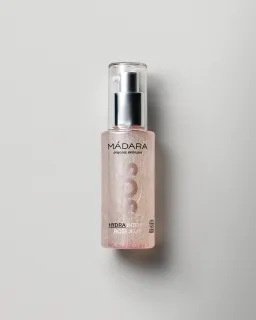
Madara Cosmetics Hydra Intense -ruusugeeli
Works for
1 of 1 advertised claim delivered
MoisturizingSodium pca, Betaine + 12 moreGood evidence
“Enriched with organic rose water, this oil-free gel moisturiser floods dry, stressed skin with lightweight hydration.”
This product contains good ingredients to attract water to the upper layer of the skin. These ingredients are called "humectants": betaine, glycerin.
When humectants are on the surface of the skin, they “pull in” the moisture from the outside environment, or from within deeper layers of the skin. If the air is dry, humectants can speed up the moisture loss from the skin. This is why it is a good idea to use another product on top of this one to help "seal in" the moisture (look for ingredients like dimethicone, squalane, oils and butters).
Can it cause trouble?
Irritancy4 strong irritants: Rosa damascena flower water, Parfum + 2 more — patch-test recommendedHigh risk
Comedogenic1 ingredient rated 2 or more on the 0–5 pore-clogging scale1 flagged
User reviews
Be the first — your take helps the next person decide.
Ingredients
Filter by role to see what each ingredient is doing.
Aloe barbadensis leaf juice~23–34%
- Irritation risk
- Medium
Traditionally used to treat sunburns, dermatitis and inflammation, but evidence for its effectiveness is lacking. The extract can contain humectants that help attract water into the skin
More about Aloe barbadensis leaf juiceGlycerin~3.1–4.7%
- Irritation risk
- Low
One of the best moisturizing ingredients. Naturally present in skin. It attracts water to the upper layer of the skin working as a humectant
More about GlycerinRosa damascena flower water~4.1–6.1%
- Irritation risk
- High
Used to add a nice rose smell to the product. Might help attract water to the upper layer of the skin and have some anti-oxidant effect. Can be irritating
More about Rosa damascena flower waterPentylene glycol~3.7–5.5%
- Irritation risk
- Medium
Used to preserve products, dissolve other ingredients and create a nice product texture
More about Pentylene glycolButylene glycol~2.6–3.9%
- Irritation risk
- Low
Used to create a nice product texture and help delivery of other ingredients. Might be somewhat helpful in attracting water to the upper layer of the skin
More about Butylene glycolSodium pca~1.8–2.7%
- Irritation risk
- Low
Naturally present in skin and helps to attract water to its upper layer
More about Sodium pcaSclerotium gum~1.3–2%
- Irritation risk
- Low
Used to create gel-like formulas and stabilize emulsions
More about Sclerotium gumWater~1.1–1.7%
Propanediol~1–1.5%
- Irritation risk
- Low
Acts as a solvent for other ingredients. Speeds up the absorption of other ingredients into the skin
More about PropanediolParfum~0.6–1.4%
- Irritation risk
- High
An aromatic blend of unspecified and possibly irritating ingredients
More about ParfumHydrolyzed glycosaminoglycans~0.5–1.15%
- Irritation risk
- Low
Long sugars that help attract water to the upper layer of the skin
More about Hydrolyzed glycosaminoglycansBetaine~0.4–0.95%
- Irritation risk
- Low
Helps attract water to the upper layer of the skin and improves the product texture
More about BetainePaeonia lactiflora root extract~0.4–0.9%
- Irritation risk
- Medium
A plant extract that might help neutralize free radicals and reduce hyperpigmentation, but the research on its effectiveness in skin is lacking
More about Paeonia lactiflora root extractAlgin~0.35–0.8%
- Irritation risk
- Low
- Comedogenicity
- 3/5
Used to thicken product formulation. Can help attract water to the upper layer of the skin
More about AlginSodium hyaluronate~0.3–0.7%
- Irritation risk
- Low
One of the best moisturizing ingredients. Attracts water into the upper layer of the skin
More about Sodium hyaluronateSodium phytate~0.3–0.7%
Lactobacillus ferment lysate~0.2–0.75%
- Irritation risk
- Low
A "broth" with parts of dead cells of lactobacteria. Might be helpful supporting diverse microbiome in skin, but evidence is lacking
More about Lactobacillus ferment lysateBenzyl alcohol~0.15–0.5%
- Irritation risk
- High
A preservative. Can be used to mask unpleasant smell. Can be irritating
More about Benzyl alcoholSodium benzoate~0.25–0.5%
Potassium sorbate~0.15–0.5%
Lactic acid~0.1–0.5%
- Irritation risk
- Medium
An exfoliating and moisturizing alpha-hydroxy acid (AHA). Typically causes less irritation than other AHAs, for example, glycolic acid. At high concentrations (about 15%), lactic acid can help reduce lines and wrinkles. Recent studies show that lactic acid can support the "good" bacteria living on skin's surface (healthy skin microbiome)
More about Lactic acidRhamnose~0.1–0.45%
- Irritation risk
- Low
Helps oil and water mix together. It also helps attract water to the upper layer of the skin
More about RhamnoseGlucuronic acid~0.1–0.35%
- Irritation risk
- Low
Glucose~0.1–0.3%
- Irritation risk
- Low
Helps attract water to the upper layer of the skin. Could be helpful in restoring the skin barrier function
More about GlucoseLinalool~0.05–0.3%
Limonene~0.05–0.25%
- Irritation risk
- High
A common frangrance that can easily irritate skin, especially if exposed to air, light or heat
More about LimoneneIngredient list view
Aloe barbadensis leaf juice, Glycerin, Rosa damascena flower water, Pentylene glycol, Butylene glycol, Sodium pca, Sclerotium gum, Water, Propanediol, Parfum, Hydrolyzed glycosaminoglycans, Betaine, Paeonia lactiflora root extract, Algin, Sodium hyaluronate, Sodium phytate, Lactobacillus ferment lysate, Benzyl alcohol, Sodium benzoate, Potassium sorbate, Lactic acid, Rhamnose, Glucuronic acid, Glucose, Linalool, Limonene
Compare prices
Retailers ranked by price — lowest first.

Affiliate links · prices updated regularly
Sources cited in this review
Every concentration estimate and effectiveness label is anchored to one of these 9 studies and safety reviews.
- 1
- 2
- 3
- 4Hyaluronic acid: A key molecule in skin agingncbi.nlm.nih.gov
- 5
- 6Epidermal and dermal effects of topical lactic acidncbi.nlm.nih.gov

Affiliate links · As an Amazon Associate, WIMJ earns from qualifying purchases.