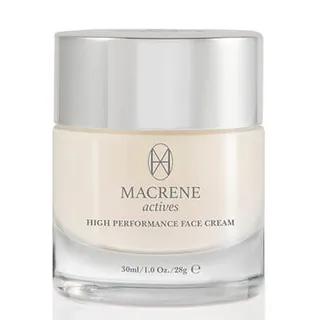
Macrene Actives High Performance Face Cream
Works for
Anti-agingAcetyl glucosamine, Resveratrol + 6 moreWorks well
“reduce the appearance of fine lines and wrinkles, reduce the appearance of blemishes and spots, smooth skin texture, clear the complexion, maintain the skin barrier and balance, soothe & hydrate the skin.”
This product can help reduce and prevent fine lines and wrinkles, improve skin elasticity and firmness because it contains acetyl glucosamine.
These ingredients in the product can also be helpful, even though there is less evidence for their effectiveness: arabidopsis thaliana extract, aspartic acid, resveratrol, serine, threonine.
Keep in mind that it typically takes at least 6 weeks to notice any results because the changes that are needed to improve fine lines and elasticity happen in the deeper layers of the skin. No topical anti-aging product can “erase” wrinkles or fully reverse signs of aging.
MoisturizingAcetyl glucosamine, Squalane + 28 moreWorks well
“reduce the appearance of fine lines and wrinkles, reduce the appearance of blemishes and spots, smooth skin texture, clear the complexion, maintain the skin barrier and balance, soothe & hydrate the skin.”
This product can help improve hydration of the skin with the two types of ingredients.
The first type is called “humectants”:
these ingredients help attract water.
When humectants are on the surface of the skin, they “pull in” the moisture from the outside environment, or from
within deeper layers of the skin. The following ingredients in this product do the job:
alanine, arginine.
This product also contains ingredients called “occlusives”. They help reduce the speed with which our skin loses moisture to the outside environment. These ingredients also help soften the upper layer of the skin, so it feels less tight and nicer to the touch. The following ingredients in this product do the job: arginine, helianthus annuus seed oil.
The following ingredients in this product are especially good for supporting the skin barrier and helping with the hydration level: acetyl glucosamine
Evens skin toneAcetyl glucosamine, Resveratrol + 2 moreWorks well
“reduce the appearance of fine lines and wrinkles, reduce the appearance of blemishes and spots, smooth skin texture, clear the complexion, maintain the skin barrier and balance, soothe & hydrate the skin.”
This product can help reduce hypepigmentation and even out the skin tone because it contains the following effective ingredients: acetyl glucosamine
The following ingredient (ingredients) in this product might be helpful, but there is no evidence to confirm that it actually can help even out the skin tone: alanine, resveratrol.
Keep in mind that you would need to apply any topical skincare targetted at hypigmentation consistently for a couple of months to get a result. No topical skincare product can help get rid of hyperpigmentation (including post-acne marks and age spots) instantly.
Anti-oxidationNot advertised by the brand · Resveratrol, Ilex paraguariensis leaf extract + 9 moreWorks well
This product contains antioxidants (resveratrol) that can help neutralize free radicals in skin. By doing so, they can lessen the damage the skin gets from the UV light (sun).
The following ingredients - ilex paraguariensis leaf extract also can have an antioxidant effect, but there is less evidence to confirm their effectiveness in skin.
Can it cause trouble?
Irritancy4 strong irritants: Rosa damascena extract, Ilex paraguariensis leaf extract + 2 more — patch-test recommendedHigh risk
Comedogenic3 ingredients rated 2 or more on the 0–5 pore-clogging scale3 flagged
User reviews
Be the first — your take helps the next person decide.
Ingredients
Filter by role to see what each ingredient is doing.
Water~45–55%
Squalane~5–6.1%
- Irritation risk
- Low
An oil naturally present in skin. Works as an emollient to soften the skin and form a protective layer on its surface without a greasy feeling.
More about SqualaneGlycerin~4.3–5.2%
- Irritation risk
- Low
One of the best moisturizing ingredients. Naturally present in skin. It attracts water to the upper layer of the skin working as a humectant
More about GlycerinHydrogenated ethylhexyl olivate~3.3–4%
- Irritation risk
- Low
Helps soften the upper layer of the skin
More about Hydrogenated ethylhexyl olivateHydrogenated olive oil~2.4–3%
- Irritation risk
- Low
Cetyl alcohol~2.1–2.5%
- Irritation risk
- Low
A non-drying alcohol that works to soften the skin and stabilize product formulations helping oil and water mix together
More about Cetyl alcoholTetrahexyldecyl ascorbate~1.7–2.1%
- Irritation risk
- Medium
Being a lipid soluble form of vitamin C, it is more stable than ascorbic acid, but still degrades quickly and needs to be stabilized in a formulation with another ingredient. It is claimed to penetrate skin better than pure vitamin C and have the the similar benefits, but solid studies of its effectiveness are lacking. Is likely to require a higher concentration in a product than pure vitamin C to be effective. It might be able to help reduce pore clogging.
More about Tetrahexyldecyl ascorbateHelianthus annuus seed oil~1.6–2%
- Irritation risk
- Low
A great emollient due to its high linoleic acid content. One of the most effective plant oils in helping skin hydration and repairing skin barrier function
More about Helianthus annuus seed oilAcetyl glucosamine~1.3–1.5%
- Irritation risk
- Low
An effective moisturizing ingredient that also has been shown to be effective in evening out the skin tone and reducing hyperpigmentation. It can help somewhat reduce wrinkles in skin
More about Acetyl glucosamineStearic acid~1.2–1.4%
- Irritation risk
- Low
Helps oil and water mix together and works as an emollient
More about Stearic acidSorbitan stearate~0.8–1.2%
Copper glycinate~0.65–1%
- Irritation risk
- Low
Sodium hyaluronate~0.6–0.95%
- Irritation risk
- Low
One of the best moisturizing ingredients. Attracts water into the upper layer of the skin
More about Sodium hyaluronateSodium acetylated hyaluronate~0.6–0.9%
- Irritation risk
- Low
A type of hyaluronic acid that works as an excellent moisturizer by attracting water into the upper layer of the skin. Is typically feels less sticky on the skin compared to the usual hyaluronic acid
More about Sodium acetylated hyaluronateHydrolyzed sodium hyaluronate~0.55–0.8%
- Irritation risk
- Low
Attracts water into the upper layer of the skin
More about Hydrolyzed sodium hyaluronateSodium hyaluronate crosspolymer~0.55–0.8%
- Irritation risk
- Medium
Attracts water into the upper layer of the skin
More about Sodium hyaluronate crosspolymerResveratrol~0.55–0.8%
- Irritation risk
- Medium
Helps neutralize free radicals in skin and might help reduce fine lines and wrinkles, as well as even out the skin tone
More about ResveratrolScenedesmus rubescens extract~0.5–0.75%
- Irritation risk
- Medium
A micro-algae extract that might help attract water to the upper layer of the skin, support its barrier function, amd might help neutralize free radicals, but evidence of effectiveness in skin is lacking
More about Scenedesmus rubescens extractPlankton extract~0.45–0.7%
- Irritation risk
- Medium
- Comedogenicity
- 3/5
Can help attract water to the upper layer of the skin
More about Plankton extractArabidopsis thaliana extract~0.45–0.65%
- Irritation risk
- Medium
Plant extract that might be helpful in repairing sun damage but evidence of effectiveness in skin are lacking
More about Arabidopsis thaliana extractRosa damascena extract~0.45–0.65%
- Irritation risk
- High
Oil of a very fragrant pink rose used as fragrance in cosmetics. Extensive research has shown it has mixed benefits. In the pro column, inhaling this flower’s scent seems to have relaxing properties and the plant’s petals contain skin-soothing and antioxidant compounds that can benefit skin. On the flipside, the numerous chemicals that create this rose’s distinctive fragrance pose a risk of causing skin aggravation.
More about Rosa damascena extractLeontopodium alpinum flower/leaf extract~0.4–0.6%
- Irritation risk
- Low
Ergothioneine~0.4–0.6%
- Irritation risk
- Low
Can help neutralize free radicals in skin. Preliminary studies show that it can be more effective than coenzyme Q10 but studies on effective concentration for topical applications are lacking
More about ErgothioneineCoffea arabica seed extract~0.35–0.65%
- Irritation risk
- Low
Might be helpful in neutralizing free radicals in skin
More about Coffea arabica seed extractIlex paraguariensis leaf extract~0.3–0.6%
- Irritation risk
- High
A plant extract that can help neutralize free radicals in skin. Can contain fragrand compounds like linalool that can be irritating
More about Ilex paraguariensis leaf extractChrysanthemum parthenium extract~0.3–0.6%
- Irritation risk
- High
Could have anti-inflammatory effect on skin, but can be irritating as well. Can be added to products for its smell
More about Chrysanthemum parthenium extractTheobroma cacao extract~0.35–0.65%
- Irritation risk
- Low
- Comedogenicity
- 3/5
Rosa damascena extract~0.35–0.65%
- Irritation risk
- High
Oil of a very fragrant pink rose used as fragrance in cosmetics. Extensive research has shown it has mixed benefits. In the pro column, inhaling this flower’s scent seems to have relaxing properties and the plant’s petals contain skin-soothing and antioxidant compounds that can benefit skin. On the flipside, the numerous chemicals that create this rose’s distinctive fragrance pose a risk of causing skin aggravation.
More about Rosa damascena extractPalmaria palmata extract~0.4–0.6%
- Irritation risk
- Low
- Comedogenicity
- 3/5
Red algae extract that helps attract water to the upper layer of the skin
More about Palmaria palmata extractTremella fuciformis sporocarp extract~0.4–0.6%
- Irritation risk
- Low
Mushroom extract that helps attract water to the upper layer of the skin
More about Tremella fuciformis sporocarp extractCaffeine~0.35–0.65%
- Irritation risk
- Medium
Might be helpful in neutralizing free radicals. Can have a dehydration effect that might somewhat decrease the look of puffy eyes
More about CaffeineBisabolol~0.3–0.6%
- Irritation risk
- Low
An active component of chamomile plant that historically has been used to calm down irritated skin. A recent study shows that bisabolol indeed can have some anti-inflammatory effect on skin, even though conclusive data is lacking. Bisabolol has a sweet floral scent and can be added to products for its aromatic properties
More about BisabololSodium lactate~0.4–0.6%
- Irritation risk
- Medium
Helps attract water to the upper layer of the skin. Is often used to adjust the pH level of the product
More about Sodium lactateArginine~0.35–0.65%
- Irritation risk
- Low
An amino acid that is naturally present in skin and helps keep it hydrated. When used together with AHAs, it can reduce their irritating effect on the skin
More about ArginineAspartic acid~0.35–0.65%
- Irritation risk
- Low
An amino-acid that helps increase skin hydration and might help to slightly improve skin firmness, potentially reducing lines and wrinkles
More about Aspartic acidGlycine~0.35–0.65%
- Irritation risk
- Low
Helps to attract water to the upper layer of the skin and can help restore the skin barrier function
More about GlycineAlanine~0.35–0.65%
- Irritation risk
- Low
An amino-acid that helps to attract water to the upper layer of the skin and might help to lighten the skin, but solid evidence is lacking
More about AlanineSerine~0.35–0.65%
- Irritation risk
- Low
An amino-acid that helps to attract water to the upper layer of the skin. In combination with other amino-acids, might help to reduce fine lines and wrinkles
More about SerineValine~0.35–0.65%
- Irritation risk
- Low
Proline~0.4–0.6%
Threonine~0.4–0.6%
- Irritation risk
- Low
An amino-acid that helps to attract water to the upper layer of the skin. In combination with other amino-acids, might help to reduce fine lines and wrinkles
More about ThreonineIsoleucine~0.35–0.65%
- Irritation risk
- Low
An amino acid that can help attract water to the upper layer of the skin and support skin's barrier function
More about IsoleucineHistidine~0.35–0.65%
Phenylalanine~0.4–0.6%
- Irritation risk
- Low
Pca~0.4–0.6%
- Irritation risk
- Low
Naturally present in skin and helps to attract water to its upper layer
More about PcaSodium pca~0.4–0.6%
- Irritation risk
- Low
Naturally present in skin and helps to attract water to its upper layer
More about Sodium pcaCholesterol~0.45–0.7%
- Irritation risk
- Low
An emollient that is naturally found in skin
More about CholesterolPhosphatidylcholine~0.4–0.65%
- Irritation risk
- Medium
Used to enhance the delivery of other ingredients
More about PhosphatidylcholineLecithin~0.45–0.65%
- Irritation risk
- Low
Used mostly for creating emulsions - helping oil and water mix together. Helps soften the upper layer of the skin
More about LecithinMethylglucoside phosphate~0.35–0.6%
- Irritation risk
- Low
Caprylhydroxamic acid~0.35–0.6%
Glyceryl caprylate~0.4–0.65%
- Irritation risk
- Low
An emollient that can also help water and oil mix together, as well as prevent bacteria growth in products
More about Glyceryl caprylateAlcohol~0.3–0.55%
- Irritation risk
- High
Can be drying and contribute to skin irritation. Used in formulars to dissolve other ingredients, create a thinner product consistency or for its antibacterial properties
More about AlcoholXanthan gum~0.3–0.55%
- Irritation risk
- Low
Used to create a thicker product consistency
More about Xanthan gumCitric acid~0.25–0.5%
- Irritation risk
- Medium
Can work as an exfoliant but is typically used to adjust the product pH
More about Citric acidSodium stearoyl glutamate~0.35–0.6%
- Irritation risk
- Medium
Helps oil and water mix together
More about Sodium stearoyl glutamateSodium methyl stearoyl taurate~0.55–0.8%
Phenoxyethanol~0.15–0.3%
- Irritation risk
- Low
A preservative. It helps prevent bacterial growth in cosmetic products
More about PhenoxyethanolHydroxypropyl methylcellulose stearoxy ether~0.2–0.35%
- Irritation risk
- Low
Helps create a thicker product formulation
More about Hydroxypropyl methylcellulose stearoxy etherSodium phytate~0.15–0.3%
Ethylhexylglycerin~0.1–0.2%
Tocopheryl acetate~0.15–0.25%
- Irritation risk
- Medium
A more stable but less bio-available form of vitamin E compared to Tocopherol. Might help moisturize and protect the skin from free radicals, but mostly used in low concentrations to stabilize other ingredients.
More about Tocopheryl acetateIngredient list view
Water, Squalane, Glycerin, Hydrogenated ethylhexyl olivate, Hydrogenated olive oil, Cetyl alcohol, Tetrahexyldecyl ascorbate, Helianthus annuus seed oil, Acetyl glucosamine, Stearic acid, Sorbitan stearate, Copper glycinate, Sodium hyaluronate, Sodium acetylated hyaluronate, Hydrolyzed sodium hyaluronate, Sodium hyaluronate crosspolymer, Resveratrol, Scenedesmus rubescens extract, Plankton extract, Arabidopsis thaliana extract, Rosa damascena extract, Leontopodium alpinum flower/leaf extract, Ergothioneine, Coffea arabica seed extract, Ilex paraguariensis leaf extract, Chrysanthemum parthenium extract, Theobroma cacao extract, Rosa damascena extract, Palmaria palmata extract, Tremella fuciformis sporocarp extract, Caffeine, Bisabolol, Sodium lactate, Arginine, Aspartic acid, Glycine, Alanine, Serine, Valine, Proline, Threonine, Isoleucine, Histidine, Phenylalanine, Pca, Sodium pca, Cholesterol, Phosphatidylcholine, Lecithin, Methylglucoside phosphate, Caprylhydroxamic acid, Glyceryl caprylate, Alcohol, Xanthan gum, Citric acid, Sodium stearoyl glutamate, Sodium methyl stearoyl taurate, Phenoxyethanol, Hydroxypropyl methylcellulose stearoxy ether, Sodium phytate, Ethylhexylglycerin, Tocopheryl acetate
Compare prices
Retailers ranked by price — lowest first.
Affiliate links · As an Amazon Associate, WIMJ earns from qualifying purchases.
Worth comparing, line by line.
Match % combines shared ingredients, the first five ingredients, shared actives and hero ingredients, irritancy (lower counts in the alternative's favour), texture and body area. Only products in the same routine step are compared.
| Macrene ActivesHigh Performance Face CreamYOUR PRODUCT | IOPEHyaluronic Cream | Summer FridaysDream Oasis Hydration Serum | NIODMulti-Molecular Hyaluronic Complex | |
|---|---|---|---|---|
| Match | — | 49% | 48% | 47% |
| Price | $225.00 | $35.19−$189.81 | $44.00−$181.00 | $22.75−$202.25 |
| Shared key ingredients | — | 12 of 30 | 15 of 30 | 16 of 30 |
| Key difference | — | Niacinamide | Niacinamide | Myristoyl Nonapeptide-3 |
| Irritancy | High | Medium | Medium | Medium |
| Drying alcohol | Contains drying alcohol | Contains drying alcohol | — | — |
| View product | Shop | Shop | Shop |



More alternatives: Exuviance Age Reverse Hydrafirm Hyaluronic Acid Antiaging MoisturizerRNW Moist Hyal Treatment Emulsion
Sources cited in this review
Every concentration estimate and effectiveness label is anchored to one of these 41 studies and safety reviews.
- 1
- 2
- 3
- 4
- 5
- 6Effect of topically applied lipids on surfactant-irritated skinonlinelibrary.wiley.com

Affiliate links · As an Amazon Associate, WIMJ earns from qualifying purchases.