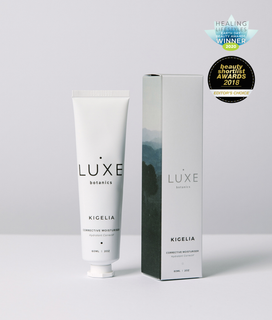
Luxe Botanics KIGELIA CORRECTIVE MOISTURISER
Works for
2 of 2 advertised claims delivered
Anti-aging6 ingredients credited for this claimStrong support
“Natural peptides restore the appearance of youthful suppleness while Kigelia fruit extract works naturally to calm the look and feel of skin.”
This product can help reduce and prevent fine lines and wrinkles, improve skin elasticity and firmness because it contains gluconolactone, palmitoyl hexapeptide-12.
These ingredients in the product can also be helpful, even though there is less evidence for their effectiveness: centella asiatica extract, palmitoyl tetrapeptide-7, palmitoyl tripeptide-1.
Keep in mind that it typically takes at least 6 weeks to notice any results because the changes that are needed to improve fine lines and elasticity happen in the deeper layers of the skin. No topical anti-aging product can “erase” wrinkles or fully reverse signs of aging.
Moisturizing17 ingredients credited for this claimStrong support
“KIGELIA CORRECTIVE MOISTURISER”
This product can help improve hydration of the skin with the two types of ingredients.
The first type is called “humectants”:
these ingredients help attract water.
When humectants are on the surface of the skin, they “pull in” the moisture from the outside environment, or from
within deeper layers of the skin. The following ingredients in this product do the job:
glycerin, saccharide isomerate.
This product also contains ingredients called “occlusives”. They help reduce the speed with which our skin loses moisture to the outside environment. These ingredients also help soften the upper layer of the skin, so it feels less tight and nicer to the touch. The following ingredients in this product do the job: palmitoyl tetrapeptide-7, palmitoyl tripeptide-1.
The following ingredients in this product are especially good for supporting the skin barrier and helping with the hydration level: palmitoyl hexapeptide-12, palmitoyl tetrapeptide-7, palmitoyl tripeptide-1
Evens skin toneNot advertised by the brand · 2 ingredients credited for this claimStrong support
This product can help reduce hypepigmentation and even out the skin tone because it contains the following effective ingredients: gluconolactone
Keep in mind that you would need to apply any topical skincare targetted at hypigmentation consistently for a couple of months to get a result. No topical skincare product can help get rid of hyperpigmentation (including post-acne marks and age spots) instantly.
ExfoliationNot advertised by the brand · 1 ingredient credited for this claimStrong support
This product can help exfoliate the skin. In other words, it helps break down the bonds between dead cells on the surface of the skin and speed up the skin turnover. Skin often appears softer and brighter after exfoliation, but overdoing it can result in disrupted skin barrier. The following ingredient is doing the exfoliating job in this product: gluconolactone.
Anti-oxidationNot advertised by the brand · 7 ingredients credited for this claimStrong support
This product contains antioxidants (superoxide dismutase) that can help neutralize free radicals in skin. By doing so, they can lessen the damage the skin gets from the UV light (sun).
The following ingredients - camellia sinensis leaf extract, centella asiatica extract, gluconolactone also can have an antioxidant effect, but there is less evidence to confirm their effectiveness in skin.
Can it cause trouble?
Irritancy12 strong irritants: Arnica montana flower extract, Pelargonium graveolens oil + 10 more — patch-test recommendedHigh risk
Comedogenic1 ingredient rated 2 or more on the 0–5 pore-clogging scale1 flagged
User reviews
Be the first — your take helps the next person decide.
Ingredients
Filter by role to see what each ingredient is doing.
Cucumis sativus fruit water~25–30%
Water~12–15%
Glycerin~4.8–5.9%
- Irritation risk
- Low
One of the best moisturizing ingredients. Naturally present in skin. It attracts water to the upper layer of the skin working as a humectant
More about GlycerinPropanediol~3.6–4.3%
- Irritation risk
- Low
Acts as a solvent for other ingredients. Speeds up the absorption of other ingredients into the skin
More about PropanediolKigelia africana fruit extract~2.8–3.4%
- Irritation risk
- Low
Chlorella vulgaris extract~2.1–2.5%
- Irritation risk
- Medium
- Comedogenicity
- 3/5
A plant extract that can help to attract water to the upper layer of the skin and might have some anti-oxidant and anti-inflammatory properties
More about Chlorella vulgaris extractGluconolactone~1.8–2.2%
- Irritation risk
- Medium
A polyhydroxy acid (PHA) that helps shed the dead cells from the skin surface revealing smoother skin. Is believed to be genter than AHAs. It helps attract water to the upper layer of the skin and can stimulate production of skin's own hyaluronic acid resulting in improved hydration levels. It has been shown to be helpful against acne and clogged pores if used consistently (e.g over a period of 12 weeks) in high enough concentration. It can help reduce fine lines and wrinkles and improve skin tone with long-term application. Can help neutralize free radicals
More about GluconolactoneSaccharide isomerate~1.6–1.9%
- Irritation risk
- Low
Helps attract water to the upper layer of the skin
More about Saccharide isomerateXylitylglucoside~1.4–1.7%
- Irritation risk
- Low
Helps attract water to the upper layer of the skin and repair the skin barrier function
More about XylitylglucosideOryza sativa extract~1.3–1.5%
- Irritation risk
- Low
A grain extract that helps to create a thicker product consistency. It might have some anti-oxidant properties and help attract water to the upper layer of the skin
More about Oryza sativa extractSodium hyaluronate~0.95–1.2%
- Irritation risk
- Low
One of the best moisturizing ingredients. Attracts water into the upper layer of the skin
More about Sodium hyaluronatePolyglyceryl-3 cocoate~0.8–1.15%
- Irritation risk
- Medium
Helps oil and water mix together
More about Polyglyceryl-3 cocoateCucumis sativus fruit extract~0.7–1.05%
- Irritation risk
- Medium
Might be somewhat helpful in reducing hyperpigmentation and neutralizing free radicals but its typical concentration in a product is too low for having an effect
More about Cucumis sativus fruit extractCentella asiatica extract~0.75–1.15%
- Irritation risk
- Medium
A plant extract that has been shown to be able to reduce inflammation in skin, support restoration of skin barrier function, as well as support collagen production. Contains active compounds called centelloids: asiaticoside, madecasosside, asiatic acid and madecassic acid. Might be helpful in preventing stretch marks. It can be itself be irritating though.
More about Centella asiatica extractArnica montana flower extract~0.6–0.9%
- Irritation risk
- High
A plant extract that can be irritating. It can have some anti-bacterial properties, but there are no evidence of a beneficial effect for skin
More about Arnica montana flower extractCamellia sinensis leaf extract~0.7–1.05%
- Irritation risk
- Low
Can contain potent anti-oxidant compounds (abbreviated ECG, GCG, EGC, and EGCG) that might help protect the skin from free radicals. Can help calm down inflammation and has some anti-bacterial properties. Unfortunately, these antioxidants are unstable and lose their effectiveness very quickly in products. The concentration of the antioxidant compounds in the extract also tends to be low to be effective in topical formulation
More about Camellia sinensis leaf extractChamomilla recutita flower extract~0.6–0.95%
- Irritation risk
- High
Plant extract that can have healing and anti-inflammatory properties. It is a potential allergen and can be irritating
More about Chamomilla recutita flower extractPassiflora incarnata extract~0.6–0.9%
- Irritation risk
- High
A plant extract that might help neutralize free radicals in skin
More about Passiflora incarnata extractCaesalpinia spinosa gum~0.7–1.05%
Amorphophallus konjac root extract~0.65–0.95%
- Irritation risk
- Low
Palmitoyl tripeptide-1~0.55–0.85%
- Irritation risk
- Low
A type of peptide. Peptides are excellent moisturizers and might be able support collagen production reducing fine lines and wrinkles
More about Palmitoyl tripeptide-1Palmitoyl hexapeptide-12~0.5–0.8%
- Irritation risk
- Low
A type of peptide. Peptides are excellent moisturizers and might be able support collagen production reducing fine lines and wrinkles
More about Palmitoyl hexapeptide-12Palmitoyl tetrapeptide-7~0.55–0.8%
- Irritation risk
- Low
A type of peptide. Peptides are excellent moisturizers and might be able support collagen production reducing fine lines and wrinkles
More about Palmitoyl tetrapeptide-7Amylopectin~0.5–0.75%
- Irritation risk
- Low
Pelargonium graveolens oil~0.5–0.7%
Citrus limon fruit oil~0.5–0.75%
- Irritation risk
- High
Lavandula hybrida oil~0.5–0.75%
- Irritation risk
- High
Plant extract that can be irritating and is a known allergen
More about Lavandula hybrida oilMentha piperita oil~0.5–0.7%
Eugenia caryophyllus oil~0.45–0.65%
- Irritation risk
- Low
Melaleuca alternifolia leaf oil~0.5–0.7%
- Irritation risk
- High
An essential oil that can be irritating. Has some anti-bacterial properties
More about Melaleuca alternifolia leaf oilLeuconostoc/radish root ferment filtrate~0.5–0.75%
- Irritation risk
- Medium
A preservative that comes from radishes fermented by a bacteria. New research suggests that the preservation properties in the ingredient come from an ammonium salt that is not present naturally in radish root but used in its cultivation. Is problematic because the exact amount of the preservative agents is difficult to determine
More about Leuconostoc/radish root ferment filtratePopulus tremuloides bark extract~0.5–0.75%
- Irritation risk
- Low
Polyglyceryl-6 caprylate~0.55–0.8%
- Irritation risk
- Medium
Helps oil and water mix together
More about Polyglyceryl-6 caprylatePolyglyceryl-4 caprate~0.5–0.75%
Polyglyceryl-6 ricinoleate~0.5–0.75%
- Irritation risk
- Medium
Helps oil and water mix together
More about Polyglyceryl-6 ricinoleateSodium benzoate~0.25–0.5%
Potassium sorbate~0.3–0.6%
Citric acid~0.4–0.65%
- Irritation risk
- Medium
Can work as an exfoliant but is typically used to adjust the product pH
More about Citric acidSodium citrate~0.4–0.6%
- Irritation risk
- Medium
Helps to control the skin's pH level. Maintains the skin's natural film of amino-lactic acids and oils. Helps to preserve products
More about Sodium citrateXylitol~0.35–0.65%
- Irritation risk
- Low
Helps attract water to the upper layer of the skin and repair the skin barrier function
More about XylitolGlucose~0.35–0.65%
- Irritation risk
- Low
Helps attract water to the upper layer of the skin. Could be helpful in restoring the skin barrier function
More about GlucoseSuperoxide dismutase~0.35–0.65%
- Irritation risk
- Low
An antioxidant enzyme that is naturally present in skin. It can help support skin barrier function and reduce inflammation in skin. It is used in topical medications for inflammatory skin conditions including atopic dermatitis (eczema) and psoriasis. There are three types of natural Superoxide Dismutase in human skin. The compound used in topical treatments and cosmetics are mimics of typically one of these natural variants
More about Superoxide dismutaseSoybean peroxidase~0.35–0.6%
- Irritation risk
- Low
Citral~0.25–0.5%
Citronellol~0.25–0.45%
Eugenol~0.2–0.4%
Geraniol~0.15–0.3%
Limonene~0.2–0.35%
- Irritation risk
- High
A common frangrance that can easily irritate skin, especially if exposed to air, light or heat
More about LimoneneLinalool~0.2–0.35%
Kigelia africana fruit extract~0.15–0.3%
- Irritation risk
- Low
Ingredient list view
Cucumis sativus fruit water, Water, Glycerin, Propanediol, Kigelia africana fruit extract, Chlorella vulgaris extract, Gluconolactone, Saccharide isomerate, Xylitylglucoside, Oryza sativa extract, Sodium hyaluronate, Polyglyceryl-3 cocoate, Cucumis sativus fruit extract, Centella asiatica extract, Arnica montana flower extract, Camellia sinensis leaf extract, Unknown, Chamomilla recutita flower extract, Passiflora incarnata extract, Caesalpinia spinosa gum, Amorphophallus konjac root extract, Palmitoyl tripeptide-1, Palmitoyl hexapeptide-12, Palmitoyl tetrapeptide-7, Amylopectin, Pelargonium graveolens oil, Citrus limon fruit oil, Lavandula hybrida oil, Mentha piperita oil, Eugenia caryophyllus oil, Melaleuca alternifolia leaf oil, Leuconostoc/radish root ferment filtrate, Populus tremuloides bark extract, Polyglyceryl-6 caprylate, Polyglyceryl-4 caprate, Polyglyceryl-6 ricinoleate, Sodium benzoate, Potassium sorbate, Citric acid, Sodium citrate, Xylitol, Glucose, Superoxide dismutase, Soybean peroxidase, Citral, Citronellol, Eugenol, Geraniol, Limonene, Linalool, Kigelia africana fruit extract
Compare prices
Retailers ranked by price — lowest first.
Affiliate links · prices updated regularly
Worth comparing, line by line.
Match % combines shared ingredients, the first five ingredients, shared actives and hero ingredients, irritancy (lower counts in the alternative's favour), texture and body area. Only products in the same routine step are compared.
| Luxe BotanicsKIGELIA CORRECTIVE MOISTURISERYOUR PRODUCT | Elizabeth GrantCaviar Cellular Recharge Super Night Cream | |
|---|---|---|
| Match | — | 50% |
| Price | — | $60.00 |
| Shared key ingredients | — | 5 of 11 |
| Key difference | — | Panthenol |
| Irritancy | High | Medium |
| Drying alcohol | — | — |
| View product | Shop |


Product summary
Based on the ingredients included, "Luxe Botanics - KIGELIA CORRECTIVE MOISTURISER" works well for moisturizing the skin. This moisturizer uses a good combo of humectants and emollients. These both types of ingredients are essentials for improving the skin hydration and keeping the skin barrier healthy. Humectants in this product (glycerin, saccharide isomerate, sodium hyaluronate, xylitylglucoside and glucose) help to increase the water content in the upper layer of the skin. (These ingredients do so by "capturing" water molecules from the outside air or from within the deeper layers of the skin). Emollients in this formulation (palmitoyl tetrapeptide-7, palmitoyl tripeptide-1 and caesalpinia spinosa gum) help to reduce the moisture loss from the skin. They also soften the skin surface and relieve the feeling of dryness and tightness.
Ingredient callouts
- This product contains acids (gluconolactone 1.80% - 2.20%). Their concentration is low, and they will not have a strong exfoliating effect. Instead, they work to support the skin natural acid mantle and to attract water (as humectants). PHAs (gluconolactone) especially are great for improving skin hydration. They might be even able to stimulate the production of skin's natural humectants and support the healthy skin microbiome.
- We like that this moisturizer contains peptides (palmitoyl tetrapeptide-7 0.55% - 0.80%, palmitoyl hexapeptide-12 0.50% - 0.80% and palmitoyl tripeptide-1 0.55% - 0.85%). There are many different kind of Peptides and they are naturally present in our skin. They all are a combination of aminoacids. Some of them work as natural antibiotics, promote wound-healing and production of collagen. The science is still not settled on how effective Peptides are in skincare, but it is very likely that they have a benefit. Peptides might help restore the skin barrier and fight the signs of aging. At the very least, Peptides work as humectants: they attract water to the upper layer of the skin and improve its hydration.
Irritation risk
There are quite a few common irritants in this product, including ingredients without particular skin benefits. We would not recommend it for sensitive skin. We assess the overall irritancy of this moisturizer to be high. For a detailed overview of all potential irritants: click here
You can see the detailed formula review with the breakdown of all actives in the product and the full ingredient list with estimated concentrations in the tables below.
Sources cited in this review
Every concentration estimate and effectiveness label is anchored to one of these 38 studies and safety reviews.
- 1
- 2
- 3
- 4
- 5
- 6

Affiliate links · As an Amazon Associate, WIMJ earns from qualifying purchases.