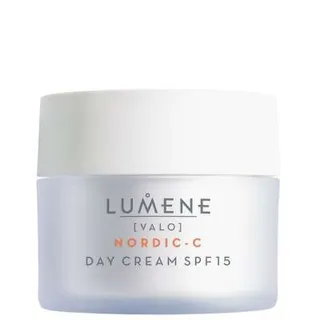
Lumene Nordic C [VALO] Day Cream SPF15
Works for
Sun protectionSPF 15 · 1 UV filter · Partial spectrumWeak protectionSPF under 30
This product does not offer good protection against UVA rays.
This product can be considered "reef safe" because it does not contain the UV filters (oxybenzone and octinoxate) that can be harmful to coral reefs when present in the water in high concentrations.
MoisturizingPanthenol, Urea + 20 moreWorks well
“Created with antioxidant-rich Arctic Cloudberry and Vitamin C, the cream forms a hydrating veil over skin to intensely moisturise and brighten.”
This product can help improve hydration of the skin with the two types of ingredients.
The first type is called “humectants”:
these ingredients help attract water.
When humectants are on the surface of the skin, they “pull in” the moisture from the outside environment, or from
within deeper layers of the skin. The following ingredients in this product do the job:
glycerin, sodium lactate.
This product also contains ingredients called “occlusives”. They help reduce the speed with which our skin loses moisture to the outside environment. These ingredients also help soften the upper layer of the skin, so it feels less tight and nicer to the touch. The following ingredients in this product do the job: butyrospermum parkii butter extract, helianthus annuus seed oil.
The following ingredients in this product are especially good for supporting the skin barrier and helping with the hydration level: panthenol, urea
Anti-agingSerine, Tocopherol + 4 moreMay help
“Protect and support your skin with Lumene Valo Nordic C SPF15 Day Cream , a lightweight facial moisturiser that helps to defend the complexion against the damaging effects of sun radiation.”
This product contains serine. There is some human evidence that this ingredient helps reduce and prevent fine lines and wrinkles and improve skin elasticity and firmness, though it is smaller or less consistent than the evidence for the best anti-aging ingredients. The biggest anti-aging effect in this product comes from sun protection. Sun damage is the main factor causing early signs of skin aging. We, however, do not recommend using this product as a sunscreen because the protection it offers is not strong enough).
Can it cause trouble?
Irritancy2 strong irritants: Rosmarinus officinalis leaf extract, ParfumMedium risk
Comedogenic3 ingredients rated 2 or more on the 0–5 pore-clogging scale3 flagged
User reviews
Be the first — your take helps the next person decide.
Ingredients
Filter by role to see what each ingredient is doing.
Water~45–55%
Heptyl undecylenate~4.5–5.5%
- Irritation risk
- Medium
Helps soften the upper layer of the skin, reduce water loss from the skin surface over time and create a nice product finish
More about Heptyl undecylenateCetearyl alcohol~3.6–4.4%
- Irritation risk
- Low
- Comedogenicity
- 2/5
A non-drying alcohol. Works as an emollient. Helps water and oil mix together and creates a nice product texture
More about Cetearyl alcoholHydrogenated polyisobutene~3.2–3.9%
- Irritation risk
- Low
Used to improve the product consistency and soften the upper layer of the skin
More about Hydrogenated polyisobutenePropanediol~2.3–2.8%
- Irritation risk
- Low
Acts as a solvent for other ingredients. Speeds up the absorption of other ingredients into the skin
More about PropanediolGlycerin~2–2.4%
- Irritation risk
- Low
One of the best moisturizing ingredients. Naturally present in skin. It attracts water to the upper layer of the skin working as a humectant
More about GlycerinSqualane~1.7–2.1%
- Irritation risk
- Low
An oil naturally present in skin. Works as an emollient to soften the skin and form a protective layer on its surface without a greasy feeling.
More about SqualaneButyrospermum parkii butter extract~1.5–1.8%
- Irritation risk
- Low
- Comedogenicity
- 3/5
A great moisturising ingredient that softens the skin and reduces water loss from its upper layer. It also can be helpful in protecting skin from free radicals
More about Butyrospermum parkii butter extractPhenoxyethanol~0.5–1%
- Irritation risk
- Low
A preservative. It helps prevent bacterial growth in cosmetic products
More about PhenoxyethanolButylene glycol~0.95–1.15%
- Irritation risk
- Low
Used to create a nice product texture and help delivery of other ingredients. Might be somewhat helpful in attracting water to the upper layer of the skin
More about Butylene glycolCetearyl glucoside~0.7–1%
- Irritation risk
- Medium
Helps water and oil in the product mix well together and improves product texture
More about Cetearyl glucosideTocopheryl acetate~0.55–0.85%
- Irritation risk
- Medium
A more stable but less bio-available form of vitamin E compared to Tocopherol. Might help moisturize and protect the skin from free radicals, but mostly used in low concentrations to stabilize other ingredients.
More about Tocopheryl acetateGlyceryl stearate~0.55–0.8%
- Irritation risk
- Low
An emollient that softens the skin and forms a protective layer on its surface. Helps water and oil mix together
More about Glyceryl stearatePeg-100 stearate~0.55–0.85%
- Irritation risk
- Low
Helps oil and water mix togehter and creates a nice product texture
More about Peg-100 stearatePanthenol~0.4–0.65%
- Irritation risk
- Low
Helps attract water to the upper layer of the skin and can help improve skin barrier function
More about PanthenolPolyacrylamide~0.45–0.7%
- Irritation risk
- Medium
Used to improve product texture and help oil and water mix together
More about PolyacrylamideXanthan gum~0.4–0.6%
- Irritation risk
- Low
Used to create a thicker product consistency
More about Xanthan gumAcrylates/c10-30 alkyl acrylate crosspolymer~0.35–0.65%
- Irritation risk
- Medium
Maintains the texture of skincare products. Allows the product to spread evenly. Helps oil and water mix together
More about Acrylates/c10-30 alkyl acrylate crosspolymerLecithin~0.3–0.55%
- Irritation risk
- Low
Used mostly for creating emulsions - helping oil and water mix together. Helps soften the upper layer of the skin
More about LecithinC13-14 isoparaffin~0.3–0.55%
- Irritation risk
- Low
Helps soften the upper layer of the skin, dissolve other ingredients and create a thicker product consistency
More about C13-14 isoparaffinDisodium edta~0.25–0.45%
Ethylhexylglycerin~0.25–0.45%
Magnesium ascorbyl phosphate~0.2–0.4%
- Irritation risk
- Medium
A derivative of vitamin C that is more stable, but less bioavailable than the pure form of vitamin C. It does not penetrate the skin well, but has been shown to convert to pure vitamin C once in skin. It can be helpful in stimulating collagen production and lightening the skin tone, but the required concentration is likely to be very high
More about Magnesium ascorbyl phosphateMica~0.25–0.45%
- Irritation risk
- Low
Creates an illusion of smoother and more radiant skin tone. Adds shimmer to the skin by reflecting light
More about MicaHippophae rhamnoides oil~0.25–0.45%
- Irritation risk
- High
A good emollient. Contains various ingredients including vitamins and fatty acids that could work in the skin to neutralize free radicals and minimize moisture loss - if enough of these compounds is able to penetrate the skin in an active form.
More about Hippophae rhamnoides oilPeg-8~0.2–0.4%
- Irritation risk
- Medium
Used to create a nice product consistency
More about Peg-8Caprylyl glycol~0.25–0.45%
- Irritation risk
- Medium
Helps preserve products and creates a nice product texture
More about Caprylyl glycolSodium hydroxide~0.2–0.4%
Laureth-7~0.25–0.4%
Tocopherol~0.2–0.4%
- Irritation risk
- Low
Pure form of vitamin E. Can help moisturise and protect the skin from free radicals. Often used to help stabilise other ingredients or the formula itself
More about TocopherolLactic acid~0.2–0.35%
- Irritation risk
- Medium
An exfoliating and moisturizing alpha-hydroxy acid (AHA). Typically causes less irritation than other AHAs, for example, glycolic acid. At high concentrations (about 15%), lactic acid can help reduce lines and wrinkles. Recent studies show that lactic acid can support the "good" bacteria living on skin's surface (healthy skin microbiome)
More about Lactic acidSerine~0.2–0.35%
- Irritation risk
- Low
An amino-acid that helps to attract water to the upper layer of the skin. In combination with other amino-acids, might help to reduce fine lines and wrinkles
More about SerineSodium lactate~0.2–0.4%
- Irritation risk
- Medium
Helps attract water to the upper layer of the skin. Is often used to adjust the pH level of the product
More about Sodium lactateSorbitol~0.2–0.4%
- Irritation risk
- Low
Helps attract water to the upper layer of the skin and improves the product texture
More about SorbitolTea-lactate~0.2–0.35%
- Irritation risk
- Low
Urea~0.2–0.35%
- Irritation risk
- Low
Naturally present in skin (urea makes up about 7% of natural moisturizing factors in skin). Attracts water to the upper layer of the skin. Also has a positive effect on the skin barrier beyond the humectant action. Can enhance penetration of other ingredients. Is an exfoliating ingredient when used in high concentrations
More about UreaAscorbyl palmitate~0.2–0.35%
- Irritation risk
- Medium
Being a lipid soluble form of vitamin C, it is more stable and can penetrate the skin better than L-Ascorbic acid. It is effective in protecting the skin from free radicals, as well as evening the skin tone, but is less effective in stimulating collagen production compared to L-Ascorbic acid.
More about Ascorbyl palmitateSea salt~0.2–0.35%
- Irritation risk
- Medium
Used to thicken the product formulation and might help to add minerals to the surface of the skin. It is used in scrubs as a physical exfoliant. Can increase sensitivity to other ingredients if left on the skin or used in high concentration
More about Sea saltCarrageenan~0.2–0.4%
- Irritation risk
- Medium
- Comedogenicity
- 3/5
Helps thicken the product formula and create a nice product formulation
More about CarrageenanAscorbic acid~0.2–0.35%
- Irritation risk
- High
The most well-researched antioxidant that works in skin. Helps neutralize free radicals supporting collagen production, helping to even out the skin tone and preventing early signs of aging
More about Ascorbic acidCitric acid~0.15–0.3%
- Irritation risk
- Medium
Can work as an exfoliant but is typically used to adjust the product pH
More about Citric acidAllantoin~0.1–0.25%
- Irritation risk
- Low
Helps calm down inflammation in skin and can help reduce itching. Helps to repair the skin barrier and keep skin hydrated
More about AllantoinHelianthus annuus seed oil~0.15–0.3%
- Irritation risk
- Low
A great emollient due to its high linoleic acid content. One of the most effective plant oils in helping skin hydration and repairing skin barrier function
More about Helianthus annuus seed oilRosmarinus officinalis leaf extract~0.15–0.25%
- Irritation risk
- High
Can be helpful in reducing inflammation in skin, including inflamed acne. It can be irritating
More about Rosmarinus officinalis leaf extractParfum~0.1–0.2%
- Irritation risk
- High
An aromatic blend of unspecified and possibly irritating ingredients
More about ParfumTitanium dioxide~0.1–0.15%
- Irritation risk
- Low
Works as a UV filter when used in high concentrations. It is photostable and is effective mostly against the UVB light, with some protection in the UVA range. In small concentrations, used for its ability to improve the color of cosmetic products. Is usually well tolerated by the skin
More about Titanium dioxideIngredient list view
Water, Heptyl undecylenate, Cetearyl alcohol, Hydrogenated polyisobutene, Propanediol, Glycerin, Squalane, Unknown, Butyrospermum parkii butter extract, Phenoxyethanol, Butylene glycol, Cetearyl glucoside, Tocopheryl acetate, Glyceryl stearate, Peg-100 stearate, Panthenol, Polyacrylamide, Xanthan gum, Acrylates/c10-30 alkyl acrylate crosspolymer, Lecithin, C13-14 isoparaffin, Disodium edta, Ethylhexylglycerin, Magnesium ascorbyl phosphate, Mica, Hippophae rhamnoides oil, Peg-8, Caprylyl glycol, Sodium hydroxide, Laureth-7, Tocopherol, Lactic acid, Serine, Sodium lactate, Sorbitol, Tea-lactate, Urea, Ascorbyl palmitate, Sea salt, Carrageenan, Ascorbic acid, Citric acid, Allantoin, Helianthus annuus seed oil, Rosmarinus officinalis leaf extract, Parfum, Titanium dioxide
Compare prices
Retailers ranked by price — lowest first.


Sources cited in this review
Every concentration estimate and effectiveness label is anchored to one of these 21 studies and safety reviews.
- 1
- 2
- 3Skin moisturizing effects of panthenol-based formulationspdfs.semanticscholar.org
- 4
- 5Safety Assessment of Isoparaffins as Used in Cosmeticsjournals.sagepub.com
- 6

Affiliate links · As an Amazon Associate, WIMJ earns from qualifying purchases.