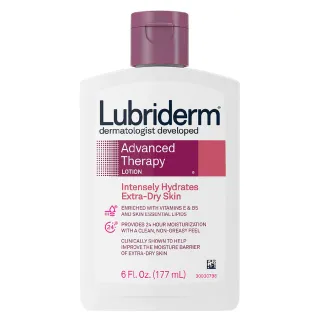
Lubriderm Lotion
Works for
1 of 2 advertised claims delivered
Moisturizing11 ingredients credited for this claimStrong support
“oz bottle of Lubriderm Advanced Therapy Daily Moisturizing Lotion Specially designed for extra-dry skin to help hydrate, replenish, and strengthen skin moisture barrier Hydrating lotion is clinically shown to help moisturizer for 24 hours Transforms dry skin into healthy looking, more resilient skin Formulated with Vitamins E and B5 plus skin-essential lipids found naturally in healthy skin Moisturizing lotion replenishes and strengthens your skin's moisture barrier Lotion formula is non-greasy with a clean, comfortable feel.”
This product can help improve hydration of the skin with the two types of ingredients.
The first type is called “humectants”:
these ingredients help attract water.
When humectants are on the surface of the skin, they “pull in” the moisture from the outside environment, or from
within deeper layers of the skin. The following ingredients in this product do the job:
glycerin, sorbitol.
This product also contains ingredients called “occlusives”. They help reduce the speed with which our skin loses moisture to the outside environment. These ingredients also help soften the upper layer of the skin, so it feels less tight and nicer to the touch. The following ingredients in this product do the job: caprylic/capric triglyceride, dimethicone.
The following ingredients in this product are especially good for supporting the skin barrier and helping with the hydration level: paraffinum liquidum
Anti-aging2 ingredients credited for this claimLimited support
“Lotion visibly improves skin's appearance and is fast-absorbing.”
This product does not contain ingredients that are able to reduce fine lines and wrinkles or help with skin elasticity, but it can improve the look of the skin temporarily through moisturization. Well-moisturized skin might also be able to repair the sun damage better.
Can it cause trouble?
Irritancy3 strong irritants: Diazolidinyl urea, Retinyl palmitate + 1 more — patch-test recommendedHigh risk
Comedogenic2 ingredients rated 2 or more on the 0–5 pore-clogging scale2 flagged


User reviews
Ingredients
Filter by role to see what each ingredient is doing.
Water~40–60%
Glycerin~4.7–7%
- Irritation risk
- Low
One of the best moisturizing ingredients. Naturally present in skin. It attracts water to the upper layer of the skin working as a humectant
More about GlycerinParaffinum liquidum~3.7–5.5%
- Irritation risk
- Low
Mineral oil. One of the most effective and well studied occlusive and emollient moisturizing ingredients. Helps reduce moisture loss in skin and repair skin barrier function
More about Paraffinum liquidumCetyl alcohol~2.1–3.2%
- Irritation risk
- Low
A non-drying alcohol that works to soften the skin and stabilize product formulations helping oil and water mix together
More about Cetyl alcoholSorbitol~1.9–2.9%
- Irritation risk
- Low
Helps attract water to the upper layer of the skin and improves the product texture
More about SorbitolCaprylic/capric triglyceride~1.7–2.5%
- Irritation risk
- Medium
A good mix of fatty acids that forms a protective layer on the skin. Improves the shelf life of products. Derived from coconut and glycerin
More about Caprylic/capric triglycerideStearic acid~1.5–2.2%
- Irritation risk
- Low
Helps oil and water mix together and works as an emollient
More about Stearic acidDimethicone~1.3–2%
- Irritation risk
- Low
A silicone that helps to reduce water loss from the surface of the skin. Can temporarily "fill in" lines and wrinkles, absorb oil, and create a nice product finish
More about DimethiconePhenoxyethanol~0.5–1%
- Irritation risk
- Low
A preservative. It helps prevent bacterial growth in cosmetic products
More about PhenoxyethanolCetearyl alcohol~0.9–1.3%
- Irritation risk
- Low
- Comedogenicity
- 2/5
A non-drying alcohol. Works as an emollient. Helps water and oil mix together and creates a nice product texture
More about Cetearyl alcoholLecithin~0.5–1.15%
- Irritation risk
- Low
Used mostly for creating emulsions - helping oil and water mix together. Helps soften the upper layer of the skin
More about LecithinCarbomer~0.4–0.9%
- Irritation risk
- Low
Helps create a thicker or gel-like product texture. It is not a surfactant but can be used in gentle cleansing formulations
More about CarbomerSodium hydroxide~0.35–0.8%
Ceteareth-20~0.4–0.95%
- Irritation risk
- Medium
- Comedogenicity
- 2/5
Helps oil and water mix together. Has some emollient properties
More about Ceteareth-20Diazolidinyl urea~0.25–0.5%
- Irritation risk
- High
A preservative. Works by releasing formaldehyde. Can be irritating
More about Diazolidinyl ureaSodium citrate~0.2–0.8%
- Irritation risk
- Medium
Helps to control the skin's pH level. Maintains the skin's natural film of amino-lactic acids and oils. Helps to preserve products
More about Sodium citrateMethylparaben~0.15–0.3%
Bht~0.15–0.65%
Panthenol~0.15–0.5%
- Irritation risk
- Low
Helps attract water to the upper layer of the skin and can help improve skin barrier function
More about PanthenolTocopheryl acetate~0.1–0.5%
- Irritation risk
- Medium
A more stable but less bio-available form of vitamin E compared to Tocopherol. Might help moisturize and protect the skin from free radicals, but mostly used in low concentrations to stabilize other ingredients.
More about Tocopheryl acetateSodium pyruvate~0.1–0.45%
- Irritation risk
- Low
Retinyl palmitate~0.1–0.4%
- Irritation risk
- High
Three steps removed from the active form of vitamin A - retinoic acid. To have an effect in the skin, it first needs to be converted twice to become the retinoic acid. This means it is less potent than retinol, but could also be less irritating. Once converted to the retinoic acid in the skin, it helps against all signs of aging, improves skin cell turnover and helps fight blemishes and clogged pores. However, in many cosmetic formulations, it is used in a concentration that is too low to have the full effect
More about Retinyl palmitatePropylparaben~0.05–0.2%
Parfum~0.05–0.25%
- Irritation risk
- High
An aromatic blend of unspecified and possibly irritating ingredients
More about ParfumCitric acid~0.05–0.25%
- Irritation risk
- Medium
Can work as an exfoliant but is typically used to adjust the product pH
More about Citric acidEthylparaben~0.05–0.2%
Tocopherol~0.05–0.15%
- Irritation risk
- Low
Pure form of vitamin E. Can help moisturise and protect the skin from free radicals. Often used to help stabilise other ingredients or the formula itself
More about TocopherolTitanium dioxide~0.05–0.15%
- Irritation risk
- Low
Works as a UV filter when used in high concentrations. It is photostable and is effective mostly against the UVB light, with some protection in the UVA range. In small concentrations, used for its ability to improve the color of cosmetic products. Is usually well tolerated by the skin
More about Titanium dioxideIngredient list view
Water, Glycerin, Paraffinum liquidum, Cetyl alcohol, Sorbitol, Caprylic/capric triglyceride, Stearic acid, Dimethicone, Phenoxyethanol, Cetearyl alcohol, Lecithin, Carbomer, Sodium hydroxide, Ceteareth-20, Diazolidinyl urea, Sodium citrate, Methylparaben, Bht, Panthenol, Tocopheryl acetate, Sodium pyruvate, Retinyl palmitate, Propylparaben, Parfum, Citric acid, Ethylparaben, Tocopherol, Titanium dioxide
Compare prices
Retailers ranked by price — lowest first.

Worth comparing, line by line.
Match % combines shared ingredients, the first five ingredients, shared actives and hero ingredients, irritancy (lower counts in the alternative's favour), texture and body area. Only products in the same routine step are compared.
| LubridermLotionYOUR PRODUCT | EucerinSoothing Body Lotion | BootsSkin Clear Lotion with niacinamide | Agua de Colonia ConcentradaBody Lotion | |
|---|---|---|---|---|
| Match | — | 57% | 56% | 53% |
| Price | $8.99 | $15.49+$6.50 | $5.29−$3.70 | $22.50+$13.51 |
| Shared key ingredients | — | 4 of 6 | 4 of 6 | 5 of 6 |
| Key difference | — | Butyrospermum Parkii Butter | Niacinamide | Petrolatum |
| Irritancy | High | Low | Low | High |
| Drying alcohol | — | — | — | — |
| View product | Shop | Shop | Shop |


Product summary
Based on the ingredients included, "Lubriderm - Lotion" works well for moisturizing the skin. The formulation is based on a combination of good humectants and emollients. Both are needed to increase the skin hydration level. Glycerin and sorbitol in this product (humectants) attract water molecules to the upper layer of the skin (the water comes from the outside air or from the deeper layers of the skin if the air is dry). Paraffinum liquidum, caprylic/capric triglyceride, dimethicone, cetearyl alcohol and cetyl alcohol in this product help decrease the water evoporation from the skin, so that it stays hydrated for longer. These ingredients also soften the skin and take away the feeling of tightness and dryness.
Ingredient callouts
- this moisturizer includes a form of retinoids (vitamin A) - retinyl palmitate 0.10% - 0.40%, but this type of vitamin A is not very effective. It could in theory help with fine lines and wrinkles, but the effect is most likely minimal.
Irritation risk
This formulation includes some common irritants, including ingredients that do not provide a benefit for the skin. We assess the overall irritancy of this moisturizer to be high. For a detailed overview of all potential irritants: click here
You can see the detailed formula review with the breakdown of all actives in the product and the full ingredient list with estimated concentrations in the tables below.
Price
The product retails for 7.97CA$ in Canada, for 183.55A$ in Australia, from 8.99$ up to 15.28$ in the United States and for 14.60£ in the United Kingdom.
For a detailed price comparison: click here.
Sources cited in this review
Every concentration estimate and effectiveness label is anchored to one of these 8 studies and safety reviews.
- 1
- 2A review on the extensive skin benefits of mineral oilncbi.nlm.nih.gov
- 3
- 4Final Report on the Safety Assessment of Dimethicone Copolyoljournals.sagepub.com
- 5Skin moisturizing effects of panthenol-based formulationspdfs.semanticscholar.org
- 6

Affiliate links · As an Amazon Associate, WIMJ earns from qualifying purchases.