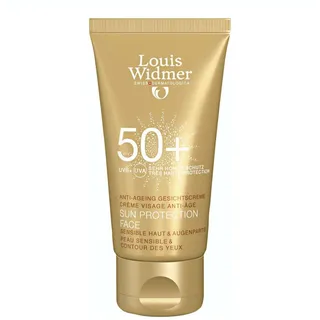
Louis Widmer SUN PROTECTION FACE ANTI-AGE 50+
Works for
Anti-agingPalmitoyl tripeptide-1, Palmitoyl tetrapeptide-7 + 1 moreMay help
“SUN PROTECTION FACE ANTI-AGE 50+”
This product contains palmitoyl tetrapeptide-7, palmitoyl tripeptide-1. There is some human evidence that these ingredients help reduce and prevent fine lines and wrinkles and improve skin elasticity and firmness, though it is smaller or less consistent than the evidence for the best anti-aging ingredients.
MoisturizingSide benefit · Panthenol, Palmitoyl tripeptide-1 + 11 moreWorks well
This product can help improve hydration of the skin with the two types of ingredients.
The first type is called “humectants”:
these ingredients help attract water.
When humectants are on the surface of the skin, they “pull in” the moisture from the outside environment, or from
within deeper layers of the skin. The following ingredients in this product do the job:
arginine, glycerin.
This product also contains ingredients called “occlusives”. They help reduce the speed with which our skin loses moisture to the outside environment. These ingredients also help soften the upper layer of the skin, so it feels less tight and nicer to the touch. The following ingredients in this product do the job: arginine, dimethicone.
The following ingredients in this product are especially good for supporting the skin barrier and helping with the hydration level: palmitoyl tetrapeptide-7, palmitoyl tripeptide-1, panthenol
Can it cause trouble?
Irritancy1 strong irritant: Isoamyl p-methoxycinnamateMedium risk
ComedogenicClean of flagged comedogenic ingredientsNone flagged

User reviews
Be the first — your take helps the next person decide.
Ingredients
Filter by role to see what each ingredient is doing.
Water~45–55%
Dibutyl adipate~6.6–8%
- Irritation risk
- Low
Helps soften the upper layer of the skin and create a nice product consistency
More about Dibutyl adipateDiethylamino hydroxybenzoyl hexyl benzoate~4.7–5.7%
- Irritation risk
- Medium
Uvinul A Plus. A new generation broad spectrum sunscreen that offers an effective protection especially in the UVA range. It is stable in formulations. Unfortunately, is not approved by the FDA (US) yet
More about Diethylamino hydroxybenzoyl hexyl benzoatePhenoxyethyl caprylate~3.2–3.9%
- Irritation risk
- Low
Isoamyl p-methoxycinnamate~3.3–4%
- Irritation risk
- High
Amiloxate or Neo Heliopan E1000. A UV filter. It is effective against UVB and UVA II rays. Not available in the US. It can be irritating
More about Isoamyl p-methoxycinnamateButylene glycol~2–2.4%
- Irritation risk
- Low
Used to create a nice product texture and help delivery of other ingredients. Might be somewhat helpful in attracting water to the upper layer of the skin
More about Butylene glycolMethylene bis-benzotriazolyl tetramethylbutylphenol~2.1–2.6%
- Irritation risk
- Medium
Tinosorb M. A UV filter. Is effective against both UVA and UVB rays. It also provides some protection against visible light. It is photostable and can also be used to improve photostability of other sunscreen ingredients. Its physical properties help to create lightweight sunscreen formulations. It can leave a slight white cast. Unfortunately, it is not approved by the FDA (US) yet
More about Methylene bis-benzotriazolyl tetramethylbutylphenolPolysilicone-15~2–2.4%
- Irritation risk
- Medium
A UV filter. Effective against UVB rays, but does not protect against the most aging UVA light
More about Polysilicone-15Trimethylpentanediol/adipic acid/glycerin crosspolymer~1.1–1.4%
- Irritation risk
- Low
Bis-ethylhexyloxyphenol methoxyphenyl triazine~1.4–1.7%
- Irritation risk
- Medium
Tinosorb S. One of the most effective broad spectrum sunscreen ingredients. Protects from both UVA and UVB rays. It is photostable. Approved by the US FDA in 2026 (listed as bemotrizinol on US labels).
More about Bis-ethylhexyloxyphenol methoxyphenyl triazineTriethylhexanoin~0.65–0.95%
- Irritation risk
- Medium
Helps soften the upper layer of the skin
More about TriethylhexanoinCetyl dimethicone~0.6–0.9%
- Irritation risk
- Low
A type of silicone. Helps soften the upper layer of the skin and creates a nice, light product texture
More about Cetyl dimethiconeEthylhexyl triazone~0.75–1.1%
- Irritation risk
- Medium
Uvinul T. A UV filter. Effective against UVB rays. It is photostable. Can increase water resistance properties of the sunscreen. Unfortunately, not approved by the FDA (US) yet
More about Ethylhexyl triazonePotassium cetyl phosphate~0.5–0.75%
- Irritation risk
- Medium
Helps oil and water mix together
More about Potassium cetyl phosphateSilica~0.6–0.95%
Glycerin~0.45–0.7%
- Irritation risk
- Low
One of the best moisturizing ingredients. Naturally present in skin. It attracts water to the upper layer of the skin working as a humectant
More about GlycerinDimethicone~0.5–0.75%
- Irritation risk
- Low
A silicone that helps to reduce water loss from the surface of the skin. Can temporarily "fill in" lines and wrinkles, absorb oil, and create a nice product finish
More about DimethiconeArginine~0.3–0.6%
- Irritation risk
- Low
An amino acid that is naturally present in skin and helps keep it hydrated. When used together with AHAs, it can reduce their irritating effect on the skin
More about ArginineBis-ethylhexyl hydroxydimethoxy benzylmalonate~0.3–0.55%
- Irritation risk
- Low
Phenylbenzimidazole sulfonic acid~0.5–0.75%
- Irritation risk
- Medium
Ensulizole. A UV filter that is effective against UVB rays. Does not protect against UVA light. It is photostable and can be used to help stabilize other sunscreen ingredients. It is water-soluble meaning that it can help create lighter sunscreen formulations
More about Phenylbenzimidazole sulfonic acidTocopheryl acetate~0.3–0.55%
- Irritation risk
- Medium
A more stable but less bio-available form of vitamin E compared to Tocopherol. Might help moisturize and protect the skin from free radicals, but mostly used in low concentrations to stabilize other ingredients.
More about Tocopheryl acetatePanthenol~0.25–0.5%
- Irritation risk
- Low
Helps attract water to the upper layer of the skin and can help improve skin barrier function
More about PanthenolPhenoxyethanol~0.25–0.5%
- Irritation risk
- Low
A preservative. It helps prevent bacterial growth in cosmetic products
More about PhenoxyethanolTrimethylsiloxysilicate~0.25–0.5%
- Irritation risk
- Low
A type of silicone that helps create a nice product consistency and support the delivery of other ingredients
More about TrimethylsiloxysilicateCetearyl olivate~0.25–0.5%
Decyl glucoside~0.3–0.6%
- Irritation risk
- High
Helps oil and water mix together. Can be irritating
More about Decyl glucosideSorbitan olivate~0.25–0.5%
Acrylates/c10-30 alkyl acrylate crosspolymer~0.25–0.45%
- Irritation risk
- Medium
Maintains the texture of skincare products. Allows the product to spread evenly. Helps oil and water mix together
More about Acrylates/c10-30 alkyl acrylate crosspolymerSodium polyphosphate~0.2–0.4%
- Irritation risk
- Low
Ethylhexylglycerin~0.2–0.4%
Tocopherol~0.2–0.4%
- Irritation risk
- Low
Pure form of vitamin E. Can help moisturise and protect the skin from free radicals. Often used to help stabilise other ingredients or the formula itself
More about TocopherolPropylene glycol~0.2–0.4%
- Irritation risk
- High
Helps oil and water mix together and can enhance the penetration of other ingredients into the skin. It can be irritating
More about Propylene glycolCarbomer~0.15–0.3%
- Irritation risk
- Low
Helps create a thicker or gel-like product texture. It is not a surfactant but can be used in gentle cleansing formulations
More about CarbomerCoco-glucoside~0.25–0.45%
- Irritation risk
- High
Used as a cleansing agent (surfactant) in cleansers. Helps water and oil mix together in lotions. Can be irritating
More about Coco-glucosideXanthan gum~0.15–0.25%
- Irritation risk
- Low
Used to create a thicker product consistency
More about Xanthan gumPantolactone~0.1–0.2%
- Irritation risk
- Low
Helps attract water to the upper layer of the skin
More about PantolactonePalmitoyl tripeptide-1~0.15–0.25%
- Irritation risk
- Low
A type of peptide. Peptides are excellent moisturizers and might be able support collagen production reducing fine lines and wrinkles
More about Palmitoyl tripeptide-1Palmitoyl tetrapeptide-7~0.1–0.25%
- Irritation risk
- Low
A type of peptide. Peptides are excellent moisturizers and might be able support collagen production reducing fine lines and wrinkles
More about Palmitoyl tetrapeptide-7Ingredient list view
Water, Dibutyl adipate, Diethylamino hydroxybenzoyl hexyl benzoate, Phenoxyethyl caprylate, Isoamyl p-methoxycinnamate, Butylene glycol, Methylene bis-benzotriazolyl tetramethylbutylphenol, Polysilicone-15, Trimethylpentanediol/adipic acid/glycerin crosspolymer, Bis-ethylhexyloxyphenol methoxyphenyl triazine, Triethylhexanoin, Cetyl dimethicone, Ethylhexyl triazone, Potassium cetyl phosphate, Silica, Glycerin, Dimethicone, Arginine, Bis-ethylhexyl hydroxydimethoxy benzylmalonate, Phenylbenzimidazole sulfonic acid, Tocopheryl acetate, Panthenol, Phenoxyethanol, Trimethylsiloxysilicate, Cetearyl olivate, Decyl glucoside, Sorbitan olivate, Acrylates/c10-30 alkyl acrylate crosspolymer, Sodium polyphosphate, Ethylhexylglycerin, Tocopherol, Propylene glycol, Carbomer, Coco-glucoside, Xanthan gum, Pantolactone, Palmitoyl tripeptide-1, Palmitoyl tetrapeptide-7
Compare prices
Retailers ranked by price — lowest first.
Worth comparing, line by line.
Match % combines shared ingredients, the first five ingredients, shared actives and hero ingredients, irritancy (lower counts in the alternative's favour), texture and body area. Only products in the same routine step are compared.
| Louis WidmerSUN PROTECTION FACE ANTI-AGE 50+YOUR PRODUCT | THE formularxBarrier plus | e.l.f. CosmeticsFragrance Free Holy Hydration! Face Cream | DermaticaNourishing Ceramide + Peptides | |
|---|---|---|---|---|
| Match | — | 50% | 50% | 50% |
| Price | — | $9.10 | $11.28 | $20.93 |
| Shared key ingredients | — | 6 of 17 | 5 of 17 | 5 of 17 |
| Key difference | — | Ceramide Np | Niacinamide | Niacinamide |
| Irritancy | Medium | Low | Low | Low |
| Drying alcohol | — | — | — | — |
| View product | Shop | Shop | Shop |

More alternatives: Medik8 Liquid Peptideses2sol Cica Youth Toner
Sources cited in this review
Every concentration estimate and effectiveness label is anchored to one of these 16 studies and safety reviews.
- 1
- 2
- 3
- 4
- 5Final Report on the Safety Assessment of Dimethicone Copolyoljournals.sagepub.com
- 6Skin moisturizing effects of panthenol-based formulationspdfs.semanticscholar.org

Affiliate links · As an Amazon Associate, WIMJ earns from qualifying purchases.