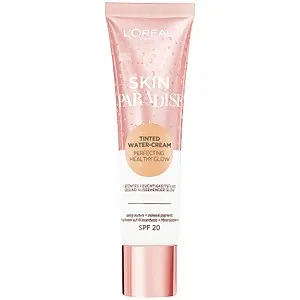
L'Oréal Paris Skin Paradise Tinted Moisturiser SPF20
Works for
Sun protectionSPF 20 · 2 UV filters · Partial spectrumWeak protectionSPF under 30
This product does not offer good protection against UVA rays.
This product can be considered "reef safe" because it does not contain the UV filters (oxybenzone and octinoxate) that can be harmful to coral reefs when present in the water in high concentrations.
MoisturizingGlycerin, Dimethicone + 7 moreWorks
“Offering essential daily hydration, and a dewy luminosity, the formula features SPF20 to help protect the skin from the damaging effects of UV exposure.”
This product can help improve hydration of the skin with the two types of ingredients.
The first type is called “humectants”:
these ingredients help attract water.
When humectants are on the surface of the skin, they “pull in” the moisture from the outside environment, or from
within deeper layers of the skin. The following ingredients in this product do the job:
glycerin, sodium hyaluronate.
This product also contains ingredients called “occlusives”. They help reduce the speed with which our skin loses moisture to the outside environment. These ingredients also help soften the upper layer of the skin, so it feels less tight and nicer to the touch. The following ingredients in this product do the job: dimethicone, pentylene glycol.
Can it cause trouble?
Irritancy7 strong irritants: Hamamelis virginiana water, Parfum + 5 more — patch-test recommendedHigh risk
ComedogenicClean of flagged comedogenic ingredientsNone flagged
User reviews
Be the first — your take helps the next person decide.
Ingredients
Filter by role to see what each ingredient is doing.
Water~45–55%
Glycerin~4.2–5.1%
- Irritation risk
- Low
One of the best moisturizing ingredients. Naturally present in skin. It attracts water to the upper layer of the skin working as a humectant
More about GlycerinCaprylyl methicone~4.1–5.1%
- Irritation risk
- Low
A type of silicone that helps to soften the upper layer of the skin and create a nice product finish on the skin
More about Caprylyl methiconePhenylbenzimidazole sulfonic acid~3.5–4.3%
- Irritation risk
- Medium
Ensulizole. A UV filter that is effective against UVB rays. Does not protect against UVA light. It is photostable and can be used to help stabilize other sunscreen ingredients. It is water-soluble meaning that it can help create lighter sunscreen formulations
More about Phenylbenzimidazole sulfonic acidPropanediol~2.3–2.8%
- Irritation risk
- Low
Acts as a solvent for other ingredients. Speeds up the absorption of other ingredients into the skin
More about PropanediolDimethicone~1.9–2.4%
- Irritation risk
- Low
A silicone that helps to reduce water loss from the surface of the skin. Can temporarily "fill in" lines and wrinkles, absorb oil, and create a nice product finish
More about DimethiconePentylene glycol~1.6–2%
- Irritation risk
- Medium
Used to preserve products, dissolve other ingredients and create a nice product texture
More about Pentylene glycolDimethicone/peg-10/15 crosspolymer~1.4–1.7%
Titanium dioxide~1.5–1.8%
- Irritation risk
- Low
Works as a UV filter when used in high concentrations. It is photostable and is effective mostly against the UVB light, with some protection in the UVA range. In small concentrations, used for its ability to improve the color of cosmetic products. Is usually well tolerated by the skin
More about Titanium dioxideSodium hydroxide~0.9–1.1%
Sodium chloride~0.7–1.05%
- Irritation risk
- Low
Used to stabilize mixtures of oil and water, and create thicker, gel-like product textures
More about Sodium chloridePhenoxyethanol~0.55–0.8%
- Irritation risk
- Low
A preservative. It helps prevent bacterial growth in cosmetic products
More about PhenoxyethanolTriethoxysilylethyl polydimethylsiloxyethyl dimethicone~0.45–0.7%
- Irritation risk
- Low
Isopropyl titanium triisostearate~0.5–0.75%
- Irritation risk
- Medium
Helps water and oil mix together
More about Isopropyl titanium triisostearateChlorphenesin~0.16–0.32%
Disodium edta~0.4–0.6%
Aloe barbadensis leaf juice powder~0.35–0.6%
- Irritation risk
- Medium
Traditionally used to treat sunburns, dermatitis and inflammation, but evidence for its effectiveness is lacking. The extract can contain humectants that help attract water into the skin
More about Aloe barbadensis leaf juice powderHamamelis virginiana water~0.3–0.5%
- Irritation risk
- High
A plant extract that can help calm down inflammation in skin. Can, however, itself be irritating
More about Hamamelis virginiana waterAlumina~0.45–0.7%
- Irritation risk
- Low
The same compound that is used safely in dental implants and bone cements. In cosmetics, it is used to improve the consistency of products
More about AluminaButylene glycol~0.25–0.5%
- Irritation risk
- Low
Used to create a nice product texture and help delivery of other ingredients. Might be somewhat helpful in attracting water to the upper layer of the skin
More about Butylene glycolParfum~0.25–0.45%
- Irritation risk
- High
An aromatic blend of unspecified and possibly irritating ingredients
More about ParfumStearic acid~0.35–0.65%
- Irritation risk
- Low
Helps oil and water mix together and works as an emollient
More about Stearic acidAluminum hydroxide~0.25–0.5%
- Irritation risk
- Low
Is used to add opaque (non-transparent) appearance to formulations. Can be used to coat other ingredients for even dispersion. This is a different ingredient compared to the ones used in antipersperants (aluminium chloride and aluminium chlorohydrate)
More about Aluminum hydroxideDipropylene glycol~0.2–0.4%
- Irritation risk
- Low
Helps to dissolve other ingredients in a formulation. Slows down the rate of product drying
More about Dipropylene glycolAlcohol~0.25–0.4%
- Irritation risk
- High
Can be drying and contribute to skin irritation. Used in formulars to dissolve other ingredients, create a thinner product consistency or for its antibacterial properties
More about AlcoholSodium hyaluronate~0.2–0.4%
- Irritation risk
- Low
One of the best moisturizing ingredients. Attracts water into the upper layer of the skin
More about Sodium hyaluronateSodium citrate~0.2–0.4%
- Irritation risk
- Medium
Helps to control the skin's pH level. Maintains the skin's natural film of amino-lactic acids and oils. Helps to preserve products
More about Sodium citrateLimonene~0.2–0.35%
- Irritation risk
- High
A common frangrance that can easily irritate skin, especially if exposed to air, light or heat
More about LimoneneCitronellol~0.15–0.3%
Tocopherol~0.2–0.35%
- Irritation risk
- Low
Pure form of vitamin E. Can help moisturise and protect the skin from free radicals. Often used to help stabilise other ingredients or the formula itself
More about TocopherolZingiber officinale root extract~0.15–0.25%
- Irritation risk
- High
A plant extract that can contain an irritating essential oil. Might have some anti-oxidant effect, but evidence is lacking
More about Zingiber officinale root extractSanguisorba officinalis root extract~0.25–0.45%
- Irritation risk
- Low
Cinnamomum cassia bark extract~0.15–0.3%
Citric acid~0.1–0.2%
- Irritation risk
- Medium
Can work as an exfoliant but is typically used to adjust the product pH
More about Citric acidTitanium dioxide~0.2–0.35%
- Irritation risk
- Low
Works as a UV filter when used in high concentrations. It is photostable and is effective mostly against the UVB light, with some protection in the UVA range. In small concentrations, used for its ability to improve the color of cosmetic products. Is usually well tolerated by the skin
More about Titanium dioxideCi 77491~0.1–0.15%
- Irritation risk
- Low
A red colorant made of iron oxide. Typically is not irritating
More about Ci 77491Ci 77492~0.05–0.1%
Iron oxides~0.05%
- Irritation risk
- Low
An umbrella term for the following three colorants: CI 77491, CI 77492, CI 77499. They might be able to offer some protection against visible light, but the degree of the protection is not clear
More about Iron oxidesIngredient list view
Water, Glycerin, Caprylyl methicone, Phenylbenzimidazole sulfonic acid, Propanediol, Dimethicone, Pentylene glycol, Dimethicone/peg-10/15 crosspolymer, Titanium dioxide, Sodium hydroxide, Sodium chloride, Phenoxyethanol, Triethoxysilylethyl polydimethylsiloxyethyl dimethicone, Isopropyl titanium triisostearate, Chlorphenesin, Disodium edta, Aloe barbadensis leaf juice powder, Hamamelis virginiana water, Alumina, Butylene glycol, Parfum, Stearic acid, Aluminum hydroxide, Dipropylene glycol, Alcohol, Sodium hyaluronate, Sodium citrate, Limonene, Citronellol, Tocopherol, Zingiber officinale root extract, Sanguisorba officinalis root extract, Cinnamomum cassia bark extract, Citric acid, Titanium dioxide, Ci 77491, Ci 77492, Iron oxides
Compare prices
Retailers ranked by price — lowest first.

Worth comparing, line by line.
Match % combines shared ingredients, the first five ingredients, shared actives and hero ingredients, irritancy (lower counts in the alternative's favour), texture and body area. Only products in the same routine step are compared.
| L'Oréal ParisSkin Paradise Tinted Moisturiser SPF20YOUR PRODUCT | La Roche-PosayHydraphase HA UV SPF25 Rich | FOTOPROTECTORFusion Water MAGIC Repair Color SPF 50 | erinsfacesMineral Sheer Tint | |
|---|---|---|---|---|
| Match | — | 42% | 41% | 41% |
| Price | — | $22.59 | — | $40.00 |
| Shared key ingredients | — | 5 of 6 | 5 of 6 | 5 of 6 |
| Key difference | — | Capryloyl Salicylic Acid | Palmitoyl Tetrapeptide-7 | Tetrahexyldecyl Ascorbate |
| Irritancy | High | Medium | Medium | Medium |
| SPF | SPF 20 | SPF 25 | SPF 50 | SPF 20 |
| Drying alcohol | Contains drying alcohol | — | — | — |
| View product | Shop | Shop | Shop |



More alternatives: ISDIN Fotoprotection Fusion Water MAGIC Medium LSF 50CeraVe Hydrating Sunscreen Face Lotion SPF 50
Product summary
We do not recommend "L'Oréal Paris - Skin Paradise Tinted Moisturiser SPF20" because it does not provide good UVA protection. UVA sun rays don't burn the skin, but they still lead to photoaging and hyperpigmentation.
This moisturizer should also be hydrating enough to use without an additional moisturizer during the day.
Sunscreen filters
This is a "mixed" sunscreen in the sense that it uses both mineral and organic (so-called "chemical") sun filters. Here are the organic filters this product uses: ensulizole. As for the mineral filters, this sunscreen uses titanium dioxide.
Irritation risk
This moisturizer contains a bunch of common irritants, including ingredients that do not provide any known benefit for the skin. It might not be the best choice if your skin is sensitive. We assess the overall irritancy of this moisturizer to be high. For a detailed overview of all potential irritants: click here
You can see the detailed formula review with the breakdown of all actives in the product and the full ingredient list with estimated concentrations in the tables below.
Price
The product retails from 8.77£ up to 10.99£ in the United Kingdom and for 10.99$ in the United States.
For a detailed price comparison: click here.
Sources cited in this review
Every concentration estimate and effectiveness label is anchored to one of these 9 studies and safety reviews.
- 1
- 2
- 3Final Report on the Safety Assessment of Dimethicone Copolyoljournals.sagepub.com
- 4
- 5Hyaluronic acid: A key molecule in skin agingncbi.nlm.nih.gov
- 6

Affiliate links · As an Amazon Associate, WIMJ earns from qualifying purchases.