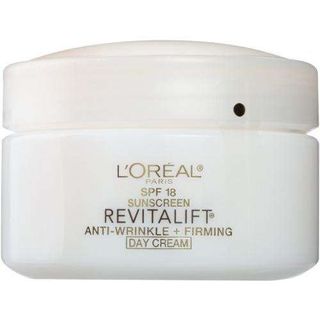
L'Oréal Paris Revitalift Anti-Wrinkle + Firming Day Cream SPF 18 Sunscreen
Works for
1 of 3 advertised claims delivered
Sun protectionSPF 18 · 3 UV filters · Partial spectrumWeak protectionSPF under 30
This product does not offer good protection against UVA rays.
MoisturizingGlycerin, Myristyl myristate + 15 moreGood evidence
“Revitalift Anti-Wrinkle + Firming Day Cream SPF 18 Sunscreen”
This product can help improve hydration of the skin with the two types of ingredients.
The first type is called “humectants”:
these ingredients help attract water.
When humectants are on the surface of the skin, they “pull in” the moisture from the outside environment, or from
within deeper layers of the skin. The following ingredients in this product do the job:
glycerin, glycine soja protein.
This product also contains ingredients called “occlusives”. They help reduce the speed with which our skin loses moisture to the outside environment. These ingredients also help soften the upper layer of the skin, so it feels less tight and nicer to the touch. The following ingredients in this product do the job: beeswax, cera alba.
Anti-agingGlycine soja protein, Retinyl palmitateLimited evidence
“Revitalift Anti-Wrinkle + Firming Day Cream SPF 18 Sunscreen”
This product does not contain ingredients that are able to reduce fine lines and wrinkles or help with skin elasticity, but it can improve the look of the skin temporarily through moisturization. Well-moisturized skin might also be able to repair the sun damage better.This ingredient - glycine soja protein - could be helpful for preventing or repairing signs of aging in theory, but there is no evidence that it actually works.
The biggest anti-aging effect in this product comes from sun protection. Sun damage is the main factor causing early signs of skin aging. We, however, do not recommend using this product as a sunscreen because the protection it offers is not strong enough).
Can it cause trouble?
Irritancy16 strong irritants: Retinyl palmitate, Diazolidinyl urea + 14 more — patch-test recommendedHigh risk
Comedogenic3 ingredients rated 2 or more on the 0–5 pore-clogging scale3 flagged
User reviews
Be the first — your take helps the next person decide.
Ingredients
Filter by role to see what each ingredient is doing.
Water~45–55%
Cyclopentasiloxane~6.7–8.2%
- Irritation risk
- Low
A silicone that helps improve the product texture and spreadability. Can absorb oil creating a short-term mattifying effect on the skin
More about CyclopentasiloxaneGlycerin~4.7–5.8%
- Irritation risk
- Low
One of the best moisturizing ingredients. Naturally present in skin. It attracts water to the upper layer of the skin working as a humectant
More about GlycerinMyristyl myristate~3.6–4.4%
- Irritation risk
- Medium
- Comedogenicity
- 3/5
An emollient. Is not recommended for acne-prone skin as it can be comedogenic
More about Myristyl myristateTriethanolamine~2.5–3.1%
- Irritation risk
- Medium
Used to adjust pH of the product and can help improve the product's smell
More about TriethanolamineStearic acid~2.3–2.8%
- Irritation risk
- Low
Helps oil and water mix together and works as an emollient
More about Stearic acidAmmonium polyacryloyldimethyl taurate~1.8–2.2%
- Irritation risk
- Low
Used to create a thicker product consistency
More about Ammonium polyacryloyldimethyl tauratePalmitic acid~1.6–1.9%
- Irritation risk
- Low
An emollient that is naturally present in skin and helps soften it
More about Palmitic acidTitanium dioxide~1.7–2%
- Irritation risk
- Low
Works as a UV filter when used in high concentrations. It is photostable and is effective mostly against the UVB light, with some protection in the UVA range. In small concentrations, used for its ability to improve the color of cosmetic products. Is usually well tolerated by the skin
More about Titanium dioxidePeg-100 stearate~1.1–1.4%
- Irritation risk
- Low
Helps oil and water mix togehter and creates a nice product texture
More about Peg-100 stearateGlyceryl stearate~0.8–1.2%
- Irritation risk
- Low
An emollient that softens the skin and forms a protective layer on its surface. Helps water and oil mix together
More about Glyceryl stearateBeeswax~0.7–1.05%
- Irritation risk
- Low
Forms a protective barrier that holds water and keeps dry skin hydrated. Keeps an emulsion from separating into its oil and liquid components, and increases the thickness of a product. Can be an allergen
More about BeeswaxPeg-20 stearate~0.55–0.85%
Stearyl alcohol~0.6–0.9%
- Irritation risk
- Low
An emollient that helps soften the skin
More about Stearyl alcoholCetyl alcohol~0.55–0.8%
- Irritation risk
- Low
A non-drying alcohol that works to soften the skin and stabilize product formulations helping oil and water mix together
More about Cetyl alcoholGlycine soja extract~0.45–0.7%
- Irritation risk
- Low
Glycine soja protein~0.5–0.75%
- Irritation risk
- Low
A plant extract that helps to attract water to the upper layer of the skin and soften it. It might be helpful in neutralizing free radicals. It might be somewhat helpful for evening out the skin tone. It might be able to support elastin production but solid research is lacking
More about Glycine soja proteinCaprylic/capric triglyceride~0.5–0.75%
- Irritation risk
- Medium
A good mix of fatty acids that forms a protective layer on the skin. Improves the shelf life of products. Derived from coconut and glycerin
More about Caprylic/capric triglycerideAcrylates copolymer~0.45–0.65%
- Irritation risk
- Medium
Used to stabilize product formulation, help create an even product layer over skin (for example, in sunscreen) and create a thicker product consistency
More about Acrylates copolymerAcetyl trifluoromethylphenyl valylglycine~0.4–0.65%
- Irritation risk
- Medium
Retinyl palmitate~0.3–0.55%
- Irritation risk
- High
Three steps removed from the active form of vitamin A - retinoic acid. To have an effect in the skin, it first needs to be converted twice to become the retinoic acid. This means it is less potent than retinol, but could also be less irritating. Once converted to the retinoic acid in the skin, it helps against all signs of aging, improves skin cell turnover and helps fight blemishes and clogged pores. However, in many cosmetic formulations, it is used in a concentration that is too low to have the full effect
More about Retinyl palmitateAlumina~0.45–0.7%
- Irritation risk
- Low
The same compound that is used safely in dental implants and bone cements. In cosmetics, it is used to improve the consistency of products
More about AluminaPolycaprolactone~0.3–0.55%
- Irritation risk
- Low
Crithmum maritimum extract~0.25–0.5%
- Irritation risk
- Low
- Comedogenicity
- 3/5
An algae extract that might have anti-oxidant properties
More about Crithmum maritimum extractMyristyl alcohol~0.3–0.6%
- Irritation risk
- High
Helps to stabilize the product formulation while softening the upper layer of the skin. Can be irritating
More about Myristyl alcoholPhenoxyethanol~0.3–0.55%
- Irritation risk
- Low
A preservative. It helps prevent bacterial growth in cosmetic products
More about PhenoxyethanolDiazolidinyl urea~0.25–0.5%
- Irritation risk
- High
A preservative. Works by releasing formaldehyde. Can be irritating
More about Diazolidinyl ureaMethylparaben~0.15–0.3%
Butylparaben~0.2–0.4%
Chlorphenesin~0.16–0.32%
Sodium dehydroacetate~0.3–0.55%
Parfum~0.25–0.5%
- Irritation risk
- High
An aromatic blend of unspecified and possibly irritating ingredients
More about ParfumBenzyl salicylate~0.25–0.5%
Benzyl benzoate~0.25–0.5%
- Irritation risk
- High
Fragrance with sweet balsamic smell. Help to preserve products and dissolve other ingredients. Could trigger allergic reactions and be irritating
More about Benzyl benzoateLinalool~0.25–0.5%
Hexyl cinnamal~0.25–0.5%
Limonene~0.25–0.5%
- Irritation risk
- High
A common frangrance that can easily irritate skin, especially if exposed to air, light or heat
More about LimoneneCitronellol~0.25–0.5%
Butylphenyl methylpropional~0.25–0.5%
- Irritation risk
- High
A fragrance. Can trigger allergic reactions and be irritating
More about Butylphenyl methylpropionalGeraniol~0.25–0.5%
Alpha-isomethyl ionone~0.25–0.5%
- Irritation risk
- High
A fragrance. Potential allergen and can be irritating
More about Alpha-isomethyl iononeBenzyl alcohol~0.25–0.5%
- Irritation risk
- High
A preservative. Can be used to mask unpleasant smell. Can be irritating
More about Benzyl alcoholAmyl cinnamal~0.25–0.5%
- Irritation risk
- High
Benzyl cinnamate~0.25–0.5%
Citral~0.25–0.5%
Water~0.3–0.55%
Cyclohexasiloxane~0.35–0.6%
- Irritation risk
- Low
A silicone that serves as an emollient. Helps create a nice non-greasy feels
More about CyclohexasiloxaneEthylhexyl methoxycinnamate~0.5–0.75%
- Irritation risk
- High
Octinoxate. When used in higher concentrations, works as a sunscreen protecting the skin from UVB rays. When used in lower concentration, helps to preserve the product formulation. Is shown to be harmful to coral reefs - consider avoiding bathing in coral reef areas when wearing a product with this ingredient. It can be irritating
More about Ethylhexyl methoxycinnamateGlycerin~0.3–0.6%
- Irritation risk
- Low
One of the best moisturizing ingredients. Naturally present in skin. It attracts water to the upper layer of the skin working as a humectant
More about GlycerinMyristyl myristate~0.35–0.6%
- Irritation risk
- Medium
- Comedogenicity
- 3/5
An emollient. Is not recommended for acne-prone skin as it can be comedogenic
More about Myristyl myristatePhenylbenzimidazole sulfonic acid~0.55–0.8%
- Irritation risk
- Medium
Ensulizole. A UV filter that is effective against UVB rays. Does not protect against UVA light. It is photostable and can be used to help stabilize other sunscreen ingredients. It is water-soluble meaning that it can help create lighter sunscreen formulations
More about Phenylbenzimidazole sulfonic acidAlcohol denat.~0.3–0.55%
- Irritation risk
- High
Produces temporary toning effect. Can help dissolve other ingredients or preserve products
More about Alcohol denat.Triethanolamine~0.3–0.6%
- Irritation risk
- Medium
Used to adjust pH of the product and can help improve the product's smell
More about TriethanolamineStearic acid~0.5–0.7%
- Irritation risk
- Low
Helps oil and water mix together and works as an emollient
More about Stearic acidAmmonium polyacryloyldimethyl taurate~0.3–0.55%
- Irritation risk
- Low
Used to create a thicker product consistency
More about Ammonium polyacryloyldimethyl tauratePalmitic acid~0.4–0.6%
- Irritation risk
- Low
An emollient that is naturally present in skin and helps soften it
More about Palmitic acidTitanium dioxide~0.45–0.65%
- Irritation risk
- Low
Works as a UV filter when used in high concentrations. It is photostable and is effective mostly against the UVB light, with some protection in the UVA range. In small concentrations, used for its ability to improve the color of cosmetic products. Is usually well tolerated by the skin
More about Titanium dioxidePeg-100 stearate~0.45–0.65%
- Irritation risk
- Low
Helps oil and water mix togehter and creates a nice product texture
More about Peg-100 stearateCera alba~0.45–0.7%
- Irritation risk
- Medium
Forms a protective barrier that holds water and keeps dry skin hydrated. Keeps an emulsion from separating into its oil and liquid components, and increases the thickness of a product. Can be an allergen
More about Cera albaBeeswax~0.4–0.6%
- Irritation risk
- Low
Forms a protective barrier that holds water and keeps dry skin hydrated. Keeps an emulsion from separating into its oil and liquid components, and increases the thickness of a product. Can be an allergen
More about BeeswaxGlyceryl stearate~0.4–0.6%
- Irritation risk
- Low
An emollient that softens the skin and forms a protective layer on its surface. Helps water and oil mix together
More about Glyceryl stearatePeg-20 stearate~0.3–0.6%
Stearyl alcohol~0.35–0.65%
- Irritation risk
- Low
An emollient that helps soften the skin
More about Stearyl alcoholGlycine soja protein~0.35–0.6%
- Irritation risk
- Low
A plant extract that helps to attract water to the upper layer of the skin and soften it. It might be helpful in neutralizing free radicals. It might be somewhat helpful for evening out the skin tone. It might be able to support elastin production but solid research is lacking
More about Glycine soja proteinAlumina~0.45–0.7%
- Irritation risk
- Low
The same compound that is used safely in dental implants and bone cements. In cosmetics, it is used to improve the consistency of products
More about AluminaPhenethyl alcohol~0.3–0.6%
Hydrolyzed soy protein~0.3–0.55%
- Irritation risk
- Low
Helps attract water to the upper layer of the skin. Might have some anti-aging, anti-oxidant, and skin lightening properties, but solid evidence is missing
More about Hydrolyzed soy proteinAcetyl trifluoromethylphenyl valylglycine~0.35–0.65%
- Irritation risk
- Medium
Faex extract~0.3–0.55%
- Irritation risk
- Low
Yeast extract. Helps attract water to the upper layer of the skin
More about Faex extractYeast extract~0.3–0.55%
- Irritation risk
- Low
Helps attract water to the upper layer of the skin and might have some anti-oxidant and skin lightening properties. It can help calm down inflammation in skin
More about Yeast extractAcrylates copolymer~0.3–0.6%
- Irritation risk
- Medium
Used to stabilize product formulation, help create an even product layer over skin (for example, in sunscreen) and create a thicker product consistency
More about Acrylates copolymerCetyl alcohol~0.35–0.65%
- Irritation risk
- Low
A non-drying alcohol that works to soften the skin and stabilize product formulations helping oil and water mix together
More about Cetyl alcoholRetinyl palmitate~0.3–0.5%
- Irritation risk
- High
Three steps removed from the active form of vitamin A - retinoic acid. To have an effect in the skin, it first needs to be converted twice to become the retinoic acid. This means it is less potent than retinol, but could also be less irritating. Once converted to the retinoic acid in the skin, it helps against all signs of aging, improves skin cell turnover and helps fight blemishes and clogged pores. However, in many cosmetic formulations, it is used in a concentration that is too low to have the full effect
More about Retinyl palmitatePotassium sorbate~0.3–0.6%
Methylparaben~0.15–0.3%
Sodium benzoate~0.25–0.5%
Phenoxyethanol~0.3–0.6%
- Irritation risk
- Low
A preservative. It helps prevent bacterial growth in cosmetic products
More about PhenoxyethanolChlorphenesin~0.16–0.32%
Ethylparaben~0.2–0.4%
Linalool~0.3–0.55%
Geraniol~0.25–0.5%
Alpha-isomethyl ionone~0.25–0.5%
- Irritation risk
- High
A fragrance. Potential allergen and can be irritating
More about Alpha-isomethyl iononeAmyl cinnamal~0.25–0.5%
- Irritation risk
- High
Limonene~0.25–0.5%
- Irritation risk
- High
A common frangrance that can easily irritate skin, especially if exposed to air, light or heat
More about LimoneneCitral~0.25–0.45%
Citronellol~0.25–0.45%
Butylphenyl methylpropional~0.25–0.45%
- Irritation risk
- High
A fragrance. Can trigger allergic reactions and be irritating
More about Butylphenyl methylpropionalHexyl cinnamal~0.2–0.4%
Benzyl alcohol~0.15–0.3%
- Irritation risk
- High
A preservative. Can be used to mask unpleasant smell. Can be irritating
More about Benzyl alcoholBenzyl benzoate~0.2–0.4%
- Irritation risk
- High
Fragrance with sweet balsamic smell. Help to preserve products and dissolve other ingredients. Could trigger allergic reactions and be irritating
More about Benzyl benzoateBenzyl cinnamate~0.2–0.35%
Benzyl salicylate~0.15–0.25%
Parfum~0.1–0.25%
- Irritation risk
- High
An aromatic blend of unspecified and possibly irritating ingredients
More about ParfumIngredient list view
Water, Cyclopentasiloxane, Glycerin, Myristyl myristate, Triethanolamine, Stearic acid, Ammonium polyacryloyldimethyl taurate, Palmitic acid, Titanium dioxide, Peg-100 stearate, Glyceryl stearate, Beeswax, Peg-20 stearate, Stearyl alcohol, Cetyl alcohol, Glycine soja extract, Glycine soja protein, Caprylic/capric triglyceride, Acrylates copolymer, Acetyl trifluoromethylphenyl valylglycine, Retinyl palmitate, Alumina, Polycaprolactone, Crithmum maritimum extract, Myristyl alcohol, Phenoxyethanol, Diazolidinyl urea, Methylparaben, Butylparaben, Chlorphenesin, Sodium dehydroacetate, Parfum, Benzyl salicylate, Benzyl benzoate, Linalool, Hexyl cinnamal, Limonene, Citronellol, Butylphenyl methylpropional, Geraniol, Alpha-isomethyl ionone, Benzyl alcohol, Amyl cinnamal, Benzyl cinnamate, Citral, Water, Cyclohexasiloxane, Ethylhexyl methoxycinnamate, Glycerin, Myristyl myristate, Phenylbenzimidazole sulfonic acid, Alcohol denat., Triethanolamine, Stearic acid, Ammonium polyacryloyldimethyl taurate, Palmitic acid, Titanium dioxide, Peg-100 stearate, Cera alba, Beeswax, Glyceryl stearate, Peg-20 stearate, Stearyl alcohol, Glycine soja protein, Alumina, Phenethyl alcohol, Hydrolyzed soy protein, Acetyl trifluoromethylphenyl valylglycine, Faex extract, Yeast extract, Acrylates copolymer, Cetyl alcohol, Retinyl palmitate, Potassium sorbate, Methylparaben, Sodium benzoate, Phenoxyethanol, Chlorphenesin, Ethylparaben, Linalool, Geraniol, Alpha-isomethyl ionone, Amyl cinnamal, Limonene, Citral, Citronellol, Butylphenyl methylpropional, Hexyl cinnamal, Benzyl alcohol, Benzyl benzoate, Benzyl cinnamate, Benzyl salicylate, Parfum
Compare prices
Retailers ranked by price — lowest first.

Product summary
We do not recommend "L'Oréal Paris - Revitalift Anti-Wrinkle + Firming Day Cream SPF 18 Sunscreen" because it does not provide good UVA protection. UVA sun rays don't burn the skin, but they still lead to photoaging and hyperpigmentation.
It contains good moisturizing ingredients and can double as a hydrating day cream.
Sunscreen filters
This is a "mixed" sunscreen in the sense that it uses both mineral and organic (so-called "chemical") sun filters. The organic filters in the product are: octinoxate and ensulizole. As for the mineral filters, this sunscreen uses titanium dioxide.
Irritation risk
This moisturizer contains a bunch of common irritants, including ingredients that do not provide any known benefit for the skin. It might not be the best choice if your skin is sensitive. We assess the overall irritancy of this moisturizer to be high. For a detailed overview of all potential irritants: click here
You can see the detailed formula review with the breakdown of all actives in the product and the full ingredient list with estimated concentrations in the tables below.
Price
The product retails from 14.22$ up to 36.32$ in the United States.
For a detailed price comparison: click here.
Sources cited in this review
Every concentration estimate and effectiveness label is anchored to one of these 17 studies and safety reviews.
- 1
- 2
- 3
- 4Extracts from Glycine max (soybean) induce elastin synthesis and inhibit elastase activityonlinelibrary.wiley.com
- 5
- 6

Affiliate links · As an Amazon Associate, WIMJ earns from qualifying purchases.