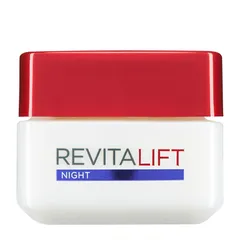
Works for:
based on ingredients and %- Moisturizing
Doesn't work for:
based on ingredients and %- Anti-aging
Can it cause trouble?
- Irritation risk: high
- Comedogenic risk ingredients: 1
Key actives
Moisturizing
What does the product description say?
Dermo-Expertise Revitalift Night Cream Anti-Wrinkle Plus Firming
Source: From product name
This product can help improve hydration of the skin with the two types of ingredients.
The first type is called “humectants”:
these ingredients help attract water.
When humectants are on the surface of the skin, they “pull in” the moisture from the outside environment, or from
within deeper layers of the skin. The following ingredients in this product do the job:
glycerin.
This product also contains ingredients called “occlusives”. They help reduce the speed with which our skin loses moisture to the outside environment. These ingredients also help soften the upper layer of the skin, so it feels less tight and nicer to the touch. The following ingredients in this product do the job: butyrospermum parkii butter, cetyl alcohol.
A great moisturising ingredient that softens the skin and reduces water loss from its upper layer. It also can be helpful in protecting skin from free radicals
One of the best moisturizing ingredients. Naturally present in skin. It attracts water to the upper layer of the skin working as a humectant
A non-drying alcohol that works to soften the skin and stabilize product formulations helping oil and water mix together
A silicone that helps improve the product texture and spreadability. Can absorb oil creating a short-term mattifying effect on the skin
Improves the texture of the product and helps soften the skin. Helps oil and water mix together and can be used as a cleansing agent
An emollient that softens the skin and forms a protective layer on its surface. Helps water and oil mix together
Used to improve the product consistency and soften the upper layer of the skin
Prevents water loss from the skin surface and thickens the product consistency
Used to stabilize formulations and increase water resistance of sunscreen ingredients. In cosmetics, the polymer form of this compound is used. The polymer's molecules cannot penetrate the skin making the compound safe for use in skin care as long as the monomer residue (which, unlike polyacrylamide, is toxic) in the final product is below 0.2%. It can be irritating for skin
Helps to stabilize the product formulation while softening the upper layer of the skin. Can be irritating
One of the most effective and the most studied occlusive ingredients that creates a protective layer on top of the skin preventing moisture loss
Helps oil and water mix together and works as an emollient
Anti-aging
What does the product description say?
Dermo-Expertise Revitalift Night Cream Anti-Wrinkle Plus Firming
Source: From product name
This product does not contain ingredients that are able to reduce fine lines and wrinkles or help with skin elasticity, but it can improve the look of the skin temporarily through moisturization. Well-moisturized skin might also be able to repair the sun damage better.This ingredient - butyrospermum parkii butter - could be helpful for preventing or repairing signs of aging in theory, but there is no evidence that it actually works.
A great moisturising ingredient that softens the skin and reduces water loss from its upper layer. It also can be helpful in protecting skin from free radicals
Three steps removed from the active form of vitamin A - retinoic acid. To have an effect in the skin, it first needs to be converted twice to become the retinoic acid. This means it is less potent than retinol, but could also be less irritating. Once converted to the retinoic acid in the skin, it helps against all signs of aging, improves skin cell turnover and helps fight blemishes and clogged pores. However, in many cosmetic formulations, it is used in a concentration that is too low to have the full effect
How honest is this product?
| Promise | Can it deliver? |
|---|---|
| Moisturizing | |
| Anti-aging |
Total Promises Fulfilled score: 62/100.
We receive a small commission for purchases made through these links at no cost for you. Thank you for your support! Learn more
Affiliate link · supports WIMJ at no cost to you
Potential irritants
Comedogenic ingredients
User reviews (0)
Averages from community submissions.
No reviews yet for this product.
Be the first to share your experience!
Tried this product?
Help capture what the ingredient list can't—texture, finish, pilling, scent, and more. Answer what you can, skip the rest.
Takes ~30 seconds.
Reviews are shown in aggregate. No personal details.
Key Actives
Three steps removed from the active form of vitamin A - retinoic acid. To have an effect in the skin, it first needs to be converted twice to become the retinoic acid. This means it is less potent than retinol, but could also be less irritating. Once converted to the retinoic acid in the skin, it helps against all signs of aging, improves skin cell turnover and helps fight blemishes and clogged pores. However, in many cosmetic formulations, it is used in a concentration that is too low to have the full effect
A great moisturising ingredient that softens the skin and reduces water loss from its upper layer. It also can be helpful in protecting skin from free radicals
A silicone that helps improve the product texture and spreadability. Can absorb oil creating a short-term mattifying effect on the skin
One of the best moisturizing ingredients. Naturally present in skin. It attracts water to the upper layer of the skin working as a humectant
Potential irritants
A preservative. Works by releasing formaldehyde. Can be irritating
Fragrance with sweet balsamic smell. Help to preserve products and dissolve other ingredients. Could trigger allergic reactions and be irritating
A preservative. Can be used to mask unpleasant smell. Can be irritating
Helps to stabilize the product formulation while softening the upper layer of the skin. Can be irritating
An aromatic blend of unspecified and possibly irritating ingredients
Used to stabilize formulations and increase water resistance of sunscreen ingredients. In cosmetics, the polymer form of this compound is used. The polymer's molecules cannot penetrate the skin making the compound safe for use in skin care as long as the monomer residue (which, unlike polyacrylamide, is toxic) in the final product is below 0.2%. It can be irritating for skin
Three steps removed from the active form of vitamin A - retinoic acid. To have an effect in the skin, it first needs to be converted twice to become the retinoic acid. This means it is less potent than retinol, but could also be less irritating. Once converted to the retinoic acid in the skin, it helps against all signs of aging, improves skin cell turnover and helps fight blemishes and clogged pores. However, in many cosmetic formulations, it is used in a concentration that is too low to have the full effect
A fragrance. Potential allergen and can be irritating
A fragrance. Can trigger allergic reactions and be irritating
A common frangrance that can easily irritate skin, especially if exposed to air, light or heat
Used to adjust pH of the product and can help improve the product's smell
Used to thicken the product's consistency
Comedogenic ingredients
A great moisturising ingredient that softens the skin and reduces water loss from its upper layer. It also can be helpful in protecting skin from free radicals
All ingredients
A preservative. Works by releasing formaldehyde. Can be irritating
Fragrance with sweet balsamic smell. Help to preserve products and dissolve other ingredients. Could trigger allergic reactions and be irritating
Used to adjust pH of the product and can help improve the product's smell
A preservative. Can be used to mask unpleasant smell. Can be irritating
A great moisturising ingredient that softens the skin and reduces water loss from its upper layer. It also can be helpful in protecting skin from free radicals
Prevents water loss from the skin surface and thickens the product consistency
Helps to stabilize the product formulation while softening the upper layer of the skin. Can be irritating
An aromatic blend of unspecified and possibly irritating ingredients
Used to stabilize formulations and increase water resistance of sunscreen ingredients. In cosmetics, the polymer form of this compound is used. The polymer's molecules cannot penetrate the skin making the compound safe for use in skin care as long as the monomer residue (which, unlike polyacrylamide, is toxic) in the final product is below 0.2%. It can be irritating for skin
A silicone that helps improve the product texture and spreadability. Can absorb oil creating a short-term mattifying effect on the skin
One of the best moisturizing ingredients. Naturally present in skin. It attracts water to the upper layer of the skin working as a humectant
Three steps removed from the active form of vitamin A - retinoic acid. To have an effect in the skin, it first needs to be converted twice to become the retinoic acid. This means it is less potent than retinol, but could also be less irritating. Once converted to the retinoic acid in the skin, it helps against all signs of aging, improves skin cell turnover and helps fight blemishes and clogged pores. However, in many cosmetic formulations, it is used in a concentration that is too low to have the full effect
Used to thicken the product's consistency
A fragrance. Potential allergen and can be irritating
A non-drying alcohol that works to soften the skin and stabilize product formulations helping oil and water mix together
A fragrance. Can trigger allergic reactions and be irritating
Improves the texture of the product and helps soften the skin. Helps oil and water mix together and can be used as a cleansing agent
One of the most effective and the most studied occlusive ingredients that creates a protective layer on top of the skin preventing moisture loss
A common frangrance that can easily irritate skin, especially if exposed to air, light or heat
Used to improve the product consistency and soften the upper layer of the skin
An emollient that softens the skin and forms a protective layer on its surface. Helps water and oil mix together
Ingredient list view
Diazolidinyl urea, Benzyl benzoate, Sorbitan tristearate, Triethanolamine, Benzyl alcohol, Polysorbate 80, Butyrospermum parkii butter, Unknown, Chlorphenesin, Unknown, Paraffin, Myristyl alcohol, Glycine soja extract, Stearyl alcohol, Polycaprolactone, Parfum, Benzyl salicylate, Methylparaben, Unknown, Acrylamide, Cyclopentasiloxane, Glycerin, Retinyl palmitate, Propylparaben, Sodium dehydroacetate, Unknown, Acetyl trifluoromethylphenyl valylglycine, Aluminum starch octenylsuccinate, Geraniol, Water, Alpha-isomethyl ionone, Cetyl alcohol, Stearic acid, Amyl cinnamal, Hexyl cinnamal, Linalool, Butylphenyl methylpropional, Isohexadecane, Petrolatum, Limonene, Citronellol, Hydrogenated polyisobutene, Glyceryl stearate, Peg-40 stearate
- Final report on the safety assessment of sorbitan caprylate, sorbitan cocoate, sorbitan diisostearate, sorbitan dioleate, sorbitan distearate, sorbitan isostearate, sorbitan olivate, sorbitan sesquiisostearate, sorbitan sesquistearate, and sorbitan triisostearate
- Cosmetic allergy from myristyl alcohol
- Contact Sensitization to Emulsifying Agents: An Underrated Issue?
- Patch testing with myristyl alcohol
- Amended final report on the safety assessment of polyacrylamide and acrylamide residues in cosmetics
- Glycerol and the skin: holistic approach to its origin and functions
- 4 Final Report on the Safety Assessment of Sodium Dehydroacetate and Dehydroacetic Acid
- Annex I: Clinical evidence regarding sensitisation to individual fragrance chemicals and to natural extracts
- Final report of the cosmetic ingredient review expert panel on the safety assessment of Polyisobutene and Hydrogenated Polyisobutene as used in cosmetics