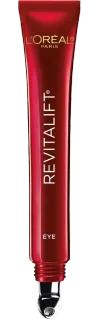
L'Oréal Group Triple Power Eye Treatment
Works for
1 of 2 advertised claims delivered
Anti-aging3 ingredients credited for this claimStrong support
“Daily Eye cream reduces wrinkles, de-puffs under eyes and brightens dark circles in 1 week.”
This product can help reduce and prevent fine lines and wrinkles, improve skin elasticity and firmness because it contains adenosine.
Keep in mind that it typically takes at least 6 weeks to notice any results because the changes that are needed to improve fine lines and elasticity happen in the deeper layers of the skin. No topical anti-aging product can “erase” wrinkles or fully reverse signs of aging.
Evens skin tone1 ingredient credited for this claimWeak support
“Revitalift Triple Power Eye Cream is an anti-aging eye cream formulated with 3 of the top proven anti-aging ingredients: Pro-Retinol, Vitamin C and Hyaluronic Acid to visibly reduce wrinkles, de-puff and brighten the eye area in 1 week.”
Effective ingredients missing or their concentration is too low
MoisturizingNot advertised by the brand · 10 ingredients credited for this claimGood support
This product can help improve hydration of the skin with the two types of ingredients.
The first type is called “humectants”:
these ingredients help attract water.
When humectants are on the surface of the skin, they “pull in” the moisture from the outside environment, or from
within deeper layers of the skin. The following ingredients in this product do the job:
glycerin, hydrolyzed hyaluronic acid.
This product also contains ingredients called “occlusives”. They help reduce the speed with which our skin loses moisture to the outside environment. These ingredients also help soften the upper layer of the skin, so it feels less tight and nicer to the touch. The following ingredients in this product do the job: dimethicone, dimethiconol.
Can it cause trouble?
Irritancy11 flagged ingredientsLow risk
Comedogenic1 ingredient rated 2 or more on the 0–5 pore-clogging scale1 flagged

User reviews
Be the first — your take helps the next person decide.
Ingredients
Filter by role to see what each ingredient is doing.
Water~40–60%
Dimethicone~5.1–7.6%
- Irritation risk
- Low
A silicone that helps to reduce water loss from the surface of the skin. Can temporarily "fill in" lines and wrinkles, absorb oil, and create a nice product finish
More about DimethiconeGlycerin~3.4–5%
- Irritation risk
- Low
One of the best moisturizing ingredients. Naturally present in skin. It attracts water to the upper layer of the skin working as a humectant
More about GlycerinSilica~2.7–4.1%
Acrylamide/sodium acryloyldimethyltaurate copolymer~2–3.1%
- Irritation risk
- Low
Helps water and oil mix together and create gel-like textures
More about Acrylamide/sodium acryloyldimethyltaurate copolymerPrunus armeniaca kernel oil~1.7–2.6%
- Irritation risk
- Medium
An emollient that helps soften the skin
More about Prunus armeniaca kernel oilIsohexadecane~1.5–2.2%
- Irritation risk
- Low
Improves the texture of the product and helps soften the skin. Helps oil and water mix together and can be used as a cleansing agent
More about IsohexadecaneDimethicone/vinyl dimethicone crosspolymer~1.2–1.8%
- Irritation risk
- Low
Used to stabilize product formulations and create a nice product texture
More about Dimethicone/vinyl dimethicone crosspolymerHydroxypropyl tetrahydropyrantriol~0.95–1.4%
- Irritation risk
- High
A sugar-derived compound that helps to attract water to the upper layer of the skin and might be able to stimulate synthesis of skin's own moisturizing factors, but solid research is lacking. It could be irritating
More about Hydroxypropyl tetrahydropyrantriolPropylene glycol~0.5–1.2%
- Irritation risk
- High
Helps oil and water mix together and can enhance the penetration of other ingredients into the skin. It can be irritating
More about Propylene glycolTitanium dioxide~0.6–1.4%
- Irritation risk
- Low
Works as a UV filter when used in high concentrations. It is photostable and is effective mostly against the UVB light, with some protection in the UVA range. In small concentrations, used for its ability to improve the color of cosmetic products. Is usually well tolerated by the skin
More about Titanium dioxidePhenoxyethanol~0.2–0.75%
- Irritation risk
- Low
A preservative. It helps prevent bacterial growth in cosmetic products
More about PhenoxyethanolAcrylates/c10-30 alkyl acrylate crosspolymer~0.15–0.55%
- Irritation risk
- Medium
Maintains the texture of skincare products. Allows the product to spread evenly. Helps oil and water mix together
More about Acrylates/c10-30 alkyl acrylate crosspolymerChlorphenesin~0.16–0.32%
Mica~0.15–0.55%
- Irritation risk
- Low
Creates an illusion of smoother and more radiant skin tone. Adds shimmer to the skin by reflecting light
More about MicaTriethanolamine~0.1–0.4%
- Irritation risk
- Medium
Used to adjust pH of the product and can help improve the product's smell
More about TriethanolaminePolysorbate 80~0.1–0.45%
Caffeine~0.1–0.4%
- Irritation risk
- Medium
Might be helpful in neutralizing free radicals. Can have a dehydration effect that might somewhat decrease the look of puffy eyes
More about CaffeineAscorbyl glucoside~0.1–0.3%
- Irritation risk
- Medium
A vitamin C derivative that is more stable but less potent than pure form of vitamin C. Has a potential to boost collagen production, nutralise free radicals and reduce hyperpigmentation, but the required concentration is likely to be much higher than for the pure form of vitamin C, limiting the ingredient's effectiveness in products
More about Ascorbyl glucosideDimethiconol~0.1–0.45%
- Irritation risk
- Low
A silicone that makes products more spreadable and keeps skin smooth. Helps to add gloss to skin and may visually fill in fine lines/wrinkles for short time
More about DimethiconolAdenosine~0.1–0.35%
- Irritation risk
- Low
Might help improve cell turnover and reduce inflammation in skin. One study shows that the ingredients might be able to help reduce dynamic wrinkles (for example, in the corners of the eyes or on the forehead)
More about AdenosineTocopherol~0.1–0.4%
- Irritation risk
- Low
Pure form of vitamin E. Can help moisturise and protect the skin from free radicals. Often used to help stabilise other ingredients or the formula itself
More about TocopherolHydrolyzed hyaluronic acid~0.05–0.3%
- Irritation risk
- Low
One of the best moisturizing ingredients. Attracts water into the upper layer of the skin. A version of it is naturally present in skin
More about Hydrolyzed hyaluronic acidHydroxyethylpiperazine ethane sulfonic acid~0.05–0.25%
- Irritation risk
- Medium
Used to regulate product's pH, but can be also used as an exfoliator when included in higher concentrations. There is a controversy about whether it can generate free radicals and induce skin cell damage when used in topical products
More about Hydroxyethylpiperazine ethane sulfonic acidDisodium edta~0.05–0.2%
Sorbitan oleate~0.05–0.15%
- Irritation risk
- Medium
- Comedogenicity
- 2/5
Helps oil and water mix together
More about Sorbitan oleateTin oxide~0.05–0.3%
- Irritation risk
- Low
A colorant that can add a pearl-like appearance to the formulation
More about Tin oxideIngredient list view
Water, Dimethicone, Glycerin, Silica, Acrylamide/sodium acryloyldimethyltaurate copolymer, Prunus armeniaca kernel oil, Isohexadecane, Dimethicone/vinyl dimethicone crosspolymer, Hydroxypropyl tetrahydropyrantriol, Propylene glycol, Titanium dioxide, Phenoxyethanol, Acrylates/c10-30 alkyl acrylate crosspolymer, Chlorphenesin, Mica, Triethanolamine, Polysorbate 80, Caffeine, Ascorbyl glucoside, Dimethiconol, Adenosine, Tocopherol, Hydrolyzed hyaluronic acid, Hydroxyethylpiperazine ethane sulfonic acid, Disodium edta, Sorbitan oleate, Tin oxide
Compare prices
Retailers ranked by price — lowest first.

Affiliate links · prices updated regularly
Worth comparing, line by line.
Match % combines shared ingredients, the first five ingredients, shared actives and hero ingredients, irritancy (lower counts in the alternative's favour), texture and body area. Only products in the same routine step are compared.
| L'Oréal GroupTriple Power Eye TreatmentYOUR PRODUCT | L'Oréal ParisRevitalift Laser X3 Anti-Ageing Power Eye Cream | VichyLiftActiv Supreme Eyes H.A Anti-Wrinkles Firming | so.koWonder Eyes Cream | |
|---|---|---|---|---|
| Match | — | 72% | 54% | 53% |
| Price | $27.99 | $66.09+$38.10 | $24.31−$3.68 | — |
| Shared key ingredients | — | 9 of 10 | 4 of 10 | 4 of 10 |
| Key difference | — | — | Ascorbyl Glucoside | Niacinamide |
| Irritancy | Low | Low | Low | Low |
| Drying alcohol | — | — | — | — |
| View product | Shop | Shop | Shop |


Sources cited in this review
Every concentration estimate and effectiveness label is anchored to one of these 18 studies and safety reviews.
- 1
- 2Final Report on the Safety Assessment of Dimethicone Copolyoljournals.sagepub.com
- 3
- 4
- 5
- 6

Affiliate links · As an Amazon Associate, WIMJ earns from qualifying purchases.